

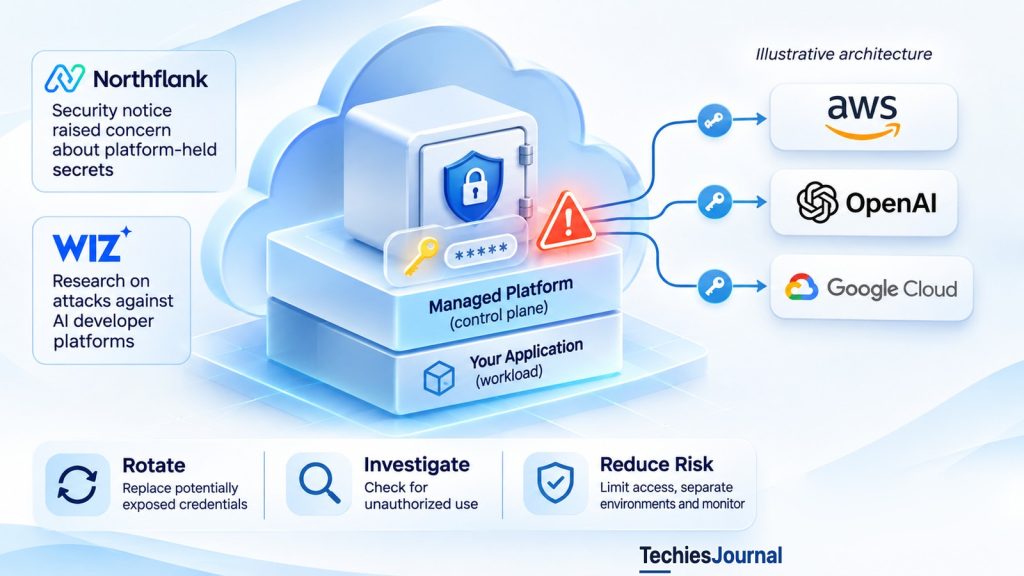
An application may continue running normally even when credentials entrusted to its hosting platform are at risk. The Northflank security incident shows why these conditions must be assessed separately.
A development team deploys an application through a managed cloud platform. The platform handles deployment, configuration and access to services the application needs.
In this hypothetical example, the application connects to an AI provider and a cloud-storage service. The team stores the relevant credentials in the platform’s secret-management system rather than embedding them in source code. During normal operation, the platform makes those credentials available to the running application.
This arrangement is useful, but it creates a trust relationship. The platform holds credentials that authorize actions outside its own infrastructure. If someone obtains those credentials, the consequences may extend to the services that accept them, even if the original application remains operational.
That distinction became important on October 30, 2026, when Northflank advised customers to assume stored environment variables had been exposed and to rotate their credentials. The incident illustrates why application availability and credential confidentiality are different security properties.
What happened at Northflank?
Northflank provides a managed platform for building, deploying and operating applications. It supports environment variables and secret management so applications can use external services without placing credentials in source code.
On October 30, Northflank began publishing security notices after receiving an alert from Wiz. It instructed customers to assume stored environment variables had been decrypted and to rotate secrets in workloads, secret groups and global secrets. The company subsequently reported customer indications of unauthorized use of AI API keys supplied to its platform.
In a November 2 update, Northflank said its investigation had found no sign that running workloads or workload data were accessed. Available evidence instead suggested that the attack focused on secrets held in its control plane. It also reported that customers on forward-deployed or dedicated control planes were unaffected and that external forensic review was continuing.
These were Northflank’s investigation findings at that time, not a completed independent root-cause analysis. They do not establish the full intrusion path, the precise number of exposed credentials or whether every stored secret was actually accessed. But the recommended customer action was clear: rotate potentially affected secrets even if an application continued running.
Source: Northflank, Security Incident Updates, October 30 to November 2, 2026.
How does a platform-held credential cross a security boundary?
Return to the hypothetical application. Its AI provider issues an API key. The development team stores the key in the managed platform, which makes it available when the application sends an authorized model request. The AI provider accepts the key subject to the account’s permissions and limits.
Three parties are involved: the application owner, the managed platform that stores or delivers the key, and the external provider that recognizes it.
Store
The development team stores the key in the managed platform. The platform holds credentials that authorize actions outside its own infrastructure.
Deliver
The platform makes the key available to the running application when it sends an authorized model request.
Accept
The AI provider accepts the key subject to the account’s permissions and limits.
Copy
Suppose an attacker obtains a usable copy from the platform’s secret store.
Direct use
If the key remains valid and has no effective restrictions preventing the request, the attacker may be able to call the AI provider directly. They need not change the application’s source code or obtain its database to make that external request.
Reach
The authority of an exposed credential is defined by the issuing system, not just by the platform that stored it. The consequences depend on permissions, expiry, network restrictions, revocation and provider-side monitoring.
Now suppose an attacker obtains a usable copy from the platform’s secret store. If the key remains valid and has no effective restrictions preventing the request, the attacker may be able to call the AI provider directly. They need not change the application’s source code or obtain its database to make that external request.
The cloud-storage credential in the same hypothetical application presents a related but different risk. Its potential misuse depends on whether it permits reading, writing or deleting particular resources. A narrowly scoped credential produces a different possible impact from a broadly privileged one.
The key lesson is that the authority of an exposed credential is defined by the issuing system, not just by the platform that stored it. The consequences depend on permissions, expiry, network restrictions, revocation and provider-side monitoring.
Why the control plane matters
A managed platform’s control plane handles tasks such as deployment, configuration, access permissions and integrations. Its workloads are the applications and services that run on the platform. The two interact, but compromise of one does not automatically establish compromise of the other.
An application might still respond normally to customers while the confidentiality of a credential stored by its control plane becomes uncertain. Conversely, a platform incident does not prove that an attacker modified running application code or copied workload data.
Northflank’s November 2 statement drew precisely that distinction. Its report that dedicated and forward-deployed control planes were unaffected also illustrates how isolation arrangements can shape incident scope. It does not prove that a dedicated control plane is immune to attack or that all centralized platforms share the same exposure.
The operational question is which components can access customer secrets, and how far unauthorized access to those components could reach.
Why stolen AI API keys can have immediate value
An AI provider credential can grant access to billable model capacity. A person using an exposed key without permission may generate requests charged to, or otherwise consuming the quota of, the legitimate account. This type of misuse is often called LLMJacking.
In its October 30 report, Black October for AI Developer Platforms, Wiz identified several security incidents involving development platforms and analyzed attempts to obtain stored credentials. It did not find one publicly established vulnerability linking all the reported incidents.
Wiz also described two cases of downstream abuse involving Amazon Bedrock credentials. It observed approximately 2.5 million attempted calls across the two cases, including unsuccessful or throttled requests. Wiz estimated that the two cases likely generated more than $100,000 of model usage at list prices. That was Wiz’s estimate, not proof that all attempted requests succeeded or that the account holders were actually billed or paid that amount.
Wiz did not publicly identify those cases as Northflank customer incidents. Their value here is to demonstrate what reuse of valid AI credentials may enable, not to establish the financial impact of Northflank’s breach.
Source: Wiz Research, Black October for AI Developer Platforms, October 30, 2026.
Attempted calls
Wiz also described two cases of downstream abuse involving Amazon Bedrock credentials. It observed approximately 2.5 million attempted calls across the two cases, including unsuccessful or throttled requests.
Mixed outcomes
The attempted calls include unsuccessful or throttled requests, so the figure is not proof that all attempted requests succeeded.
Estimated usage
Wiz estimated that the two cases likely generated more than $100,000 of model usage at list prices.
Not shown
That was Wiz’s estimate, not proof that all attempted requests succeeded or that the account holders were actually billed or paid that amount. Wiz did not publicly identify those cases as Northflank customer incidents. Their value here is to demonstrate what reuse of valid AI credentials may enable, not to establish the financial impact of Northflank’s breach.
Not every platform breach creates the same customer risk
Other October disclosures show why the affected information matters more than the broad label of an AI-related incident.
WorkOS reported unauthorized access to an internal customer-facing business application. According to the company, affected information included business contacts, customer relationships and communication summaries. It found no evidence that its production services or application data were accessed.
Chainalysis reported unauthorized access to certain customer identity and organizational information. Its investigation had found no evidence of access to authentication credentials, session tokens or investigation content at the time of its statement.
These disclosures do not establish the same platform-held secret exposure described in Northflank’s warning. Business-contact exposure may increase impersonation risks. Exposure of a valid API key calls for action at the provider that accepts that key. The necessary response follows the actual exposure boundary, not the label applied to the incident.
Sources: WorkOS, October 30th, 2026 Data Security Incident and Chainalysis, Security Incident Information.
| Disclosure | What was reported | What was not found or not claimed | What it means for customers |
|---|---|---|---|
| Northflank (October 30 to November 2) | Customers were told to assume stored environment variables had been decrypted and to rotate secrets. Northflank reported customer indications of unauthorized use of AI API keys supplied to its platform. By November 2 the evidence suggested the attack focused on secrets held in the control plane. | No sign that running workloads or workload data were accessed. Customers on forward-deployed or dedicated control planes were reported unaffected. Not a completed independent root-cause analysis. | Rotate potentially affected secrets even if the application continues running. |
| Wiz Research (October 30) | Two cases of downstream abuse of Amazon Bedrock credentials: approximately 2.5 million attempted calls and an estimated more than $100,000 of usage at list prices. | Not identified as Northflank customer incidents. Wiz did not find one publicly established vulnerability linking all the reported incidents. Not proof that all calls succeeded or that anyone was billed that amount. | Shows what reuse of valid AI credentials may enable, not the financial impact of Northflank’s breach. |
| WorkOS | Unauthorized access to an internal business application. Affected information included business contacts, customer relationships and communication summaries. | No evidence that its production services or application data were accessed. | Business-contact exposure may increase impersonation risks. It does not establish the platform-held secret exposure described in Northflank’s warning. |
| Chainalysis | Unauthorized access to certain customer identity and organizational information. | At the time of its statement, no evidence of access to authentication credentials, session tokens or investigation content. | It does not establish the platform-held secret exposure described in Northflank’s warning. |
Responding when stored credentials may be exposed
Suppose the platform in our hypothetical example warns that its secret store might have been accessed. The application is still operating and the team sees no suspicious deployment changes. That does not remove the need to assess the credentials held by the platform.
Identify the access at risk
The team inventories affected credentials and maps each to its issuing provider, environment and permissions. The AI key may authorize model requests and spending. The storage credential may allow reads or writes to specific resources. Credentials reused in several applications or environments may widen the possible consequences.
Provider notifications and audit logs can help define exposure, but a preliminary investigation may leave uncertainty. If the platform directs customers to rotate potentially affected secrets, the team should follow that guidance without treating normal application operation as evidence of safety.
Contain access and replace credentials safely
Revocation at the issuing provider can stop further use of an affected credential once that provider has invalidated it. A replacement key, however, can also be exposed if placed into a secret store that an attacker still controls.
The team therefore coordinates rotation with the platform provider’s containment instructions. Depending on the environment and available controls, it may restrict access, validate a safe destination for replacement secrets, issue narrower credentials and update workloads in a controlled order. Some services may need temporary disruption or alternative access arrangements.
There is no universal rotation sequence for every incident. The aim is to stop unauthorized access without immediately exposing the replacement or creating avoidable operational failures.
Investigate actions already performed
Replacing a key cannot undo requests made while it was valid. For the AI account, the team checks provider-side usage, request patterns, quotas and billing records. For the cloud-storage account, it examines available records of file access and changes.
Activity performed directly against an external provider may not appear in the managed platform’s workload logs. If the evidence suggests misuse, recovery may require investigating affected data, resources or charges in addition to rotating the secret.
Credential replacement is therefore a containment step, not automatic proof that the incident’s consequences are resolved.
Designing for a smaller exposure boundary
Managed secret systems can be safer than placing credentials in source code, container images or shared configuration files. The practical goal is not to reject managed platforms, but to make the trust placed in them visible and limited.
For the hypothetical application, separate production and development keys reduce unnecessary shared exposure. A storage credential scoped to one bucket or operation limits what misuse could reach. Where an issuing provider supports them, short-lived credentials, workload identities, usage restrictions and narrowly scoped permissions can reduce reliance on durable reusable secrets.
AI spending alerts and provider quotas can help surface abnormal usage, although alerts do not guarantee that malicious activity will stop. Teams should also maintain an inventory of where credentials are stored, who can revoke them and which external provider logs are needed during an incident.
Platform customers should ask where secrets are held, which components can access them, how customer isolation works, what audit records are available and what the provider can revoke on a customer’s behalf. These questions are relevant whether a platform uses a central control plane, a dedicated deployment model or another secret-management design.
The decision for platform customers
The Northflank incident does not prove that every development platform shares one weakness or that every customer’s workload was breached. It does show why a provider’s warning about secrets can demand customer action beyond the hosting environment itself.
A team using a managed platform should be able to answer three questions: Which external permissions have we entrusted to the platform? How far could their misuse extend? How would we revoke and investigate them if the platform’s secret-management boundary failed?
Those answers determine whether a platform security event remains contained or becomes a wider operational problem for the customer.
References and further reading
- Northflank, Security Incident Updates. October 30 to November 2, 2026. Vendor disclosures, investigation findings and customer guidance.
- Wiz Research, Black October for AI Developer Platforms. October 30, 2026, with subsequent updates. Research findings on developer-platform incidents and downstream credential misuse.
- WorkOS, October 30th, 2026 Data Security Incident. November 2, 2026. Vendor account of internal application access and affected information.
- Chainalysis, Security Incident Information. October 30, 2026, with a November 2 update. Vendor account of incident boundaries.
- TechiesJournal, AI Agents Need Identities, Not API Keys. Related foundational reading on identity and authorization.
- TechiesJournal, AI Dependencies Under Attack. Related coverage of compromised software dependencies.
Evidence review cutoff: November 3, 2026. Incident assessments and customer guidance may change. Recheck primary disclosures before release.