

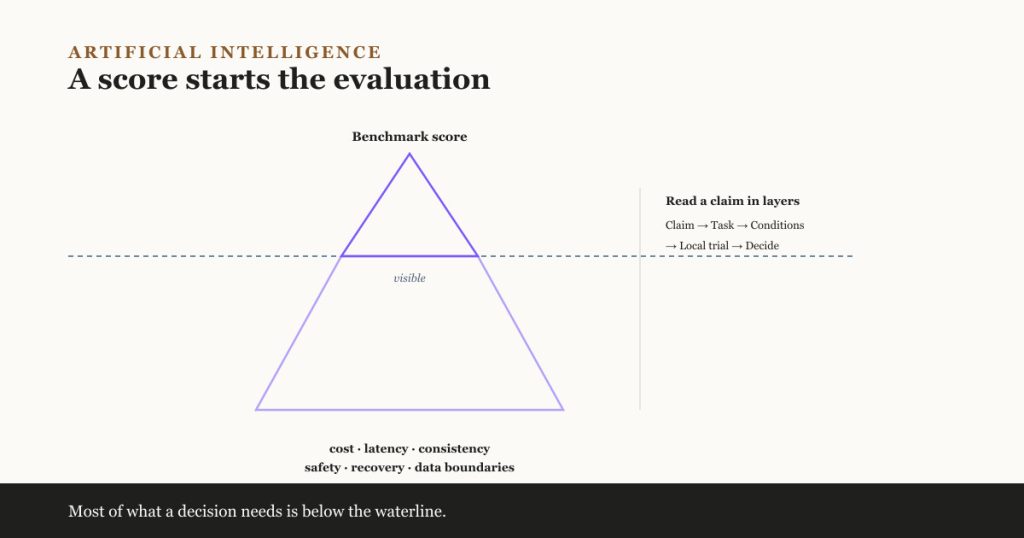
A leaderboard can help you choose what to test. It cannot tell you which model will work in your environment.
The chart is answering a smaller question than you think
A new AI model arrives with a chart showing that it beats its competitors. Another laboratory tests the same model and reports a different result. Both numbers may be valid.
The difference can come from the prompt, model version, tool access, scoring method, number of attempts or even the order of answer choices. More importantly, the benchmark may test a clean, narrow task while your work is messy, connected to private data and constrained by cost, latency and risk.
A benchmark score answers one question: how did this system perform under these test conditions? It does not automatically answer the question you care about: should we use this model?
What a benchmark actually measures
An AI benchmark is a repeatable set of tasks with a scoring method. Someone chooses the questions, decides what counts as correct and sets the conditions under which the model runs.
Those choices create the measurement. A coding benchmark may check whether tests pass but not whether maintainers would accept the code. A reasoning benchmark may use short puzzles but say little about debugging a production incident. A multilingual score may hide weak performance in the language your customers use.
This does not make benchmarks dishonest. It makes their boundaries important.
Where benchmark theatre begins
Benchmark theatre starts when a limited result is presented as a broad victory. Common warning signs include:
- only the tests where the new model wins are shown;
- the exact model version or settings are missing;
- a tiny score difference is treated as meaningful without uncertainty;
- the publisher designed the test, ran it and declared the winner;
- cost, latency, consistency and failure severity are absent;
- a benchmark category such as “reasoning” is treated as a general ability.
One result can still be useful. The problem is the leap from “higher score here” to “better model everywhere.”
Read the claim in layers
| Check | Question to ask | Why it matters |
|---|---|---|
| Task | What did the model actually have to do? | A broad label may hide a narrow test |
| Conditions | Which version, prompt, tools and number of attempts were used? | Small setup changes can change the result |
| Scoring | Was success judged by exact match, tests, a model judge or humans? | Each method misses different failures |
| Independence | Who designed and ran the evaluation? | Self-evaluation needs reproducible detail |
| Uncertainty | Are confidence intervals or repeated runs reported? | A small gap may be noise rather than a real lead |
| Fit | Does the test resemble your users, data and constraints? | Relevance matters more than leaderboard position |
| Missing measures | What about cost, latency, safety and consistency? | Quality is only one part of an operational choice |
A practical example
The following is a fictional, illustrative example, not a real benchmark comparison.
Suppose Model A scores 88% on a coding benchmark and Model B scores 84%. It is tempting to choose Model A.
Now add your real conditions. Your team works in a large private repository, requires generated changes to pass security review and cannot send source code outside a particular region. Model A is slower, costs twice as much and repeatedly changes files outside the requested scope. Model B is easier to constrain and produces fewer review comments.
The benchmark was not wrong. It measured something useful. It simply did not measure the full decision.
Build a small evaluation from real work
You do not need a research laboratory. Start with 20–50 representative tasks that your organization understands well. Include routine cases, difficult cases and failures you cannot accept.
Define the evaluation before running the models:
- What outcome counts as correct?
- Which mistakes are harmless, expensive or dangerous?
- What context and tools may the model use?
- How will humans review subjective output?
- What are the cost and latency limits?
- How many repeated runs are needed to expose inconsistency?
Keep the test set away from people tuning the prompts where practical. Record the model version and settings. Review failures, not only the average score. A model that is slightly weaker overall may be the better choice if its errors are easier to detect and recover from.
Know, use or master?
Know: Understand that every benchmark has a task, scoring method and boundary. A score is not a universal grade.
Use: If you select AI tools, read the methodology and use public benchmarks to create a shortlist. Test that shortlist on representative work.
Master: If model performance is central to your product, build versioned evaluations, measure uncertainty and monitor whether production behaviour drifts from the test.
What should you do next?
Take the most important benchmark claim behind your current model choice. Write down what it measured and three things it did not measure. Then run one real task that exposes one of those missing dimensions.
Benchmarks are useful maps. Benchmark theatre begins when the map is presented as the territory. Use public scores to decide what deserves a closer look—not to outsource the final decision.
Go deeper
- HELM: Holistic Evaluation of Language Models — Stanford Center for Research on Foundation Models. A transparent evaluation framework covering scenarios, metrics and trade-offs. Reviewed September 2026.
- SWE-bench — Princeton NLP. A benchmark based on resolving real GitHub issues; its documentation helps explain task construction and scoring. Reviewed September 2026.
- Research Update: Algorithmic vs. Holistic Evaluation — METR, 13 August 2025. Shows why test-passing code may still fall short of production quality. Reviewed September 2026.
- Artificial Intelligence Risk Management Framework: Generative AI Profile — NIST, July 2024. Guidance for evaluating generative AI beyond a single quality score. Reviewed September 2026.