

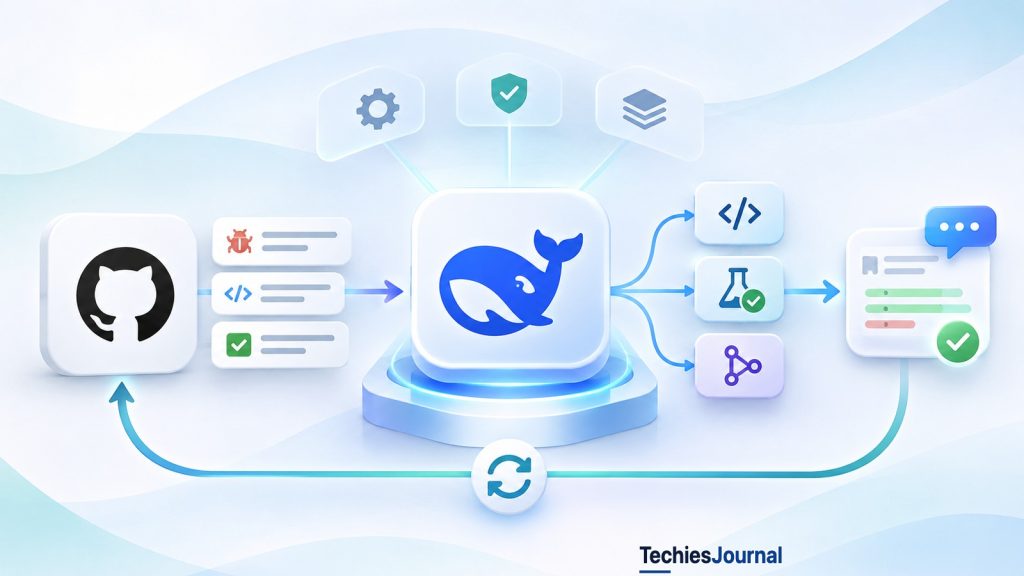
AI coding agents can already help developers write code, fix bugs, run tests, and prepare pull requests. But development work still requires someone to assign tasks, follow up on progress, and bring the agent back when additional changes are needed.
What if an AI agent could stay connected to a development team’s daily work, receive authorized requests, and continue handling assigned tasks without someone repeatedly starting a new conversation?
That is the idea behind DeepSeek’s new open-source Super-Agent prototype.
The project explores how coding agents can become ongoing participants in software development rather than tools developers use only when they need help.
So what does DeepSeek’s Super-Agent actually do, how does it work, and should developers pay attention to it?
What is DeepSeek’s Super-Agent?
DeepSeek’s Super-Agent is an experimental, open-source coding-agent system built for DeepSeek Harness.
The project, called dsh-superagent, connects an AI coding agent to a development team’s existing workflow. It receives requests through GitHub and can optionally integrate with Feishu, a workplace messaging platform.
Instead of opening an AI coding tool and entering every task manually, an authorized developer can request work directly through GitHub. The system can assign that work to an agent session, track its progress, and return the result to the original conversation.
It works on each assignment in its own agent session and directory.
For example, one developer could ask the agent to investigate a bug while another asks it to update tests or implement a small feature.
The project was published on GitHub on October 31, 2026, under the MIT open-source license, allowing developers to inspect the code and adapt it for their needs.
However, DeepSeek makes an important distinction in its official repository: this is a research prototype, not an official production-ready product. The public implementation also differs from DeepSeek’s internal system, and some ideas discussed in its broader Super-Agent design are not yet implemented.
The release is therefore an opportunity to explore a different approach to coding-agent workflows, rather than a finished replacement for existing development tools.
Source: DeepSeek, Official Super-Agent GitHub Repository.
How does it work?
The easiest way to understand the Super-Agent is through a normal development task.
Imagine a team maintaining a web application. A developer discovers that one of its APIs returns an incorrect validation error and creates a GitHub issue explaining the problem.
The developer then asks the Super-Agent to investigate.
The system receives the request through GitHub and checks whether the person is authorized to assign work. If the request is accepted, it creates a task and assigns it to an agent session.
The agent can examine the repository, investigate the issue, modify code, run relevant tests, and prepare a pull request.
The result can then be shared in the original GitHub discussion.
Now suppose a reviewer identifies another problem in the proposed fix and leaves a comment.
Instead of requiring the developer to create an entirely new agent task, the system is designed to deliver that feedback to the agent responsible for the existing work.
The agent can examine the comment and continue the assignment within its authorized scope.
This is the main idea behind DeepSeek’s approach. The agent does not simply respond to one request and disappear. The system maintains the relationship between an assigned task and subsequent development activity.
Behind the scenes, DeepSeek uses task records, authorization rules, separate agent sessions, and execution-state tracking to coordinate this work.
Developers do not need to understand every internal component to appreciate the basic workflow.
An authorized request starts a task, the agent works on it, and relevant follow-up activity can return to the same assignment.
Request
A developer discovers that one of the web application’s APIs returns an incorrect validation error, creates a GitHub issue explaining the problem and asks the Super-Agent to investigate.
Check
The system receives the request through GitHub and checks whether the person is authorized to assign work.
Task
If the request is accepted, the system creates a task and assigns it to an agent session.
Work
The agent can examine the repository, investigate the issue, modify code, run relevant tests, and prepare a pull request. The result can then be shared in the original GitHub discussion.
Follow-up
If a reviewer identifies another problem in the proposed fix and leaves a comment, the system is designed to deliver that feedback to the agent responsible for the existing work. The agent can examine the comment and continue the assignment within its authorized scope.
This is an illustrative example of the documented design, not an independently verified demonstration of the prototype completing that exact workflow.
Sources: DeepSeek, Domain Model and Execution.
What makes it different from existing coding agents?
The main difference is not that DeepSeek’s agent can write code or create pull requests.
Existing coding agents already support those capabilities. Some can also work asynchronously or respond to events from development tools.
DeepSeek’s Super-Agent focuses on how those activities are coordinated over time.
Three capabilities are particularly interesting.
First, it can receive work through existing collaboration tools. Developers can request help through GitHub rather than manually transferring every task into a separate AI interface.
Second, it maintains the connection to assigned work. The system tracks individual tasks and can deliver relevant comments and updates to the agent handling them. This may reduce the need to repeatedly explain the same context.
Third, it supports proactive work under defined rules. The system can evaluate certain development events as possible tasks instead of relying entirely on explicit requests.
That third capability needs clarification.
DeepSeek does not simply allow the agent to act on everything it sees. Its authorization model distinguishes explicit requests from work the system identifies itself. Its admission rules cover new issues, pull requests, comments, and the default branch’s CI, and each kind of activity can count as an explicit request, an inferred candidate, or nothing.
For inferred work, the system provides three modes: off, observe, and auto.
The documented default is observe, which allows the system to assess potential tasks without automatically starting them. Automatic acceptance requires appropriate rules and configuration.
This gives teams a way to examine what the agent might do before granting it greater autonomy.
The significance is not that DeepSeek has invented autonomous coding. It is that the project brings task intake, authorization, execution, and follow-up into one open-source system.
Source: DeepSeek, Authorization.
What can developers actually do with it?
Developers and engineering teams can use the prototype to experiment with several practical workflows.
A team could assign GitHub issues to an agent and review the resulting code changes. It could explore how an agent handles pull-request feedback or how several assignments are managed without requiring a developer to coordinate every session manually.
Another useful experiment involves development events.
For example, a team could configure rules that evaluate certain CI failures as possible tasks. In observation mode, it could examine which events the system considers relevant before permitting automatic task creation.
The prototype also provides a web management panel that shows work waiting for review, blocked tasks, and items requiring human attention.
These capabilities may interest teams already using coding agents regularly, particularly when several tasks are being handled at the same time.
The project is available on GitHub, and DeepSeek provides setup instructions for configuring the integration, agent identity, authorization rules, and execution environment.
Setting it up involves more than installing a coding extension. Developers need to configure accounts, access permissions, an execution environment, and the running service. The documented prerequisites include Node.js, pnpm, git, tmux, Python, the GitHub CLI, DeepSeek Harness, and a model provider, and the prototype serves one GitHub repository.
It should therefore be treated as an engineering experiment rather than a ready-made productivity application.
Source: DeepSeek, Setup Guide.
What are its limitations?
The most important limitation is the project’s maturity.
DeepSeek explicitly warns that the published code may contain bugs and requires review and adaptation before use. The public repository does not establish that the prototype can reliably perform unattended development work across different engineering environments.
There are also security considerations.
The agent needs access to source code and development tools to perform useful tasks. In the published prototype, execution sessions can run shell commands without individual approval under the operating-system account used to run the service.
DeepSeek’s documentation says that the wrappers and working directories only establish defaults, not a security boundary, and that a worker can still execute a program by absolute path.
This makes access permissions important. An experimental agent should not have unrestricted access to sensitive credentials, production infrastructure, or critical repositories.
Teams also need to decide which actions require human approval. A coding agent may be permitted to prepare changes without being authorized to merge them directly into a protected branch.
DeepSeek’s setup guidance recommends beginning with a dedicated GitHub agent account and keeping merging under human control.
Finally, there is the question of actual productivity.
A system that handles multiple tasks automatically is not necessarily more efficient. Developers still need to review its work, correct mistakes, and maintain the infrastructure running it.
There is currently insufficient independent evidence to conclude that this prototype consistently reduces development time or outperforms established coding-agent workflows.
These limitations do not make the release unimportant. They establish the difference between an interesting open-source experiment and software ready for routine production use.
| Limitation | What is documented or known | Precaution |
|---|---|---|
| Maturity | DeepSeek warns the published code may contain bugs and needs review and adaptation before use. | Start with a non-production repository. |
| Execution | Sessions can run shell commands without individual approval under the operating-system account that runs the service. The wrappers and directories only establish defaults, not a security boundary. | Do not give it unrestricted access to sensitive credentials, production infrastructure or critical repositories. |
| Merging | The setup guidance recommends a dedicated GitHub agent account and keeping merging under human control. | Keep human review of proposed changes. |
| Evidence | There is currently insufficient independent evidence that the prototype consistently reduces development time or outperforms established coding-agent workflows. | Judge whether it reduces manual coordination and helps the team complete useful work. |
Sources: DeepSeek, Execution and Setup Guide.
Should developers explore it?
That depends on how developers currently use AI coding agents.
If you are still learning how coding agents work, there is no immediate reason to install a persistent Super-Agent system. Understanding how to delegate tasks, review generated changes, and use agents safely is a better starting point.
If you regularly use coding agents for development, the project is worth examining. It provides a practical example of how agents can receive tasks through GitHub, maintain task context, and participate in an ongoing development workflow.
For DevOps engineers and software architects, the architecture may be particularly interesting because it combines AI agents with familiar engineering concerns such as permissions, event handling, execution environments, and monitoring.
Engineering teams considering a trial should start with a non-production repository, limited permissions, and human review of proposed changes.
The objective should be simple: determine whether the system reduces manual coordination and helps the team complete useful work.
There is no need to adopt it merely because it is open source or because autonomous agents are receiving industry attention.
Final thoughts
DeepSeek’s open-source Super-Agent is an interesting development in AI-assisted software engineering.
Rather than concentrating only on how well an agent writes code, it explores how agents can remain connected to a team’s development workflow, accept authorized assignments, and continue working as new information arrives.
The released project is still experimental, and its reliability and real-world productivity benefits remain to be demonstrated.
For developers, the important takeaway is straightforward: coding agents are becoming capable of participating in more of the development process, but greater autonomy also requires careful control over what they are allowed to do.
DeepSeek’s prototype offers an open-source way to explore that direction.
It is worth understanding today, even if most engineering teams do not yet need to adopt it.
Go deeper
Primary sources checked November 3, 2026.
- DeepSeek, Super-Agent Prototype. Official implementation, license, scope and research-prototype limitations.
- DeepSeek, Domain Model. How development events, tasks and agent sessions relate.
- DeepSeek, Authorization Rules. Explicit requests, inferred work and policy modes.
- DeepSeek, Execution. Execution, recovery and security limitations.
- DeepSeek, Setup Guide. Setup requirements and configuration for experimentation.