

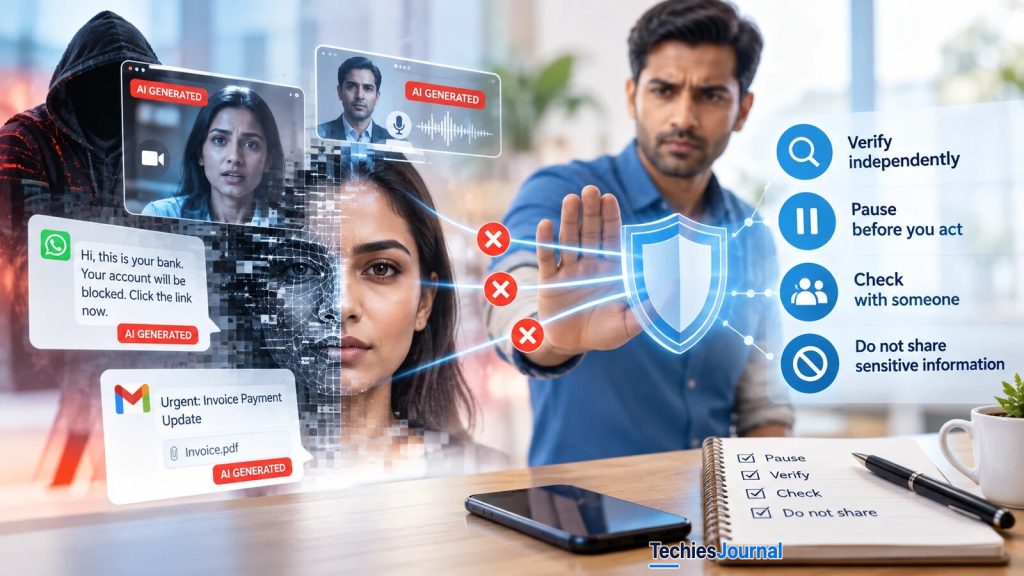
Conceptual illustration, not a real case: AI-made messages, calls and faces on one side, and a person who stops to check on the other. The four habits in the picture are a general summary, not the four Get Cyber Safe habits this article tests.
AI changed how scams are made, not what they ask for
Scammers still want the same four things: your money, your password, your code, or your trust in someone else. AI changed how convincingly and how cheaply they can ask.
You have probably heard that AI makes scams impossible to spot. The truth is more useful. Some things really did change, some did not, and the advice you get depends on which is which.
This article is for IT professionals and the people they look after, whether family, colleagues or customers. It sorts the evidence into what is solid and what is uncertain.
Then it asks which of the usual safety habits still work. A Canadian government campaign, Get Cyber Safe, published four such habits in October 2026. They are sensible, but the post cites no data, so we test them against the evidence here.
How big the problem is
The best numbers come from the United States. The FBI’s Internet Crime Complaint Center, called IC3, received 1,008,597 complaints in 2025 with reported losses of US$20.877 billion. Of those, 22,364 complaints mentioned artificial intelligence, with about US$893 million in losses.
By our own arithmetic, that is about 2 percent of complaints and 4 percent of losses. The IC3 report says many victims do not realise how far AI may be involved, so the true number is probably higher. It also notes that all of its figures are reported by the public. So AI is a real but still minority part of the reported total, and the true share is unknown.
Canada’s picture has less detail. The Canadian Anti-Fraud Centre received over 112,000 fraud reports in 2025 with over C$704 million (Canadian dollars) in reported losses, and it estimates that only 5 to 10 percent of fraud is reported at all. Its public pages do not separate out AI-enabled fraud. The Canadian Centre for Cyber Security says in its 2025 to 2026 threat assessment that cybercriminals are “almost certainly” using large language models to improve social engineering, and that fraud and scams will keep growing.
Verizon’s 2025 Data Breach Investigations Report adds a balancing note. It says synthetic text in malicious emails doubled over two years, based on one partner’s data. It also says generative AI “has still not taken over the world”, and that the human element in breaches stayed around 60 percent.
What the phishing studies show
Studies disagree, and the disagreement is informative. Three tests used different methods and gave different answers.
| Test | What was measured | Result |
|---|---|---|
| IBM X-Force Red, 1,600 healthcare employees | Human-written phishing against AI-written phishing | 14 percent clicked the human email and 11 percent clicked the AI email. The AI email took about 5 minutes to produce. The human email took 16 hours. |
| Heiding and colleagues, 101 participants (2024) | Generic, human expert, AI, and AI with human help | Clicks were 12 percent for the generic control, 54 percent for human experts, 54 percent for fully automated AI, and 56 percent for AI with a human. |
| Czybik and colleagues, 7,741 university staff (USENIX Security 2026) | Generic and personalised emails, written by people or by AI | Generic AI 3.7 percent and generic human 4.1 percent. Personalised AI 10.0 percent. Personalised human 24.2 percent, from only 99 emails. |
Our reading of these three results is that AI writing is not the main change.
In the largest study, a generic email written by AI worked about as well as one written by a person. What raised clicks was personalisation, meaning a message tailored to the target’s job and interests. Skilled humans were still better at it.
What AI changed is the price. The researchers estimated under three cents per personalised email, and about US$120 for 4,010 emails.
These studies have limits.
The sample in the Heiding test was small. The Czybik study ran at one university that already trains staff, used local open-source models that the authors call a lower bound for a stronger attacker, and had a briefing beforehand that probably lowered clicks. The IBM test used earlier tools.
None of this says AI phishing is harmless. It says the risk is mostly about volume and personalisation, which is a different problem from “perfect writing”.
Most people cannot spot fake faces and voices
This matters more than the email results. Two recent studies measured it.
A University of Florida team, published in Cognitive Research: Principles and Implications in January 2026, found that people did no better than chance at telling real still faces from AI-made ones. People did better with video, getting about two thirds right. Computer detectors showed the reverse: up to 97 percent accurate on still images, but at chance on video.
A separate listening study of 1,768 people, still a preprint, found human accuracy at telling real from synthetic speech of 68.7 percent, down from 72.8 percent in a similar 2021 test. Real recordings were the problem. People correctly identified only 64.1 percent of genuine speech, so they are also starting to doubt real voices. Software detectors scored 94.5 percent in that study.
The FBI’s advice from December 2024 tells people to look for distorted hands, odd teeth or eyes, and unnatural tone. That is reasonable advice, but it sits uneasily with these results. If most people are near chance on still faces and wrong about one voice in three, then “look closely” cannot be the main defence. This is our inference, and the studies themselves are controlled tests rather than real-life calls, so treat it as a strong hint rather than a proof.
A real case shows the same thing.
In early 2024, an employee of the engineering firm Arup in Hong Kong paid out about HK$200 million, roughly US$25.6 million, in 15 transfers. He had first suspected a phishing email, then joined a video call with what looked and sounded like the finance chief and other colleagues, all deepfakes, and put his doubts aside. Arup said none of its internal systems were compromised.
The control that failed was not a password. It was “I saw and heard them.”
Which habits hold up
If detection by eye is weak, the best habits are the ones that do not rely on judging the content. The table sorts the four Get Cyber Safe habits that way. The ranking is our judgement, because we found no study that measures whether any of these habits reduces losses.
| Habit | How well it fits the evidence | How to strengthen it |
|---|---|---|
| Verify before you act | Strongest. It does not depend on spotting the fake. A call to a number you already trust would probably have broken the Arup scam. | Use a number you looked up yourself, never one from the message. Agree a secret word with family, as the FBI suggests. At work, make it a written rule for payments and bank detail changes. |
| Make security routine | Strong where it removes the weak step. Passkeys and security keys cannot be typed into a fake page. | Prefer phishing-resistant sign-in. Our article on Microsoft 365 token replay shows why ordinary MFA codes can be stolen along with the session. |
| Pause and assess | Necessary but not enough. Urgency is the common thread in scams, so slowing down helps. The Arup employee paused and was still persuaded. | Pair the pause with a fixed next step, so people know what to do while they wait. |
| Think before you click or share | Weakest on its own. Personalised emails roughly tripled clicks in the largest study. | Train people on personalised phishing, as the Czybik authors advise. Limit what is public about staff, because the researchers built the emails from web searches. |
Try it yourself. Each situation below asks what you would do, then shows what the evidence says about that choice.
Choose a situation. Pick what you would do, then see what the evidence says.
You work in finance. An email from your finance chief asks for confidential transfers, and it looks like phishing. Then you join a video call where the finance chief and colleagues you know look and sound real. What do you do?
Weak step. Documented case. This is what happened at Arup in Hong Kong. About HK$200 million, roughly US$25.6 million, went out in 15 transfers. Everyone else on the call was a deepfake. Seeing and hearing was the control that failed.
Helps, not enough. Documented case. Slowing down helps because scams depend on urgency. But the Arup employee had doubts at first and was still persuaded by the call. A pause needs a fixed next step.
Strongest step. Our inference. This does not depend on judging faces or voices. A call to a number you already trust would probably have broken the Arup scam. At work, make it a written rule for payments.
A WhatsApp message says it is your bank: 'Your account will be blocked. Click the link now.' What do you do?
Weak step. Illustrative example. A sign-in page reached from a message can be fake. Ordinary MFA codes can be stolen along with the session, which our Microsoft 365 token replay article explains. Passkeys and security keys cannot be typed into a fake page.
Weak step. Our inference. The reply goes to whoever sent the message, so the answer proves nothing. Checking inside the same conversation is not an independent check.
Strongest step. You reach the bank through a route you chose yourself, never one from the message. That is the habit 'verify before you act'.
A call comes from a family member. The voice sounds right. They say they are in trouble and need money now. What do you do?
Weak step. Research finding. In a study of 1,768 listeners, people told real from synthetic speech correctly 68.7 percent of the time, and recognised only 64.1 percent of real speech. Listening closely is a weak foundation.
Helps. Documented advice. The FBI suggests agreeing a secret word with family. It only works if you agreed it before the call, so agree one this week.
Strongest step. A call to a number you already have does not depend on judging the voice. Do not trust a face or a voice alone, because both can be faked.
An email titled 'Urgent: Invoice Payment Update' asks finance to change a supplier's bank details. It mentions a real project and the right contact names. What do you do?
Weak step. Research finding. In the largest study, personalised AI emails were clicked 10.0 percent of the time, against 3.7 percent for generic AI emails. Real details are exactly what makes a scam convincing, and AI made them cheap.
Weak step. Our inference. The reply goes to whoever sent the email. It confirms nothing.
Strongest step. Confirm bank detail changes on a number already on file, and do not let one person complete a large payment alone. These are two of the team rules below.
Read every situation and outcome as text
- Video call from your finance chief. You work in finance. An email from your finance chief asks for confidential transfers, and it looks like phishing. Then you join a video call where the finance chief and colleagues you know look and sound real. What do you do?
- Make the transfers. I saw and heard them. Weak step. Documented case. This is what happened at Arup in Hong Kong. About HK$200 million, roughly US$25.6 million, went out in 15 transfers. Everyone else on the call was a deepfake. Seeing and hearing was the control that failed.
- Wait a day and think it over. Helps, not enough. Documented case. Slowing down helps because scams depend on urgency. But the Arup employee had doubts at first and was still persuaded by the call. A pause needs a fixed next step.
- Call the finance chief on a number already on file. Strongest step. Our inference. This does not depend on judging faces or voices. A call to a number you already trust would probably have broken the Arup scam. At work, make it a written rule for payments.
- A message from your bank. A WhatsApp message says it is your bank: 'Your account will be blocked. Click the link now.' What do you do?
- Click the link and sign in. Weak step. Illustrative example. A sign-in page reached from a message can be fake. Ordinary MFA codes can be stolen along with the session, which our Microsoft 365 token replay article explains. Passkeys and security keys cannot be typed into a fake page.
- Reply and ask whether it is really the bank. Weak step. Our inference. The reply goes to whoever sent the message, so the answer proves nothing. Checking inside the same conversation is not an independent check.
- Open the bank's app, or call the number on your card. Strongest step. You reach the bank through a route you chose yourself, never one from the message. That is the habit 'verify before you act'.
- A call from a family member. A call comes from a family member. The voice sounds right. They say they are in trouble and need money now. What do you do?
- Listen closely for anything that sounds off. Weak step. Research finding. In a study of 1,768 listeners, people told real from synthetic speech correctly 68.7 percent of the time, and recognised only 64.1 percent of real speech. Listening closely is a weak foundation.
- Ask for the family secret word. Helps. Documented advice. The FBI suggests agreeing a secret word with family. It only works if you agreed it before the call, so agree one this week.
- Hang up and call them back on the number you have saved. Strongest step. A call to a number you already have does not depend on judging the voice. Do not trust a face or a voice alone, because both can be faked.
- An email asking to change bank details. An email titled 'Urgent: Invoice Payment Update' asks finance to change a supplier's bank details. It mentions a real project and the right contact names. What do you do?
- It mentions our real project, so it is genuine. Weak step. Research finding. In the largest study, personalised AI emails were clicked 10.0 percent of the time, against 3.7 percent for generic AI emails. Real details are exactly what makes a scam convincing, and AI made them cheap.
- Reply to the email to confirm the change. Weak step. Our inference. The reply goes to whoever sent the email. It confirms nothing.
- Call the supplier on the number in your records, and get a second approver. Strongest step. Confirm bank detail changes on a number already on file, and do not let one person complete a large payment alone. These are two of the team rules below.
What an IT team can do
The habits above are for individuals. A team can turn them into rules that do not depend on anyone having a good day.
- Require a call-back for money and access changes. Any request to change bank details, send a payment, or reset a password or MFA method is confirmed by a number already on file.
- Use two approvers for large payments. One person alone should not be able to complete a large transfer on the strength of a call or a video meeting.
- Move to phishing-resistant sign-in. Start with administrators, finance and the help desk.
- Tell the help desk what the rules are. Help desks are a common target because they can reset access.
- Train on personalised messages. Show staff an email that mentions their real project, not only the clumsy example from five years ago.
- Reduce public detail. Staff directories and public profiles are raw material for personalised messages.
What to tell a non-technical person
Three sentences cover most of it. If a message or call asks for money, a code or a password, stop and contact the person or company on a number you already have. Do not trust a face or a voice alone, because both can be faked. Agree a secret word with your family, and use it.
What we know and what we do not
| Label | Statement |
|---|---|
| Fact | The FBI received 22,364 complaints mentioning AI in 2025, with about US$893 million in losses. Total complaints exceeded one million. |
| Research finding | In the largest test, personalised AI emails roughly tripled clicks compared with generic emails, and cost under three cents each. |
| Research finding | People perform near chance on still faces, about two thirds on video, and 68.7 percent on audio. |
| Our inference | The main change is cheap personalisation and unreliable faces and voices, not better writing. Habits that do not depend on judging the message are the most dependable. |
| Unknown | The true share of fraud that involves AI. Whether any of these habits measurably reduce losses. How the results change with newer models. Canadian figures on AI-enabled fraud. |
How deeply should you learn this?
Know: Everyone should understand that a face, a voice or a well-written message is no longer proof of who is behind it. Make “check on a number I already have” a reflex.
Use: IT staff, finance teams and help desks should be able to run a call-back, set up two-person approval, recognise a personalised message, and explain the reasons to colleagues.
Master: Security leads should design these controls into payment, access and recovery processes, choose phishing-resistant sign-in, and test the processes with realistic personalised exercises.
What you can ignore for now
You do not need to learn the names of the latest deepfake tools or buy a detector for staff to use on every call. The tools change quickly and the detectors are not a reliable safeguard on their own. The process rules above stay useful whichever tool the scammer picks.
A practical next step
Do two things this week. Agree a secret word with the people who matter to you. Then write a half-page rule for your team that says payment and access changes are always confirmed by a call to a number already on file.
Go deeper
- FBI IC3 2025 Internet Crime Report for the complaint and loss figures, including the AI section.
- FBI public service announcement on generative AI fraud, December 2024 for the techniques and protective steps.
- Canadian Anti-Fraud Centre: top frauds in 2025 and fraud trends for Canadian figures.
- National Cyber Threat Assessment 2025-2026 from the Canadian Centre for Cyber Security.
- Verizon 2025 Data Breach Investigations Report, executive summary for the synthetic-text and human-element figures.
- A Large-Scale Study of Personalized Phishing using Large Language Models, USENIX Security 2026.
- Heiding and colleagues on automated spear phishing for the 2024 test.
- SecurityWeek on the IBM X-Force human vs AI phishing test for the IBM test.
- Large-scale study of human audio deepfake perception and the University of Florida deepfake detection study.
- CNN on the Arup deepfake case.
Facts in this article were checked on 26 October 2026. Fraud statistics and research findings change often, so confirm against the sources above before you rely on a figure.