

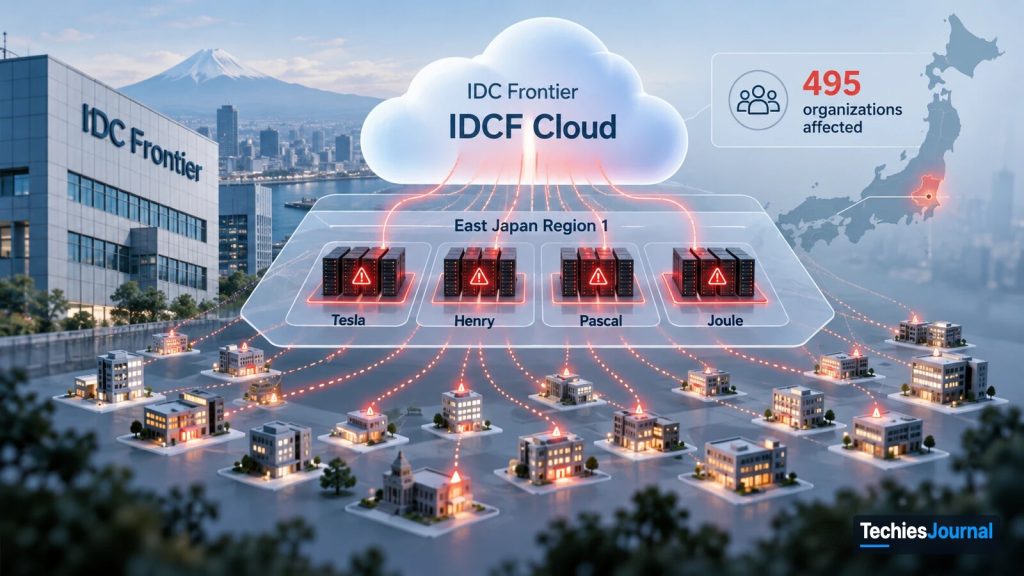
Illustration only. It shows the dependency of many customers on one provider and is not a diagram of IDC Frontier's actual network. The buildings and the map position are symbolic.
An October 2026 ransomware attack disrupted cloud services used by 495 organizations in Japan. The incident shows how a security problem within one provider can affect many customers and complicate their recovery.
One incident, 495 affected organizations
On October 7, 2026, Japanese cloud provider IDC Frontier reported unauthorized access affecting part of its IDCF Cloud infrastructure. In its second report that day, the company confirmed that the incident involved ransomware and reported that 495 companies and local-government organizations were affected.
The disruption involved four zones within East Japan Region 1: Tesla, Henry, Pascal and Joule. Virtual servers in those zones had stopped and could not be restarted. As part of its response, IDC Frontier disconnected affected infrastructure from the network and temporarily restricted access to cloud management systems. Other zones and regions, including the radian and newton zones of East Japan Region 1, East Japan Regions 2 and 3 and West Japan Region 1, were not disrupted, and the provider said it had confirmed no unauthorized access there. Their customers kept their virtual servers but were asked to take their own backups, and the provider started and stopped servers for them while the management console was paused.
For customers, this meant more than a temporary interruption. Their applications could be unavailable, and the normal tools used to manage or restart their virtual servers were not necessarily accessible. Source: IDC Frontier, October 8 incident report.
The reports in sequence
| Date | Report | What it covered |
|---|---|---|
| October 7 | Second report | Ransomware confirmed, 495 organizations and the provider’s initial response |
| October 8 | Third report | Four affected zones, 495 organizations, stopped virtual servers and recovery guidance |
| October 14 | Fifth report | Customer-data findings, queries involving 48 customers and snapshot retrieval for 194 customers |
| October 18 | Sixth report | Backup service resumption announced for the unaffected areas, snapshot feature still suspended |
Why one attack can affect many customers
Cloud providers operate infrastructure that many organizations use independently. Each customer may have separate virtual machines, applications and data. However, those services still depend on the provider’s underlying computing, storage, networking and management infrastructure.
This creates a shared dependency. Even when customer workloads are logically isolated, a problem affecting the provider’s infrastructure or its ability to operate that infrastructure can disrupt multiple customers.
In IDC Frontier’s case, the company reported disconnecting affected systems and restricting management access as part of its response to ransomware. These containment measures were important to the investigation and efforts to prevent further damage, but they also limited what affected customers could do.
Normally, a customer might restart a virtual server using a cloud console or API. During this incident, IDC Frontier reported that the affected virtual servers could not be restarted. The incident illustrates an important distinction: customers manage their applications, but they do not control every underlying system on which those applications depend.
Recovery was not immediately straightforward
On October 8, IDC Frontier warned that retrieving or restoring data from the affected zones would be difficult. The company initially advised affected customers to prepare alternative environments and recover using backups they maintained themselves, and said its view at that point was that data could be restored only from those backups.
This presented a particular challenge for customers depending on the provider’s built-in recovery features. A cloud snapshot can preserve a copy of a virtual machine’s data. But accessing that snapshot may still depend on the provider’s storage infrastructure and management services. If those systems are unavailable or restricted during an investigation, the existence of a snapshot does not guarantee that a customer can immediately retrieve it.
The situation changed as IDC Frontier investigated further. On October 14, the company reported that, after an external security firm had helped confirm that the backup data was safe, snapshot backup data could be retrieved for 194 affected customers who had used its snapshot feature.
This was an important development, but it did not mean all 194 customers had already restored their applications. The provider was still working with customers on how the retrieved data could be used for recovery. It also did not mean the other 301 organizations (495 minus 194) had permanently lost their data. They may have had other backups or recovery arrangements, and the published findings did not establish their final recovery outcomes. Source: IDC Frontier, October 14 investigation update.
The sequence reveals why recovery was more complicated than simply restarting a virtual machine. Customers needed both access to usable data and an environment in which their services could operate again.
What the investigation established about customer data
A ransomware incident can involve service disruption, unauthorized data access or data theft. These are different outcomes. In its October 14 report, IDC Frontier stated that its investigation had found no evidence that attackers had accessed or extracted data stored in customer virtual servers across the four affected zones. It said it had confirmed no misuse or other secondary damage at that time, and it concluded that no data had left its systems.
The company separately reported unauthorized queries involving cloud-portal registration information associated with 48 customers. The queried data types included company names, portal login IDs, portal passwords stored as hashes that the provider described as random and difficult to restore, notification e-mail addresses and total monthly charges, and two e-mail addresses may have included an individual’s name. At that time, IDC Frontier said it had not found evidence that the queried registration information had been taken outside its systems.
These were the provider’s findings at the time of the announcement, rather than proof that every possible form of exposure had been ruled out. The confirmed large-scale impact was the disruption of cloud services. It would therefore be inaccurate to describe all 495 affected organizations as victims of confirmed data theft. Source: IDC Frontier, October 14 investigation update.
What happened next
On October 18, IDC Frontier announced that its separate IDCF Cloud Backup service would resume in the radian and newton zones, East Japan Regions 2 and 3 and West Japan Region 1, where virtual servers had remained operational. The provider also described options for retrieving backup data and restoring it outside IDCF Cloud, including in other cloud or on-premises environments.
However, the snapshot feature remained suspended while additional safety checks continued. This was a partial restoration of a specific backup service, not an announcement that all affected systems and customers had recovered. Source: IDC Frontier, October 18 backup-service update.
What this incident tells us
The IDC Frontier incident is a reminder that cloud customers can be affected by events beyond their own applications and security configurations. One provider-level ransomware incident disrupted services for 495 organizations. Containment measures restricted normal infrastructure operations, and recovery options became clearer only as the investigation progressed.
The incident does not establish that all affected customers lost data, that the provider’s security architecture was necessarily inadequate, or that using multiple cloud providers would have prevented the disruption.
It does show something important about shared cloud infrastructure: an incident at the provider can affect many customers at once, and recovering an application may depend on capabilities those customers do not directly control. That distinction deserves attention whenever organizations assess how much of their business depends on a single infrastructure provider.
Go deeper
Research cutoff: October 20, 2026. The following original IDC Frontier announcements are published in Japanese.
- IDC Frontier, October 7, 2026: Second incident report, confirmation of ransomware and the provider’s initial incident response.
- IDC Frontier, October 8, 2026: Third incident report, four affected zones, 495 affected organizations, stopped virtual servers and recovery guidance.
- IDC Frontier, October 14, 2026: Fifth incident report, investigation of customer-data exposure, queries involving 48 customers and snapshot retrieval for 194 customers.
- IDC Frontier, October 18, 2026: Sixth incident report, resumption of the separate backup service in specified operating areas.
Related reading on TechiesJournal
- Cloud Capacity Is Not the Same as Cloud Availability for why a cloud service can be running and still be unable to supply the resources a customer needs.