

The moment nobody marked on the calendar
In the last thirty days, something shifted quietly in how infrastructure teams need to think about TLS encryption. A Java release made hybrid post-quantum cryptography the default. A standards body formalized how it works. A federal compliance deadline arrived. And suddenly, a technology that felt like research-department work became something infrastructure and security teams need to actually handle.
Nobody held a press conference. There was no vendor rally. But the conversation around post-quantum cryptography moved from “eventually we will need to think about this” to “your organization’s compliance status probably just changed, and you may not have noticed.”
This article is for infrastructure professionals, security teams, and anyone whose job involves TLS, certificate management, or meeting compliance deadlines. It covers what just happened, why it matters to you, and what the realistic next steps actually look like.
What actually happened this month
Three separate events converged in August and September 2026, each trivial by itself. Together, they closed off the runway for “we’ll deal with this later.”
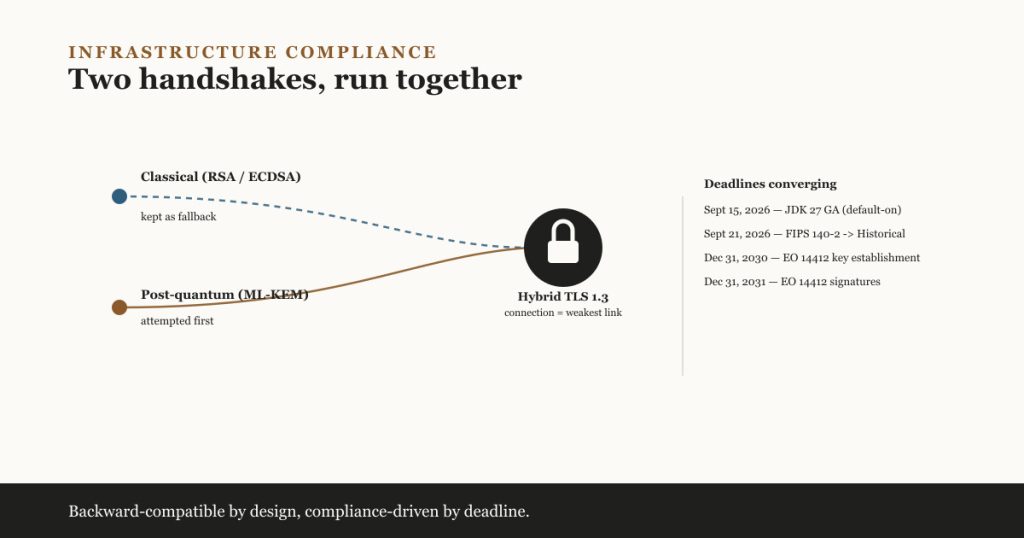
JDK 27 GA chose hybrid post-quantum TLS by default. On September 15, Java Development Kit version 27 entered general availability with hybrid post-quantum cryptography enabled as the default for TLS connections. That means every Java application running on JDK 27 or later will attempt to negotiate with servers using both classical RSA/ECDSA and post-quantum algorithms at the same time. The classical algorithms stay as a fallback if the server does not yet support post-quantum. The post-quantum ones are attempted first. This is not an opt-in flag. It is the default behavior.
RFC 10024 formalized how hybrid post-quantum TLS works. In August, the Internet Engineering Task Force published the standard that defines exactly how clients and servers negotiate post-quantum algorithms. This moved hybrid PQC from “a thing some vendors are experimenting with” to “the internet has a standard now.” Organizations running infrastructure that needs to handle JDK clients — whether that is your own applications or customer-facing services — will see TLS handshakes using these new algorithms whether or not you have planned for it.
FIPS 140-2 moved to Historical status on September 21. The US National Institute of Standards and Technology (NIST) formally reclassified FIPS 140-2, the cryptography standard that has governed most enterprise security infrastructure for two decades, as Historical. Organizations required to operate under FIPS standards — government agencies, federal contractors, organizations handling sensitive data under contract — now face deadlines to migrate to FIPS 140-3. That migration path now includes post-quantum cryptographic algorithms.
These three events are not separate stories. They are the same story from three different angles: the infrastructure world has stopped treating post-quantum cryptography as future-proofing and started treating it as a compliance requirement with deadlines.
Why post-quantum cryptography exists and why it matters now
Modern internet security relies on algorithms that are easy to verify with today’s computers but computationally impossible to break. The public key in your TLS certificate and the classical encryption methods that protect your data depend on mathematical problems — large-number factorization for RSA, elliptic-curve discrete logarithms for ECDSA — that would require thousands of years to solve even with the fastest classical computers we have.
A sufficiently powerful quantum computer could solve those problems in hours. One does not exist yet. But cryptography experts, national security agencies, and standards bodies have accepted as a working assumption that such a computer will eventually exist. The timeline is uncertain — some estimates say ten years, others say twenty or thirty. The uncertainty is not really the point. If you have data that needs to stay secret for decades, and if a quantum computer becomes practical within that timeframe, then encryption that works today may be useless tomorrow.
Post-quantum cryptography is a family of algorithms that remain difficult to solve even if a large quantum computer exists. NIST completed a standardization process in 2022, identifying several candidates that meet this requirement. The algorithms are ready to use now.
The reason this suddenly matters is not that quantum computers have arrived. It is that governments and standards bodies have decided not to wait anymore.
On June 22, 2026, the US federal government issued Executive Order 14412, “Securing the Nation Against Advanced Cryptographic Attacks.” It sets December 31, 2030 as the deadline for federal agencies’ high-value and high-impact systems to support post-quantum key establishment, and December 31, 2031 for post-quantum digital signatures. Those dates sound distant, but the order’s own implementation guidance — OMB Memorandum M-26-15 — is due roughly 90 days after signing, around September 20, 2026, which is why agencies and their contractors are already scoping this work now rather than waiting. The European Union’s telecommunications supervisors have separately asked organizations to assess and begin transitioning by the end of 2026. NIST has not given organizations the option to stay on FIPS 140-2 indefinitely. And now, with JDK 27 as the default behavior for Java applications worldwide, the infrastructure that serves those applications is being pushed toward supporting post-quantum algorithms whether or not those infrastructure teams planned for it.
Put next to each other, the deadlines that matter right now look like this:
| Requirement | Who it applies to | Deadline |
|---|---|---|
| FIPS 140-2 validations move to Historical status | Anyone procuring or validating new cryptographic modules | September 21, 2026 |
| OMB M-26-15 implementation guidance for EO 14412 | Federal agencies | ~September 20, 2026 (90 days after signing) |
| EU telecom PQC assessment and transition start | EU telecommunications operators | End of 2026 |
| EO 14412 — post-quantum key establishment | Federal high-value and high-impact systems | December 31, 2030 |
| EO 14412 — post-quantum digital signatures | Federal high-value and high-impact systems | December 31, 2031 |
This is not a vendor-driven trend. This is a standards-driven and compliance-driven reality.
Who this actually affects
If your organization runs any of the following, post-quantum cryptography is now a practical concern rather than a future consideration:
You maintain Java applications or use a platform that runs on the JDK. When those applications move to version 27 or later, they will attempt post-quantum TLS connections. Your infrastructure needs to understand what that means and whether your TLS libraries and network appliances support it.
You operate infrastructure that must meet FIPS compliance. Your current FIPS 140-2 compliance story is now on a defined end-of-life path. The transition to FIPS 140-3 and post-quantum methods is no longer optional timing — it has a deadline.
You work in roles where security or infrastructure is a compliance concern: government contracting, healthcare, financial services, or any industry where regulatory requirements govern your technology choices. Your regulator or customer is becoming aware that post-quantum migration exists, and questions are starting to arrive.
You maintain the TLS libraries, load balancers, API gateways, or certificate management infrastructure that client applications connect to. Clients — especially Java clients — will start requesting post-quantum algorithms. Your systems need to handle those requests without breaking, even if your own strategy is still being decided.
If your organization does not run Java workloads, does not hold FIPS compliance requirements, and does not serve as infrastructure for third-party applications, post-quantum cryptography still matters eventually, but your timeline is probably measured in years rather than months.
What you actually need to understand: know vs. use vs. master
Know. You should understand that post-quantum cryptography is a set of algorithms that remain secure even against quantum computers, that major platforms like JDK 27 are now defaulting to hybrid post-quantum TLS (which uses both classical and post-quantum algorithms together), and that regulatory deadlines for federal and European organizations are now real constraints, not future planning.
You do not need to understand the mathematics of how post-quantum algorithms work. You do not need to perform the cryptography yourself. You need to know that the shift is happening, that your infrastructure may encounter TLS handshakes using these algorithms, and that your compliance situation may have changed.
Use. If you maintain infrastructure that serves Java applications, or if your organization is subject to FIPS compliance requirements, you need practical working knowledge. That means:
Understanding whether your TLS libraries support hybrid post-quantum algorithms. Most modern versions do — OpenSSL, BoringSSL, Java’s built-in JSSE, and most cloud platform TLS stacks have added support — but “most” is not the same as “yours.” This requires checking documentation and possibly testing.
Knowing how to verify that your load balancers, API gateways, or reverse proxies can handle post-quantum TLS handshakes without crashing or dropping connections. Hybrid TLS is backward compatible — servers that do not support post-quantum algorithms still work — but you need confidence that your specific infrastructure does not choke on the handshakes.
Understanding your organization’s FIPS compliance status and timeline. If you are on FIPS 140-2, you have a deadline to migrate. If you are not, you do not have a compliance urgency, but you still need to handle clients that are asking for post-quantum algorithms.
Master. If you are designing the TLS infrastructure for an organization subject to compliance requirements, or if you are a security architect responsible for cryptographic strategy, you need to understand the trade-offs between hybrid PQC adoption timelines, certificate management implications (post-quantum certificates are larger, which affects some systems), performance characteristics of different algorithms, and migration sequencing (which pieces move first, how do you maintain backward compatibility while transitioning).
What you should know first
Before deciding what to do about post-quantum cryptography, understand what “hybrid” means in this context. Hybrid post-quantum TLS means the client and server negotiate both classical algorithms (RSA, ECDSA) and post-quantum algorithms (like ML-KEM, which is one of NIST’s newly standardized algorithms) at the same time in a single handshake. The connection is only as strong as the weakest algorithm in the pair. The point is not to be stronger — it is to be protected if the classical algorithms turn out to be weaker than expected, while keeping the infrastructure compatible with systems that do not yet support post-quantum algorithms.
This is different from “replace all RSA with post-quantum algorithms,” which is not the current path. It is also different from “post-quantum cryptography is perfect,” which is not true — new algorithms always carry some risk of undiscovered weaknesses.
Understand also that JDK 27’s default-on behavior does not mean all Java applications instantly break or stop working. Servers that do not support post-quantum algorithms will still work with Java clients on JDK 27. The classical algorithms remain as a fallback. What changes is that Java applications will try post-quantum first, and infrastructure teams need to know that these handshakes are coming.
What you can ignore for now
You do not need to understand the specific mathematics of ML-KEM, SLH-DSA, or other NIST-standardized post-quantum algorithms unless you are a cryptography specialist or your role involves evaluating new algorithms. Understanding what they do and that they are standardized is enough.
You do not need to replace your entire certificate infrastructure immediately. Hybrid TLS works with your existing certificates and infrastructure if your TLS libraries support it. This is a gradual transition, not a forklift replacement.
You do not need to choose between “go all-in on post-quantum” or “ignore it completely.” Most organizations are in a middle ground: understand the landscape, verify support in your infrastructure, and plan a migration schedule that aligns with your compliance requirements and your application refresh cycles.
What you should do next
Check whether your current TLS libraries support hybrid post-quantum TLS. This is a practical half-hour investigation. Documentation for OpenSSL, BoringSSL, Java JSSE, and AWS/Azure/Google Cloud TLS stacks will tell you directly. If you maintain infrastructure that serves TLS connections, verify your current position.
If you run Java applications, understand your JDK upgrade timeline. JDK 27 is now GA. Upgrade schedules vary — some organizations move every six months, others take years. Understand when your applications will encounter JDK 27 by default, and use that as a planning anchor.
If your organization is subject to FIPS compliance, start with your security or compliance team. These deadlines are real constraints, and they should be driving your infrastructure planning, not the other way around. Understand your actual compliance status and timeline before making infrastructure decisions.
If you serve as infrastructure for third-party applications, start expecting post-quantum TLS handshakes from Java clients. Not all Java applications will move to JDK 27 immediately, but once significant numbers do, your infrastructure needs to handle the handshakes gracefully. Test this with a modern JDK against your current TLS setup.
Post-quantum cryptography has moved from “research” to “infrastructure concern” in a single month. The conversations happening in your organization should be shifting from “should we think about this?” to “what is our actual status and timeline?” The answer will be different depending on your compliance requirements and the platforms you maintain, but the answer matters now.
Go deeper
- JEP 527: Post-Quantum Hybrid Key Exchange for TLS 1.3 — OpenJDK. The proposal that made hybrid post-quantum key exchange the default in JDK 27, including which named groups are negotiated and in what order. Reviewed September 2026.
- RFC 10024: Post-Quantum Traditional (PQ/T) Hybrid Key Agreement Mechanisms for TLS 1.3 — Internet Engineering Task Force. The technical standard defining the X25519MLKEM768, SecP256r1MLKEM768 and SecP384r1MLKEM1024 hybrid mechanisms.
- NIST Post-Quantum Cryptography Standardization Project — NIST. Standardized algorithms (including ML-KEM, specified in FIPS 203) and migration guidance. Reviewed September 2026.
- Executive Order 14412: Securing the Nation Against Advanced Cryptographic Attacks — The White House, signed June 22, 2026. Sets the 2030/2031 federal transition deadlines and directs OMB/national cyber director coordination.
- Cryptographic Module Validation Program — NIST CMVP. Official guidance on the FIPS 140-2 Historical transition and FIPS 140-3 validation. Reviewed September 2026.
Sources reviewed: 25 September 2026.