

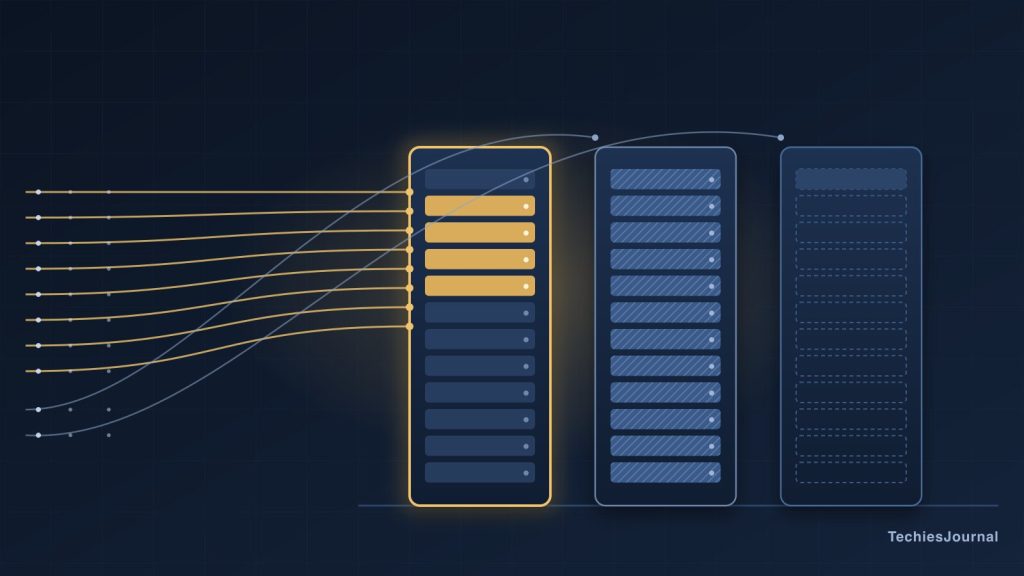
For years, load balancing has followed a simple idea.
A request arrives. The system looks for an available server and sends the request there.
That still works for most applications.
AI creates an interesting complication.
With a large language model, the best server may not always be the one with the least work.
Sometimes another server has already processed much of the information needed for the new request.
That means AI infrastructure is beginning to ask a different question.
Instead of only:
Which server is free?
it may also ask:
Which server is best prepared to handle this particular request?
That small change is starting to reshape how large AI systems route traffic.
A simple example
Imagine a company has an internal AI assistant used by 1,000 employees.
Before answering any employee, the AI receives the same company information:
- security rules
- internal instructions
- available tools
- product documentation.
After that, each employee asks a different question.
One asks about an invoice.
Another asks about a contract.
Another asks about an application problem.
The questions are different, but a large part of what the AI receives before each question is the same.
An ordinary load balancer may simply distribute those requests across available servers.
AI infrastructure can potentially do something smarter.
If one AI server has already processed that shared company information, sending another similar request to the same place can allow some of that earlier work to be reused.
Another server may have to start that work again.
So two servers that appear equally available may not actually be equally efficient.
The AI can remember part of the processing
Large language models perform considerable work before the first word of an answer appears.
While processing a prompt, the model creates temporary information that can be kept in memory.
This is commonly called a KV cache.
You do not need to understand the mathematics behind it to understand why it matters.
Think of it as temporary working notes.
If the model has already processed a long set of company instructions, keeping those working notes can sometimes prevent it from repeating the same calculation when another request begins with the same information.
This is called prefix caching.
And once that cached work becomes valuable, where a request is sent begins to matter.
The least busy server may not always be the best server
Consider two AI servers.
Server A already has useful information from an earlier similar request.
Server B does not.
If both are equally busy, Server A is probably the better destination because it may be able to reuse some previous work.
But now imagine Server A has a long queue of requests while Server B is almost idle.
Should the system still send the request to Server A?
Maybe not.
The routing system now has to balance two things:
reusing previous work
and
avoiding an overloaded server.
That is why AI load balancing is becoming more interesting.
There may no longer be one simple rule such as:
Always send the request to the least busy machine.
Accessible text alternative for this figure
Two routes side by side. Traditional routing: a request goes to an available, healthy server. Inference-aware routing: a request is checked against the model that is running, any cached work, the current load and whether compute is ready, and then goes to the best inference target.
This is already happening
This is not only an academic idea.
AWS recently introduced the SageMaker HyperPod Inference Gateway.
Its routing system can consider information specific to AI inference, including how busy an AI server is and whether useful previously processed prompt information is already available there.
AWS reports substantial reductions in the time users wait before seeing the first generated token in some of its benchmark workloads.
Those are AWS’s own benchmark results, so they should not be treated as guaranteed improvements for every application.
But the important development is the architecture itself.
The routing layer now understands something about the AI workload.
Open-source systems are doing similar things.
vLLM, a widely used LLM serving platform, supports routing that considers whether an inference server already contains useful cached prompt information.
Google is also developing inference-routing technology for GKE so AI requests can be distributed more effectively across large pools of GPU and TPU resources.
Different products are approaching the problem differently.
The common idea is more important:
AI requests are becoming something infrastructure can understand rather than simply forward.
There is more than cached information to consider
Caching is only one reason two AI servers may not be equivalent.
One server may already have the required model running.
Another may have more GPU capacity available.
One may have several requests waiting.
Another may be almost idle.
Large environments may also run different versions or specialized variations of models.
So an AI routing decision can gradually become:
Which machine can handle this particular request most effectively?
rather than:
Which machine should receive the next request?
That begins to look less like traditional traffic distribution and more like workload scheduling.
Does every AI application need this?
No.
A small company running a modest AI application does not automatically need sophisticated inference routing.
If an application uses one model, has relatively little traffic and runs on a small amount of infrastructure, an ordinary load-balancing setup may be entirely sufficient.
This becomes more important when organizations operate:
- large models
- many GPUs
- high request volumes
- long prompts
- repeated instructions or shared documents
- several models
- strict response-time requirements.
At that scale, repeating unnecessary AI computation can become expensive.
Better routing may help the organization use its existing AI infrastructure more efficiently.
But complexity should follow the problem.
There is little value in building sophisticated AI routing for a workload that does not need it.
Why infrastructure teams should care
Until recently, concepts such as model caching and inference optimization mainly belonged to machine-learning engineering teams.
That boundary is beginning to change.
Platform engineers, SREs and cloud architects may increasingly encounter questions such as:
Where is the model running?
How busy are the GPUs?
Has part of this request already been processed somewhere?
Can the request reuse previous computation?
Which destination is likely to respond faster?
These are infrastructure questions.
The people operating AI platforms do not need to become experts in how transformers work.
But they may need to understand enough about inference behaviour to make good infrastructure decisions.
This does not replace traditional load balancing
Traditional load balancers are not disappearing.
AI applications still use familiar networking components such as gateways, proxies and load balancers.
The difference appears closer to the model.
A normal load balancer may get the request into the AI platform.
Inside that platform, another routing layer can decide which model server or GPU should actually perform the work.
Think of it as two decisions:
First: Where should the application request go?
Then:
Where should the AI computation happen?
For simple systems, those decisions may effectively be the same.
For large AI platforms, they increasingly may not be.
Perspective
The interesting change is not that AI needs a special new type of load balancer.
It is that AI makes the workload itself more important to the routing decision.
With traditional applications, two healthy servers can often be treated as equivalent.
With AI inference, one server may already have useful work in memory, another may have the right model ready, and another may simply have more GPU capacity available.
So infrastructure is beginning to move from:
Find an available server.
toward:
Find the best place to perform this particular piece of AI work.
For small AI applications, that distinction may not matter.
For large inference environments, it increasingly does.
And that may be the easiest way to understand why AI inference is changing load balancing: the system is no longer routing only traffic. It is starting to route computation.
Related reading: Cloud Capacity Is Not Cloud Availability looks at another place where a server being available is not the same as being ready for the work, and AI Cost per Task looks at what AI work actually costs.
Sources and Further Reading
Source review: 5 October 2026.
- AWS — Amazon SageMaker HyperPod Inference Gateway for scalable LLM inference. AWS announcement of the gateway, its routing signals and AWS’s reported first-token latency results.
- AWS Documentation — SageMaker HyperPod managed tiered KV cache and routing. How prefix-aware routing sends requests to replicas that already hold the relevant cached work.
- AWS Machine Learning Blog — Introducing Amazon SageMaker HyperPod Inference Gateway. AWS’s own benchmark workloads and conditions. Results are vendor-reported, and AWS notes comparable performance on uniform fleets under steady traffic.
- Google Cloud — About GKE Inference Gateway. Prefix-cache aware and load-aware routing for generative AI on GKE across GPU and TPU accelerators.
- vLLM Documentation — Prefix-aware routing. Routing requests that share a prompt prefix to the same instance to reuse cached work.
- vLLM Documentation — Load-aware routing. Weighing the benefit of cached work against how loaded each instance is.
- vLLM Documentation — Automatic prefix caching. How cached work for a shared prompt prefix is reused, and where it helps most.