

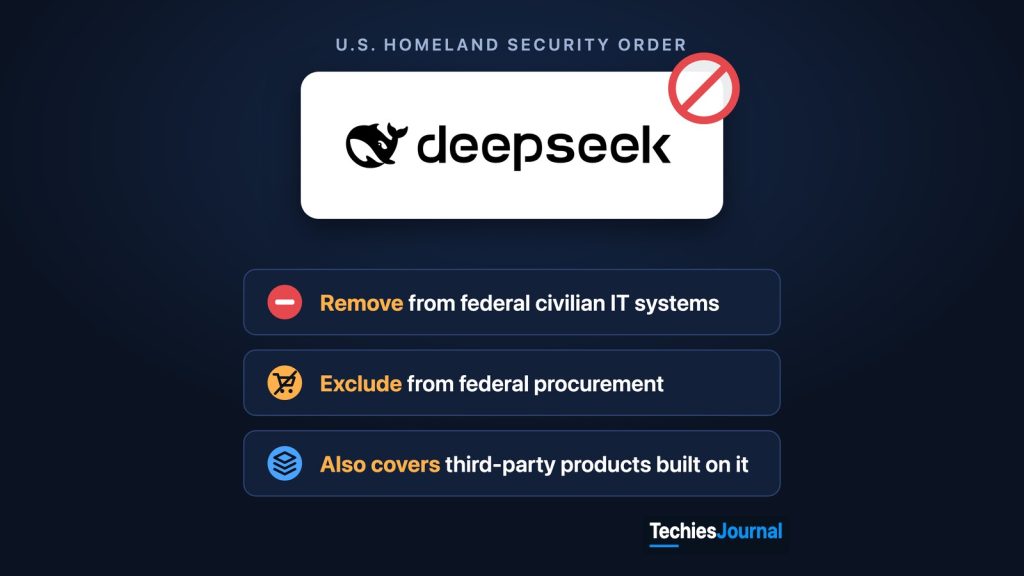
Summary graphic. The DeepSeek logo identifies the company named in the order and implies nothing beyond what the article reports.
The Department of Homeland Security has ordered covered federal agencies to remove DeepSeek-related technology from government IT systems and stop purchasing its products and services.
The United States has directed federal civilian agencies to remove products and services associated with Chinese artificial intelligence company DeepSeek from their information technology systems. The order, issued by the U.S. Department of Homeland Security (DHS), also prohibits covered agencies from purchasing technology products and services developed by DeepSeek and its affiliated entities.
The restriction extends beyond DeepSeek’s own products. It also covers third-party products and services developed using DeepSeek implementations. The order was originally issued on July 24, 2026, and published in the Federal Register on October 20, 2026. Source: U.S. Department of Homeland Security, Federal Register notice.
What the order requires
Issued under the Federal Acquisition Supply Chain Security Act of 2018, the order requires covered federal civilian agencies to exclude DeepSeek and affiliated products from government procurement and remove covered DeepSeek-related technology from existing IT systems. Both restrictions took effect immediately upon issuance of the order, and the order tells agencies to remove covered technology immediately or seek an exception.
Agencies may request written exceptions, including additional time to comply. Requests go to the DHS issuing official, and the Cybersecurity and Infrastructure Security Agency (CISA) reviews them and gives written approval or disapproval. The order says requests must be submitted in writing within 60 days of its issuance. Counted from the original date of July 24, 2026, that period would have ended on September 22, before the notice was published. The order does not say how the period applies after publication or whether later requests are accepted.
The order applies to federal civilian executive branch agencies, except for their national security systems and secure compartmented information systems. It addresses federal agencies, and it does not itself impose a nationwide prohibition on DeepSeek use by private businesses or individual consumers. Source: DHS, Signed Exclusion and Removal Order #2026-01.
Security concerns cited by DHS
DHS identified data privacy, national security and software security concerns as reasons for the restriction. In the signed order, the department stated that DeepSeek-hosted services operate on servers located in China. DHS raised concerns about potential access to sensitive information under Chinese law and the possibility of government-related information being transferred through prompts submitted to DeepSeek applications. It also said that creating an account on DeepSeek-hosted services collects personal information and may track users, and that the models themselves may contain malware or other security vulnerabilities.
The department also referenced open-source security research that found multiple critical vulnerabilities in DeepSeek’s iOS mobile application.
Until covered technology is fully removed, the order encourages agencies to monitor traffic in and out of their systems, add logging and controls on data exfiltration, and detect and flag anomalous activity. It also says CISA may provide technical help to agencies that lack the capability to comply.
These are concerns cited in the government’s order. The document does not establish that every DeepSeek deployment has experienced a security breach or that all previously reported vulnerabilities remain present.
China criticizes the decision
China criticized the U.S. restriction following its public disclosure. According to Reuters and the Associated Press, China’s Ministry of Commerce and Foreign Ministry opposed the decision, accusing Washington of using national security concerns to restrict Chinese technology companies.
The Foreign Ministry said China would resolutely safeguard the legitimate rights and interests of Chinese companies. The Ministry of Commerce said the United States had disregarded the consensus reached between the two countries’ leaders, and that China would closely monitor the situation and take all necessary measures to defend its legitimate rights and interests. DeepSeek did not immediately respond to the Associated Press’s request for comment. Sources: Reuters and Associated Press.
What the order means for IT teams and vendors
The order governs what federal civilian agencies buy and run. It does not itself bind private companies, so most organizations are affected only indirectly, through the federal agencies they sell to or support. This section is TechiesJournal’s reading of the order, not DHS guidance.
The removal duty is wider than DeepSeek’s own applications. It reaches third-party products and services developed using DeepSeek implementations, and the exclusion applies to agency-approved product lists, service-provider equipment lists and e-commerce markets. A vendor that embeds DeepSeek models or services in a product sold to an agency may therefore be asked about it. The order text we read does not say how a fine-tuned or self-hosted model would be treated.
The concerns DHS cites relate to DeepSeek-hosted services: servers located in China, account data collected at sign-up and prompts sent to the service. Running a model on your own infrastructure is a different situation, and the order does not rule on it. Because the order also says the models themselves may contain malware or other vulnerabilities, a team that downloads a model can reasonably apply the same supply-chain checks it applies to other software.
For organizations that sell to or support federal agencies, practical steps follow from the order:
- Inventory where DeepSeek models, applications or services appear in your products, your internal tools and your suppliers’ products, including third-party tools built on them.
- Check federal contracts and procurement lists for exposure, and ask suppliers whether their products use DeepSeek.
- Follow agency and CISA instructions, and remember that agencies themselves may request exceptions through DHS.
- For agencies still removing covered technology, apply the interim measures the order encourages: monitor traffic, add logging and exfiltration controls, and flag anomalies.
Several points remain unclear from the published documents: how exceptions are handled after publication, how derivatives and self-hosted models are treated, and how compliance will be checked. Readers should rely on agency instructions and on the order itself rather than on this summary.
Go deeper
Research reviewed October 21, 2026.
Official government documents
- U.S. Department of Homeland Security, Federal Register notice, published October 20, 2026, document 2026-21447, 91 FR 66346.
- DHS, Signed Exclusion and Removal Order #2026-01, originally issued July 24, 2026, contains the order, scope, exceptions and cited security concerns.
Independent news reporting
- Reuters, China says U.S. DeepSeek ban disregards bilateral consensus, October 20, 2026.
- Associated Press, China defends DeepSeek after U.S. restrictions, October 20, 2026.
Related reading on TechiesJournal
- Why China Is Building a Full AI Stack: Models, Chips, Capital and Compute for the wider Chinese AI industry that this order concerns.
- Running Open AI Models Yourself: What It Actually Takes for what using an open model on your own infrastructure involves, as opposed to a vendor-hosted service.