

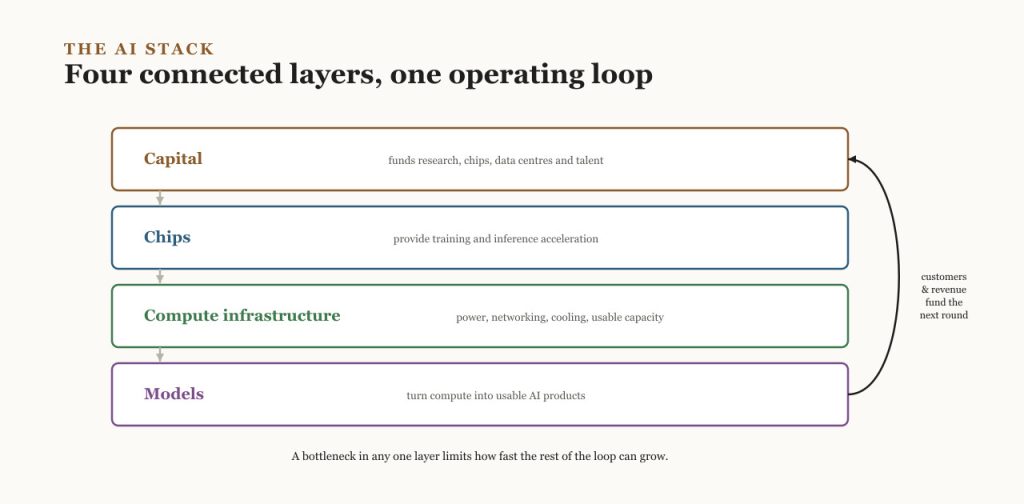
Strong AI models attract attention, but a country cannot run an AI economy on models alone. The harder task is connecting software, semiconductors, funding and physical infrastructure.
When a new AI model performs well, most of the attention goes to its benchmark scores, price and the size of its context window. The model looks like the product.
Behind it is a longer chain. The laboratory needs chips to train and run the model. Those chips need memory, servers, high-speed networks, cooling and electricity. Cloud platforms turn that infrastructure into services. Large amounts of capital pay for research, hardware, data centres and skilled teams before revenue is certain.
If one part of that chain is weak, progress elsewhere becomes harder to use.
This is why China’s AI strategy is moving beyond the release of competitive models. Chinese companies and government programmes are trying to strengthen the wider system: models, chips, compute infrastructure, developer ecosystems, industrial applications and funding.
The phrase full AI stack describes that ambition. It does not mean China has already replaced every foreign technology or solved every manufacturing constraint.
The model is only the visible layer
DeepSeek, Alibaba’s Qwen, Moonshot AI’s Kimi and other Chinese model families have shown that capable systems can be built and offered at aggressive prices. Open or downloadable models also help developers adapt them without depending entirely on a closed foreign API.
But a successful release creates its own infrastructure problem. More users mean more inference—the repeated computation required every time a model answers a request. Larger context windows, reasoning workloads, video generation and agents that make many model calls can raise that demand quickly.
A company that controls only the model still depends on other organisations for accelerators, cloud capacity and financing. Those dependencies become strategic when hardware is restricted or supply is scarce.
China’s response is not one centrally built machine. It is a mixture of state policy, large technology companies, model startups, semiconductor firms, cloud providers, universities and local investment programmes. Their interests overlap, but they also compete.
Why chips became the pressure point
Modern AI systems rely on accelerators that perform many calculations in parallel. Nvidia built the dominant platform around GPUs, software libraries, networking and developer tools. Replacing it involves more than designing another processor; compilers, communication systems and operational knowledge also matter.
US export controls have repeatedly changed which advanced processors can be shipped to China. The rules are not a complete ban on every AI chip. In January 2026, the US Bureau of Industry and Security moved the Nvidia H200, AMD MI325X and similar products to case-by-case licence review, subject to conditions. The policy can change again, which is itself a planning risk for buyers.
Chinese firms are consequently working on domestic accelerators and supporting systems. Huawei’s Ascend platform is one example. Alibaba’s chip unit, T-Head, announced the Zhenwu V900 in September 2026 and plans commercial release in the first quarter of 2027.
Those are vendor claims and a future production schedule. They should not be treated as independently verified fleet-scale performance. Chip design, fabrication yield, advanced packaging, high-bandwidth memory, interconnects and software support can all limit how many useful systems reach customers.
Domestic progress can reduce one dependency without creating complete semiconductor independence.
Compute means more than owning chips
A box of accelerators is not yet an AI service. Thousands of chips have to operate as a coordinated system. Training and serving large models require fast networks, storage, scheduling software, fault recovery, cooling and dependable power.
Alibaba’s September 2026 full-stack roadmap illustrates how these layers are being combined. The company presented Qwen model plans, its Zhenwu processor, server and networking components, storage services, model-training infrastructure and an enterprise agent platform.
It also set a target for Alibaba Cloud’s global operated data-centre capacity to exceed 20 gigawatts by 2032. This is a corporate target six years into the future, not capacity available today. Reaching it would require sites, grid connections, power contracts, cooling, equipment and customers willing to pay for the services.
China’s national plans use similar language at a broader level. A January 2026 government summary calls for coordinated development of AI chip hardware and software, improvements in training and inference, industrial datasets and model deployment. A separate July plan covers data, computing power, open-source ecosystems, industrial use, talent, standards and governance.
This shows why the stack matters. Better models increase demand for compute. More compute needs energy and cloud operations. Domestic chips need software and customers. Industrial deployment creates revenue and data that can support the next round of development.
The operating loop
- Capital
- Chips
- Compute infrastructure
- Models
Useful models attract customers, revenue and strategic value—which funds the next round of capital, closing the loop.
Each layer’s constraint
Capital
Funds research, chips, data centres and talent. Main constraint: sustainable returns and continued financing. What fails when this layer is constrained: chip purchases, data-centre construction and hiring all slow, even when the underlying technology is ready.
Chips
Provide the training and inference acceleration everything else depends on. Main constraint: fabrication, yield, advanced memory, packaging and software. What fails when this layer is constrained: training and serving capacity stalls even when funding and demand exist.
Compute infrastructure
Connects chips through servers, networks, storage, cooling and power. Main constraint: electricity, grid connection, networking, cooling and usable capacity. What fails when this layer is constrained: chips sit idle or underused without enough power, networking or cooling to run them as one coordinated system.
Models
Turn compute into useful AI capabilities and products. Main constraint: training methods, data quality, adoption and serving cost. What fails when this layer is constrained: capable hardware and available funding still produce no usable product or revenue.
Why capital belongs in the technical story
Model development is often discussed as research while data centres are discussed as infrastructure. Financially, they are part of one long investment cycle.
Companies pay for chips, cloud contracts, energy, data, engineers and repeated experiments before they know which model or product will succeed. Once a service grows, inference becomes an ongoing operating cost. Price competition can increase adoption while delaying profit.
Large companies such as Alibaba can fund AI from established cloud, commerce and consumer businesses. Independent laboratories need other sources. DeepSeek began with backing from founder Liang Wenfeng’s High-Flyer hedge fund, but its capital needs have expanded. Reuters reported in September 2026 that the company was preparing for a possible Shanghai listing, had begun external fundraising and was increasing spending on compute infrastructure, chip development and talent.
The widely repeated $74 billion figure is a reported fundraising valuation. It is not money raised, annual revenue or a completed IPO value. Confusing those measures makes the capital story look stronger than the evidence supports.
Investors can also influence hiring, disclosure, governance and pressure to commercialise. A research-focused lab entering public markets gains resources while accepting new financial expectations.
What integration can improve
A company working across several layers can tune them together. Models, accelerators, schedulers, storage and networks can be optimised for the same workloads instead of following separate roadmaps.
Integration may also reduce cost and supply risk. If an organisation owns the model, cloud service and customer channel, it can reuse infrastructure and distribute the model through products that already have users.
There is a trade-off. Tighter integration can make customers dependent on one vendor’s hardware and software. Internal components can appear successful because they are bundled into a large platform rather than because outside customers independently chose them. Performance claims may be difficult to compare when benchmarks, availability and pricing are not transparent.
Full-stack ownership does not automatically produce the best component at every layer.
What China still depends on
The move toward domestic capability should not be confused with isolation from global technology.
Chinese AI systems can still depend on foreign semiconductor equipment, manufacturing processes, memory, open-source software, research, cloud customers and international supply chains. Even where domestic substitutes exist, they may differ in performance, energy use, software maturity, production volume or cost.
The same is true elsewhere. US model companies depend on chip fabrication concentrated in Asia, specialised manufacturing equipment from several countries, global energy projects and outside capital. No major AI ecosystem is completely self-contained.
China’s strategy is better understood as reducing vulnerable dependencies while building more bargaining power and operational choice. Success will vary by layer. Models can improve quickly through software work. Advanced semiconductor manufacturing and large power projects usually move more slowly.
How to read the next announcement
When a company announces a new Chinese model, chip or data-centre plan, four questions provide more value than a simple “ahead or behind” judgement:
- Is this a working product, a limited deployment, a roadmap or a long-term target?
- Which other layers are required before customers can use it at scale?
- Are performance and cost claims independently comparable?
- Which dependency has genuinely been reduced, and which dependencies remain?
These questions also apply to US and European AI announcements. The value of the full-stack view is that it exposes the distance between a demonstration and a dependable service.
The practical conclusion
China is building across the AI stack because models alone do not guarantee control over cost, supply or deployment. Export restrictions increased the urgency, but domestic competition, cloud economics and industrial policy also push companies in the same direction.
The result will not be one unified Chinese platform. It will be an uneven ecosystem in which strong models may run ahead of chip supply, infrastructure may expand before demand becomes profitable, and some domestic components will mature faster than others.
The progress is real. So are the gaps. The useful question is not whether China has achieved complete AI independence. It is which dependency each new investment removes—and what still has to work before the announcement becomes usable capacity.
References and further reading
- Alibaba full-stack AI strategy — Alibaba Cloud, 22 September 2026. Company roadmap covering Qwen models, Zhenwu chips, cloud infrastructure, agents and the 20 GW target.
- China aims for secure, reliable supply of AI core technology by 2027 — Chinese government portal, 8 January 2026. Summary of plans for coordinated chip, software, model, dataset and industrial development.
- China issues action plan on AI cooperation and development — Chinese government portal, 17 July 2026. Covers data, computing power, ecosystems, talent, standards and governance.
- Department of Commerce revises semiconductor licence-review policy for China — US Bureau of Industry and Security, 13 January 2026. Current policy announcement for H200-, MI325X- and similar-class products.
- DeepSeek hires dealmaker as CFO ahead of possible IPO — Reuters, 14 September 2026. Reporting on fundraising, possible listing preparation and infrastructure investment.
Sources reviewed: 24 September 2026.
Related reading: When AI Models Learn From Other AI Models: Distillation, API Abuse and the Limits of Export Controls, which looks at the same export-control landscape from the API and training-data side rather than the hardware side.