

| Part | Article | Covers |
|---|---|---|
| 1 | Free vs. Paid AI Models: What the Words Actually Mean | What each tier means, what you give up at $0, licenses, a decision framework |
| 2 | Running Open AI Models Yourself: What It Actually Takes | Hardware, tools, skills, and the real challenges of self-hosting |
| 3 | Where to Find and Verify Open AI Models Safely | Trusted sources, spotting tampered downloads, safe practices |
| 4 | Open AI Models Worth Knowing Right Now (this article) | A field guide to 18 current free and open-weight models |
This part assumes Parts 1–3: what “open-weight” means, what it takes to run one, and how to get a copy safely. This one puts names to that knowledge.
Read This as a Snapshot, Not a Ranking
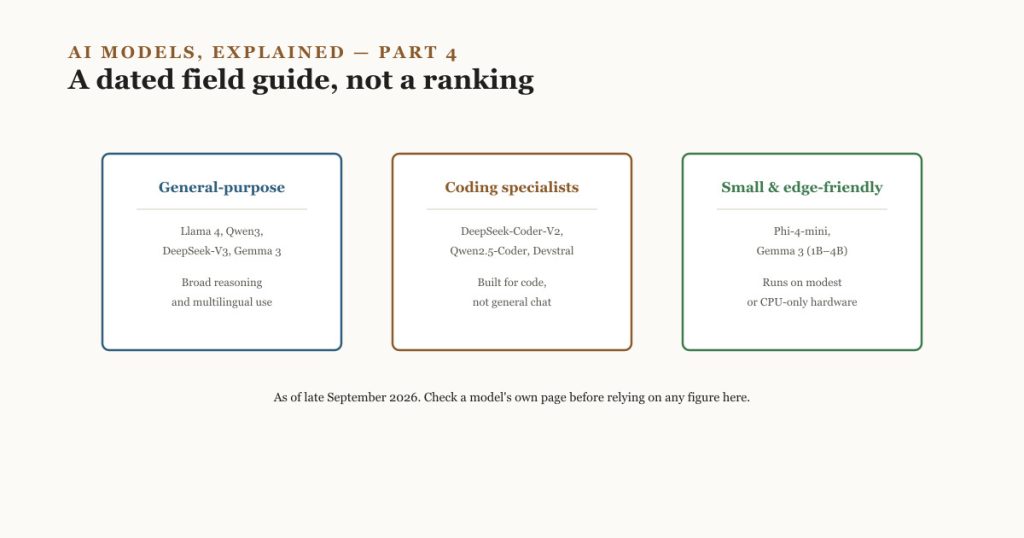
As of late September 2026. New models replace today’s best every few months in this field, and even the models listed below get updated with new versions on their own release schedule. This list is not an endorsement of any one model over another, and it is not a claim that this is the complete set of options — it is a starting point for further reading, organized so a reader can match a model to what Part 1’s license table and Part 2’s hardware table already covered.
Each entry lists the publisher, the license family (see Part 1 for what these actually restrict), an approximate size, and what the model is generally known for. Exact parameter counts, context lengths, and benchmark standings change with every point release — check the model’s own page on Hugging Face or the publisher’s site for the current numbers before relying on any figure here.
General-Purpose Models
| Model | Publisher | License | Approximate size | Known for |
|---|---|---|---|---|
| Llama 4 (Scout / Maverick) | Meta | Llama Community License (700M MAU threshold — see Part 1) | 109B–400B total, 17B active (mixture-of-experts) | Very long context windows; widest third-party tool support of any open-weight family |
| Qwen3 / Qwen3.5 | Alibaba | Apache 2.0 | 1.7B–235B | Strong reasoning across a very wide size range; broad multilingual coverage |
| DeepSeek-V3 / R1 | DeepSeek | MIT | 671B total, 37B active (mixture-of-experts) | Frontier-level reasoning and coding benchmarks at a fully permissive license |
| Mistral Small / Large | Mistral AI | Apache 2.0 | Small models undisclosed exact size; Large 2 at 123B | Efficient inference, strong function-calling and agentic tool-use support |
| Gemma 3 | Gemma Terms of Use | 1B–27B | Runs on modest hardware; wide multilingual and multimodal support | |
| Phi-4 / Phi-4-mini | Microsoft | MIT | 3.8B–14B | Strong reasoning for its size; the mini version runs on CPU-only hardware |
| gpt-oss | OpenAI | Apache 2.0 | 20B, 120B | OpenAI’s first openly licensed weight release; built for reasoning tasks |
| Falcon 3 | Technology Innovation Institute (UAE) | Apache 2.0 | 1B–10B | Lightweight general-purpose models aimed at edge and on-device use |
| Yi-1.5 | 01.AI | Apache 2.0 | 6B–34B | Balanced general-purpose performance across a mid-size range |
| InternLM 3 | Shanghai AI Laboratory | Apache 2.0 | 8B | Research-oriented release with strong reasoning benchmarks for its size |
| Jamba 1.5 | AI21 Labs | Apache 2.0 | 52B total, 12B active (hybrid architecture) | Combines transformer and state-space design for longer context at lower memory cost |
| DBRX | Databricks | Databricks Open Model License | 132B total, 36B active | Enterprise-oriented mixture-of-experts release |
| Command R+ | Cohere | CC-BY-NC (non-commercial) | 104B | Strong at retrieval-augmented and multi-step tool-use tasks; not licensed for commercial products |
| Kimi K2.5 | Moonshot AI | Modified MIT (attribution required above a stated usage threshold) | 1T total, 32B active | Very large mixture-of-experts model competitive with frontier paid models on several benchmarks |
Coding Specialists
| Model | Publisher | License | Approximate size | Known for |
|---|---|---|---|---|
| DeepSeek-Coder-V2 | DeepSeek | MIT | 236B total, 21B active | Coding-focused variant of DeepSeek’s architecture |
| Qwen2.5-Coder | Alibaba | Apache 2.0 | 0.5B–32B | Wide size range purpose-built for code generation and completion |
| StarCoder2 | BigCode / Hugging Face / ServiceNow | BigCode OpenRAIL-M | 3B–15B | Trained specifically on permissively licensed source code |
| Devstral | Mistral AI | Apache 2.0 | 24B | Built for software-engineering agents and multi-file coding tasks |
| CodeLlama | Meta | Llama Community License | 7B–70B | Meta’s original code-specialized Llama variant |
Small and Edge-Friendly Models
| Model | Publisher | License | Approximate size | Known for |
|---|---|---|---|---|
| Phi-4-mini | Microsoft | MIT | 3.8B | Runs acceptably on CPU-only hardware, no GPU required |
| Gemma 3 (1B–4B variants) | Gemma Terms of Use | 1B–4B | Small multimodal models suited to on-device and mobile use | |
| StableLM 2 | Stability AI | Stability AI Community License | 1.6B–12B | Lightweight general-purpose family from Stability AI |
The One Genuinely “Open Source” Entry Worth Naming
Part 1 drew a line between open-weight (only the trained numbers are public) and true open source (the training data and process are public too). Almost every model above is open-weight only. OLMo 2, from the Allen Institute for AI, is one of the few current releases that also publishes its training data and training code under Apache 2.0, making it a genuine reference point for what full openness actually looks like — at the cost of being smaller (7B–13B) and less capable on frontier benchmarks than the largest closed-training releases above.
Using This List With the Rest of the Series
- Match a model’s license here to Part 1’s license table before using it in anything commercial.
- Match a model’s size here to Part 2’s hardware table before assuming it will actually run on your machine.
- Only download from the sources and formats described in Part 3, regardless of how reputable a model’s name is.
This Series So Far
This closes the four-part series. Together, the parts answer: what the tiers mean, what running one actually takes, where to get one safely, and which specific models exist today. A reader arriving at any single part can use the table at its top to reach the other three.
- Part 1 — Free vs. Paid AI Models: What the Words Actually Mean. What each tier means, and what you give up at $0.
- Part 2 — Running Open AI Models Yourself: What It Actually Takes. The hardware, tools, and real trade-offs of self-hosting.
- Part 3 — Where to Find and Verify Open AI Models Safely. Trusted sources, and how to spot a tampered download.
Go Deeper
- Hugging Face Models — the primary catalog for checking a model’s current version, license, and file formats directly.
- LMSYS Chatbot Arena — an independent, continuously updated leaderboard for comparing model performance, useful for checking whether the standings above still hold.
- Meta Llama models, Qwen, Mistral AI, Google Gemma, DeepSeek — official publisher pages for the models discussed most in this article.
This article is a snapshot and should be revisited and refreshed on a regular cycle (recommended: every 3–4 months) rather than treated as a permanent reference. When it is updated, the original publish date stays and a separate “Updated” date is added, per TechiesJournal’s publishing standard.