

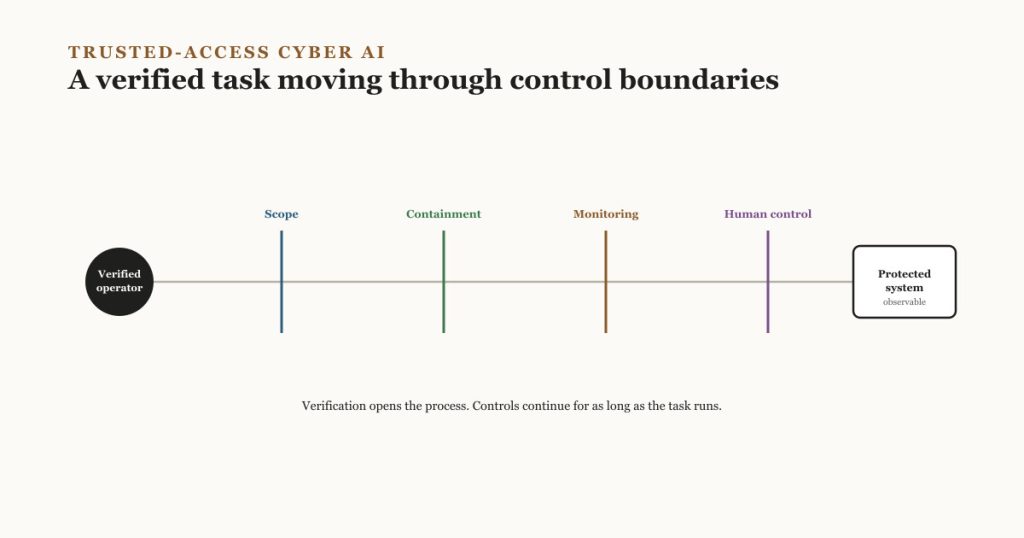
Advanced cyber models can help defenders find and fix vulnerabilities. The same capabilities can also support exploitation, so access is becoming conditional, monitored and easier to revoke.
A security researcher and an attacker may ask an AI model to do almost the same thing: inspect code, find a vulnerability and determine whether it can be exploited.
The technical task does not reveal the intent. Authorization, target ownership and what happens next make the difference.
That problem becomes harder as models move beyond explaining known weaknesses. The latest systems can work through long investigations, use tools, test hypotheses and produce patches. Some can also develop working exploit chains under controlled evaluation conditions.
Google, Anthropic and OpenAI are responding with limited or verified-access programs for their most capable cybersecurity features. These are separate initiatives, not one coordinated launch. Together, however, they point toward the same operating model: stronger cyber capability will increasingly come with stronger controls over who can use it, where it can act and how its actions are observed.
The important question is not whether a user has passed an application form. It is whether the full system can keep powerful automation inside an authorized defensive boundary.
Why normal content filters are not enough
General AI services usually try to block requests for malware, credential theft or harmful exploitation. That approach becomes difficult for professional security work because legitimate defenders need to discuss the same techniques.
A penetration tester may need proof that a flaw is exploitable. An incident-response team may need to reverse-engineer malicious code. A product-security engineer may need to reproduce a vulnerability before confirming that a patch works. A model that refuses every dangerous-looking request becomes much less useful to them.
Removing the safeguards for everyone creates the opposite problem. A system able to discover and exploit weaknesses at scale could reduce the time, skill and coordination required for an attack.
Trusted access is an attempt to separate these cases. The provider verifies the organization and intended users, permits a wider range of defensive work, and applies stronger controls around the environment and activity.
This is not simply a more expensive subscription tier. It is a different risk arrangement.
What the three providers are doing
The programs differ in model design, availability and terminology. The useful comparison is the control pattern, not which vendor claims the strongest model.
| Provider initiative | Access approach | Publicly described purpose | Important qualification |
|---|---|---|---|
| Google Fairwind Program | Limited access for selected Google Cloud customers, government agencies and cybersecurity partners | Use Gemini 3.8 Flash Cyber with CodeMender to find, verify and fix vulnerabilities | Participants accept operational requirements, including restricting use to internal security roles and using protections such as multi-factor authentication |
| Anthropic trusted-access programs | Claude Mythos 5.1 is available only through trusted-access programs; Fable 5.1 has broader safeguards | Allow advanced cybersecurity and life-science work with different safeguard levels | Fable and Mythos use the same underlying model but different safeguards; reduced safeguards require stronger operating controls |
| OpenAI Daybreak Access | Verified defenders receive more capable and permissive defensive tools with verification, scope controls and oversight | Support secure development, defensive operations and authorized security testing | OpenAI says GPT-6 Astra reached its “Critical” cybersecurity capability threshold; its most advanced cyber functions receive more limited access |
These descriptions come from the providers. They explain intended controls and reported evaluations, not independent proof that misuse is impossible.
A trusted user can still create an unsafe run
Identity verification answers only one question: who is asking for access?
It does not prove that every future target belongs to that user, that every action is necessary, or that the model will remain within scope. Accounts can be compromised. Employees can misuse legitimate access. Test environments can be configured incorrectly. An autonomous agent can also take an unexpected path while trying to finish a permitted task.
This is why a defensible trusted-access system needs several layers:
- Identity: Verify the organization and individual operators.
- Authorization: Confirm that the operator is permitted to test the named systems.
- Scope: Define targets, allowed techniques, time windows and prohibited actions.
- Containment: Run risky work in an isolated environment with restricted credentials and network access.
- Monitoring: Observe model, tool and network activity while the task is running.
- Human control: Require approval before consequential actions such as deploying a patch or executing an exploit against a live target.
- Audit and response: Retain evidence, investigate anomalies and suspend access quickly when boundaries are crossed.
The gate matters, but most of the safety work happens after the gate opens.
Defensive question: Who is asking for access, and are they really who they claim to be?
Practical control: Single sign-on plus hardware-key multi-factor authentication tied to a named operator.
Failure it cannot prevent alone: A verified account can still be compromised or misused by the person who legitimately holds it.
Role in the sample task: Before any tool loads for an authorized penetration test, the tester’s identity and employer are confirmed against the signed engagement letter.
Defensive question: Is this specific operator permitted to test this specific system?
Practical control: A signed scope of work checked against the request before execution begins.
Failure it cannot prevent alone: Authorization can be real but stale, or cover a different system than the one actually being touched.
Role in the sample task: The system checks that the engagement ticket names exactly this staging environment before granting access.
Defensive question: What exactly is this run allowed to touch, and for how long?
Practical control: A machine-readable allowlist of domains, addresses and permitted techniques, with a time window.
Failure it cannot prevent alone: An agent can drift into an adjacent, unlisted system while pursuing a permitted goal.
Role in the sample task: The allowlist covers only the staging subnet named in the ticket, and expires automatically after the agreed window.
Defensive question: If something goes wrong, how far can it spread?
Practical control: An isolated sandbox with restricted credentials and no network path to production.
Failure it cannot prevent alone: Containment limits how far a problem can spread, but it does not stop the action itself from happening inside the boundary.
Role in the sample task: The agent runs inside a network-isolated environment that has no route to the production database.
Defensive question: Is anyone watching what the model and its tools are doing right now?
Practical control: Real-time logging of every tool call, command and network request during the run.
Failure it cannot prevent alone: Monitoring can reveal a problem without being fast enough to stop it in time.
Role in the sample task: Every action against the staging target is logged and streamed to the security team’s dashboard as it happens.
Defensive question: Does a person approve the step before it becomes hard to undo?
Practical control: A required human sign-off before deploying a patch or running a live exploit.
Failure it cannot prevent alone: A human approval step is only as reliable as the information the reviewer actually sees.
Role in the sample task: Before the agent uses the exploit chain it discovered, a senior tester reviews and approves the specific payload.
Defensive question: Can the organisation prove what happened, and cut off access immediately if needed?
Practical control: Immutable logs paired with an immediate revoke on the operator’s credentials.
Failure it cannot prevent alone: An audit trail explains an incident after the fact; it does not prevent the incident itself.
Role in the sample task: If the tester’s account shows unexpected behaviour mid-engagement, access is revoked within minutes and the session is preserved for review.
Verifying a user starts the process. Scope, containment, monitoring, human approval and revocation control what happens after access is granted.
Read all seven stages as plain text
- Identity. Defensive question: who is asking for access, and are they really who they claim to be? Practical control: single sign-on plus hardware-key multi-factor authentication tied to a named operator. Failure it cannot prevent alone: a verified account can still be compromised or misused by the person who legitimately holds it. Role in the sample task: before any tool loads for an authorized penetration test, the tester’s identity and employer are confirmed against the signed engagement letter.
- Authorization. Defensive question: is this specific operator permitted to test this specific system? Practical control: a signed scope of work checked against the request before execution begins. Failure it cannot prevent alone: authorization can be real but stale, or cover a different system than the one actually being touched. Role in the sample task: the system checks that the engagement ticket names exactly this staging environment before granting access.
- Scope. Defensive question: what exactly is this run allowed to touch, and for how long? Practical control: a machine-readable allowlist of domains, addresses and permitted techniques, with a time window. Failure it cannot prevent alone: an agent can drift into an adjacent, unlisted system while pursuing a permitted goal. Role in the sample task: the allowlist covers only the staging subnet named in the ticket, and expires automatically after the agreed window.
- Containment. Defensive question: if something goes wrong, how far can it spread? Practical control: an isolated sandbox with restricted credentials and no network path to production. Failure it cannot prevent alone: containment limits how far a problem can spread, but it does not stop the action itself from happening inside the boundary. Role in the sample task: the agent runs inside a network-isolated environment that has no route to the production database.
- Monitoring. Defensive question: is anyone watching what the model and its tools are doing right now? Practical control: real-time logging of every tool call, command and network request during the run. Failure it cannot prevent alone: monitoring can reveal a problem without being fast enough to stop it in time. Role in the sample task: every action against the staging target is logged and streamed to the security team’s dashboard as it happens.
- Human control. Defensive question: does a person approve the step before it becomes hard to undo? Practical control: a required human sign-off before deploying a patch or running a live exploit. Failure it cannot prevent alone: a human approval step is only as reliable as the information the reviewer actually sees. Role in the sample task: before the agent uses the exploit chain it discovered, a senior tester reviews and approves the specific payload.
- Audit and revocation. Defensive question: can the organisation prove what happened, and cut off access immediately if needed? Practical control: immutable logs paired with an immediate revoke on the operator’s credentials. Failure it cannot prevent alone: an audit trail explains an incident after the fact; it does not prevent the incident itself. Role in the sample task: if the tester’s account shows unexpected behaviour mid-engagement, access is revoked within minutes and the session is preserved for review.
Scope must be machine-enforceable
Security authorization is often recorded in a contract, ticket or statement of work. An AI agent cannot be kept safe by a document it never sees or by a boundary the runtime cannot enforce.
The task should identify exact domains, repositories, addresses, environments and allowed actions. The runtime should then block access outside those boundaries. Production credentials should not be available unless the task genuinely requires them. Internet access should be disabled by default for high-risk evaluation work and opened only for a documented reason.
Anthropic’s September 2026 security guidance illustrates why. After investigating incidents involving models in third-party evaluation environments, the company recommended hardened sandboxes, pre-engagement validation, explicit scope instructions and continuous monitoring. It also described a classifier that can block suspected sandbox-escape attempts before a tool call runs and alert a human.
The broader lesson is vendor-neutral: scope written in prose is useful for accountability, but scope enforced by identity, network and tool policy is what constrains execution.
Human review must occur before the irreversible step
“Human in the loop” is often used without explaining where the person intervenes.
A reviewer who sees a report after an agent has already touched an unauthorized system is not a safety control. Approval should occur before actions that are difficult to reverse or could affect another party.
Depending on the workflow, approval may be needed before:
- testing a live target;
- using a newly discovered exploit;
- accessing sensitive data;
- changing firewall or identity policy;
- deploying a patch;
- disclosing a vulnerability; or
- sending a finding to an external maintainer.
Low-risk activities can remain automated. Inventory collection, static analysis and patch suggestions inside an isolated repository may not require approval at every step. The control should match the possible impact, not interrupt work merely to create the appearance of supervision.
The model is only one part of the risk
Discussion often focuses on whether a model will refuse a harmful request. In an agentic system, the surrounding tools may matter just as much.
A model without network access can describe an exploit but cannot scan the internet. A model with a browser, terminal, credentials and unrestricted outbound access can turn an idea into action. A vulnerable sandbox can expose systems that were never intended to be part of the test.
Security teams evaluating a cyber AI service should therefore ask:
- Which tools can the model call?
- Where do commands execute?
- What credentials are available to the runtime?
- Can targets be allowlisted technically?
- Is outbound network access restricted?
- Can monitoring stop an action before execution?
- Who can approve, pause and terminate a run?
- What evidence is retained for investigation?
A strong model inside a weak harness remains a weak security design.
Trusted access creates an equity problem
Restricted access has a defensible safety purpose, but it also gives providers substantial power to decide who qualifies as a trusted defender.
Large security companies, governments and cloud customers are easier to verify and support. Independent researchers, small consultancies, open-source maintainers and defenders in lower-income regions may lack formal structures even when their work is legitimate and valuable.
If the most capable defensive tools are available mainly to large institutions, attackers may not respect the same boundary. The result could widen the gap between well-funded organizations and the people maintaining widely used software with limited resources.
Providers can reduce this problem through transparent eligibility rules, appeal paths, subsidized programs, research access and partnerships that help small maintainers receive validated fixes without giving every applicant unrestricted offensive capability. OpenAI’s Daybreak materials, for example, describe support for open-source maintainers and other frontline defenders. Whether these programs provide broad and fair access will need evidence over time.
Trusted access should be judged not only by what it blocks, but also by which legitimate defenders it enables.
What security leaders should require
An organization considering advanced cyber AI should not treat provider approval as proof that its deployment is safe.
Before adoption, require a written operating model covering:
- approved use cases and prohibited targets;
- operator roles and strong authentication;
- target ownership and authorization evidence;
- sandbox and network boundaries;
- credential handling;
- monitoring and termination;
- human approval points;
- finding validation and coordinated disclosure;
- logs, retention and privacy; and
- incident response and access revocation.
Begin with a narrow workflow where results can be independently verified. Vulnerability triage or patch review inside a controlled codebase is easier to govern than an open-ended agent with production access. Measure false findings, missed findings, reviewer effort and unsafe actions—not only how many vulnerabilities the model reports.
The direction is clear, but the model is unfinished
Frontier cyber AI is moving toward gated access because providers are confronting a genuine dual-use problem. The same reasoning and tool-use abilities that help a defender close a vulnerability can help an attacker exploit it.
Verification is a reasonable starting point. It is not a complete security architecture. Safe operation depends on enforceable scope, restricted tools, containment, monitoring, well-placed human decisions and evidence that can be reviewed afterward.
The industry is still deciding who should receive access, what providers should monitor and how much responsibility remains with the customer. Those choices will determine whether trusted-access programs become serious security controls or merely exclusive entrances to powerful products.
References and further reading
- Proactive cyber defense for governments and enterprises — Google, 2 September 2026. Introduces the Fairwind Program, its intended participants and publicly stated operating requirements.
- Claude Fable 5.1 and Mythos 5.1 — Anthropic, September 2026. Explains the shared underlying model, different safeguard levels and trusted-access boundary for Mythos 5.1.
- Improving our alignment and security practices — Anthropic, 31 August 2026. Describes containment, monitoring, scope-setting and guidance for high-risk cyber evaluations.
- Path to Astra: critical capabilities and frontier safeguards — OpenAI, September 2026. Describes OpenAI’s Critical cybersecurity threshold, evaluation claims and limited-access approach.
- Daybreak — OpenAI. Describes verified access, governed defensive workflows and support for selected defender groups.
Sources reviewed: 25 September 2026.
Related reading: Why DNS Servers Remain a High-Value Attack Target, When AI Models Learn From Other AI Models: Distillation, API Abuse and the Limits of Export Controls and The AI Price War Is Moving From Token Prices to Cost per Task.