

Imagine that a cloud provider has secured thousands of advanced AI chips. The servers are assembled, customer demand is waiting and investment has already been approved.
There is still a practical question: Can the proposed data centre receive enough reliable electricity at the required location?
A modern AI facility may require hundreds of megawatts. Some planned campuses are larger still. The electricity cannot simply be taken from the nearest power line. The grid must have enough generation, transmission capacity, substations and local distribution equipment to serve the new load without making the wider system unreliable.
Chips can be ordered and buildings can be financed faster than much of that infrastructure can be planned and constructed. This is why electricity is becoming one of the important limits on AI growth.
It is not accurate, however, to say that the world is simply “running out of power.” The constraint is usually regional. A country may have enough electricity in total while a particular technology hub cannot add another large data centre at the time and place requested.
Why AI changes the data-centre power question
Data centres existed long before generative AI. They already ran search engines, business software, video streaming, financial systems and the public cloud. AI adds several pressures.
Training a large model brings thousands of accelerators together for long periods. Serving the model—called inference—can create continuing demand as more people and applications use it. Agent-based systems may make several model calls and tool calls to complete one user task.
The chips also produce heat. Removing that heat requires cooling equipment, which consumes electricity and may use water depending on the design. Backup systems, storage, networking and power-conversion equipment add further requirements.
The International Energy Agency projects that global data-centre electricity consumption could rise from about 485 terawatt-hours in 2025 to around 950 terawatt-hours by 2030. That would still be approximately 3% of global electricity demand, not most of the world’s electricity. The difficulty is concentration: new demand arrives in large blocks and often in regions where many data centres already operate.
The IEA expects the United States and China to account for nearly 80% of global data-centre electricity-consumption growth through 2030. National totals therefore hide the local engineering problem.
The path from electricity to usable AI capacity
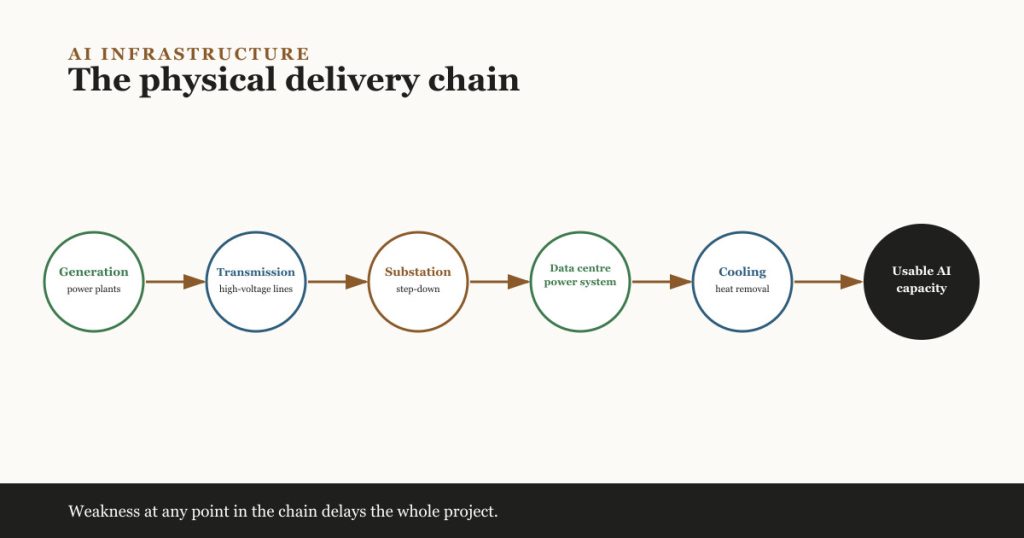
Money and chips sit near the end of a longer chain:
Generation → transmission → substation → data centre power system → cooling → servers → usable AI capacity
Weakness at any point can delay the entire project.
Generation
Someone must produce the additional electricity. Renewable energy can be built comparatively quickly in suitable locations, but its output varies. Storage, flexible demand or other generation may be needed to maintain continuous service. Natural gas can provide firm capacity but raises fuel and emissions concerns. Nuclear power provides steady low-carbon electricity, although new plants usually require long development periods.
The likely answer is a changing mix rather than one winning source. The IEA expects renewables and natural gas to meet much of the additional demand during this decade, with nuclear power also contributing.
Transmission and substations
Electricity may be available somewhere on the grid but not deliverable to the chosen site. New high-voltage lines, transformers and substations can require long planning, approval and construction cycles. Large transformers also have their own manufacturing lead times.
This creates the uncomfortable infrastructure reality: signing an energy contract does not guarantee that the physical grid can deliver the required power on schedule.
Grid connection
A utility must study how the proposed facility affects the network. It may require the developer to fund upgrades or accept conditions on when and how much power it can use.
Rapid demand forecasts make this harder. Utilities may receive several requests for very large projects, some of which will never be built. Planning for all of them risks unnecessary investment. Planning for too few risks delayed connections and lost economic development.
Local permission
Data centres compete with other uses of land, electricity and water. Communities may question whether they will receive enough jobs or tax revenue to justify new infrastructure, noise, water use or higher system costs.
This means a project can be financially viable and technically possible yet still fail to secure local acceptance. The reported value of blocked or delayed projects should therefore not be described as proof of an electricity shortage alone. Permitting, water, land use, cost allocation and public trust may all be involved.
Efficiency helps—but may not reduce total demand
AI chips and models are becoming more efficient. Quantization can reduce the precision used for model weights. Better model architectures can perform useful work with fewer calculations. Software can batch requests, reuse cached results and route simple work to smaller models.
These improvements matter. They reduce the electricity and cost required for a given task.
But lower cost often increases usage. A cheaper model may be added to more products, used by more people or called repeatedly by an automated agent. This is a form of the rebound effect: efficiency reduces consumption per task while total consumption continues to grow because the number of tasks grows faster.
The correct conclusion is not that efficiency is pointless. It is that efficiency and capacity planning must be considered together.
What operators are trying
There is no single fix, but several approaches can shorten delays or reduce pressure.
Build where power is available
AI infrastructure does not have to follow the same location pattern as traditional office technology. Training jobs that can tolerate some network delay may be placed near available generation. This can reduce pressure in established data-centre regions, although access to fibre, workforce and equipment still matters.
Make some workloads flexible
Not every AI task must run at the same moment. Some training, testing and batch inference can move to a different time or region when the grid is less constrained. Interactive services have less flexibility because users expect immediate responses.
The important distinction is between work that can wait and work that must always be available.
Use storage and microgrids
Batteries can smooth short power changes, reduce peak demand and support backup operation. The IEA estimates that data centres could install around 20–25 gigawatts of battery storage globally by 2030.
Some facilities are also considering microgrids or on-site generation. These can improve resilience and reduce dependence on a single grid connection. They do not remove questions about fuel, emissions, maintenance, safety or who pays for shared infrastructure.
Contract for new supply
Technology companies are signing long-term agreements for renewable, nuclear and other generation. Such agreements can help finance new supply. They should not be confused with instant physical delivery: generation, transmission and connection work still must be completed.
What this means for technology professionals
Cloud capacity is no longer only a software-procurement question.
Architects designing large AI systems should consider regional capacity, model efficiency and workload flexibility. Platform teams need to understand which workloads can move across times or locations. FinOps teams should expect electricity availability and infrastructure commitments to influence price. Business leaders should challenge plans that assume every requested accelerator will become usable capacity on the announced date.
Most software professionals do not need to master power-system engineering. They should understand four things:
- Computing capacity depends on a physical delivery chain.
- The constraint may differ sharply by region.
- Efficiency per AI task does not guarantee lower total demand.
- More generation alone is insufficient if transmission, substations or permits are missing.
The practical conclusion
AI infrastructure is often discussed as a race for chips and capital. That view is incomplete.
The next unit of AI capacity also needs electricity at the correct location, a grid connection that can support it, cooling that can remove its heat and a community willing to host the infrastructure. Each part operates on a different timeline.
Electricity will not end AI expansion. It will shape where expansion happens, how quickly capacity becomes usable and which projects remain announcements rather than operating systems.
Go deeper
- Key Questions on Energy and AI — Executive Summary — the IEA’s updated global projections for data-centre and AI electricity demand. Reviewed 24 September 2026.
- Energy and AI: Energy demand from AI — regional demand projections and the role of AI-focused facilities.
- Energy and AI: Energy supply for AI — projected contributions from renewables, natural gas and nuclear power.
- Speed to Power: Solutions for Accelerating Large Load Connections — Lawrence Berkeley National Laboratory’s review of large-load connection challenges and responses.
- Powering Intelligence 2026 — EPRI scenarios for U.S. data-centre electricity demand and grid planning.