

Imagine an operations assistant investigating a failed application deployment.
It needs to read monitoring data, inspect deployment records and perhaps run an approved diagnostic command. It may ask a separate security agent to examine suspicious activity. It may also need to use a support website to open an incident or request a change.
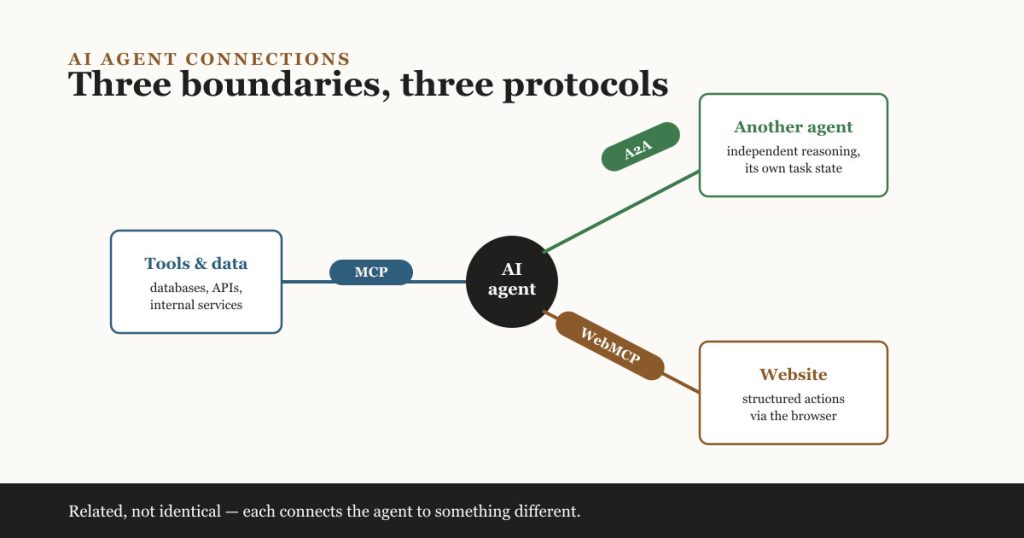
Those actions look similar from the user’s point of view: the assistant is completing one task. Technically, they involve three different relationships:
- an AI application connecting to tools and data;
- one independent agent communicating with another; and
- an agent interacting with a website through the browser.
MCP, A2A and WebMCP address these three boundaries. They can complement one another, but they are not interchangeable parts of a finished universal stack.
The short explanation
| Protocol | Main connection | Plain-language purpose | Current position |
|---|---|---|---|
| MCP | AI application ↔ tools and data | Gives an AI application a consistent way to discover and use external capabilities | Widely adopted, under the Agentic AI Foundation |
| A2A | Agent ↔ agent | Lets independent agents discover capabilities, exchange messages and manage shared tasks | Stable 1.0 specification with growing platform support |
| WebMCP | Browser agent ↔ website | Lets a website expose structured actions instead of making an agent guess how to click the interface | Early preview and community-group specification; not a W3C standard |
The easiest way to remember the distinction is:
MCP connects an agent to capabilities. A2A connects an agent to another agent. WebMCP lets a website describe actions to a browser agent.
That summary is useful, but real systems require more care. A tool can hide a complex service behind MCP. An A2A agent may itself use MCP tools. A website may expose WebMCP actions while its backend uses ordinary APIs. The protocols describe connection boundaries; they do not decide the complete architecture.
MCP: connecting AI applications to tools and data
The Model Context Protocol, or MCP, provides a common way for an AI application to connect to external systems. An MCP server can expose tools the application may call, resources it may read and reusable prompts it may request.
Without a shared protocol, every AI product needs a custom integration for every database, repository, business application or internal service. MCP gives clients and servers a common contract for discovering and invoking those capabilities.
In our operations example, MCP could expose narrowly defined tools such as:
get_deployment_statusread_error_logscompare_configurationrun_approved_diagnostic
The agent does not need direct database credentials or knowledge of every vendor API. It sees the tools, their descriptions and their expected inputs. The MCP server translates an approved request into the underlying system operation.
This does not automatically make the operation safe. A broadly privileged MCP server simply gives the agent broadly privileged tools. Production design still requires authentication, authorization, limited scopes, input validation, audit logs, timeouts and human approval for consequential actions.
MCP has moved well beyond its original association with Claude. It is now governed within the Linux Foundation’s Agentic AI Foundation and is supported across several major AI platforms. That is strong evidence of adoption. It does not mean every MCP server is secure, compatible or suitable for enterprise use.
A2A: allowing independent agents to work together
MCP works well when an AI application needs a capability. A different problem appears when the capability belongs to another independent agent that manages its own reasoning, task state and interaction.
The Agent2Agent protocol, or A2A, is designed for that relationship. An agent can publish an Agent Card describing its identity, endpoint, skills and authentication requirements. Other agents can use that information to decide whether and how to communicate with it.
A2A also defines a task model for work that may take time, require more information or produce several updates. That matters because agent collaboration is rarely a single request followed immediately by a final answer.
In the deployment incident, the operations agent might send the security agent a task:
Examine authentication failures associated with deployment 1842 and return the affected identities, confidence level and supporting evidence.
The security agent controls how it performs that work. It may use its own models, policies and MCP-connected tools. It can return status updates and, eventually, an artifact containing its findings.
This is the important architectural difference: with MCP, the calling application invokes a defined capability. With A2A, it collaborates with another agent that has its own task boundary.
A2A 1.0 is described by its project as production-ready, and the Linux Foundation reports support from more than 150 organisations. Those are meaningful adoption signals, but they partly come from the organisations developing and promoting the protocol. Teams should still test interoperability, failure behaviour and security controls in their own environment.
WebMCP: making websites understandable to browser agents
Browser agents can already inspect pages, read text and attempt to click controls. This approach is fragile. A redesigned button, an unexpected dialog or an ambiguous form can cause the agent to perform the wrong action.
WebMCP proposes a more structured relationship. A website can declare actions that a browser agent may use, including simple actions described through forms and more complex actions registered through JavaScript.
A travel website might expose actions such as search_flights or select_itinerary. A support portal might expose create_incident, with defined fields for severity, system, description and evidence. The agent can call that action instead of trying to infer the purpose of every visual control.
This does not replace the website or its backend APIs. It adds an agent-facing interface within the browser context.
WebMCP must also be described more cautiously than MCP or A2A. As of this article’s source review, it is available as an early, experimental preview behind a browser flag in Chrome and published through the W3C Web Machine Learning Community Group. The specification explicitly states that it is not a W3C Standard and is not on the W3C Standards Track. Calling it an established web standard would therefore be inaccurate.
How they can work together
Return to the failed deployment:
- The operations agent uses MCP tools to read deployment history and monitoring data.
- It sends an investigation task through A2A to an independently operated security agent.
- After receiving the findings, it uses a structured WebMCP action exposed by the support portal to prepare an incident.
- A human reviews the evidence and approves the final submission.
This is a plausible combined architecture, not a mandatory protocol stack. Many systems need only one of these protocols. A single assistant with several internal tools may need MCP but not A2A. Two services may communicate perfectly well through existing APIs without becoming agents. A website should not add WebMCP merely to appear “agent-ready.”
The architectural question should always come first: Which connection problem are we actually trying to solve?
The protocols do not solve trust
Shared message formats improve interoperability. They do not prove that a tool, agent or website should be trusted.
An MCP tool description can misrepresent what the tool does. A remote A2A agent can return incorrect or malicious content. A WebMCP tool or its output can attempt to influence the agent through prompt injection. Even honest components may receive more data or authority than the task requires.
Teams still need controls outside the protocol:
- verify the identity and ownership of servers and agents;
- grant the smallest practical permissions;
- keep user identity and authorization context intact across calls;
- separate reading from modifying or deleting data;
- require confirmation for financial, security or irreversible actions;
- treat descriptions, messages and returned content as untrusted input;
- log the request, decision, tool call and result;
- define timeouts, retries and safe failure behaviour.
The protocol answers, “How can these components communicate?” Governance must answer, “Should this action be allowed, under whose authority, and who is accountable if it fails?”
What should you learn?
Know
Most developers, architects, security professionals and technology leaders should understand the three boundaries and the maturity difference. That is enough to evaluate proposals without treating every agent integration as the same problem.
Use
Developers building AI applications should learn MCP tool design, authorization and error handling. Teams building cross-platform multi-agent systems should study A2A Agent Cards, tasks, messages, artifacts and authentication. Web developers should experiment with WebMCP only when browser-agent interaction is relevant, while treating its API as changeable.
Master
Platform engineers responsible for an enterprise agent environment need deeper knowledge of identity propagation, policy enforcement, observability, protocol gateways, data boundaries and incident response. Mastering message formats without mastering authority and failure handling is not enough.
The practical decision
Start with the boundary, not the acronym:
- If an AI application needs tools or data, evaluate MCP.
- If independent agents need to collaborate, evaluate A2A.
- If a website needs to expose reliable actions to a browser agent, watch or experiment with WebMCP.
- If an ordinary API or workflow already solves the problem, keep it.
MCP and A2A now have credible adoption and shared foundation governance. WebMCP addresses a real browser problem, but it remains earlier and less settled. Together they show where agent interoperability may be heading. They do not remove the harder work of security, operational reliability and human accountability.
Go deeper
- Model Context Protocol specification (2026-07-28) — the current stable protocol specification and core concepts. Reviewed 24 September 2026.
- MCP architecture overview — explains the host, client and server roles and the main protocol primitives.
- A2A key concepts — covers Agent Cards, messages, tasks, parts and artifacts.
- What is new in A2A 1.0 — documents the stable release and migration changes.
- WebMCP community-group specification — the evolving API, its formal status, and its security and privacy considerations.