

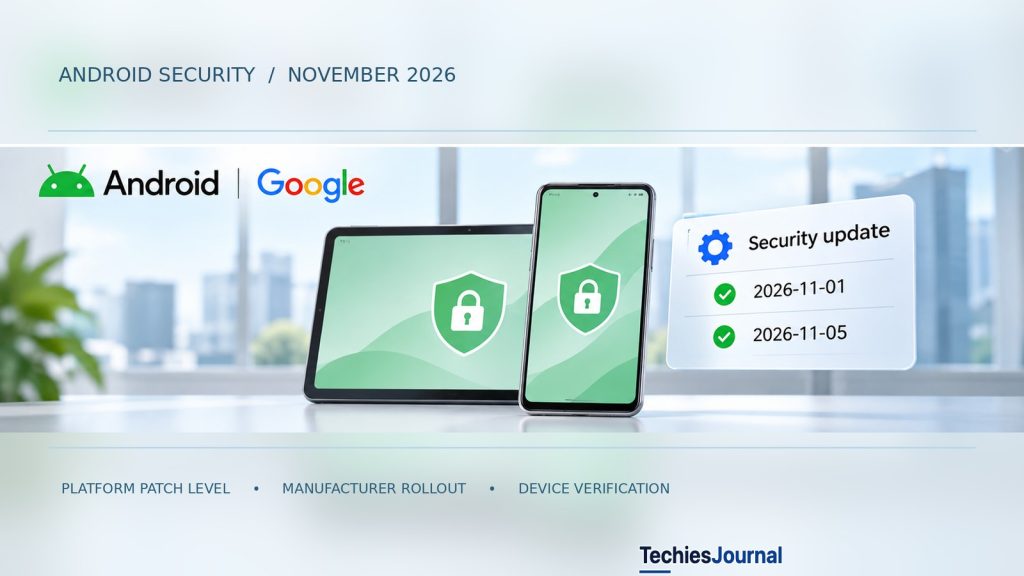
Google’s November bulletin addresses critical Android vulnerabilities, including remote-code-execution flaws requiring no user interaction. The immediate enterprise task is identifying which devices have received the applicable fixes.
Google published its November 2026 Android Security Bulletin on November 2.
The bulletin identifies critical vulnerabilities in Android Framework, System and other components, including remote-code-execution flaws that do not require user interaction.
For organizations managing Android phones and tablets, the practical question is whether affected devices have received the necessary security updates.
Google defines two security patch levels for November: 2026-11-01 and 2026-11-05.
Those dates do not mean the same thing.
Which vulnerabilities matter?
The bulletin includes three critical remote-code-execution vulnerabilities in Framework and System.
| Vulnerability | Component | Severity | Type |
|---|---|---|---|
| CVE-2026-58868 | Framework | Critical | Remote code execution |
| CVE-2026-58876 | System | Critical | Remote code execution |
| CVE-2026-58936 | System | Critical | Remote code execution |
Google states that the most severe Framework vulnerability could allow remote code execution without additional execution privileges or user interaction.
The bulletin describes similar risks for the critical System remote-code-execution issues.
These are vulnerability-impact assessments. They do not establish that every affected device can be compromised under all conditions.
Google’s severity assessment assumes that relevant platform or service protections are disabled or successfully bypassed.
The official November bulletin does not report confirmed active exploitation of the three highlighted RCE vulnerabilities. That should not be interpreted as proof that exploitation has never occurred.
The bulletin also covers other vulnerabilities involving privilege escalation, information disclosure and denial of service. Five further System issues are also rated Critical: three privilege-escalation vulnerabilities and two denial-of-service vulnerabilities.
Depending on the issue, the bulletin lists updated Android Open Source Project versions 14, 15, 16, 16-qpr2 and 17.
Source: Android Open Source Project, Android Security Bulletin, November 2026.
November 1 versus November 5: what is the difference?
Android uses security patch levels to indicate which groups of fixes a device manufacturer has incorporated.
| Android security patch level | Coverage |
|---|---|
| 2026-11-01 | All issues assigned to the November 1 group, plus applicable fixes from previous Android security bulletins |
| 2026-11-05 | All applicable fixes in both November groups and previous Android security bulletins |
The November 1 group includes the highlighted Framework and System remote-code-execution vulnerabilities.
The November 5 group adds further fixes involving the kernel and other applicable components, including vendor components.
Google permits two patch levels so manufacturers can deliver a common subset of fixes earlier while completing the remaining applicable changes.
A device reporting 2026-11-01 should therefore not be treated as equivalent to a device reporting 2026-11-05.
2026-11-01
The 2026-11-01 level covers all issues assigned to the November 1 group, plus applicable fixes from previous Android security bulletins. The November 1 group includes the highlighted Framework and System remote-code-execution vulnerabilities.
2026-11-05
The 2026-11-05 level covers all applicable fixes in both November groups and previous Android security bulletins. The November 5 group adds further fixes involving the kernel and other applicable components, including vendor components.
Not equivalent
A device reporting 2026-11-01 should therefore not be treated as equivalent to a device reporting 2026-11-05. Google states that the November 5 level or later addresses all applicable issues in the bulletin.
Google states that the November 5 level or later addresses all applicable issues in the bulletin.
Source: Android Security Bulletin, November 2026, patch-level definitions.
Android security patch level versus Google Play system update
Android devices may display two different security-related dates.
The Android security patch level reports the device’s installed platform security patch status, as declared by its manufacturer.
The Google Play system update reflects updates delivered to supported modular Android components through Google’s update mechanism.
The November bulletin includes fixes for Project Mainline components that may be delivered through Google Play system updates on supported devices. One of the three critical remote-code-execution vulnerabilities, CVE-2026-58876, is listed among the Project Mainline issues, under Media Codecs.
However, updating those components does not by itself establish that all required Framework, kernel and manufacturer-specific fixes have been installed.
Google also notes that, for some devices on Android 10 or later, the Google Play system update will have a date string that matches the 2026-11-01 security patch level. That match does not change the point above, because the Google Play system update does not report the platform patch status.
The two indicators should not be treated as interchangeable.
Security patch level
The Android security patch level reports the device’s installed platform security patch status, as declared by its manufacturer. Administrators should use it when assessing the bulletin’s platform patch requirements.
Play system update
The Google Play system update reflects updates delivered to supported modular Android components through Google’s update mechanism. One of the three critical remote-code-execution vulnerabilities, CVE-2026-58876, is listed among the Project Mainline issues, under Media Codecs.
Not interchangeable
Updating modular components does not by itself establish that all required Framework, kernel and manufacturer-specific fixes have been installed. The two indicators should not be treated as interchangeable.
Administrators should use the Android security patch level when assessing the bulletin’s platform patch requirements, while also monitoring Google Play system updates where applicable.
What should enterprise teams do?
A practical response begins with the managed-device inventory.
Identify affected devices. Record the device model, Android version, installed Android security patch level and update availability. On a device, both indicators appear under Settings, About phone, Android version, labelled Android security update and Google Play system update.
Check manufacturer advisories. Google publishes the platform bulletin, but manufacturers incorporate applicable fixes into device-specific software. Distribution schedules can differ by product and carrier.
Prioritize based on exposure. Devices used for privileged administration, sensitive applications or access to confidential records may require faster remediation, depending on the organization’s threat and risk assessment.
Track devices that cannot update. Devices without an available corrective release should remain visible in the exception inventory. Temporary access restrictions, reduced privileges or replacement may be appropriate until the required fixes are available.
Identify devices
Record the device model, Android version, installed Android security patch level and update availability.
Check manufacturers
Google publishes the platform bulletin, but manufacturers incorporate applicable fixes into device-specific software. Distribution schedules can differ by product and carrier.
Prioritize
Devices used for privileged administration, sensitive applications or access to confidential records may require faster remediation, depending on the organization’s threat and risk assessment.
Track exceptions
Devices without an available corrective release should remain visible in the exception inventory. Temporary access restrictions, reduced privileges or replacement may be appropriate until the required fixes are available.
For example, a managed phone reporting `2026-11-01` may have the critical Framework fixes addressed by the first group while still lacking applicable fixes assigned to November 5.
An administrator should confirm the organization’s required patch level rather than mark the phone fully compliant simply because its date contains November 2026.
What about Google Play Protect?
Google Play Protect and Android’s built-in security controls can reduce the likelihood of successful exploitation.
They remain valuable defenses, particularly against harmful applications.
But they do not replace security patches.
A device can have Google Play Protect enabled and still require a manufacturer update to resolve a platform or kernel vulnerability.
Organizations should distinguish these protective mechanisms rather than treating any single indicator as proof that a device is fully patched.
The operational takeaway
The November bulletin establishes the vulnerabilities, affected components and required patch levels.
Enterprise administrators must establish which managed devices have actually received the applicable updates.
The immediate action is to identify devices below the required patch level, verify manufacturer availability and keep unresolved exceptions visible until remediation is complete.
A published security update makes a fix available. Device-fleet protection depends on confirming that the fix has reached the affected devices.
References and further reading
- Android Open Source Project, Android Security Bulletin, November 2026. November 2, 2026. Official vulnerability classifications, affected components and patch-level definitions.
- Google, Check and update your Android version. Official guidance on checking Android security and Google Play system update status.
- Android Open Source Project, Android Security Bulletins. Official archive of Android platform security advisories.
Evidence cutoff: November 6, 2026. Google published the bulletin on November 2 as version 1.0 and states that it will be revised with source-code links. Bulletin revisions, device-specific update availability and exploitation reporting should be rechecked before publication.