

Quantum computers are often compared by the number of qubits they contain. But a larger qubit count does not necessarily mean a more capable computer. To understand why, we need to look at how quantum information is stored, how errors occur and what logical qubits actually solve.
Why having more qubits is not enough
When we compare conventional computers, we often look at their processors, memory and processing capabilities. A faster processor or more memory can improve performance, although the actual benefit depends on the workload.
It is natural to approach quantum computers in a similar way. If one quantum processor has 100 qubits and another has 1,000, we might assume the second machine is significantly more powerful.
But quantum computing has a problem that makes this comparison less straightforward.
Quantum information is fragile. A qubit can lose its intended state because of environmental disturbances, imperfect operations or errors during measurement. Even when individual operations are highly accurate, those small errors become important as calculations grow longer.
Consider a quantum computer where a two-qubit operation has an error rate of 0.1%, or roughly one failure in every 1,000 operations.
That may sound acceptable for an individual operation. However, a complex quantum algorithm could require millions or billions of operations. Without effective error management, the probability of completing a long calculation correctly can become very low.
How small errors add up
Pick an error rate per operation and a number of operations. The result is the chance that every single operation works, with no error correction. This is an illustration: it assumes each operation fails independently at the same rate. Real hardware differs by platform and by operation.
1,000 operations in a row
Chance that every operation works
36.8%
| Operations in a row, at 0.1% per operation | Chance that every one works |
|---|---|
| 100 | 90.5% |
| 1,000 | 36.8% |
| 10,000 | about 1 in 22,000 |
| 100,000 | less than 1 in 10^43 |
| 1,000,000 | less than 1 in 10^434 |
| 1,000,000,000 | less than 1 in 10^434511 |
Adding more qubits does not automatically improve reliability. Those additional qubits also need to be controlled, measured and protected from errors.
This is where the difference between physical and logical qubits becomes important.
What are physical and logical qubits?
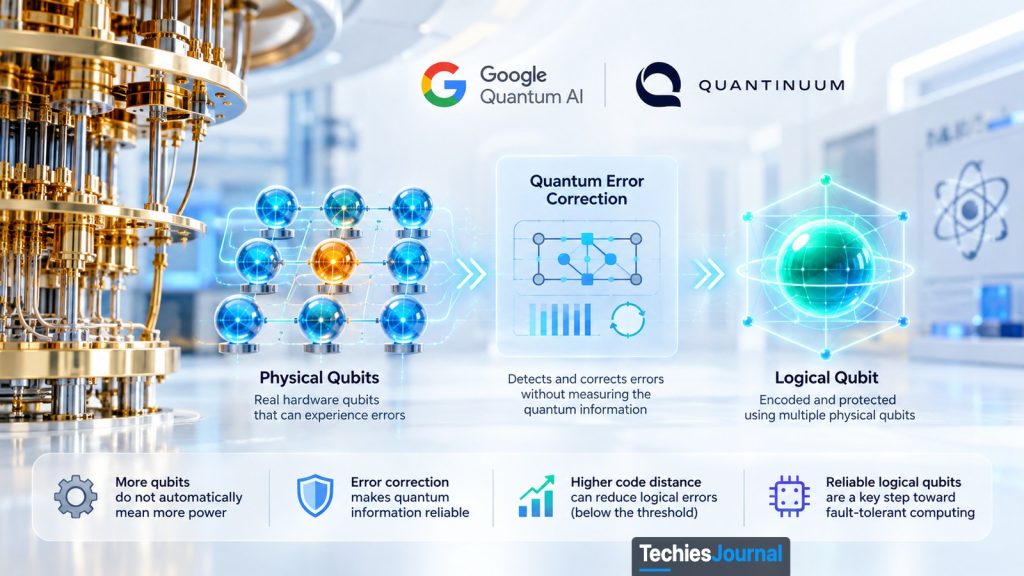
A physical qubit is the actual hardware that stores quantum information. Depending on the technology, it might be a trapped ion, a neutral atom or a superconducting electrical circuit.
These physical systems behave differently, but they share a common challenge. Their quantum states must remain sufficiently stable while the processor performs operations.
Researchers have spent years improving physical qubit quality, reducing errors and extending the time quantum information can be preserved.
Yet there is a limit to what improving individual qubits can achieve. A computer performing very long calculations must be able to manage errors even when its hardware is not perfect.
Conventional computers address reliability in several ways. One familiar approach is to store information with additional bits so that errors can be detected or corrected.
Quantum computers need a related capability, although they cannot simply copy an unknown quantum state and compare several identical copies.
Instead, they use quantum error correction.
The basic idea is to encode quantum information across multiple physical qubits. Rather than depending on one physical qubit to remain error-free, the system uses a group of qubits to protect the information they collectively represent.
This protected unit is called a logical qubit.
A logical qubit is therefore not another type of physical hardware. It is quantum information encoded across multiple physical qubits using an error-correcting code.
The number of physical qubits required depends on the code, the quality of the hardware and the level of protection needed.
The important difference is that physical qubits provide the hardware, while logical qubits provide a way to protect the information being processed.
How quantum error correction works
Understanding the idea of a logical qubit is easier when we follow what happens after an error occurs.
Suppose quantum information has been encoded across several physical qubits. During operation, one of those qubits experiences an error.
The system cannot simply read every qubit to find the problem. Directly measuring the protected quantum information could disturb or destroy the state needed for the calculation.
Instead, quantum error-correcting codes allow the processor to measure certain relationships between qubits without directly revealing the encoded information.
These measurements produce what researchers call an error syndrome.
An error syndrome gives the system clues about what may have gone wrong. A classical decoding process then interprets those clues and determines the most likely correction.
The processor can apply a corrective operation or keep track of the correction so that later operations and measurements are interpreted correctly.
Because errors can occur throughout a calculation, this process must be repeated.
The objective is not to guarantee that physical qubits never fail. It is to prevent individual physical errors from changing the logical information that the algorithm depends on.
There is an important limitation, however. Error correction is not unlimited.
If too many errors occur, or if the system interprets the error information incorrectly, the protected logical state can still become corrupted.
That remaining failure is called a logical error.
The reliability of a logical qubit depends on how effectively the encoding and correction process reduces these logical errors.
Follow one error through one correction cycle
Step through the six stages. The nine qubits are the article’s conceptual picture, not a hardware design or a specific code. The text of each step repeats the article above.
Spread the information
Suppose quantum information has been encoded across several physical qubits. A logical qubit is quantum information encoded across multiple physical qubits using an error-correcting code.
One qubit goes wrong
During operation, one of those qubits experiences an error. The system cannot simply read every qubit to find the problem, because directly measuring the protected quantum information could disturb or destroy the state needed for the calculation.
Measure relationships, not the data
Quantum error-correcting codes allow the processor to measure certain relationships between qubits without directly revealing the encoded information. These measurements produce what researchers call an error syndrome, which gives the system clues about what may have gone wrong.
Work out the likely fix
A classical decoding process interprets those clues and determines the most likely correction.
Apply the fix, or keep track of it
The processor can apply a corrective operation or keep track of the correction so that later operations and measurements are interpreted correctly.
Errors keep arriving
Because errors can occur throughout a calculation, this process must be repeated. It is not unlimited: if too many errors occur, or if the system interprets the error information incorrectly, the protected logical state can still become corrupted. That remaining failure is called a logical error.
What determines the reliability of a logical qubit?
Not all logical qubits offer the same level of protection.
One important property of a quantum error-correcting code is its code distance.
Code distance describes the minimum weight of a physical error that can act as an undetected logical operation. Under standard quantum error-correcting code assumptions, a distance-3 code can correct one arbitrary physical error.
Increasing the distance can provide protection against more errors, but it also requires additional physical resources.
This creates a practical question: if we use more physical qubits to protect one logical qubit, will the result actually become more reliable?
The answer depends on the quality of the underlying hardware and the correction process.
Error correction itself involves operations and measurements that can fail. When physical error rates are too high, adding more resources can introduce additional problems instead of reducing them.
Researchers describe the boundary at which increasing the code size can begin to improve reliability as the error-correction threshold.
Below the relevant threshold, larger codes can produce lower logical error rates. Above it, increasing code distance may not improve reliability.
This is one of the most important milestones in quantum computing because it demonstrates whether additional hardware can be used to make protected quantum information progressively more reliable.
We can see this principle in experimental research.
In work published in Nature, Google demonstrated quantum error correction below the surface-code threshold. The researchers reported that logical errors decreased as code distance increased, with an error-suppression factor of approximately 2.14 for each increase of two in code distance across the tested sequence.
In October 2026, Quantinuum reported a suppression factor of approximately 12 for each successive increase in the tested color-code distance sequence.
The experiments used different hardware and error-correcting codes, so their numerical results should not be treated as a simple performance ranking.
What makes both results important is the demonstrated relationship between stronger encoding and lower logical error rates.
It shows progress toward building quantum systems whose reliability can improve as additional physical resources are introduced.
A reliable logical qubit is not yet a complete quantum computer
Once we understand how logical qubits protect information, another question appears.
If researchers can create highly reliable logical qubits, why are useful fault-tolerant quantum computers still so difficult to build?
The answer is that storing quantum information and computing with it are different engineering challenges.
A logical qubit may be able to preserve its encoded state through many rounds of error correction. This is known as logical memory.
But a quantum computer also needs to perform operations on that information. These operations are called logical gates when they act on encoded qubits.
Performing a logical gate is more complicated than simply keeping the encoded information stable. The operation must produce the intended result without introducing errors that overwhelm the protection provided by the code.
Quantum computers also need to coordinate many logical qubits, perform measurements, process error information and complete calculations within practical operating times.
Quantinuum’s October 2026 research illustrates this distinction.
The company reported a logical memory error rate of approximately five in a million per error-correction round at code distance 7.
That is an important result for preserving quantum information. However, its logical gate experiments reached distance 5 and used Clifford circuits rather than a universal set of logical operations. The researchers also evaluated decoding approaches with processing speeds potentially compatible with real-time operation, but the reported experiments did not demonstrate an integrated real-time decoding and corrective-feedback loop.
The result provides evidence of strong logical memory protection and progress toward reliable logical gates. It does not yet demonstrate the complete fault-tolerant computing process needed for general quantum algorithms.
What the October 2026 Quantinuum result shows, and what it does not
Pick a part of a fault-tolerant computer to see how far this one experiment goes. The text repeats the article above.
Keeping encoded information aliveshown
The company reported a logical memory error rate of approximately five in a million per error-correction round at code distance 7. That is an important result for preserving quantum information.
Source: Quantinuum, October 2026 preprint (not yet peer reviewed at the time of the source check). arXiv:2610.24077
Operating on encoded qubitspartly shown
The logical gate experiments reached distance 5 and used Clifford circuits rather than a universal set of logical operations.
Decoding fast enough, in the loopnot shown
The researchers evaluated decoding approaches with processing speeds potentially compatible with real-time operation, but the reported experiments did not demonstrate an integrated real-time decoding and corrective-feedback loop.
Running general quantum algorithmsnot shown
The result provides evidence of strong logical memory protection and progress toward reliable logical gates. It does not yet demonstrate the complete fault-tolerant computing process needed for general quantum algorithms.
Operation speed matters as well. Two machines could report similar error rates per correction round while taking very different amounts of time to complete those rounds.
A practical quantum computer must balance reliability, processing speed, decoding capability and physical hardware requirements.
This is why the development of logical qubits is a major step toward fault-tolerant quantum computing, but not the final step.
How should we understand quantum-computing claims?
Now consider an announcement that a company has demonstrated 30 logical qubits.
The result tells us that the researchers created a particular encoded quantum system. But to understand its significance, we would need to know how those qubits were protected, how reliably they operated and what computations were demonstrated.
Similarly, an announcement of extremely low logical error rates needs context. Was the error rate measured while storing information or performing logical operations? Was it measured per gate, per checking round or over a period of time? Did the system become more reliable as the code distance increased?
These details explain what the hardware can actually do.
Read a quantum announcement
Answer up to two questions. This is TechiesJournal’s own reading aid, built from this section. It is not a verdict on any real announcement.
What does the announcement count?
Ask how they were protected. The result tells us that the researchers created a particular encoded quantum system. To understand its significance, we would need to know how those qubits were protected, how reliably they operated and what computations were demonstrated.
Was the rate measured while storing information or while performing logical operations?
A memory result. Ask whether it was measured per gate, per checking round or over a period of time, and whether the system became more reliable as the code distance increased.
An operations result. Ask whether it was measured per gate, per checking round or over a period of time, and whether the system became more reliable as the code distance increased.
Ask that first. An announcement of extremely low logical error rates needs context. Was the error rate measured while storing information or performing logical operations? Was it measured per gate, per checking round or over a period of time?
Is it a resource estimate or a machine that ran the calculation?
An estimate, not a demonstration. These estimates are useful for understanding potential future requirements. They are not demonstrations that existing quantum hardware can complete the calculation. Read the hardware assumptions behind the number.
Ask what it computed. These details explain what the hardware can actually do: how the qubits were protected, how reliably they operated and what computations were demonstrated.
The same principle applies to estimates about future quantum computers.
For example, researchers have published estimates of how many physical qubits might be required to factor RSA-2048 using a fault-tolerant quantum computer.
Craig Gidney’s 2025 resource estimate described a possible approach using fewer than one million noisy physical qubits under specific hardware assumptions. Iceberg Quantum’s Pinnacle 1.2 study subsequently reported simulated estimates of 48,000 to 72,000 physical qubits at a code cycle of one microsecond, using a different proposed architecture and assumptions. At a code cycle of one millisecond, the same study gives 714,000 to 2.1 million.
These estimates are useful for understanding potential future requirements. They are not demonstrations that existing quantum hardware can complete the calculation.
The distinction matters particularly for security planning. Organizations should prepare for post-quantum cryptography based on established security guidance and the lifetime of information they need to protect, rather than waiting for a particular qubit-count milestone.
For more on that subject, see TechiesJournal’s Post-Quantum Cryptography Goes Default-On.
What matters as quantum computers develop?
Building a useful quantum computer requires progress in several areas at the same time.
Physical qubits must become more reliable. Error-correcting codes must protect quantum information without introducing excessive overhead. Logical operations must work accurately enough to support long calculations, and the classical systems responsible for decoding errors must keep up with the quantum hardware.
These requirements are closely connected. Improving one part does not automatically solve the others.
For someone learning about quantum computing, understanding this relationship is more useful than memorizing the latest processor specifications.
For engineers and researchers working directly with quantum systems, the deeper challenges involve code design, decoding algorithms, noise behaviour, logical gate implementation and the physical cost of scaling the architecture.
Quantum computing will continue to produce impressive experimental results. Some will demonstrate better physical qubits, others more effective error correction or new ways to perform logical operations.
The significance of those advances depends on how they contribute to the larger engineering goal.
Physical qubits make quantum computation possible. Logical qubits make it possible to protect quantum information from errors. Fault-tolerant quantum computing requires that protection to remain effective while useful algorithms are executed.
The real measure of progress is not how many qubits a machine contains, but whether those qubits can work together reliably enough to complete meaningful calculations.
Go deeper
- Quantum Error Correction Below the Surface Code Threshold, Google Quantum AI research, published in Nature. Explains how increasing code distance can reduce logical errors.
- Quantum Error Correction Well Below the Color Code Threshold, Quantinuum, October 2026 preprint. Examines logical memory protection and error suppression using color codes.
- From Memory to Logic, Quantinuum, 13 November 2025. Explores the engineering differences between protecting quantum memory and performing logical operations.
- How to Factor 2048 Bit RSA Integers with Less Than a Million Noisy Qubits, Craig Gidney, 2025. Shows how fault-tolerant architectures influence estimates of the resources needed for a complex quantum algorithm.
- Pinnacle 1.2, Iceberg Quantum, 22 October 2026. Original company account of simulated RSA-2048 resource estimates and their assumptions.
Research reviewed: 30 October 2026. Experimental findings, preprints and resource estimates are presented according to their stated evidence. Recheck time-sensitive results before public publication.