

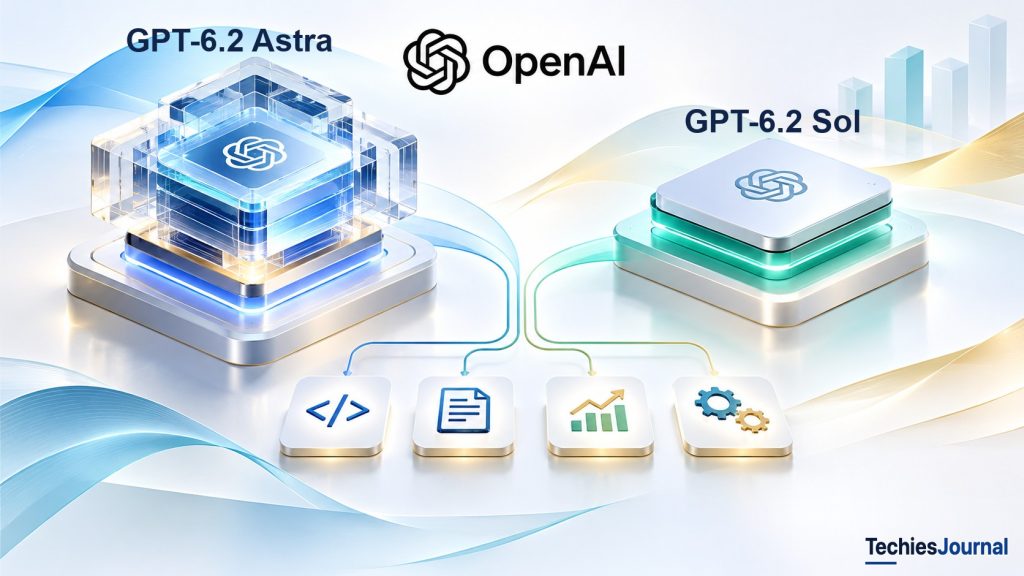
OpenAI’s GPT-6.2 Astra and Sol offer different balances of capability, performance and cost. For developers and technology teams, choosing between them requires more than comparing benchmark scores or token prices.
A software development team uses AI to review code, investigate defects, write documentation and implement features. Some requests are straightforward. Others require the model to understand a large codebase, make changes across several components, use development tools and verify that the final result works.
Using the most capable AI model for every task might seem sensible. However, doing so can increase operating costs without necessarily improving every outcome. Choosing a cheaper model for everything creates a different risk when difficult tasks require repeated attempts or extensive corrections.
OpenAI has introduced GPT-6.2 Astra and GPT-6.2 Sol. Astra is positioned for demanding professional and technical work, while Sol is designed to provide strong general-purpose capabilities at a lower cost.
The two models share many technical features. Their differences become more meaningful when we examine the work they are expected to perform, the evidence behind their reported improvements and the cost of producing an acceptable result.
What changed with GPT-6.2?
GPT-6.2 builds on OpenAI’s existing Astra and Sol model lines. Astra succeeds GPT-6 Astra, with reported improvements in complex professional assignments, software engineering, scientific work and document creation. Sol follows GPT-6.1 Sol, with improvements aimed at everyday tasks, coding and workflows that use tools to complete several connected steps.
OpenAI also emphasizes token efficiency. A token is a unit of text that a model processes or generates. AI providers commonly use token counts when calculating API charges. Greater efficiency can matter because a model may complete a task while generating fewer tokens than its predecessor.
OpenAI’s GPT-6.2 announcement reports improvements across coding, professional documents, scientific work and agent-based tasks. Those results establish useful areas for comparison. They do not guarantee the same improvements in every organization’s applications.
Astra and Sol share many important capabilities
Both GPT-6.2 models accept text and image inputs and produce text outputs. Both support function calling, structured outputs and tools through supported API workflows. They also have the same published context capacity.
| Technical specification | GPT-6.2 Astra | GPT-6.2 Sol |
|---|---|---|
| Model identifier | gpt-6.2-astra | gpt-6.2-sol |
| Context window | 1,050,000 tokens | 1,050,000 tokens |
| Maximum input | 922,000 tokens | 922,000 tokens |
| Maximum output | 128,000 tokens | 128,000 tokens |
| Text and image input | Supported | Supported |
| Function calling | Supported | Supported |
| Structured outputs | Supported | Supported |
| Computer use through supported tools | Supported | Supported |
| Fine-tuning | Not supported | Not supported |
Sources: Astra model documentation and Sol model documentation.
The context window determines how much information a model can handle within a request, subject to the input and output limits. Identical capacity does not imply equal reasoning quality over long inputs. Similarly, supporting computer use does not establish that both models will navigate complex applications with equal reliability.
A feature checklist is therefore insufficient to select between Astra and Sol. The more useful differences appear in evaluated performance and resources consumed.
Performance: What does the evidence establish?
Each benchmark tests a particular kind of work. Its results must be interpreted within the task scope, scoring method, baseline and configuration used.
Complex professional work
OpenAI’s internal GDPval v2 benchmark measures long-running professional assignments involving fields such as finance, consulting, biotechnology and marketing. According to OpenAI, Astra improved by 6.2 percentage points over GPT-6 Astra while using 22% fewer output tokens. Sol improved by 5.3 percentage points over GPT-6.1 Sol. These are different previous-generation comparisons, not a 6.2-point direct Astra-versus-Sol advantage.
The figures support the vendor’s reported progress on the evaluated work. They do not establish equal improvements across every document, spreadsheet or business workflow. Professional deliverables also need correct calculations, sound source attribution and defensible conclusions, not just attractive formatting.
Coding and repository-level changes
Cognition’s FrontierCode 2.0 evaluates AI-generated changes to real software repositories against maintainability and merge-readiness criteria. In OpenAI’s published comparison, Sol finished within 0.5 points of Astra at approximately one-fifth of the cost under the tested maximum-reasoning settings.
That result makes Sol a credible candidate for demanding coding workloads, rather than just easy programming tasks. Its cost ratio applies to the specific evaluation, however, not every repository or API request. Codebase complexity, tools, task instructions and acceptance criteria may alter the outcome. Teams should run representative tests in their own repositories before choosing a default model.
Scientific and technical tasks
OpenAI reports a nine-percentage-point Astra improvement over GPT-6 Astra on Terminal-Bench-Science 0.1, at less than one-third of the reported cost in that evaluation. The announcement also describes Astra performance on the Vals Science Index. These results justify evaluating Astra for difficult scientific analysis, but do not replace domain expertise, reproducibility or verification.
API pricing: The difference is substantial
At OpenAI’s published standard short-context API rates, Astra is four times the price of Sol per input or output token.
| USD per million tokens | GPT-6.2 Astra | GPT-6.2 Sol |
|---|---|---|
| Input | $8.00 | $2.00 |
| Cached input | $0.40 | $0.10 |
| Output | $40.00 | $10.00 |
| Cache write, 30-minute retention | $10.00 | $2.50 |
Source: OpenAI API pricing. These API rates are distinct from ChatGPT subscription terms.
For inputs exceeding 272,000 tokens, the published pricing moves to a long-context tier with higher rates: input and cache rates double and output rates rise by 50%. Batch processing, faster processing tiers and cache-retention choices may change the charge. Verify these terms against the current pricing pages before you budget.
A practical cost illustration
Suppose a hypothetical analysis request processes 20,000 input tokens and generates 5,000 output tokens, without caching, extra tools or retries.
| Cost component | Astra | Sol |
|---|---|---|
| 20,000 input tokens | $0.16 | $0.04 |
| 5,000 output tokens | $0.20 | $0.05 |
| Total for one task | $0.36 | $0.09 |
| Total for 10,000 identical tasks | $3,600 | $900 |
Illustrative arithmetic using standard published API rates, not measured task executions. Actual consumption and success rates may differ between models.
Under identical token usage, Sol costs 75% less. This calculation does not prove equal quality, equal token consumption or equal cost to deliver an acceptable result.
The economics of a successful task
An AI workflow may incur retries, tool calls and human correction. A more expensive model may be competitive if it produces more accepted results with fewer attempts, but that benefit must be measured rather than assumed.
Cost per accepted task = Total measured workflow cost ÷ Number of accepted tasks.
Define total cost consistently across both models. Include model tokens, tools, retries, infrastructure and human correction time when relevant. Also measure end-to-end completion time, since fast token generation is not the same as fast delivery of an accepted result.
For illustration, if one model completes 80 of 100 comparable tasks successfully while another completes 95, the second may be economical despite higher prices per attempt. The counts are hypothetical and make no claim about Astra or Sol.
Practical use cases for Astra and Sol
The following are evaluation candidates, not universally superior model assignments.
Software engineering
Sol’s pricing and competitive FrontierCode result make it a reasonable candidate for code explanation, documentation, routine fixes and selected complex repository changes. Astra merits direct testing when tasks require difficult diagnosis or coordination across several components. Compare accepted changes, regressions, time, corrections and cost under realistic tools and review conditions. Both still require appropriate code-review and security controls.
Professional documents and financial analysis
A less expensive model may suffice for accurate extraction and routine summaries. Astra deserves evaluation for assignments that reconcile numerous source documents, apply detailed business rules or produce demanding professional work products. Financial workbooks must be checked for extracted values, formulas, assumptions and conclusions regardless of how polished they appear. Sol should remain part of the evaluation when it meets the quality threshold.
AI agents and business automation
Agentic workflows introduce repeated decisions and tool calls. Sol’s lower unit price is attractive for high-volume tasks, while Astra may merit testing on difficult investigations or workflows with persistent failures. A system may use one model or route between them, but routing adds configuration, monitoring and misclassification risks. Do not build a multi-model orchestration layer unless measured benefits justify the complexity.
Scientific analysis and research
Astra’s reported scientific results make it relevant to evaluate for difficult analysis and technical research. The appropriate choice still depends on the problem, precision, supported tools and verification method. Data, code, statistical methods and experimental conclusions must remain reproducible and reviewable.
Reliability matters beyond capability
OpenAI’s GPT-6.2 system-card discussion of blocker disclosure reports evaluation regressions in which models omitted obstacles preventing task completion, such as unavailable files or tools. OpenAI says additional Codex instructions reduced the issue in its evaluation environment. The findings should not be generalized into production failure-rate predictions.
For an application using external tools, a model’s declaration of success is not enough to prove that an operation completed. Tool errors should be retained, important results verified independently, incomplete work reported and consequential actions kept behind appropriate permissions. Higher benchmark scores do not remove these responsibilities.
How to compare the models for an actual workload
Start with a representative task sample, such as routine maintenance, difficult debugging and multi-file changes for a development team, or document extraction and reconciled reporting for a business team. Define the acceptance criteria before testing.
| Dimension | What to measure |
|---|---|
| Output quality | Requirements and review criteria met |
| Reliability | Accepted completions per attempted task |
| Completion time | End-to-end time to accepted result |
| Model usage | Input, output and cache tokens |
| Cost | Model, tools, retries and infrastructure |
| Correction effort | Human edits and review required |
| Operational safety | Tool errors, missing status and unauthorized action attempts |
Document model configurations, reasoning settings and tool access. Use the existing production workflow as a baseline where appropriate. Different model settings may be reasonable, but the comparison should reflect configurations actually being considered for deployment.
What the GPT-6.2 release means for technology teams
Astra and Sol share important technical capabilities but offer different performance and pricing considerations. Astra reports strong results on several demanding professional and scientific evaluations. Sol has lower unit pricing and competitive results on selected difficult coding tasks.
The practical response is to select representative workloads, measure accepted outcomes and compare the whole cost of delivering them. Developers should assess correctness and reliability. Architects should account for integration and operational constraints. Technology leaders should ask whether additional spending creates measurable value.
Model capability determines what may be possible. Reliable results and total operating cost determine what is practical.
References and further reading
- OpenAI: Introducing GPT-6.2 Astra and Sol. Official release announcement. Model positioning and reported evaluations.
- OpenAI: GPT-6.2 Astra model documentation. Limits, tools and supported inputs.
- OpenAI: GPT-6.2 Sol model documentation. Limits, tools and supported inputs.
- OpenAI API pricing. Rates and pricing conditions.
- OpenAI: GPT-6.2 safety evaluation, blocker disclosure. Disclosed evaluation limitations and mitigations.
Source-review boundary: November 17, 2026. All quantified model results above are vendor-reported unless otherwise identified.