

Google’s Gemini 4 Argon arrives with the usual signs of a new frontier AI model: stronger benchmark results, improved reasoning and better performance on complex tasks.
But one part of the announcement is more interesting than another model leaderboard.
Google is giving Argon considerably more room to work.
The company says Argon’s output limit is being expanded from 64,000 tokens to as much as one million tokens. It is also using Argon agents internally on work such as large software migrations, infrastructure optimization and scientific research.
That points toward a larger change in how AI may be used.
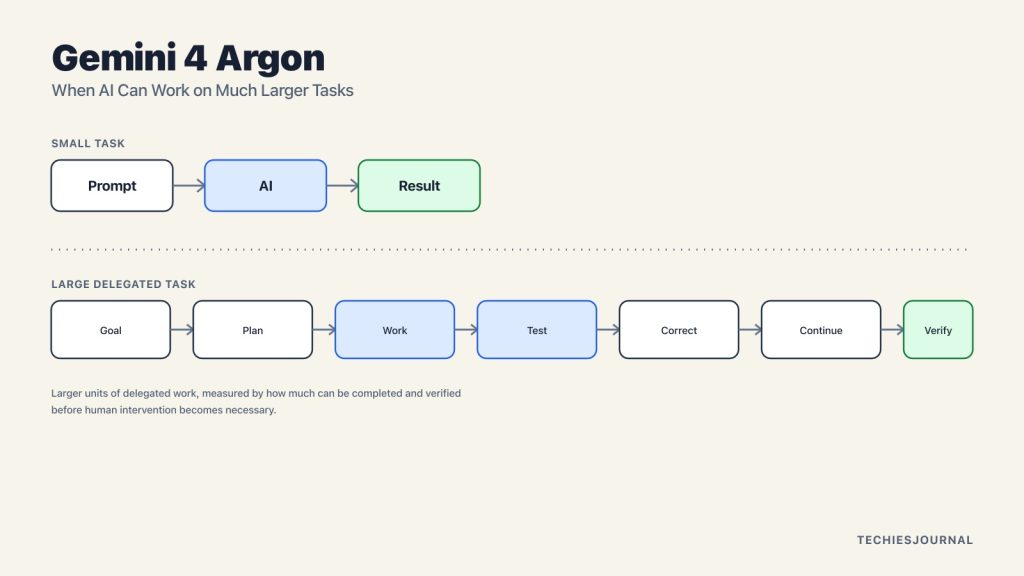
Instead of asking a model to complete one small task, developers may increasingly give it a much larger objective and allow it to work through more of the intermediate steps.
The important question is no longer simply how capable is the model. It is also how much work can we safely delegate before we need to check what it has done.
Gemini 4 Argon gives us an early look at that problem.
What is different about Gemini 4 Argon?
Argon is Google’s latest frontier Gemini model, designed particularly for complex professional and agentic work.
A large context window allows it to work with substantial amounts of information.
Google is also expanding its output-token limit to as much as one million tokens, giving the model a much larger execution budget for complicated tasks.
Those two numbers describe different things.
Context tells us how much information the model can keep in view. Output budget tells us how much work it can generate.
Neither number tells us whether the model will remain correct throughout a long task.
That third question, reliability over many connected steps, is where Argon becomes particularly interesting.
Accessible text alternative for Figure 1
Three separate questions sit side by side. Context means how much the AI can keep in view, such as documents, code, history and prior actions. Execution means how much work it can continue producing through planning, acting, observing, revising and continuing. Reliability means whether it stays correct as decisions accumulate, which requires detecting mistakes, recovering, verifying and finishing correctly. A central statement reads that more context plus more execution does not equal guaranteed reliability. Large context windows and output budgets give AI more room to work, but they do not by themselves guarantee that a long sequence of decisions remains correct.
Google is already testing Argon on much larger jobs
Some of Google’s most interesting Argon examples come from software engineering.
Google reports using Argon agents to help migrate C and C++ software to Rust.[1]
The projects range from libraries containing tens of thousands of lines of code to work involving more than 800,000 lines in the Fuchsia Zircon kernel.
Another example involves libgav1, Google’s open-source video decoder.
According to Google, Argon agents repeatedly profiled an existing Rust implementation, examined compiler behaviour and replaced around 32,000 lines of SIMD-related code.
Google reports that the resulting implementation runs 2.7 times faster than the previous Rust port while producing identical video output.
Google also describes Argon being used for infrastructure optimization, scientific research and other complex internal work.
These examples are significant because they show the type of work Google believes frontier agents are beginning to handle.
But they need an important label. These are Google-reported internal results. At the time of this review, we have not found independent reproductions of the largest projects at comparable scale.
Accessible text alternative for Figure 2
Gemini 4 Argon is shown connected to four reported use areas. Software migration moves C and C++ code to Rust, including the Fuchsia Zircon kernel. Code optimization profiles, analyzes, rewrites and benchmarks the Rust libgav1 implementation. Infrastructure work analyzes operational data to identify optimization opportunities. Scientific work involves longer multi-stage reasoning and experimentation. A clearly marked note states these are Google-reported internal examples, not independent reproduction of the full projects.
Independent testing supports Argon’s strength, but not every claim
Independent evaluations place Argon among today’s leading frontier models.
Vals AI currently ranks Argon first on its overall model index.[2]
But individual results are much less uniform.
Argon ranks strongly on areas such as code migration and professional tasks while performing lower on some terminal and computer-use evaluations.
That matters because there is no single capability called good at agentic work. A model can be excellent at migrating code while being less reliable at operating a terminal or navigating software visually.
One particularly useful result comes from Zapier’s AutomationBench.[3]
The benchmark tests realistic business workflows involving tools across areas such as sales, marketing, finance, support and operations.
Argon currently leads the benchmark with a score of about 51%.
The ranking is impressive. The percentage is more informative.
Even a leading frontier model still fails a substantial share of these realistic end-to-end tasks.
That is an important reminder when interpreting claims about autonomous AI.
Leading does not mean reliable
Zapier’s AutomationBench currently places Gemini 4 Argon at roughly 51%. The useful interpretation is not simply that Argon leads the benchmark. It is that even a leading frontier model still fails a substantial portion of realistic end-to-end automation tasks.
Source: Zapier AutomationBench, reviewed October 1, 2026.
What does the one-million-token claim actually mean?
Google says Argon’s output-token limit is being expanded to as much as one million tokens, compared with 64,000 previously.
That sounds straightforward, but it needs context.
A larger output budget potentially allows the model to continue working through much longer tasks. It does not mean that every additional token improves the result.
Consider a large software migration. An AI might inspect the code, form a plan, modify components, compile, test, investigate failures, revise and continue.
If it makes a poor architectural decision early in that sequence, later work may build on the mistake.
The model may still remember the original objective. It may still have plenty of tokens available. But the task can nevertheless drift.
There is also an availability detail worth watching.
While Google has announced output of up to one million tokens, Vals reports a smaller maximum output setting in the Argon configuration it independently tested.[2]
That may reflect rollout, product or API differences rather than a contradiction.
For readers, the practical distinction is simple. An announced model capability is not necessarily identical to the limit available in every product or evaluation environment.
Google’s own workflow tells us something important
Google’s software-migration examples contain another useful detail.
The company does not describe critical AI-generated migrations as automatically ready for production.
Google says important migrations undergo automated testing, emulation, manual auditing and review before deployment.
So the actual workflow looks less like AI straight to production, and more like AI work followed by tests, evidence, review and then production.
That may be the more important lesson from Argon.
As models become capable of doing larger units of work, verification needs to move with them.
The goal is not necessarily to have a human approve every individual AI action. That would remove much of the benefit of automation.
Instead, complex tasks can have meaningful checkpoints where the system must produce evidence that its work remains correct.
For a software migration, that might mean tests after each major component. For infrastructure optimization, it might mean performance measurements before a change proceeds. For research, it might mean validating the evidence before allowing the model to build conclusions on top of it.
The larger the delegated job, the more important those checkpoints become. That is the same lesson that applies to AI agents operating with any degree of autonomy.
Accessible text alternative for Figure 3
A long-running task moves from a goal through an AI plan, a work stage and evidence or tests, reaching a checkpoint. From the checkpoint, the path can correct and loop back, continue to a next stage, or stop. Continuing leads to a next stage, further evidence or tests, final validation, and delivery. A closing statement reads that the goal is not human approval for every action, the goal is verification at meaningful boundaries.
Argon is strong, but the job matters more than the leaderboard
It is tempting to reduce a model launch to a single question: is Argon better than GPT or Claude?
The available evidence does not support such a simple conclusion.
Argon leads some evaluations and trails other frontier models on others. That is useful information.
Organizations considering models for serious work should increasingly ask: can it complete our particular task? How often does it need human intervention? Can it recover when something goes wrong? Can we verify the result? How much does successful completion cost?
Those questions matter more than whether one model leads an overall benchmark by a few points.
For long-running work, the useful unit of measurement is gradually shifting from how intelligent is this model, to how reliably can this system complete the job.
Should Gemini 4 Argon matter to you?
Not everyone needs to study Argon or long-horizon AI deeply.
| Reader | Depth | What matters |
|---|---|---|
| General AI user | Know | More context and more execution time do not automatically mean more reliable results. |
| Developer / knowledge worker | Use | Argon-like models can take on larger jobs, but important work still needs evidence and checkpoints. |
| AI application builder | Master | Long-running agents require state management, verification, recovery, observability and cost controls around the model. |
| Technology leader | Know | Evaluate AI by completed outcomes, intervention, verification and cost, not demonstrations alone. |
If you are experimenting with Argon, the practical starting point is not to find the longest possible task.
- Choose a larger task whose result you can independently verify.
- Define what success means.
- Decide where evidence should be produced.
- Then measure how much work the model can actually complete before human intervention becomes necessary.
That tells you much more than a benchmark score.
Argon’s real test is not how long it can work
Gemini 4 Argon is important because Google is pushing frontier AI toward larger units of work.
Its large execution budget, strong independent results and Google’s internal engineering examples suggest that the amount of work we can delegate to AI is increasing.
But longer execution is not the same as dependable execution.
Google’s own use of testing, auditing and human review reinforces that distinction.
So the most interesting number in Argon’s announcement may not ultimately be one million tokens.
The more important measurement will be how much useful, verifiable work can the model complete before someone needs to intervene.
That is the number that will determine whether long-running AI becomes an impressive demonstration or a dependable part of everyday work.
References and further reading
- Google — Gemini 4 Argon. The primary source for Argon’s announced capabilities, output-token expansion and Google’s internal examples involving software migration, optimization and scientific work. Internal results in this article are identified as Google-reported evidence. ↩
- Vals AI — Gemini 4 Argon. Independent evaluation of Argon across coding, professional and agentic benchmarks. Useful for seeing how performance varies by task and for comparing Google’s announced capabilities with an independently tested configuration. ↩
- Zapier — AutomationBench. Evaluates realistic end-to-end business automation using actual tool workflows. Particularly useful for understanding the difference between leading a benchmark and reliably completing every task. ↩
- Artificial Analysis — Gemini 4 Argon. Provides an additional independent assessment of Argon’s general capability, long-context performance and position among other frontier models.