

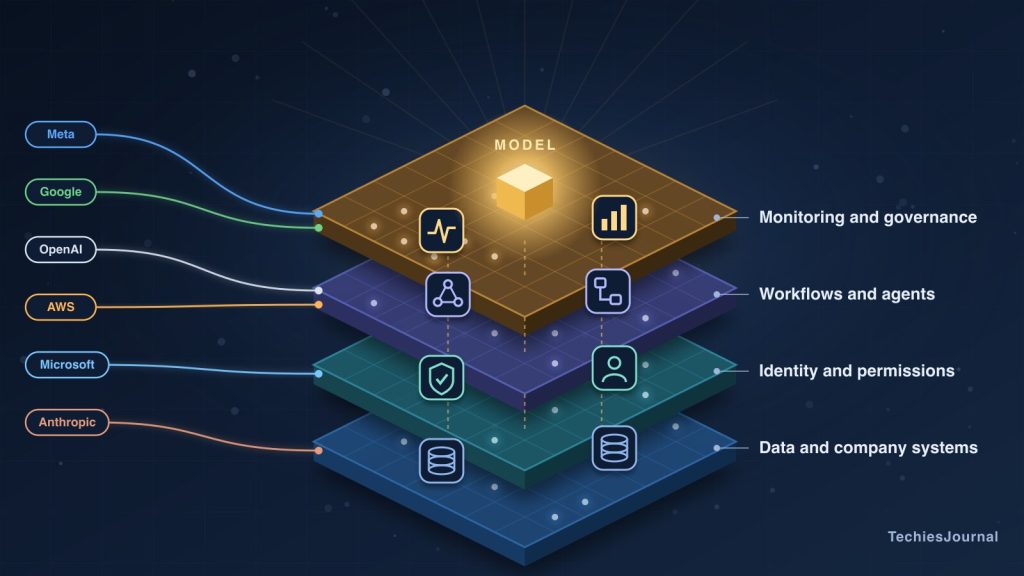
For the last few years, most AI competition has been discussed in terms of models (see our reference on essential AI terms and foundational map on distinctions between AI, machine learning, and LLMs).
Which model is smarter?
Which one is faster?
Which one is cheaper?
Which one has the longest context window?
Those questions still matter.
But they are no longer the whole story.
The larger AI companies are increasingly competing over something broader:
the platform around the model.
That includes the systems that connect AI to company data, user permissions, workflows, business applications, monitoring, security and cost controls.
Meta’s recent move into enterprise AI makes this shift easier to see.
The competition is no longer only about building the best model.
It is increasingly about becoming the place where companies actually run AI.
A model alone is not enough
Imagine a company wants to use AI across its business.
Choosing a capable model is only the first step.
The company also has to decide:
- who can use it
- what company information it can access
- what applications it can connect to
- what actions it is allowed to perform
- how employees create or share AI agents
- how usage is monitored
- how costs are controlled
- how activity is audited
- how security rules are enforced.
Those questions are not solved simply by choosing a better model.
They require a larger platform.
That is where much of the competition is moving.
Accessible text alternative for this figure
Two decisions. The earlier AI decision was to choose a model. The enterprise AI decision combines a model with data, permissions, workflows, agents, monitoring and governance.
Meta makes the shift more visible
Meta recently announced its Meta Enterprise Platform.
The important part is not just that Meta launched another AI product.
Meta has spent years being known mainly for consumer platforms, advertising and open-weight AI models.
Now it is explicitly trying to build a broader enterprise AI business.
That includes tools for business agents, developers and company workflows.
Meta is joining a market where Microsoft, Google, AWS, OpenAI and Anthropic are already expanding beyond model access.
The approaches are different.
But the direction is similar.
What companies actually need around AI
Think about what happens after a company selects a model.
The model needs access to useful information.
That might include:
- internal documents
- customer data
- product information
- business applications
- cloud systems
- company policies.
Then the company needs control.
For example:
Who can access payroll information?
Can an AI agent approve a refund?
Can it deploy code?
Can it send an external email?
Can it make a purchase?
What happens if it makes a mistake?
The organization also needs visibility.
It may want to know:
- which AI tools are being used
- which agents are active
- which systems they access
- how much they cost
- what actions they took
- whether they followed company policy.
This is why enterprise AI quickly becomes bigger than the model itself.
Different companies are approaching the problem from different directions
The major vendors are not all building the same thing.
They start from different strengths.
Microsoft already has a large position inside business productivity through Microsoft 365, Azure and enterprise applications.
Google has cloud infrastructure, data platforms, Workspace and Gemini.
AWS starts from cloud infrastructure and enterprise workloads.
OpenAI starts from ChatGPT, models, developer APIs and agent tools.
Anthropic has focused heavily on models, coding and enterprise deployment through several cloud environments.
Meta brings its own combination of business communication, consumer platforms, advertising systems and AI models.
So this is not a race where every company follows exactly the same plan.
It is more like several companies approaching the same enterprise problem from different sides.
The common goal is becoming clearer
Despite those differences, many of the same capabilities are appearing repeatedly.
Enterprise AI platforms increasingly include some combination of:
- model access
- agents
- company-data connections
- permissions
- identity
- workflows
- monitoring
- security controls
- evaluation
- cost management
- deployment tools.
That list matters because those features can become deeply connected to how a company operates.
Once an organization builds workflows, permissions and agents around a platform, moving away from it can become much harder than simply changing one model.
The model may become easier to replace than the platform
Suppose a company uses one AI model today.
A better model appears next year.
Changing the model may eventually be relatively straightforward.
But imagine the same company has already built:
- hundreds of internal agents
- connections to company systems
- access policies
- approval flows
- monitoring
- usage rules
- audit history
- internal skills and workflows.
Moving all of that may be much more difficult.
That creates an important possibility:
Future AI lock-in may come less from the model itself and more from everything built around it.
That is not yet a universal outcome.
Enterprise AI platforms are still developing, and many companies use several providers.
But the direction is worth watching.
This does not mean models stop mattering
It would be a mistake to conclude that the underlying model no longer matters.
It still matters a great deal.
Companies care about:
- quality
- reliability
- reasoning
- speed
- cost
- security
- context length
- coding ability
- multimodal capabilities.
A weak model does not become useful simply because it has a strong enterprise platform.
But the reverse is also becoming true.
A strong model may not be enough if the organization cannot safely connect it to the rest of the business.
That is why enterprise AI decisions are becoming more complicated.
Companies may use several models inside one platform
Another important possibility is that enterprises do not choose one model provider at all.
A company may use:
- one model for coding
- another for customer service
- another for document analysis
- another for low-cost routine tasks.
Several major platforms already support more than one model family.
That could lead to an interesting structure:
one enterprise AI platform, several models underneath it.
If that becomes common, the most important vendor decision may not always be:
Which model should we standardize on?
It may become:
Which platform should control access, data, agents and workflows across all these models?
That is a very different competitive landscape.
What should enterprises evaluate?
Companies should still evaluate model quality.
But they may also need to ask broader questions.
Can we move models?
If a better or cheaper model appears, how difficult is it to switch?
Can we move agents and workflows?
Are they built using portable standards, or deeply tied to one platform?
Who controls the data?
Where does company information live, and how is access managed?
How are permissions handled?
Can the company clearly control what each user or agent can do?
Can we see what happened?
Are actions, costs and decisions visible enough to audit?
What happens if we leave?
This may be one of the most important questions.
If the company decided to move to another provider next year, what would actually need to be rebuilt?
The answer reveals where the real dependency sits.
Convenience can become dependency
Enterprise platforms are useful partly because they remove complexity.
Instead of building everything internally, a company can receive:
- identity
- security
- deployment
- monitoring
- agent management
- integrations.
That convenience has real value.
But convenience can gradually become dependency.
This does not mean companies should avoid enterprise AI platforms.
It means they should understand what they are giving the platform responsibility for.
There is an important difference between:
We use this company’s model.
and
Our AI workflows, permissions, data connections and operational controls all live inside this company’s platform.
The second relationship is much deeper.
Perspective
The AI industry spent its first major phase competing over model capability.
That competition is continuing.
But another competition is becoming visible beside it.
The major vendors increasingly want to provide the environment where companies connect AI to their data, employees, systems and workflows.
That makes the enterprise platform strategically important.
The model may still be the intelligence.
But the platform decides where that intelligence can go, what it can access and how the organization uses it.
So when companies evaluate AI providers, one question may become increasingly important:
Are we choosing a model, or are we choosing the place where our AI operations will live?
Those are no longer the same decision.
Related reading: Claude Sonnet 5.5 and the Falling Cost of AI Intelligence looks at how model capability alone can stop being the main difference, and AI Agents Need a Control Plane looks at the governance layer enterprises add around AI agents.
Sources and Further Reading
Source review: 5 October 2026.
- Meta — Launching Meta Enterprise Platform. Meta’s announcement of its enterprise business and the products it starts with.
- Google Cloud — The new Gemini Enterprise, one platform for agent development. Gemini Enterprise as an app, an agent platform and partner agents, with data connectors, identity and governance.
- OpenAI — ChatGPT workspace agents for Enterprise and Business. Workspace agents, connectors, skills, schedules and admin controls.
- AWS — Amazon Bedrock Managed Agents powered by OpenAI. AWS announcement of Bedrock Managed Agents, in limited preview at announcement.
- AWS — Amazon Bedrock AgentCore. AWS’s runtime, identity and observability services for production agents.
- Microsoft Learn — Microsoft Agent 365. Microsoft’s control plane for observing and governing agents, including Copilot Studio agents.
- Microsoft Learn — Microsoft Copilot Studio overview. What Copilot Studio is for and how agents and workflows are built.
- Anthropic — Claude Enterprise. Claude Enterprise features for identity, visibility and control.
- Anthropic — Enterprise deployment overview. Using Claude through Amazon Bedrock, Google Cloud and Microsoft Foundry.