

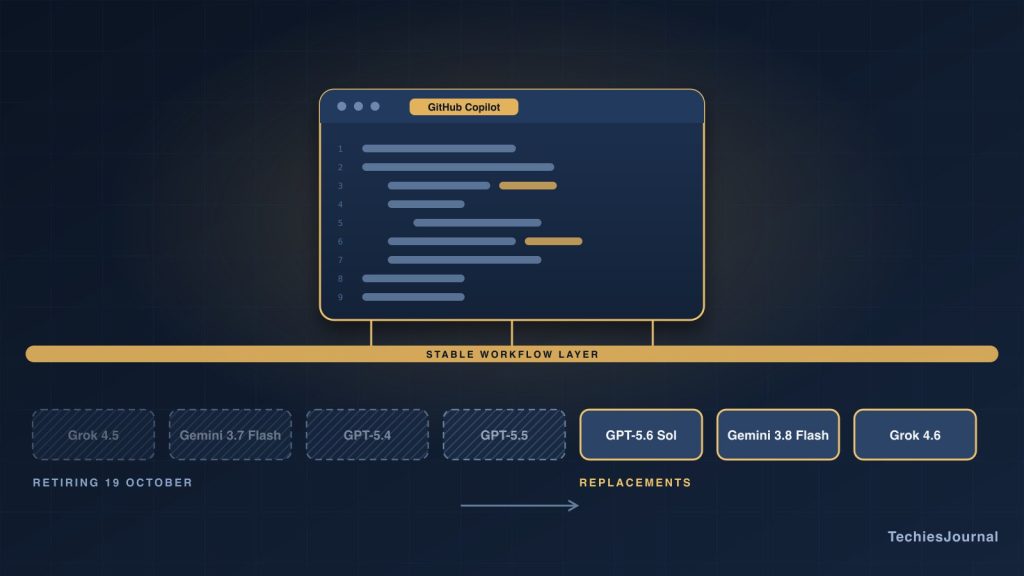
GitHub Copilot is retiring another group of AI models this month.
GPT-5.5, several GPT-5.4 variants, Gemini 3.7 Flash and Grok 4.5 are among the models scheduled to leave Copilot on October 19. Other models were retired earlier this month.
This is not unusual anymore.
Throughout 2026, GitHub has added, replaced and retired models from OpenAI, Anthropic, Google, xAI and others. A model available to developers today may be replaced by something newer within months.
For someone using Copilot to explain a function or help write a test, that may not matter very much.
For a company that has tested and approved a particular model for an internal coding agent, it could matter considerably.
The important question is therefore not simply:
Which AI model should we use?
It is:
How dependent should our development workflow become on a particular model?
The model underneath Copilot is no longer fixed
AI coding assistants increasingly sit above several models rather than being tied to one.
GitHub Copilot, for example, provides models from multiple providers and allows users to select between them. It also offers Auto model selection, where Copilot chooses a model based on the task and current model availability.
GitHub has gone further by allowing Auto to optimize around three preferences:
- Efficiency
- Balance
- Intelligence
That is a subtle but important change.
Instead of saying:
Use this particular model.
a developer can increasingly say:
Give me an appropriate model for this kind of work.
The platform handles more of the selection underneath.
For many everyday coding tasks, that may be exactly what we want.
If one capable model replaces another capable model, the developer may not need to care.
But that is only one kind of AI-assisted development.
Not every model dependency is the same
It helps to separate AI workflows into three levels.
1. Replaceable
Suppose a developer asks Copilot:
Explain what this function does and suggest a cleaner implementation.
The developer wants a useful answer.
Whether the request is handled by one capable coding model or another may not be particularly important.
The requirement is the capability, not the model name.
This is where automatic model routing makes sense.
If the platform can choose a suitable model while balancing quality, availability and cost, there may be little value in creating a dependency on a particular version.
2. Selected
Now consider a team that has compared several models and discovered that one performs particularly well for a specific job.
Perhaps it handles a particular programming language better.
Perhaps another is faster for routine transformations.
Perhaps one produces better results for large codebases.
The team may deliberately select that model.
That is a reasonable decision.
But the dependency now has a lifecycle.
If the model is retired, the team needs to choose a replacement and determine whether the new model still behaves well enough for the task.
The model is replaceable, but not completely interchangeable.
3. Validated
The situation changes again when a model becomes part of an approved engineering process.
Imagine an organization building an internal coding agent that can modify repositories.
Before deployment, the organization evaluates the model against its own repositories, coding standards and security requirements.
Security reviews it.
Engineering approves it.
The team measures its behaviour.
Policies are configured around it.
Now replacing the model is no longer simply:
Select another option from the Copilot menu.
The organization may need to repeat some of that validation.
In this situation, model stability becomes an engineering and governance requirement.
Accessible text alternative for this figure
Three levels of dependency on an AI model in a coding workflow, from left to right. Replaceable: you need a capable model, and when it retires the platform can route to another, for example when explaining a function. Selected: you need this model for a reason, and when it retires you choose a replacement and check its behaviour, for example when one model is best for one language. Validated: you need an approved model, and when it retires you re-test it like a dependency upgrade, for example for an internal coding agent. Model identity matters more from left to right.
GitHub is already responding to both sides of the problem
Interestingly, GitHub is not betting entirely on either automatic model switching or fixed models.
It is supporting both.
On one side is Auto.
Auto allows Copilot to choose among available models and can optimize for efficiency, balance or intelligence.
That treats models increasingly like interchangeable infrastructure underneath the developer experience.
On the other side, GitHub introduced a Long-Term Support model category in 2026.
Its first LTS model, GPT-5.3-Codex, came with a one-year availability commitment for eligible GitHub Copilot Business and Enterprise customers.
GitHub explained one reason clearly: organizations may need time to complete internal security and safety reviews before approving models.
That tells us something important.
Rapid model improvement and enterprise stability are both real requirements.
The answer cannot simply be:
Always use the newest model.
Nor can it be:
Always pin one model.
Different workloads need different levels of stability.
Model choice is also becoming policy
There is another change happening quietly.
Choosing an AI model is no longer always an individual developer decision.
GitHub provides enterprise controls that allow administrators to determine which models are available within an organization.
Companies can restrict model access based on their own requirements.
That can involve questions such as:
- Which providers are approved?
- What data-handling arrangements are acceptable?
- Which models have completed internal evaluation?
- What level of cost is acceptable?
- Can developers use open-weight models?
- Can teams bring models through their own provider arrangements?
Once those decisions exist, changing a model can affect more than the person writing code.
It can affect governance, security review, cost controls and internal development standards.
This is where model churn becomes an organizational issue rather than simply a product update.
What should development teams do?
The first step is not to create a complicated model-management process.
It is to understand what kind of dependency already exists.
For each important AI-assisted workflow, ask:
Is the model replaceable, selected or validated?
If it is replaceable, avoid unnecessary dependence on a model name. Automatic routing may be sufficient.
If it is selected, document why that model was chosen and what behaviour needs to survive when it is replaced.
If it is validated, treat a model change more like a dependency upgrade. Test the replacement against the requirements that caused the original model to be approved.
The distinction matters because otherwise teams can make either of two mistakes.
They can spend too much effort controlling models that do not need to be controlled.
Or they can assume models are interchangeable in workflows where behaviour has already become important.
The abstraction may be moving upward
Software developers have seen this pattern before.
We often begin by managing a low-level component directly.
As the ecosystem matures, platforms introduce abstractions that hide more of the underlying complexity.
AI development may be moving in that direction.
Instead of developers constantly asking:
Which model should I use?
platforms may increasingly allow them to specify:
I need low cost.
I need fast responses.
I need strong reasoning.
I need a model approved for this workflow.
The platform can then decide which model satisfies that requirement.
GitHub’s Auto model selection already points in this direction.
But the existence of LTS models points in the opposite direction at the same time: sometimes the underlying model still matters enough that organizations need stability.
Those two approaches are not contradictory.
They represent two different kinds of AI workload.
Perspective
The rapid replacement of models inside GitHub Copilot can look like another symptom of an AI industry moving too quickly.
There is a more useful way to read it.
We are beginning to discover where model identity matters and where it does not.
For ordinary development assistance, the model may increasingly become an implementation detail hidden behind a smarter routing layer.
For specialized or governed workflows, the model may remain a dependency that needs evaluation, approval and a controlled migration path.
That gives development teams a better question than trying to identify the single best coding model:
What part of our workflow actually depends on this model being this model?
If the answer is “almost nothing,” let the platform manage the churn.
If the answer includes tested behaviour, security approval, cost assumptions or governance controls, then the model is part of your architecture, and its lifecycle deserves attention.
Related reading: AI Agents Need a Control Plane looks at the governance layer enterprises add around AI agents, and Building Agentic Systems, Part 2 covers what makes an agentic system reliable.
Sources and Further Reading
Source review: 4 October 2026.
- GitHub Docs — Supported AI models in GitHub Copilot. Current model list and notice that availability is subject to change.
- GitHub Changelog — Selected models in GitHub Copilot deprecated, 2 October 2026. Models retired on 2 October 2026 and the suggested replacements.
- GitHub Changelog — Upcoming deprecation of selected GitHub Copilot models in mid-October, 18 September 2026. Models scheduled to leave Copilot on 19 October 2026.
- GitHub Docs — About Copilot auto model selection. How Auto chooses a model by task and availability, and which models are excluded.
- GitHub Changelog — Configure cost and quality in Copilot auto model selection, 14 September 2026. The Efficiency, Balance and Intelligence preferences.
- GitHub Changelog — GPT-5.3-Codex long-term support in GitHub Copilot, 18 March 2026. GitHub’s first Long-Term Support model and its availability commitment for Copilot Business and Enterprise.
- GitHub Docs — Custom agents configuration. Choosing a model for a custom agent.
- GitHub Docs — Managing availability of models in your enterprise. How enterprise owners enable or disable models.
- GitHub Docs — Enterprise managed settings. Central configuration for Copilot CLI and VS Code across an enterprise.
- GitHub Docs — AI model comparison. GitHub’s guidance on comparing models for coding tasks.