

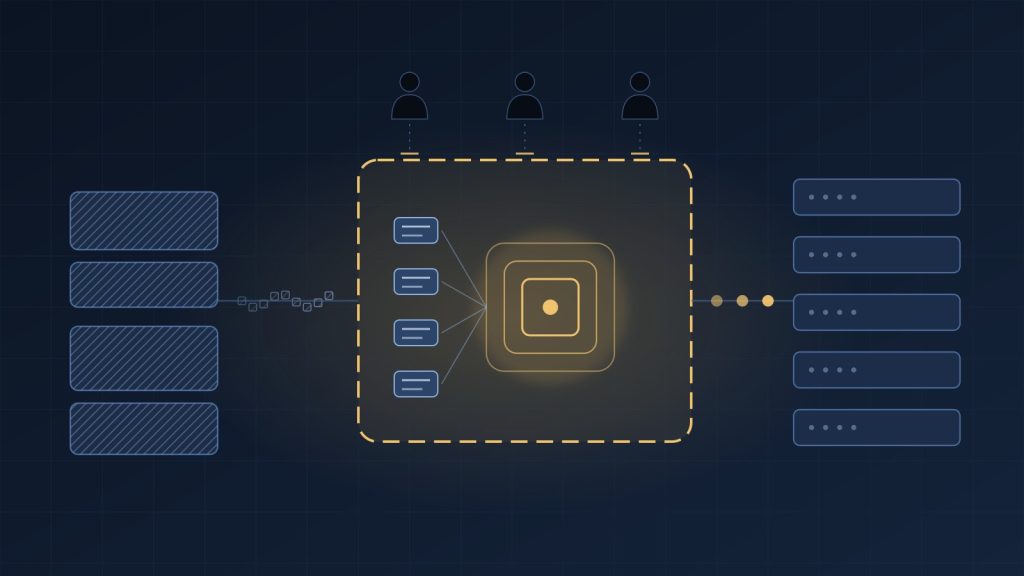
Enterprises want two things from cloud AI that can pull in opposite directions.
They want the AI provider to protect the platform from serious misuse.
But they also want the provider to avoid retaining or reading sensitive business data.
Those requirements become harder to reconcile as AI systems take on longer tasks.
A single request may look harmless.
A sequence of requests may reveal something very different.
OpenAI’s Private Safety Processing is an attempt to solve that problem.
The idea is simple to state:
Allow automated safety systems to examine patterns across interactions without giving OpenAI personnel access to the underlying customer content.
The architecture behind that idea is more interesting.
Why Zero Data Retention becomes difficult
OpenAI already offers Zero Data Retention, or ZDR, to eligible API customers.
With ZDR, OpenAI says customer prompts and model responses are not retained after processing, and enterprise data is not used for model training unless the customer explicitly opts in.
That is valuable for organizations handling:
- financial information
- health data
- confidential business documents
- intellectual property
- proprietary research
But safety systems have traditionally benefited from retained context.
Imagine one request:
“How does this industrial control system work?”
That may be legitimate.
Then another:
“Which safety protections stop remote commands?”
And later:
“How could someone bypass those protections without triggering alarms?”
The risk may only become clear when the interactions are considered together.
If every interaction disappears immediately, cross-session safety analysis becomes much harder.
That creates a conflict:
privacy says retain less
while
safety may require more context.
OpenAI’s answer: keep the content under customer control
With ZDR plus Private Safety Processing, selected records are stored in customer-controlled cloud storage rather than readable storage controlled by OpenAI.
OpenAI currently supports customer storage through services such as:
- AWS S3
- Azure Blob Storage
- Google Cloud Storage
The records are encrypted.
The customer controls the storage and the key authorization needed to access that protected data.
OpenAI keeps operational metadata and a reference to where the protected record is stored, rather than keeping a readable copy of the customer content itself.
This changes the normal trust model.
Instead of:
send sensitive content to provider → provider stores it → provider reviews it
the design becomes closer to:
customer retains encrypted content → approved protected system temporarily processes it → limited safety result leaves the protected environment
That distinction is central.
Accessible text alternative for this figure
Two flows side by side. An illustrative conventional model: customer content goes to the provider environment, then safety review, and the provider may retain or review the content. The protected model, as documented by OpenAI: customer-controlled encrypted storage goes to an attested protected runtime, then automated safety analysis, and only a bounded safety signal leaves. The detailed protected result is returned encrypted to customer-controlled storage, shown as a dashed return line. The two steps inside the protected boundary are drawn with dashed outlines and labelled, and every step has a text label, so no meaning depends on colour.
The safety system can see more than the humans
The most interesting part of the architecture is the Safety Review Runtime.
OpenAI describes it as a hardware-attested computing environment designed so that the approved workload can decrypt the protected customer content while human operators cannot.
The runtime performs automated safety review.
Only predefined safety signals and approved operational metadata are allowed to leave the protected environment in plaintext.
Detailed results remain encrypted and are returned to customer-controlled storage.
Conceptually:
Encrypted customer content
↓
Hardware-protected safety runtime
↓
Automated analysis
↓
Bounded safety signal
The provider may learn:
a defined category of serious risk was detected
without receiving:
the customer’s full conversation.
That is a much more interesting architecture than simply saying the data is encrypted.
Accessible text alternative for this figure
Three zones. Zone 1, the customer: owns protected storage, controls key authorization, and manages retention and configuration. Zone 2, inside the protected boundary, the protected runtime: temporarily processes readable content and runs the approved safety workload. Zone 3, provider operations: receives restricted safety signals and should not receive full readable customer content during normal protected processing. Encrypted records flow from the customer to the protected runtime, and bounded safety signals flow from the runtime to provider operations. The protected runtime is drawn with a dashed outline and labelled as inside the boundary, so no meaning depends on colour.
Encryption alone would not solve the problem
If OpenAI held the keys and its employees could freely decrypt the records, the privacy boundary would be much weaker.
Private Safety Processing relies on several controls working together:
- customer-controlled storage
- customer-managed key authorization
- hardware attestation
- restricted workloads
- predefined output schemas
- human-access restrictions
The point is not merely:
the data is encrypted.
The point is:
the system attempts to restrict who and what can decrypt it, what processing may occur, and what information can leave afterward.
That is closer to confidential-computing architecture than conventional encrypted storage.
Safety outputs are intentionally narrow
Another important detail is the output boundary.
The protected runtime is not supposed to send the full analysis or original conversation back to OpenAI.
It can emit predefined, bounded signals indicating the type of safety concern detected.
This matters because privacy can be lost at the output stage even if input processing is protected.
Imagine a safety system that technically hides the original document but produces a detailed summary containing all its sensitive information.
The encryption would accomplish very little.
Constraining the output is therefore part of the privacy architecture.
This is a useful principle beyond OpenAI:
A private computation system must control not only who can read the inputs, but also what information its outputs can reveal.
Zero retention does not literally mean zero storage everywhere
The terminology needs care.
With Private Safety Processing, selected protected records can remain in customer-controlled storage for safety purposes.
OpenAI’s current documentation requires customers to retain those encrypted records for at least 30 days.
So “Zero Data Retention” does not mean:
no copy of any data exists anywhere after inference.
It means the provider does not retain customer content in the usual provider-controlled abuse-monitoring logs covered by the ZDR commitment.
For PSP, protected records remain under customer storage and key controls for the required safety window.
That distinction should matter to security and compliance teams.
The customer also inherits responsibility
This architecture gives customers more control, but not less work.
Organizations using ZDR with PSP are responsible for maintaining:
- storage configuration
- regional storage requirements
- encryption permissions
- key authorization
- retention lifecycle
- connectivity
- validation
- responses to safety notices
OpenAI explicitly documents these as customer responsibilities.
That means Private Safety Processing is not simply a checkbox that makes AI private.
It adds an operational security dependency.
If storage or key configuration is wrong, the safety pipeline may not work as intended.
Enterprise privacy increasingly becomes an architecture problem rather than merely a contractual promise.
There are still exceptions
The word “private” should not be interpreted as absolute.
OpenAI notes legal exceptions, including apparent child sexual abuse material, where flagged images may still be retained for manual review and reporting as required by law.
OpenAI’s broader data-control documentation also describes circumstances where retention policies may change for specific customers where severe-risk investigation is required, with notification requirements depending on the applicable policy.
So the correct interpretation is not:
OpenAI can never access or retain anything.
It is:
The architecture is designed to preserve much stronger customer control and prevent routine human access while still maintaining defined safety and legal mechanisms.
Those are very different claims.
Why this matters more as agents become persistent
This problem becomes more important when AI moves from isolated prompts to long-running agents.
A chatbot may process a few exchanges.
An agent could:
- access internal systems
- execute code
- work for hours
- make repeated requests
- interact with external services
- continue acting after the original user request
Safety signals may therefore emerge across an entire task rather than one prompt.
OpenAI explicitly identifies longer agentic interactions as one reason safety systems need broader context.
That means privacy architecture also has to evolve.
Simply inspecting every individual request independently may no longer be enough.
But retaining complete enterprise workflows centrally may be unacceptable.
Private Safety Processing is an attempt to occupy the space between those extremes.
Is this fully proven?
Not yet.
OpenAI’s technical documentation is now detailed enough to understand the intended architecture, but many of the security claims are still primarily OpenAI’s own claims.
The system depends on several important assumptions:
- hardware attestation works as intended
- only approved workloads receive decryption capability
- key permissions remain correctly configured
- bounded outputs do not leak sensitive information
- operational metadata does not expose unexpected information
- implementation matches the documented design
Those are all areas where independent technical scrutiny will matter.
When OpenAI first announced Private Safety Processing in August, outside coverage correctly noted that the architecture had not yet been published in detail.
OpenAI has since published substantially more implementation documentation.
That improves transparency.
It does not turn vendor documentation into independent verification.
What about Private Inference?
At DevDay 2026, OpenAI placed Private Safety Processing under a broader direction it called Private Intelligence and said a Private Inference preview was planned for the fall.
That could become even more significant.
Private Safety Processing protects the safety review path.
Private Inference could potentially address privacy in the model inference itself.
But there is not yet enough public technical documentation to explain its architecture responsibly.
Questions remain:
- Where does inference run?
- Who controls encryption keys?
- What hardware trust mechanism is used?
- Can OpenAI operators inspect memory?
- How is the model protected while customer data is protected?
- What can be independently attested?
- What performance cost does confidential inference introduce?
Until those details are published, Private Inference should remain a watch item rather than a technical conclusion.
My Perspective: privacy and safety do not have to be opposite choices
Enterprise AI discussions often present a simple trade-off:
Either the provider can inspect activity for safety
or
the customer’s data remains private.
Private Safety Processing suggests a third architectural possibility.
Allow machines inside a tightly controlled computing boundary to inspect what human operators cannot.
Allow only restricted safety signals to leave.
Keep the underlying records under the customer’s storage and key controls.
That does not eliminate trust.
The customer still has to trust:
- the hardware
- the implementation
- the attestation system
- the safety workload
- the provider’s enforcement mechanisms
But it changes where that trust is placed.
That may be the more important development.
The future of enterprise AI privacy may not depend on providers promising:
“Trust us not to look.”
It may increasingly depend on architectures designed so that:
even the provider’s own people are technically prevented from looking during normal operation.
If that architecture proves reliable, privacy and safety may no longer need to be treated as opposite ends of the same switch.
They can become separate controls designed into the system.
Sources and Further Reading
Source review: 2 October 2026.
- OpenAI — Offering Zero Data Retention for Frontier Models. OpenAI’s introduction to Private Safety Processing and the privacy-versus-safety problem it is designed to address.
- OpenAI API — ZDR with Private Safety Processing. Current technical documentation covering customer-controlled storage, protected safety runtime, bounded outputs and customer responsibilities.
- OpenAI API — Data Controls in the OpenAI Platform. Current retention policies, ZDR behavior, endpoint limitations and safety-retention exceptions.
- OpenAI — DevDay 2026 Announcements. DevDay summary identifying Private Intelligence and the planned Private Inference preview.
- The Register — OpenAI Chases Anthropic’s Biz Customers with Zero Data Retention Pledge. Early independent coverage highlighting the tension between safety monitoring and enterprise data-retention requirements.
- TechCrunch — OpenAI Seeks to One-Up Anthropic with New Customer Privacy Protections. Independent context around enterprise privacy concerns and competing safety-retention approaches.