

| Part | Article | Covers |
|---|---|---|
| 1 | Free vs. Paid AI Models: What the Words Actually Mean (this article) | What each tier means, what you give up at $0, licenses, a decision framework |
| 2 | Running Open AI Models Yourself: What It Actually Takes | Hardware, tools, skills, and the real challenges of self-hosting |
| 3 | Where to Find and Verify Open AI Models Safely | Trusted sources, spotting tampered downloads, safe practices |
| 4 | Open AI Models Worth Knowing Right Now (dated snapshot) | A field guide to 15–20 current free and open-weight models |
A reader who lands on any single part should be able to find the other three from here.
The Promise Nobody Checks
A short video promises that a viewer never has to pay for AI again: download this one file, run it on a laptop, get the “same thing” as a $20-a-month subscription. The video gets millions of views. Most people who try it get a model that answers slower, gets more things wrong, or simply refuses to install on their machine. Few come back to say so.
The video was not exactly lying. It was just using one word, free, to cover three very different arrangements that happen to share a price tag. A chatbot’s free daily quota, a company’s request to try their model before buying a subscription, and a set of numbers anyone can download and run on their own computer are not the same product wearing different labels. They come from different companies, run on different hardware, answer to different rules, and fail in different ways.
This article does not rank them. It answers a narrower and more useful question: what does “free AI” actually mean, tier by tier, and what does a reader give up or take on at each price point? Once that is clear, the rest of this series covers what it takes to actually run one, where to get it safely, and which specific models are worth knowing about right now.
Three Words, Three Different Deals
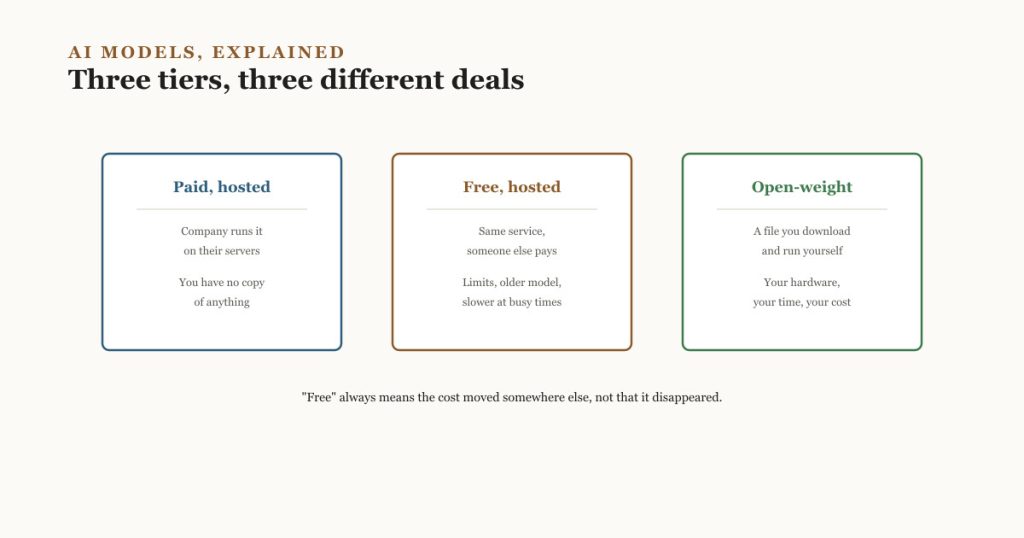
Most of the confusion clears up once these three arrangements are told apart. They are not competing definitions; they describe who owns the computer the model runs on.
| Tier | What it means | Who runs the model | Common examples (category, not a ranking) |
|---|---|---|---|
| Paid, hosted | A company runs the model on its own servers and sells access, usually as a monthly subscription or pay-per-use API. | The company (OpenAI, Anthropic, Google, and similar) | ChatGPT Plus, Claude Pro, Gemini Advanced |
| Free, hosted | The same kind of company-run service, offered at no cost, usually with a daily message limit, an older model version, or slower response times. | The company, subsidizing the cost | Free tiers of ChatGPT, Claude, Gemini, Copilot |
| Open-weight | The company publishes the model’s trained numbers (its “weights”) for anyone to download and run on their own hardware or rented cloud server. | Whoever downloads it | Llama, Qwen, Mistral, Gemma, DeepSeek, Phi |
A fourth term, open-source AI, gets used loosely. In software, open source has always meant the full recipe is public: the code, and often the process to rebuild it from scratch. Very few AI models meet that bar, because almost none of their publishers release the training data or the exact training process, only the finished weights. The Open Source Initiative’s own definition draws this distinction directly (Open Source AI Definition 1.0). This article uses open-weight for that reason, and reserves open source only for the rare case where the training data and code are public too.
A fine point that changes the decision: paid and free hosted models are a service — the company can change the model, the price, or the limits at any time, and the reader has no copy of anything. An open-weight model, once downloaded, is a file the reader owns a copy of. It will not disappear if the company changes its business, though it also will not get security patches or improvements unless the reader goes and gets a newer version themselves.
Where Your Prompt Actually Goes
The most practical difference between these tiers is not speed or quality. It is where the text a reader types actually travels before an answer comes back.
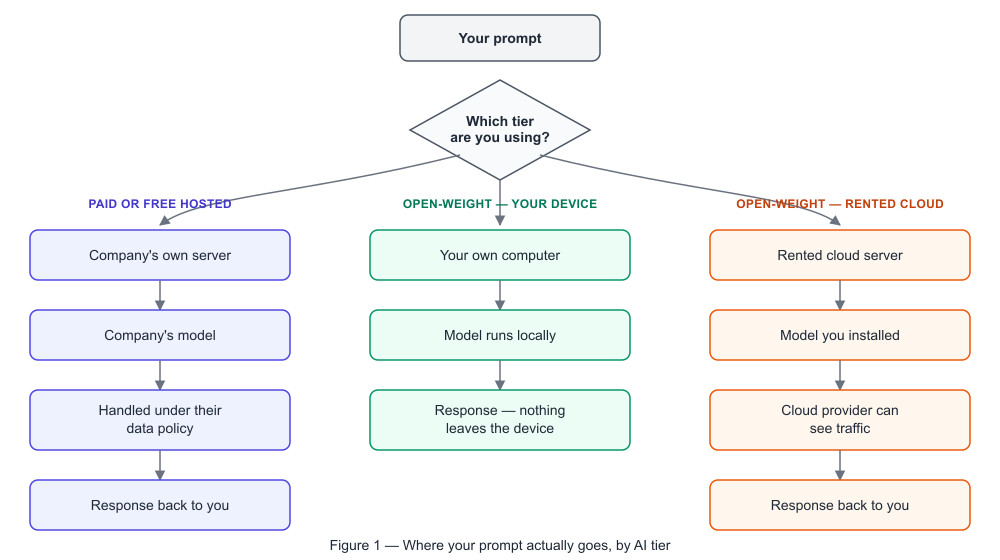
Suppose a reader pastes part of a client contract into a prompt to get it summarized. With a paid or free hosted service, that text reaches the company’s servers, and what happens to it next — whether it is stored, reviewed by a human, or used to improve a future model — is decided entirely by that company’s data-use policy for the specific product being used. Business and API plans commonly carry different, stricter data terms than the free consumer app version of the same company’s chatbot, so the plan matters as much as the company. This changes often enough that the only reliable step is reading the current policy for the exact product in use, not assuming it matches something read about the company generally.
With an open-weight model running on the reader’s own laptop, that same text never leaves the device. Nobody else can see it, log it, or use it, because there is no second party involved in running the model. That is the single biggest practical reason people choose to self-host: not that it is free, but that it is private by construction, not by policy.
Running an open-weight model on a rented cloud server sits in between: the reader controls what the model does with the data, but the cloud provider hosting the machine can, in principle, see the traffic passing through it — the same as with any other server they rent.
What “Free” Really Costs
Running a large language model is expensive: it needs specialized processors, electricity, and constant engineering. Nobody offers that for nothing. “Free” always means the cost has moved somewhere else, not disappeared.
| Tier | Who actually pays, and how | What the reader notices |
|---|---|---|
| Free hosted chatbot tier | The company subsidizes it — funded by paying subscribers, investor capital, or (per that specific product’s policy) by using conversations to improve future models | Daily or hourly message limits, an older or smaller model than the paid version, slower responses at busy times |
| Downloading an open-weight model | The company gains from wider adoption, developer goodwill, and a path toward its paid cloud or enterprise offering; some are funded by research labs, universities, or national AI programs | No usage cap from the publisher, but also no company standing behind the answers, and no support line to call |
| Running that model on your own hardware | You pay directly — electricity, hardware wear, and the hours spent installing and maintaining it | The model itself cost nothing to download, but using it is not actually free; the cost just moved from a monthly bill to your own time and power meter |
The honest way to describe free AI, in any of its forms, is not “no cost.” It is a different arrangement about who is paying and what they get in return — money, attention, data, or the reader’s own time and electricity.
The Fine Print: Licenses That Matter
“Free to download” and “free to use for anything” are not the same promise. Every open-weight model is published under a specific license, and the differences are not academic — they decide whether a reader can legally use the model in a product they sell.
| License type | What it actually allows | Example |
|---|---|---|
| Apache 2.0 / MIT | Use, modify, and sell without asking permission or paying royalties, with almost no conditions | Used by many Qwen, Mistral, and DeepSeek releases |
| Meta’s Llama Community License | Free for most users, but any organization whose products already serve more than 700 million monthly active users must first request a separate license from Meta | Llama 4 (Llama 4 License Agreement) |
| Google’s Gemma Terms of Use | Commercial use and redistribution are allowed, but redistributors must pass along the same terms, mark modified files, and follow a separate Prohibited Use Policy | Gemma 3 (Gemma Terms of Use) |
| Non-commercial research licenses | Free for research and personal projects; using the model or its outputs in a commercial product is not allowed without a separate agreement | Some Cohere Command R+ releases |
Three things about licenses catch people out. First, the license belongs to the specific model version, not the company — a newer release from the same publisher can carry different terms. Second, a permissive license for the model does not automatically cover everything built on top of it; check the license of the tool or app used to run it too. Third, an organization’s own size can change which rules apply to it, as the Llama example shows, so a hobby project and a company built on the same model may not be bound by the same terms. When it matters, the only reliable step is opening that exact model’s license page, not relying on a summary written before the current version was released.
Limits That Do Not Go Away
Some limitations are not solved by choosing a different tier. Others change sharply depending on which tier a reader picks.
- Hallucination is universal. Every model in every tier — the most expensive paid subscription included — can state a wrong fact with complete confidence. Price buys a lower error rate on many tasks, not immunity from the problem.
- The quality ceiling still tends to favor paid frontier models, for now. On the hardest reasoning, coding, and multi-step tasks, the largest paid hosted models generally lead independent benchmarks as of late 2026, though the gap has narrowed each year and the best open-weight models now match or beat older paid models on many everyday tasks. This is a moving line, not a fixed rule, so it is worth rechecking rather than assumed.
- Safety filtering is thinner once the model is in the reader’s own hands. Paid and free hosted products apply the company’s own moderation layer on every response. An open-weight model, once downloaded, answers whatever it is asked, limited only by whatever safeguards the reader chooses to add — which puts the responsibility for how it is used on the person running it, not on the original publisher.
- Support and accountability shrink from paid, to free, to self-hosted. A paid plan usually comes with a support channel and a stated uptime commitment. A free hosted tier can change its limits or retire a model version without notice. A self-hosted open-weight model has no one to call at all — only community forums and the reader’s own troubleshooting.
- Open-weight models demand a real skill floor. Downloading a chatbot app takes a minute. Running an open-weight model well takes comfort with a command line, enough storage and processing power, and the discipline to keep it updated — covered in detail in Part 2 of this series.
Which Tier Fits Your Situation
There is no universally correct tier. There is a tier that fits a given situation, and the fit changes as the situation does.
| Your situation | Tier that usually fits | Why |
|---|---|---|
| Everyday writing, research, or general questions | Free hosted tier of a mainstream product | No setup, no hardware needed, easy to compare against what colleagues are using |
| Working with confidential client, patient, or financial data | An open-weight model run on your own device | Nothing leaves your machine; you are not trusting a third party’s data policy at all |
| Building a product you plan to sell | A paid hosted API, or an Apache 2.0/MIT-licensed open-weight model | Predictable pricing and support (paid API), or full commercial freedom with no size-based licensing clause to track (permissive open-weight) |
| Learning how AI models actually work | A small open-weight model on your own laptop | Inexpensive to experiment with, and it forces you to learn the mechanics a polished chatbot app hides |
| No fixed budget, occasional heavy use | Free hosted tier, accepting its daily limits | No cost commitment; move to a paid or open-weight option only once the limits genuinely get in the way |
| A product expected to reach hundreds of millions of users | A paid hosted API, or a permissively licensed open-weight model | Some open-weight licenses, like Meta’s Llama Community License, require a separate agreement once usage crosses a stated threshold |
The rest of this series assumes the reader has decided that open-weight is at least worth exploring, and walks through what that decision actually involves.
Continue This Series
This article answered what the words paid, free, and open-weight actually mean. The next three parts answer what to do with that knowledge, in the order most readers actually need it.
- Part 2 — Running Open AI Models Yourself: What It Actually Takes. The realistic hardware tiers (what runs on a laptop versus what needs a dedicated GPU), the tools people actually use (Ollama, LM Studio, llama.cpp), and the challenges that influencer content skips: quantization trade-offs, context-length limits, and the ongoing work of keeping a model updated.
- Part 3 — Where to Find and Verify Open AI Models Safely. Trusted sources such as Hugging Face and each publisher’s own repository, how to tell a legitimate model file from a tampered or mislabeled one, and what “safe” actually means once there is no company standing behind the download.
- Part 4 — Open AI Models Worth Knowing Right Now. A dated field guide to 15–20 current free and open-weight models, each explained in plain terms, published as a snapshot rather than a permanent ranking, since this list changes every few months.
Each part will link back to this one and to every other part, so a reader who finds any single article can still reach the full series.
Go Deeper
- Open Source AI Definition 1.0 — Open Source Initiative. The formal definition this article uses to separate “open-weight” from true “open source” AI. Reviewed September 2026.
- Llama 4 Community License Agreement — Meta. Primary source for the 700-million-monthly-active-user licensing threshold discussed above. Reviewed September 2026.
- Gemma Terms of Use — Google. Primary source for Gemma’s commercial-use and redistribution conditions. Reviewed September 2026.
- Hugging Face Model Hub licenses — Hugging Face. How to find and read the exact license attached to any specific model version before using it commercially.
License terms and free-tier limits change often. Treat the examples above as illustrations of how these licenses work, and always check the current terms on the model’s own page before relying on them.