

Your company may have a quantum-computing problem long before it has any reason to run a quantum computer.
That sounds contradictory.
Consider an organisation that stores information which must remain confidential for another 10 or 20 years.
Its systems may use public-key cryptography that works perfectly well today.
But sufficiently capable future quantum computers could threaten some of those cryptographic methods.
An attacker does not necessarily need such a quantum computer today. Encrypted information can potentially be collected now and retained for future decryption.
At the same time, businesses are hearing very different quantum messages:
- quantum optimisation could improve logistics;
- quantum computing could help drug discovery;
- banks are experimenting with quantum algorithms;
- cloud providers offer access to quantum processors;
- vendors are talking about quantum advantage;
- governments and technology companies are investing heavily in quantum research.
That creates a difficult leadership question.
What should an organisation actually do?
Build a quantum team?
Buy hardware?
Start proofs of concept?
Change its security architecture?
Wait?
For most organisations, the useful question is not:
When should we adopt quantum computing?
It is:
What should we prepare for now, what is worth experimenting with, and what still needs stronger evidence?
Those are different decisions.
Treating them as one decision is where organisations can either spend too early or prepare too late.
This is the third article in TechiesJournal’s quantum computing series. The first, Quantum Computing Is Not a Faster Supercomputer, looks at where the technology actually fits today. The second, Quantum Computing for Students, explains what depth of understanding is actually useful. This one turns to organisations.
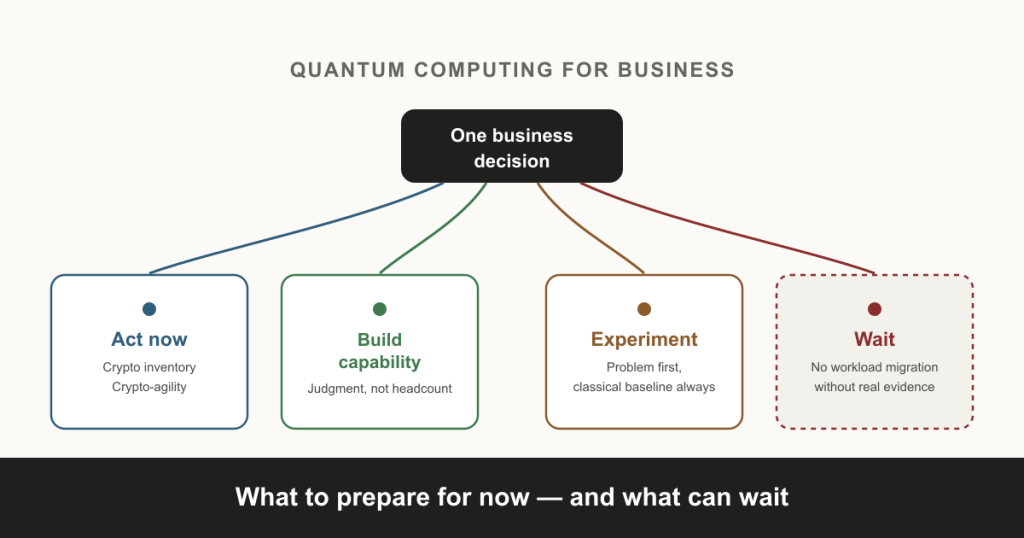
Four different responses to quantum computing
Before looking at security, business applications or quantum hardware, it helps to separate four different levels of response.
Act now
Some quantum-related work already deserves operational attention—especially cryptographic discovery, long-lived data protection, supplier readiness and crypto-agility.
Build capability
Organisations should develop enough understanding to recognise relevant business problems and evaluate technical claims without automatically creating a large quantum programme.
Experiment selectively
Some companies already have difficult scientific, financial, engineering or optimisation problems that may justify controlled quantum experiments.
Wait for evidence
Broad production migration, major hardware purchases and large transformation programmes should wait where useful business advantage has not yet been demonstrated.
This distinction prevents two opposite mistakes.
The first is ignoring quantum computing completely because large fault-tolerant systems are not yet widely available.
The second is spending heavily because every emerging technology has suddenly become a strategic transformation.
Neither is necessary.
The useful question is simply:
Which of these four responses applies to the decision in front of us?
Your company can have a quantum problem without owning a quantum computer
The most immediate business consequence of quantum computing is not faster optimisation or quantum machine learning.
It is security.
Today’s widely used public-key cryptography includes systems based on mathematical problems that are difficult for classical computers but could become vulnerable to sufficiently capable future quantum computers.
That is why governments and standards organisations are already moving towards post-quantum cryptography, or PQC.
PQC does not require a quantum computer.
It consists of cryptographic algorithms designed to run on conventional computers while resisting attacks from both classical and future quantum computers.
NIST has standardised post-quantum algorithms and advises organisations to begin preparing for migration.
Canada’s Cyber Centre has published guidance and migration planning for post-quantum cryptography.
The UK’s National Cyber Security Centre also treats PQC migration as a multi-year technology transition rather than something organisations should begin only after a cryptographically powerful quantum computer appears.
That gives businesses their first important distinction:
Quantum-computing adoption may still be experimental. Quantum-security preparation is already operational planning.
What does “quantum ready” actually mean?
A quantum-ready company does not necessarily own quantum hardware.
It does not necessarily have quantum applications in production.
It may not even have a dedicated quantum team.
A more useful test is whether the organisation can answer questions such as:
- Where do we use quantum-vulnerable cryptography?
- Which information must remain confidential for many years?
- Can we replace cryptographic algorithms without rebuilding entire systems?
- Which critical suppliers control cryptography that we depend on?
- Which business problems might genuinely justify quantum experimentation?
- Who inside the organisation can evaluate quantum claims?
- Can we experiment through cloud access without major capital spending?
- What evidence would justify moving from research to production?
That is readiness.
It is mostly about:
security;
architecture;
suppliers;
skills;
experimentation;
and judgement.
Not ownership of a quantum processor.
Act now: understand where your cryptography lives
For many organisations, the first serious quantum project should be a cryptographic discovery exercise.
That means understanding where cryptography exists across the technology estate.
It is usually more complicated than looking through application source code.
Cryptography may be embedded in:
- applications;
- APIs;
- databases;
- network equipment;
- operating systems;
- identity systems;
- VPNs;
- cloud services;
- hardware security modules;
- certificates;
- CI/CD pipelines;
- mobile devices;
- industrial equipment;
- third-party products.
Centre: Organisation / Technology Estate — select a node
Applications
Encryption libraries, signing, tokens, stored keys.
APIs
TLS, client certificates, service-to-service authentication.
Identity
Certificates, signing, key exchange, authentication protocols.
Databases
Column/field-level encryption, backup encryption, key-protected connections.
Cloud
Managed encryption, provider-controlled TLS, key-management services.
Network / VPN
Key exchange, transport encryption, VPN tunnel authentication.
Certificates
Issuing CAs, signing algorithms, expiry and rotation practices.
CI/CD
Signing keys, package signatures, certificates, secret-management integration.
Devices
Firmware signing, secure boot, on-device key storage.
HSM / Key Management
Root and signing keys; generation, storage and rotation policy.
Industrial / specialised equipment
Long-lived control systems and embedded cryptography that can be hard to patch or replace.
Third-party products
Cryptography controlled by the vendor and dependent on the vendor’s migration plan.
Crypto inventory means finding cryptography across the whole technology estate — not searching one application.
This is why cryptographic inventory matters.
The objective is not simply to produce a spreadsheet containing algorithm names.
The organisation needs to understand:
What cryptography is being used?
Where?
Why is it being used?
Who owns the system?
How long must the protected information remain secure?
Can the cryptography be changed?
Does the organisation control that change, or does a supplier?
Without that visibility, a migration programme is mostly guessing.
Why data lifetime changes the urgency
Not every encrypted asset deserves the same priority.
Imagine two pieces of information.
One is a temporary authentication token that loses value within minutes.
The other contains intellectual property, medical information, government information or business strategy that must remain confidential for decades.
Those two assets have very different risk profiles.
Attackers may potentially collect encrypted information today and retain it in the hope that future technology eventually makes decryption possible.
This is commonly described as:
harvest now, decrypt later.
That does not mean every organisation should panic.
It means one question should become part of security prioritisation:
How long must this information remain secret?
Information that loses its value quickly may not deserve the same migration priority as information that must remain protected for another 10, 20 or 30 years.
Quantum risk is therefore partly a technology question.
But it is also a data-lifetime question.
Can your organisation change cryptography when it needs to?
Finding the cryptography is only half of the problem.
Suppose an organisation discovers that an important application uses an algorithm that eventually needs to be replaced.
Can that algorithm be changed without:
- redesigning the application;
- replacing hardware;
- breaking integrations;
- negotiating with several vendors;
- interrupting operations?
If not, the organisation has another problem.
This is where crypto-agility matters.
In simple terms:
A crypto-agile system is designed so that its cryptography can change without rebuilding everything around it.
PQC makes this particularly visible, but the principle is bigger than quantum computing.
Cryptographic algorithms can change for many reasons.
Standards evolve.
Vulnerabilities are discovered.
Policies change.
Products reach end of support.
Quantum computing is giving organisations another reason to stop treating cryptography as something permanently buried inside systems.
Your suppliers are part of your quantum readiness
Most businesses do not control all of the cryptography they depend on.
Consider:
- cloud platforms;
- SaaS applications;
- network devices;
- security appliances;
- operating systems;
- identity providers;
- payment platforms;
- databases;
- industrial equipment.
A supplier may control when PQC support becomes available.
Some products may receive software upgrades.
Some may require firmware changes.
Some hardware may eventually need replacement.
Some SaaS providers may make much of the transition nearly invisible to customers.
This means quantum readiness is also a supplier-management and procurement question.
For important products, organisations should increasingly understand:
- Does the product depend on quantum-vulnerable public-key cryptography?
- What is the supplier’s migration direction?
- Can cryptographic algorithms be changed?
- Is the product designed for crypto-agility?
- Would migration require an upgrade or replacement?
- How long will the product remain supported?
This is particularly important when buying systems expected to remain operational for many years.
A product purchased today may still be running when post-quantum migration becomes much more urgent.
Not every organisation needs the same quantum programme
A 100-person company using mostly modern SaaS services does not have the same quantum-readiness problem as:
- a bank;
- a telecom provider;
- a government department;
- a defence organisation;
- a hospital network;
- a critical-infrastructure operator;
- a multinational with thousands of bespoke applications.
For many smaller organisations using commodity technology, much of the transition may arrive through normal platform, operating-system, browser and cloud-provider upgrades.
Large organisations with bespoke systems, specialised hardware and long-lived infrastructure have considerably more migration work to manage.
A smaller organisation may initially need
- basic PQC awareness;
- supplier visibility;
- sensible technology lifecycle management;
- supported products;
- awareness of long-lived sensitive data.
A large or regulated organisation may need
- formal cryptographic inventory;
- migration governance;
- risk prioritisation;
- supplier coordination;
- architectural standards;
- procurement requirements;
- internal expertise;
- targeted quantum experimentation.
The useful advice is therefore not:
Every company needs a quantum programme.
It is:
Every organisation should understand which quantum-related risks and opportunities are actually relevant to it.
What does this mean for a startup?
Startups deserve slightly different advice.
An established organisation may have thousands of applications, certificates, appliances and integrations that eventually need to be discovered and migrated.
A startup may still be designing its architecture.
That creates an advantage.
It is usually cheaper to design for change now than to remove years of technical debt later.
But startups also have less capital, fewer people and much less room for technical experiments that do not help the customer.
So the right approach is neither:
“Ignore quantum because we are too small.”
nor:
“We need a quantum strategy before we launch.”
It is:
Build the company so future change is possible, while spending today’s money on today’s customer problem.
A startup’s advantage is flexibility
A young company can make architectural decisions before years of legacy technology accumulate.
For example, it can:
- avoid hard-coding cryptographic algorithms throughout application logic;
- use well-maintained security libraries and managed services;
- keep important dependencies current;
- document where significant cryptography is used;
- choose vendors with clear security-maintenance policies;
- design components so cryptographic mechanisms can evolve.
That does not mean a startup should immediately implement experimental PQC everywhere.
It means avoiding architecture that makes future cryptographic change unnecessarily difficult.
That is the startup version of crypto-agility.
Established organisation
- Existing systems
- Discover cryptography
- Identify dependencies
- Coordinate suppliers
- Migrate legacy technology
- Higher change cost
Startup
- Design now
- Use maintained components
- Avoid hard-coded cryptography
- Build for crypto-agility
- Fewer legacy constraints
Startup advantage: flexibility.
Startup risk: spending today’s runway on tomorrow’s problem.
Do not create a security problem while trying to become “quantum safe”
A startup trying to prepare for quantum threats can accidentally make its security worse.
Founders should not respond by inventing their own encryption systems or implementing immature algorithms merely to advertise that a product is quantum-safe.
Use:
- recognised standards;
- established security libraries;
- supported platform capabilities;
- vetted implementations.
Then evolve with the standards.
For most startups, strong security engineering matters more than being the first company to use quantum-related marketing language.
Do not optimise for a quantum future before finding product-market fit
This may be the most important startup warning.
A company with:
- few or no customers;
- limited runway;
- an unproven product;
- no quantum-relevant computational problem;
probably should not prioritise a quantum proof of concept over:
- understanding customers;
- shipping the product;
- solving reliability problems;
- implementing basic security properly;
- improving distribution;
- managing cash flow.
Quantum readiness should remain proportional to the business.
Future-proofing should not become future-driven overengineering.
When can quantum awareness become an advantage for a startup?
There are cases where understanding the field early may create strategic value.
Cybersecurity
PQC migration, cryptographic discovery, crypto-agility, key management and related tooling may create product opportunities.
Unlike many speculative quantum applications, the security transition is already creating practical work.
Science-heavy businesses
Startups in:
- biotechnology;
- chemistry;
- materials;
- pharmaceuticals;
- energy;
may have computational problems connected to areas already being explored through quantum research.
Early understanding can help them recognise useful research partnerships and experiments.
Optimisation-heavy products
A startup working in:
- logistics;
- scheduling;
- mobility;
- supply chains;
- finance;
may want to follow quantum optimisation research.
But one rule remains important:
Having a difficult optimisation problem does not automatically make it a quantum problem.
A strong classical baseline still comes first.
Infrastructure and developer tools
Opportunities may also develop around:
- cloud integration;
- orchestration;
- simulation;
- workflow management;
- developer tooling;
- observability;
- security;
- hybrid classical-quantum systems.
A startup does not have to build the quantum processor itself to participate in a future quantum ecosystem.
What if the startup itself is a quantum company?
Then the business problem changes significantly.
A company building:
- quantum processors;
- control systems;
- cryogenic technologies;
- photonics;
- quantum networking;
- quantum sensors;
- error-correction technology;
- compilers;
- quantum algorithms;
- quantum applications;
is entering a deep-technology market.
The potential opportunity can be significant.
But so can the challenges.
Depending on the technology, development may require:
- specialised laboratories;
- fabrication;
- cryogenic systems;
- lasers or photonics;
- control electronics;
- expensive technical equipment;
- highly specialised researchers and engineers.
The commercial timeline may also be substantially longer than for conventional software.
A founder therefore needs to answer not only:
“Can we build it?”
but:
Can we finance the time required to prove that it works—and that someone will pay for it?
Technical progress is not automatically a business.
A quantum startup still needs:
- a customer;
- a problem worth paying for;
- differentiation;
- a path to deployment;
- defensible capability;
- realistic commercial timing.
That distinction matters in an emerging field where research grants, partnerships and investor interest can exist before a repeatable commercial market.
When should a business experiment with quantum computing?
Security readiness is one side of the story.
The other is computational opportunity.
Real organisations are already experimenting with quantum computing in:
- finance;
- chemistry;
- biotechnology;
- materials;
- engineering;
- energy;
- logistics;
- optimisation.
But experimentation and production advantage are not the same thing.
A company should not begin with:
“We need a quantum proof of concept.”
It should begin with:
We have a difficult business problem. Is there a credible technical reason quantum computing might eventually help with it?
Problem first.
Technology second.
Should we run a quantum proof of concept?
Do we have a real, difficult business problem?
Do not start with quantum. Define the problem first.
Do we understand the strongest practical classical solution?
Establish the classical baseline first.
Is there a credible technical reason quantum might help?
Stay classical unless new evidence changes the case.
Can current hardware or simulation test a meaningful reduced version?
Monitor the technology rather than forcing a POC.
Run a controlled experiment.
Did it produce a meaningful, measurable result against the classical baseline?
Document the learning. Revisit later if the technology changes.
Validate scalability, cost, reproducibility and operational value before making production claims.
A useful quantum experiment begins by answering six questions.
1. What is the actual business problem?
Be specific.
Not:
Optimisation is important to our company.
But perhaps:
Our current approach to scheduling these assets becomes increasingly difficult as constraints grow.
Or:
Modelling this molecular behaviour requires approximations that limit what our researchers can practically investigate.
A vague problem produces a vague experiment.
2. What is the best practical classical solution?
This may be the most important technical question.
A quantum experiment without a serious classical baseline proves very little.
Suppose the quantum approach outperforms one classical algorithm.
That sounds impressive.
But what if a better classical technique already exists?
The useful question is not:
Did quantum beat something classical?
It is:
Did it beat the best practical alternative we would actually use?
3. Why might this problem suit a quantum algorithm?
“Because the problem has many combinations” is not enough.
Many difficult combinatorial problems remain difficult for quantum computers.
There needs to be an actual technical hypothesis.
The problem might involve:
- quantum-system simulation;
- mathematical structure for which a relevant quantum algorithm exists;
- a particular optimisation formulation;
- sampling behaviour;
- another workload with plausible quantum characteristics.
Novelty is not a technical reason.
4. Can current hardware test a meaningful version?
Today’s quantum computers remain limited.
A useful experiment may therefore test a smaller representation of the real problem.
That can still provide meaningful learning.
The problem begins only when a reduced experiment is presented as if the full production problem had already been solved.
5. What counts as success?
Define success before the experiment.
Possibilities include:
- accuracy;
- solution quality;
- runtime;
- cost;
- resource use;
- scalability;
- another measurable technical result.
Without a defined result, almost any outcome can later be described as “promising.”
6. What makes us stop?
This is equally important.
A legitimate experiment may conclude:
The technology is not useful for this problem yet.
That can still be a successful proof of concept.
The organisation learned something before making a much larger commitment.
What are companies actually experimenting with?
Business experimentation is already real.
But these examples need to be read carefully.
They are useful because they show how organisations are learning.
They should not be treated as proof that quantum computing is already replacing established production systems.
HSBC: testing a real financial problem
HSBC and IBM tested a hybrid quantum-classical approach using production-scale European corporate-bond trading data.
HSBC reported an improvement of up to 34% in predicting whether customer requests for quotes would result in trades compared with commonly used classical techniques in the experiment.
This is interesting because the trial included:
- a real financial problem;
- realistic data;
- a classical comparison;
- a measurable result.
But the correct conclusion is not:
Banks should move algorithmic trading to quantum computers.
A better conclusion is:
Current quantum hardware can be tested against serious business workloads, and individual results deserve careful evaluation.
One trial does not establish broad quantum advantage across finance.
Moderna: building capability around biotechnology
Moderna and IBM have explored quantum methods related to modelling mRNA structures.
The work used current IBM quantum hardware to investigate a problem connected with molecular structure.
The important business lesson is not:
Quantum computers are now designing medicines.
They are not.
The lesson is that an organisation whose future may depend on difficult molecular computation can begin developing expertise and testing methods before the technology is mature enough to change production workflows.
That is:
capability building + targeted research
rather than:
full production adoption.
Boeing: reducing a real engineering problem to something testable
Boeing’s composite-design problems can involve very large numbers of variables.
In work with IBM, part of that challenge was reduced to a much smaller representation that available quantum hardware could test.
This provides a useful pattern for responsible experimentation:
Real business problem
↓ Smaller testable model
↓ Current hardware experiment
↓ Learning
↓ No claim that the full production problem is solved
That is how emerging-technology experimentation should work.
Where might quantum computing eventually matter to business?
Some areas have stronger technical motivations than others.
Businesses should continue separating:
interesting research
from:
established production advantage.
Act now
Why it matters
Cryptography protecting long-lived data can be exposed by a future quantum computer, even if that computer does not exist yet — “harvest now, decrypt later.”
What exists today
Standards/migration work exists; crypto inventory, crypto-agility and supplier planning are already practical steps.
What has not been established
A completed, organisation-wide migration — this remains a multi-year programme for most organisations.
Strong research motivation
Why it matters
Molecules and materials are themselves quantum systems, so using quantum systems to simulate them has a natural technical connection.
What exists today
Serious research into molecular structure, chemistry, battery materials, pharmaceuticals and industrial materials.
What has not been established
That quantum computers will soon replace classical chemistry simulation — useful advantage still has to be demonstrated on relevant workloads.
Serious experimentation
Why it matters
Finance contains optimisation, risk, probability, pricing and simulation problems that make it an active research area.
What exists today
Realistic trials exist — for example current hardware tested against production-scale trading data with a measurable result.
What has not been established
Broad production advantage across financial computing generally — one trial does not establish that.
Active experimentation
Why it matters
Scheduling, routing, supply chains and industrial optimisation regularly appear in quantum discussions.
What exists today
Meaningful research activity, with organisations testing real scheduling and routing problems.
What has not been established
That large search spaces alone imply quantum advantage — a credible classical comparison remains essential.
Research-heavy
Why it matters
Quantum machine learning explores how quantum computation might interact with machine-learning methods.
What exists today
Active research and hybrid classical-quantum approaches.
What has not been established
A replacement strategy for present enterprise AI — QML is not a migration plan for GPUs or current ML infrastructure.
Wait
Why it matters
Conventional business computing has no natural quantum connection today.
What exists today
No reason exists to migrate conventional workloads merely because quantum processors exist.
What has not been established
Any credible case for migrating ordinary enterprise workloads to quantum computing.
Post-quantum security
Business position: Act now
This is the clearest practical quantum-related business issue today.
Organisations do not need to predict when a cryptographically powerful quantum computer will arrive before beginning inventory, planning and crypto-agility work.
Chemistry and materials
Business position: Strong research motivation
Molecules and materials are themselves quantum systems.
Using quantum systems to help simulate quantum behaviour therefore has a natural technical connection.
Research already includes areas such as:
- molecular structure;
- chemistry;
- battery materials;
- pharmaceuticals;
- industrial materials.
That does not justify saying:
Quantum computers will soon replace classical chemistry simulation.
Useful advantage still has to be demonstrated on relevant workloads.
Finance
Business position: Serious experimentation
Finance contains computational problems involving:
- optimisation;
- risk;
- probability;
- pricing;
- simulation.
That makes it an active research area.
The HSBC example shows that current systems can already produce technically interesting results on realistic financial workloads.
It does not establish that quantum computing broadly outperforms conventional financial computing.
Optimisation and logistics
Business position: Active experimentation; broad advantage not established
Scheduling, routing, supply chains, cargo loading and industrial optimisation regularly appear in quantum discussions.
They are reasonable areas to investigate.
But businesses should avoid one common misconception:
A problem having millions of possible combinations does not automatically mean quantum computing can solve it efficiently.
The organisation still needs:
- an appropriate algorithm;
- suitable hardware;
- a credible classical comparison;
- evidence that the approach scales usefully.
Quantum machine learning
Business position: Research-heavy
Quantum machine learning explores how quantum computation might interact with machine-learning methods.
It is an active research area.
But organisations already deploying AI should not treat QML as a replacement plan for:
- GPUs;
- established AI infrastructure;
- current machine-learning systems.
For now, QML belongs primarily in:
research and selective experimentation
rather than:
enterprise AI migration strategy.
AI, HPC and quantum do not need separate innovation silos
Many organisations already have:
- AI teams;
- data science;
- high-performance computing;
- cloud platforms;
- advanced analytics;
- scientific computing;
- cybersecurity architecture;
- research functions.
Quantum computing may intersect with several of them.
That creates a useful organisational question:
Does every emerging technology need its own independent innovation department?
Usually not.
Quantum work may fit naturally inside:
- advanced computing;
- R&D;
- scientific computing;
- cybersecurity;
- enterprise architecture;
- an existing innovation function.
A small cross-functional group may be enough initially.
That group might include:
- an architect;
- cybersecurity expertise;
- someone who deeply understands the business problem;
- relevant scientific or mathematical expertise;
- quantum expertise when required.
This combination is more useful than hiring quantum specialists first and then asking them to search for business problems.
The structure should follow the problem.
Not the technology label.
How should you evaluate a quantum vendor claim?
As business interest grows, leaders will encounter phrases such as:
quantum ready
quantum advantage
enterprise quantum
production quantum
quantum-powered
Those phrases can describe very different levels of maturity.
A useful test is to classify the claim.
Available capability
Can customers actually use it now?
Demonstration
Has a technical capability been shown?
Trial
Has it been tested against a realistic business problem?
Advantage
Has it beaten a strong classical alternative on a meaningful measure?
Roadmap
Is it something the vendor expects to deliver later?
Do not treat these as interchangeable.
A roadmap is not a product.
A demonstration is not production ROI.
A trial is not broad advantage.
And a quantum result compared with a weak classical baseline may tell you very little.
Whenever someone says:
“Quantum improved this by 20%.”
the next question should be:
Compared with what?
Was it compared with:
- a simple heuristic;
- an older algorithm;
- the organisation’s current system;
- the strongest practical classical method;
- an optimised HPC implementation?
That one question can reveal a great deal.
Most businesses do not need to buy quantum hardware
Cloud access has changed the experimentation model.
Organisations can already access quantum systems remotely rather than owning the hardware themselves.
That matters because quantum computers may require highly specialised:
- physical environments;
- control systems;
- calibration;
- cooling or other infrastructure depending on the technology;
- operational expertise.
For most organisations exploring possible applications:
Access matters more than ownership.
Buying a quantum computer should not be the starting point for deciding whether quantum computing is relevant.
Cloud access, research partnerships and narrowly scoped experiments are usually much lower-risk ways of answering that question.
What should organisations probably not spend heavily on yet?
Several areas deserve restraint.
Dedicated quantum hardware
Unless quantum computing itself is part of the organisation’s research or infrastructure mission, ownership is unlikely to be the sensible first step.
Broad production workload migration
There is no reason to move ordinary computing workloads to quantum systems simply because quantum technology exists.
Large programmes without identified business problems
“Become quantum ready” is too vague to justify a large transformation programme by itself.
Proofs of concept with no classical baseline
Without a strong baseline, success cannot be measured meaningfully.
Quantum projects designed mainly for publicity
A successful press release is not technical evidence.
Forecast-driven spending
Predictions about the future size of the quantum industry do not prove that a particular organisation needs a particular investment today.
Two companies hear the same quantum news
Consider two fictional companies.
Both read that quantum computing is progressing.
Both operate large technology estates.
Both have innovation budgets.
Company A: technology first
Company A creates a Quantum Transformation Programme.
It hires consultants.
It launches several proofs of concept.
Different teams experiment with finance, logistics and AI because those topics frequently appear in quantum presentations.
Success is measured by:
- number of POCs;
- number of employees trained;
- conference presentations;
- vendor partnerships.
Meanwhile:
- the company has no cryptographic inventory;
- no one knows which systems depend on vulnerable public-key cryptography;
- important suppliers have not been asked about PQC;
- its quantum experiments lack strong classical baselines.
Company A is doing a lot of quantum activity.
It is not necessarily quantum-ready.
Company B: problem first
Company B begins with questions.
Security
Where are we exposed to future cryptographic change?
Data
Which information must remain confidential for many years?
Architecture
Can our cryptography be replaced?
Suppliers
Which vendors control our migration path?
Business problems
Are there one or two computational problems where quantum methods have a credible technical reason to be investigated?
Experimentation
What is the strongest classical baseline?
Investment
What evidence would justify the next stage?
The company trains a small cross-functional group.
It runs one carefully selected experiment through cloud access.
The experiment may succeed.
It may also conclude:
Interesting problem. Technology not ready. Revisit later.
Company B may spend considerably less than Company A.
Yet it may be better prepared.
What should business and technology leaders ask now?
Leadership does not need to become expert in quantum physics.
But an organisation should eventually be able to answer questions such as:
- Do we know where quantum-vulnerable cryptography exists across our important systems?
- Which information has a long confidentiality lifetime?
- Can we change cryptographic algorithms without major system redesign?
- What are our critical technology suppliers doing about PQC?
- Are we buying long-lived technology that may become difficult to migrate?
- Do we have a business problem with a credible reason to investigate quantum methods?
- If we run an experiment, what is the strongest practical classical baseline?
- What measurable result would justify further investment?
- Who can distinguish a demonstration, a trial, an advantage claim and a roadmap?
- Are we building useful capability—or simply reacting to headlines?
If an organisation can answer those questions, it is already approaching quantum computing more seriously than one that simply has a large quantum budget.
What should organisations do now?
The answer depends on the activity.
Act now
Understand cryptographic exposure.
Identify long-lived sensitive information.
Improve crypto-agility.
Talk to important suppliers.
Consider future cryptographic change when purchasing long-lived technology.
Build capability now
Make sure someone inside the organisation can understand:
- quantum fundamentals;
- security consequences;
- relevant algorithms;
- hardware limitations;
- vendor claims.
This does not require turning the technology organisation into quantum engineers.
Experiment selectively
If a difficult business problem has a plausible quantum connection:
- define the problem;
- benchmark the classical solution;
- establish the quantum hypothesis;
- use cloud access or a research partner;
- define success;
- define when to stop.
Then learn from the result.
Wait where evidence is not strong enough
Do not migrate production computing simply because quantum computing is advancing.
Do not assume quantum will outperform classical systems for your workload.
Do not make major capital investments based on roadmaps.
Do not confuse research momentum with established business value.
And for startups in particular:
Do not spend scarce runway solving a future technology problem before proving today’s customer problem.
Quantum readiness is not quantum migration
Businesses have dealt with technology transitions before.
Cloud computing changed architecture.
AI is changing software, data and work.
Cybersecurity continually forces systems to evolve.
Quantum computing will create its own decisions.
But those decisions will not all arrive at once.
Security preparation is already becoming practical.
Application experimentation is real.
Some trials are producing interesting results.
Broad production advantage remains much less established.
That combination requires neither complacency nor hype.
It requires judgement.
For most organisations, quantum readiness today does not mean moving the business to quantum computing.
It means:
understanding the security consequences;
knowing which business problems may eventually matter;
developing enough capability to judge technical evidence;
experimenting where there is a genuine reason to experiment;
and refusing to make expensive commitments before the evidence supports them.
For a startup, it also means something slightly different:
use the flexibility you have now to avoid unnecessary future technical debt—but do not let future possibilities distract you from building a viable business today.
The organisations best prepared for quantum computing may not be the ones running the most quantum projects.
They may be the ones that know exactly why they are running each one.
References and further reading
Post-quantum cryptography and migration
- NIST — Post-Quantum Cryptography
- NIST — Crypto Agility
- NIST NCCoE — Migration to Post-Quantum Cryptography
- Canadian Centre for Cyber Security — Roadmap for migration to post-quantum cryptography
- UK NCSC — Timelines for migration to post-quantum cryptography
Business experimentation and case studies
- HSBC — Quantum-enabled algorithmic trading trial with IBM
- IBM — Moderna quantum-computing case study
- IBM Quantum — Moderna mRNA research
- IBM — Boeing quantum-computing case study
- IBM Quantum — Additional quantum case studies
Quantum hardware, algorithms, platform capabilities, standards and migration guidance continue to evolve. Time-sensitive claims and external links should be rechecked against the intended publication date before publication.