

Sources reviewed for this article: May 2026.
You may already be learning Python.
You may be experimenting with AI.
You may be studying computer science, cybersecurity, electronics, physics, mathematics, chemistry or another engineering field.
And now quantum computing keeps appearing in technology news.
That raises a reasonable question:
Do I need to learn quantum computing too?
The short answer is:
You probably need to understand it before you decide whether you need to specialise in it.
You do not need to choose a quantum career today.
You also do not need to ignore the subject simply because large fault-tolerant quantum computers are still under development.
For most students, a better way to think about it is:
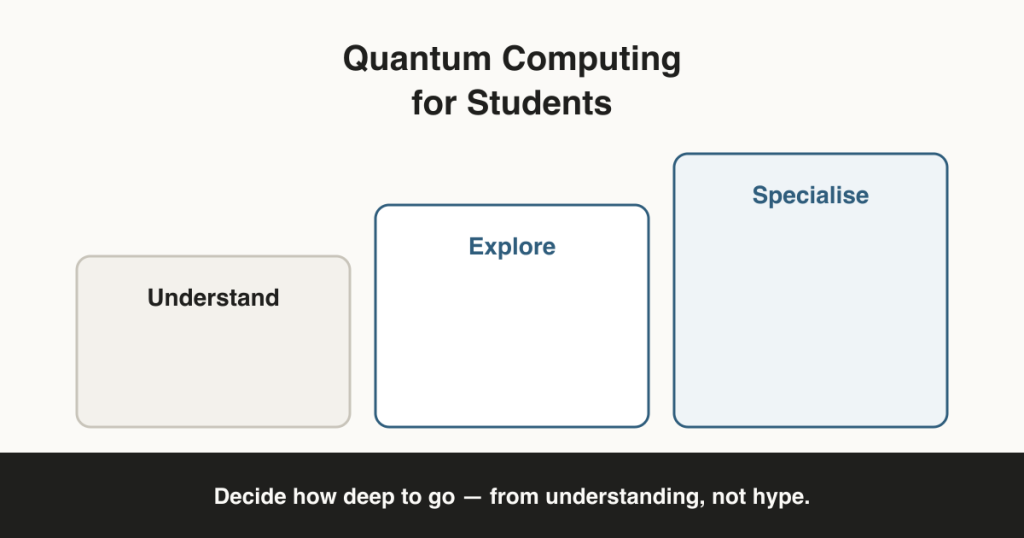
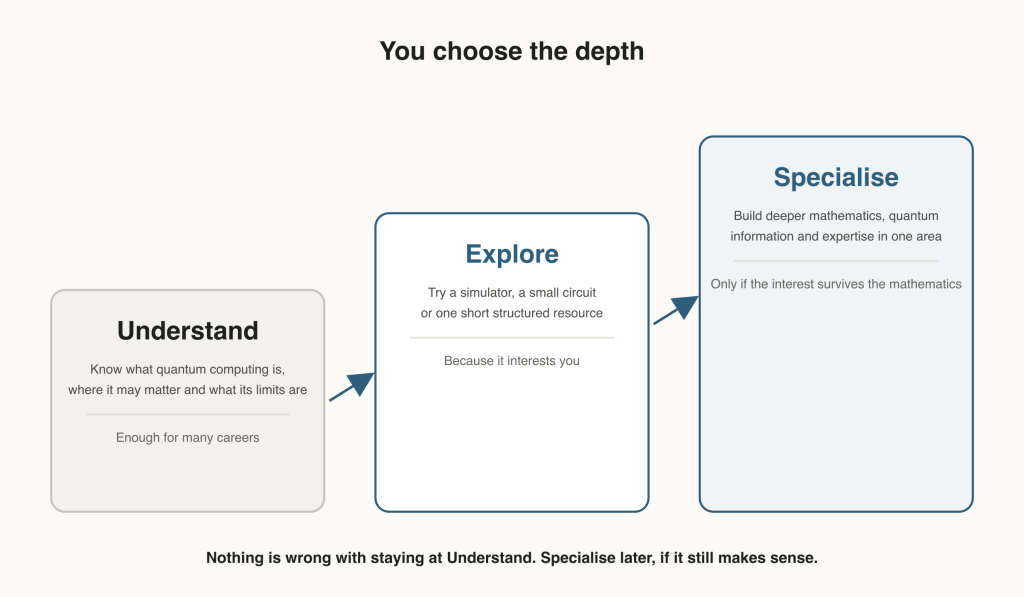
Understand → Explore → Specialise only if it makes sense for you.
A student is probably asking the same questions
Imagine a computer-science student.
She already knows some Python.
She is learning about AI because it is becoming relevant across software and technology.
Then she starts hearing about:
- qubits;
- quantum algorithms;
- quantum security;
- quantum machine learning;
- IBM Quantum;
- Google Quantum AI;
- new quantum processors.
Now she wonders:
Should I stop focusing on AI and learn quantum instead?
Do I need advanced physics?
Will quantum computing matter to my career?
Should I learn Qiskit?
Will understanding quantum give me an advantage?
Those are better questions than:
“Is quantum computing the future?”
A student does not need to predict the future.
The more useful question is:
How much quantum knowledge could strengthen the field I am already building expertise in?
You do not have to choose between AI and quantum computing
AI and quantum computing are different technologies.
They are also at very different levels of maturity.
AI already runs inside search engines, coding tools, business applications, smartphones, scientific systems and many other products.
Quantum computing is much earlier. Real quantum processors exist, but large fault-tolerant systems are still under development.
So if you are studying AI today, quantum computing is not a reason to abandon it.
And if you are interested in quantum computing, that does not make AI irrelevant.
In fact, the two fields increasingly intersect.
Where AI and quantum computing meet
There are two directions worth understanding.
AI can help quantum computing
Operating a quantum computer involves large amounts of control, calibration, measurement and analysis.
AI and machine-learning techniques can help researchers with tasks such as:
- tuning quantum devices;
- identifying patterns in hardware behaviour;
- improving control;
- analysing experimental results;
- modelling noise;
- helping optimise circuits.
So one important intersection is:
AI helping researchers build and operate better quantum systems.
Can quantum computing help AI?
Researchers are also exploring the opposite direction:
Could quantum algorithms improve some machine-learning tasks?
This area is usually called quantum machine learning, or QML.
Research includes areas such as:
- quantum kernels;
- variational quantum circuits;
- optimisation;
- quantum data;
- hybrid quantum-classical learning methods.
But this needs careful framing.
Quantum machine learning is still largely a research field. It is not a replacement for today’s AI systems.
IBM’s Quantum Machine Learning course provides a useful introduction to the area and how quantum methods may interact with existing machine-learning approaches.
For students, the useful mental model is not:
AI or quantum?
It is:
AI
Quantum computing
and potentially an intersection between the two
depending on where your interests and career eventually develop.
Quantum knowledge can complement the field you already study
One mistake would be to think:
“I need to become a quantum specialist or I will miss the opportunity.”
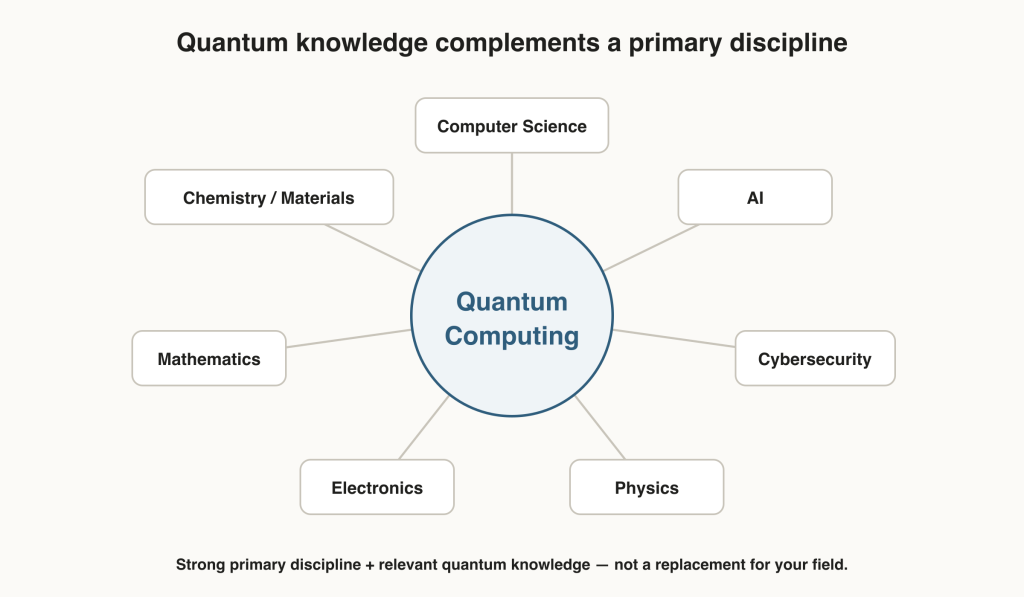
Quantum technology draws on many disciplines.
A more useful combination is often:
Strong primary discipline + relevant quantum knowledge
Computer Science + Quantum Computing
A computer-science student may eventually encounter:
- quantum algorithms;
- quantum software;
- compilers;
- simulators;
- developer tools;
- cloud platforms;
- classical-quantum integration.
The strongest foundation is still good computer science.
Cybersecurity + Quantum Computing
This intersection already matters.
A sufficiently capable future quantum computer could threaten some forms of today’s public-key cryptography.
That is why work on post-quantum cryptography is happening before large fault-tolerant quantum computers exist.
A cybersecurity student who understands cryptography, networks, security architecture and post-quantum standards may find quantum awareness increasingly useful without ever becoming a quantum programmer.
Physics + Quantum Computing
Physics students can go much deeper into:
- quantum information;
- quantum hardware;
- experimental systems;
- qubit technologies;
- error correction;
- fundamental research.
This path normally requires substantially more quantum mechanics than the average software student needs.
Electrical or Electronics Engineering + Quantum Computing
Quantum hardware also needs engineers.
Relevant areas can include:
- control electronics;
- signal processing;
- instrumentation;
- device engineering;
- cryogenic systems;
- testing and measurement.
Mathematics + Quantum Computing
Quantum algorithms are deeply connected with mathematics.
Students interested in areas such as linear algebra, probability, optimisation, number theory and computational complexity can find strong connections with quantum information and algorithms.
Chemistry or Materials Science + Quantum Computing
One of the long-term motivations for quantum computing is simulating quantum systems themselves.
That creates connections with:
- chemistry;
- molecular modelling;
- materials;
- catalysts;
- energy research.
The larger point is:
Quantum computing does not have to replace your field. It can become another capability inside your field.
What should most students actually understand?
You do not need to begin with advanced quantum mechanics.
For general awareness, it is useful to understand:
- what a qubit is;
- how it differs from a classical bit;
- what superposition means at a useful level;
- why interference matters;
- what entanglement means;
- what measurement does;
- what a quantum circuit is;
- why quantum computers make errors;
- physical versus logical qubits;
- why quantum computers are not faster at everything;
- why classical and quantum computers will often work together.
If you can explain those ideas clearly, you already understand substantially more than someone who simply knows that “quantum computers use qubits.”
If you want those ideas explained from the beginning, start with the foundation article in this series: Quantum Computing Is Not a Faster Supercomputer: Where It Fits and What Matters Today.
Do you need advanced mathematics?
Eventually, if you want to go deep.
Not necessarily on day one.
One of the most important mathematical foundations for quantum computing is linear algebra.
You will encounter ideas such as:
- vectors;
- matrices;
- complex numbers;
- probability;
- transformations.
MIT’s quantum-computation material lists linear algebra among the important prerequisites and notes that prior quantum mechanics can be helpful without being required for every entry point.
See MIT OpenCourseWare — Quantum Computation.
The depth you need depends on where you are going.
A cybersecurity student seeking quantum awareness does not need the same mathematical depth as someone researching quantum algorithms.
Do you need to know physics?
Again:
It depends on what you want to do.
If you want to understand quantum computing
You can start without advanced physics.
If you want to write basic quantum programs
You can also begin without becoming a quantum physicist.
If you want to study quantum algorithms seriously
You will need stronger mathematics and quantum-information foundations.
If you want to build quantum hardware or conduct experimental research
Physics becomes much more important.
So instead of asking:
“Does quantum computing require physics?”
ask:
How much physics does the direction I am interested in require?
What if I seriously want to master quantum computing?
Then the answer changes.
Quantum computing should no longer be treated as another framework to add to your résumé.
Mastery requires depth.
A serious learner will eventually need strong foundations across several areas.
Mathematics
Especially:
- linear algebra;
- probability;
- complex numbers;
- discrete mathematics;
- optimisation, depending on the area.
Computer science
Including:
- programming;
- algorithms;
- data structures;
- computational thinking;
- complexity.
Quantum information
Eventually you need to understand:
- quantum states;
- gates;
- circuits;
- measurement;
- entanglement;
- algorithms;
- noise;
- error correction;
- fault tolerance.
A deeper specialisation
At some point, serious study usually moves towards one or more areas such as:
- quantum algorithms;
- quantum software;
- hardware;
- error correction;
- quantum security;
- quantum chemistry;
- quantum machine learning;
- theoretical research.
Some research and hardware paths may require postgraduate-level education.
The important distinction is:
Mastering quantum computing means developing deep foundations and then specialising. It is not the same as learning one quantum SDK.
Understand, explore or specialise?
For most students, this is a better decision model than simply asking whether they should “learn quantum.”
| Level | What it means |
|---|---|
| Understand | Know what quantum computing is, where it may matter and what its limitations are |
| Explore | Try a simulator, simple circuits or a short structured learning resource |
| Specialise | Build deeper mathematics, quantum-information knowledge and expertise in a particular area |
There is nothing wrong with staying at Understand.
A cloud engineer, security professional or software developer may eventually need quantum awareness without becoming a quantum programmer.
There is also nothing wrong with moving to Explore simply because the subject interests you.
Specialisation should come later, when the interest survives contact with the actual mathematics, circuits and engineering.
Try the field before committing to it
Students sometimes decide whether they like a technology entirely by reading or watching videos about it.
Quantum computing is easier to judge once you try something small.
Return to our computer-science student.
She already knows some Python.
Instead of registering for several courses, she performs one experiment.
She creates a small quantum circuit.
Perhaps two qubits.
She uses a gate to place one qubit into superposition and connects the two qubits to create an entangled state.
She runs the circuit first on a simulator.
Then she runs the same circuit on real cloud-accessible quantum hardware.
The results are not perfectly identical.
Why?
Because real quantum hardware contains noise and errors.
Through one small experiment, she has now encountered:
- qubits;
- gates;
- circuits;
- superposition;
- entanglement;
- measurement;
- simulation;
- real hardware;
- quantum noise.
That tells her more about whether the subject genuinely interests her than reading another prediction about future quantum jobs.
Do not try to learn every quantum framework
Students entering AI often feel pressure to learn every framework.
Quantum computing can create the same problem.
You may encounter:
- Qiskit;
- Cirq;
- Q#;
- Amazon Braket;
- PennyLane.
You do not need to master all of them.
The concepts matter more than the syntax.
Choose one environment, understand the circuit model and learn why the program behaves as it does.
If you later need another framework, much of the conceptual knowledge transfers.
Study resources: where can you explore further?
This is not intended to be a complete quantum-computing curriculum.
These resources are starting points for students who want to move beyond awareness and explore the subject.
Learn — structured material
IBM Quantum Learning
IBM Quantum Learning provides structured material covering quantum foundations, quantum information, algorithms, error correction, Qiskit and related topics.
Useful for: students who want structured learning connected with practical quantum programming.
Microsoft Quantum
Microsoft provides a Quantum Computing Fundamentals learning path covering introductory concepts, Q# and quantum programming.
Useful for: students who prefer guided modules and want to see quantum computing from a software and cloud perspective.
MIT OpenCourseWare
MIT OpenCourseWare — Quantum Computation goes deeper into quantum algorithms, computation and error correction.
Useful for: students with stronger mathematical foundations who want university-level depth.
PennyLane Codebook
The PennyLane Foundations of Quantum Computing material combines concepts with hands-on coding exercises.
Useful for: students who learn better by experimenting while they study.
Watch — useful channels and video resources
Videos can make unfamiliar concepts easier to visualise.
But use them carefully:
Use YouTube to build intuition, not as your entire curriculum.
Watch a concept, then reinforce it through structured material or hands-on work.
Qiskit
The official Qiskit channel includes tutorials, lectures, coding demonstrations and quantum-information material.
Useful for: beginner-to-intermediate learning and seeing quantum circuits in practice.
Google Quantum AI
Google’s official channel includes material on quantum processors, algorithms, error correction and research.
Useful for: understanding what current quantum research and engineering look like once you know the basics.
Microsoft Quantum
Microsoft Quantum documentation and learning resources provide tutorials, Q# resources and related learning material.
Useful for: students interested in the software and cloud side of quantum computing.
Amazon Braket
Amazon Braket documentation includes examples and learning material covering simulators and multiple quantum-hardware approaches.
Useful for: understanding cloud-based quantum access and seeing that there is more than one type of quantum hardware.
Practice — if you want to touch the technology
IBM Quantum / Qiskit
IBM Quantum provides quantum-development tools and access to quantum processors.
A useful first experiment is simply:
Build a circuit → simulate it → run it on hardware → compare the results.
PennyLane
PennyLane Codebook provides interactive coding exercises.
It also becomes relevant later for students interested in areas such as quantum machine learning and quantum chemistry.
Amazon Braket
Amazon Braket — Getting Started provides access to simulators and different quantum-hardware technologies through a cloud environment.
You do not need to use every platform.
One is enough to discover whether you want to explore further.
Where could quantum knowledge give you an advantage?
Learning quantum computing does not guarantee a job.
The commercial quantum industry is still developing, and many specialised research positions require advanced academic preparation.
The advantage is broader.
You may understand an emerging technology earlier
If quantum technology increasingly appears around cloud platforms, cybersecurity, scientific computing or engineering, you are less likely to encounter it as a completely unfamiliar subject.
You may connect disciplines other people treat separately
Examples include:
AI + quantum
cybersecurity + quantum
cloud + quantum
chemistry + quantum simulation
electronics + quantum hardware
Technical careers often become interesting at the boundaries between disciplines.
You may make better career decisions
Someone who has actually explored quantum computing is better positioned to decide:
“This is interesting, but awareness is enough for me.”
or:
“I want to go much deeper.”
Both are useful outcomes.
You may develop a useful way of thinking
Quantum computing forces students to think carefully about:
- probability;
- algorithms;
- mathematical models;
- physical limitations;
- what computers can and cannot efficiently solve.
Those ideas remain useful even if your future job title never contains the word “quantum.”
What kinds of career areas exist?
Rather than focusing only on job titles, it is more useful to understand the types of work around quantum technology.
Quantum software and algorithms
For people with strong computer-science and mathematical foundations.
Quantum hardware and experimental systems
For students interested in physics, electronics, devices and laboratory research.
Error correction and quantum information
A technically deep area focused on making quantum computation reliable.
Quantum security
Includes post-quantum cryptography and the security transition created by potential future quantum threats.
Quantum applications
Research into areas such as chemistry, materials and scientific simulation.
Quantum machine learning
The intersection between machine learning and quantum computing.
This remains research-heavy and should not be treated as a replacement for mainstream AI.
Quantum platforms and infrastructure
As quantum processors are accessed through cloud and hybrid environments, conventional software, platform and infrastructure skills also become relevant.
The field therefore needs more than physicists.
But some directions require substantially deeper academic preparation than others.
Should you build your whole career around quantum computing?
Not necessarily.
Especially if you are still early in your education.
A safer principle is:
Build a strong primary discipline first, then use quantum knowledge as an additional capability where it becomes relevant.
If quantum computing develops more slowly than expected, your core skills remain valuable.
If it develops faster, you have a foundation from which to go deeper.
Quantum knowledge should increase your options, not narrow them too early.
What should students avoid?
Do not abandon fundamentals for a fashionable technology
Strong programming, mathematics, physics, engineering or security foundations remain useful regardless of how quickly quantum computing develops.
Do not collect certificates without understanding
A certificate shows that you completed material.
It does not automatically demonstrate deep understanding.
Do not try to learn every SDK
Learn concepts first.
Tools change.
Do not assume every quantum role requires a PhD
Software, platform, security and engineering roles can have different education requirements.
But do not assume advanced research is easy to enter either
Fundamental theory, hardware research and some algorithmic areas may require substantial mathematics, physics and postgraduate study.
Do not choose quantum because someone says it is “the future”
No one can guarantee how quickly fault-tolerant systems will develop or which applications will become commercially important.
Choose depth because the subject connects with your abilities and interests—not because of fear of missing out.
So how deep should you go?
Ask yourself three questions.
Do I mainly need to understand what is happening?
Stay at Understand.
Follow major developments and understand the foundations, error correction and security implications.
That may be enough for many careers.
Am I curious enough to try it?
Move to Explore.
Watch a reliable introduction.
Run one circuit.
Use a simulator.
Perhaps try real cloud hardware.
Then decide again.
Do I still want more after the novelty disappears?
Now Specialise may make sense.
Go deeper into mathematics, quantum information and whichever area genuinely interests you.
That is a much better reason to specialise than fear of missing out.
What should our student do?
Return to the student from the beginning.
She was worried that learning AI meant missing quantum computing.
She does not have to choose.
She continues building strong computer-science and AI foundations.
She learns enough quantum computing to understand:
- qubits;
- circuits;
- interference;
- entanglement;
- error correction;
- where quantum algorithms differ.
She runs one small experiment.
Then she discovers that the AI–quantum intersection interests her.
Maybe she goes deeper.
Maybe she does not.
Either way, she has gained something valuable:
She can make the decision from understanding rather than hype.
That is the real advantage students should seek.
What should you take away?
You do not need to become a quantum-computing specialist simply because the technology is important.
And you should not ignore it simply because large fault-tolerant quantum computers are not ready yet.
A more useful approach is:
Understand it.
Explore it if it connects with your interests.
Specialise only if you want the depth required.
Most importantly:
Build a strong primary discipline first. Quantum knowledge can then become an additional capability that expands where that discipline can take you.
AI and quantum computing are not necessarily competing career choices.
Cybersecurity and quantum computing are not separate worlds.
Physics, electronics, chemistry, cloud computing and mathematics can all intersect with quantum technology in different ways.
Students who understand those connections will be better prepared to recognise where the technology fits as the field develops—without having to bet their entire career on predicting its future.
References and learning resources
Quantum foundations and structured learning
- IBM Quantum Learning — Courses
- Microsoft Learn — Quantum Computing Fundamentals
- Microsoft Quantum Documentation
- MIT OpenCourseWare — Quantum Computation
- PennyLane — Foundations of Quantum Computing
- PennyLane Codebook
AI and quantum computing
- IBM Quantum Learning — Quantum Machine Learning
- IBM Research — Quantum Machine Learning
- Nature Computational Science — Challenges and opportunities in quantum machine learning
Cloud and hands-on exploration
YouTube and video resources
- Qiskit — YouTube
- Google Quantum AI — YouTube
- Microsoft Quantum learning resources
- Amazon Braket learning resources
Sources and learning resources reviewed for a first-week-of-May 2026 publication context. Course structures, platform access and external learning links should be rechecked if the publication date changes.