

Whenever a new AI model is released, the discussion quickly becomes a competition. Which model is faster? Which one is better at coding? Which one scored higher? Which one should you use?
Those comparisons are useful in some situations. But for most people, there is a more important question: What has actually changed?
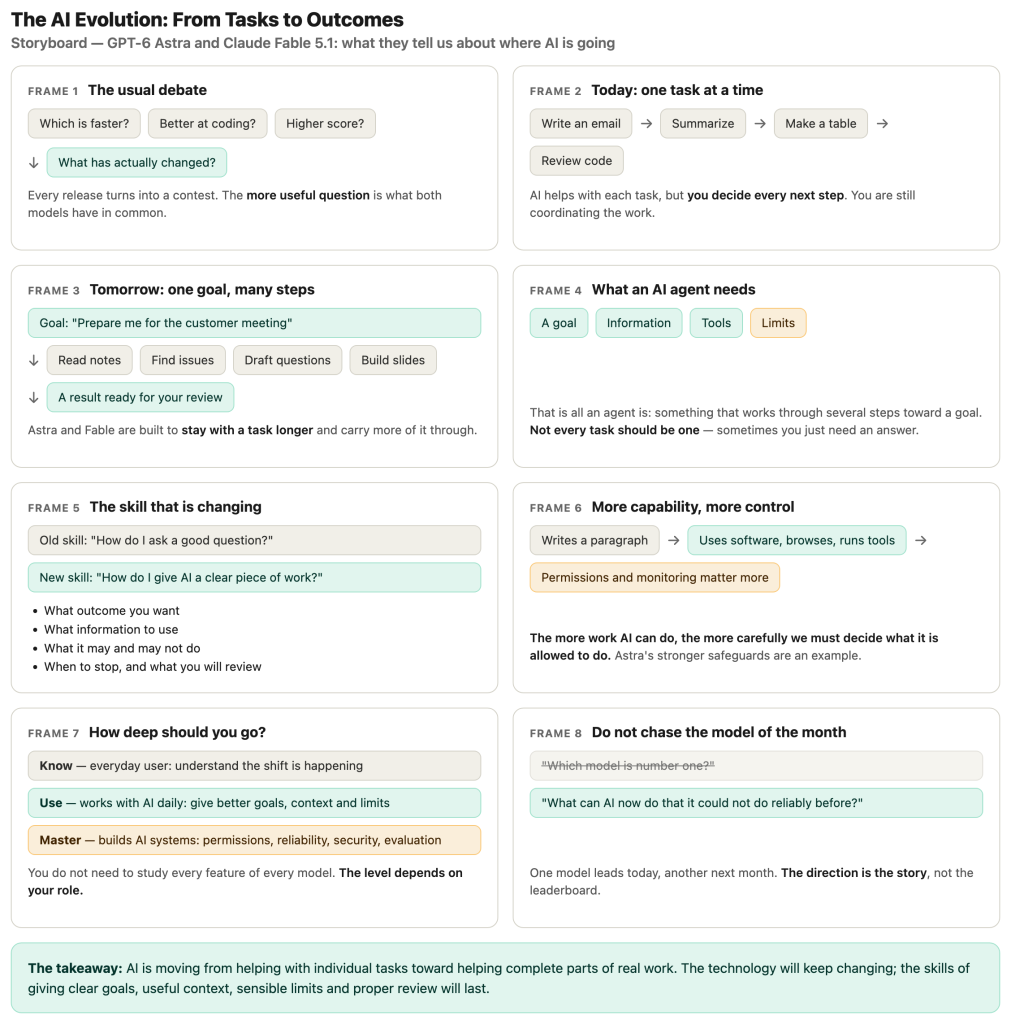
GPT-6 Astra and Claude Fable 5.1 are interesting because both show the same larger shift. AI is moving from "Ask me something and I will answer" toward "Give me a piece of work and I will help carry it through." That change matters more than which model wins a benchmark this month.
Until Now, We Mostly Used AI One Task at a Time
Think about how most people use AI today. You ask it to write an email. Then you ask it to summarize a document. Then you ask it to create a table. Then perhaps you ask it to review some code.
Each time, you decide the next step. The AI helps with individual tasks, but you are still coordinating the work. That is already useful. The newer generation of models is trying to go further.
The Bigger Change Is From Answers to Outcomes
Imagine you need to prepare for a customer meeting. Normally, you may read the customer notes, identify the important issues, prepare questions, create a short presentation, and organize everything before the meeting. AI can already help with each of those tasks separately.
But what happens if you give it the larger goal instead?
"Review the customer information, identify the important issues, prepare questions for the meeting, and create a short presentation for me to review."
Now the AI has to understand the goal, work through several steps, use the information available, and return something closer to a finished result. That is the direction these new models are moving toward.
OpenAI describes GPT-6 Astra as being designed for computer use, browsing, software development, research, documents, presentations, and other complex multi-step professional work. Anthropic describes Claude Fable 5.1 as its most capable model for coding and knowledge work, with stronger support for longer and more demanding tasks.
The important point is not that both models work in exactly the same way. They do not. The important point is that both companies are trying to answer a similar question: How can AI stay with a task for longer and help complete more of the work?
This Is Why AI Agents Matter
You may already have heard the term AI agent. The name can make the idea sound more complicated than it is. At a simple level, an AI agent is a system that can be given:
- a goal
- some information
- access to tools
- a set of limits
It can then work through several steps toward that goal. Astra and Fable are part of this broader move.
This does not mean every AI task should become an agent. Sometimes you only need an answer. Sometimes you only need a summary. Sometimes normal software is still better. The important change is that AI can now stay involved in a task for longer and do more between the first instruction and the final result.
Why Should a Normal User Care?
Because the way we use AI is starting to change. Until now, one useful skill has been: How do I ask AI a good question? That still matters. But another skill is becoming more important: How do I give AI a clear piece of work?
If AI is going to handle several steps, you need to think differently. You need to explain:
- what outcome you want
- what information it should use
- what it is allowed to do
- what it should not do
- when it should stop
- what you need to review
This is a much more useful lesson than memorizing which model scored highest on a particular test.
More Capability Also Means More Control
There is another side to this progress. An AI that only writes a paragraph has limited ability to affect anything outside that conversation. An AI that can use software, access systems, browse, run tools, or work with sensitive information is different. The more it can do, the more important permissions and limits become.
OpenAI says Astra has reached a higher level of cybersecurity capability and therefore requires stronger safeguards and monitoring. You do not need to understand the technical safety framework to understand the lesson: The more work AI can do, the more carefully we must decide what it is allowed to do.
This matters to developers. It matters to security teams. It matters to companies. And as these systems become more common, it will increasingly matter to ordinary users too.
Do You Need to Learn Astra or Fable?
Probably not in the way you may be thinking. You do not need to study every feature of every new model. Another model will come. Then another.
Instead, learn what is changing underneath them. AI systems are becoming better at:
- understanding a larger goal
- working through several connected steps
- using tools
- handling more information
- staying with a task for longer
- producing a more complete result
That is the part worth understanding.
If you are a normal AI user, you mainly need to know this change is happening. If you use AI regularly at work, you may need to use these capabilities and learn how to give AI better goals, context, and limits. If you build AI systems, you may need to master deeper areas such as permissions, reliability, security, tool use, and evaluation. The level depends on your role.
Do Not Chase the Model of the Month
This is where many people can easily lose direction. One model may lead today. Another may lead next month. A benchmark may favour Astra. Another test may favour Fable. That matters when someone is choosing a model for a specific technical need. But it is not the most important lesson for everyone.
Instead of asking "Which model is number one?" ask "What can AI now do that it could not do reliably before?" That question tells you much more about where the technology is going.
What Should You Take Away From This?
You do not need to become an expert in GPT-6 Astra or Claude Fable 5.1. You should understand the direction they represent. AI started by helping us answer questions. Then it became better at helping with individual tasks. Now it is becoming better at handling connected pieces of work.
That means people will need to become better at giving AI clear goals, useful context, sensible limits, and proper review. The technology may change. Those skills are likely to remain useful.
Final Thought
GPT-6 Astra and Claude Fable 5.1 will be compared in many ways. Speed. Coding. Research. Benchmarks. Price. Those comparisons have value.
But the bigger story is simpler. AI is moving from helping with individual tasks toward helping complete parts of real work. That does not mean we should hand everything over to AI. It means we need to understand where it is useful, where it needs limits, and where human judgement still matters.
Do not focus only on which model is better. Understand what these models are becoming capable of doing, and decide where that capability is useful to you.