

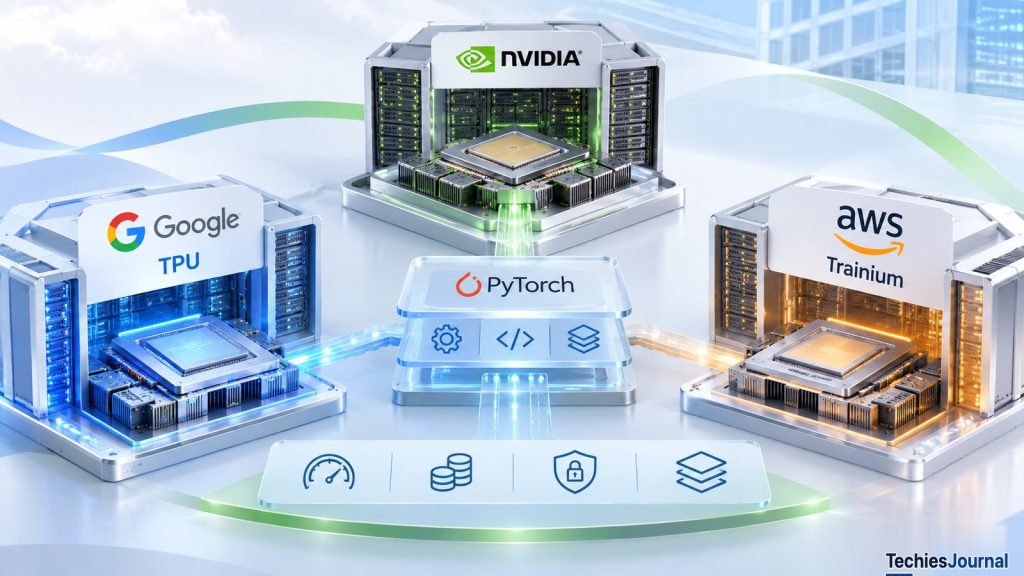
Google’s newest TPU systems and improvements in PyTorch support are creating more options for AI computing. But reducing dependence on NVIDIA requires more than choosing a different processor.
Why organizations are looking beyond NVIDIA
Imagine a company operating an AI assistant that helps employees search internal documents, answer questions and complete routine tasks. The assistant runs on NVIDIA GPUs. Its developers use PyTorch and libraries optimized for NVIDIA’s computing platform.
As the service expands, the company needs more processing capacity. Its architects want to know whether alternative hardware can deliver the required service at a lower total cost without sacrificing reliability or their previous engineering investment.
Google offers Tensor Processing Units (TPUs), specialized processors for machine-learning workloads. AWS offers Trainium, another family of AI accelerators. Both providers are improving support for familiar development frameworks. Google’s announcement of TPU 8tx and TPU 8i Max on November 9, 2026 makes the question timely, but the deeper change is whether organizations can operate suitable AI workloads without relying exclusively on NVIDIA.
Why NVIDIA is difficult to replace
Graphics processing units (GPUs) became important to AI because they can perform many calculations in parallel. That makes them useful for training neural networks and for inference, which means using a trained model to produce results.
NVIDIA’s advantage extends beyond its processors. CUDA, its parallel computing platform, provides programming tools and optimized libraries. AI frameworks, custom operations, inference engines and deployment tools have become closely integrated with that ecosystem. A PyTorch application may therefore depend on NVIDIA-specific components even when its developers rarely write CUDA code directly.
Moving the application to another accelerator requires more than matching the GPU’s compute performance. The model, dependent libraries, memory requirements and operating tools must work correctly and efficiently on the alternative hardware. That is why NVIDIA is not easily replaced.
For processor fundamentals, see TechiesJournal’s CPU vs GPU vs TPU vs NPU vs LPU vs DPU explainer.
What Google’s new TPU systems change
On November 9, 2026, Google announced TPU 8tx and TPU 8i Max, expanding its eighth-generation TPU portfolio.
| TPU system | Intended workload |
|---|---|
| TPU 8t | Large-scale model training |
| TPU 8i | Real-time inference and reasoning |
| TPU 8tx | Confidential inference and sensitive AI workloads |
| TPU 8i Max | Large-context workloads and increased compute density |
These are not four interchangeable versions of one processor. Google is adapting hardware systems, including packaging, memory, networking and security, to different AI workloads. Google says TPU 8tx uses the same silicon as TPU 8t and that TPU 8i Max packages two existing TPU 8i chips, so these are new system configurations rather than new chip architectures.
TPU 8tx: Protecting sensitive workloads
Consider a financial institution using an AI model to process sensitive customer records. Protecting data in storage and transit matters, but the institution may also need protections while the model processes that information.
Confidential computing uses hardware-supported isolation and protection mechanisms to reduce unauthorized access during execution. Google says TPU 8tx offers such capabilities for supported inference workloads, alongside private model customization and selected training use cases.
Confidential computing does not guarantee end-to-end application security. Identity, permissions, model behavior and deployment configuration remain separate responsibilities.
TPU 8i Max: Supporting demanding context workloads
An AI agent processing extensive documents or software repositories may be constrained by memory capacity and the speed at which information moves between memory and compute components.
Google combines two TPU 8i chips in one package for TPU 8i Max. The company reports twice the compute, on-chip SRAM and high-bandwidth memory bandwidth of a single TPU 8i. These comparisons are within Google’s own portfolio. They do not establish an advantage over an equivalent NVIDIA deployment.
Announced does not mean universally available
The announcement describes intended capabilities. It does not establish general customer availability for every configuration, location or deployment model. Buyers must confirm eligibility, capacity, supported software, pricing and commercial access before planning a migration.
Source: Google, November 9, 2026.
Why PyTorch support may matter more than the chips
An accelerator becomes useful to developers when their applications can run on it. On October 20, 2026, the PyTorch project announced TorchTPU, an open-source collaboration between Google and Meta. TorchTPU introduces a native PyTorch backend for Google’s TPUs and aims to reduce the need to rebuild applications around another machine-learning framework.
The project is actively evolving. Its developers describe production use for certain training and inference workloads, but that is not a guarantee of compatibility or production readiness for every model.
Running a model is not the same as optimizing it
Return to the company’s AI assistant. Suppose its existing PyTorch model uses NVIDIA GPUs. For a supported configuration, changing the execution device may let the model run on TPUs and produce correct answers. TorchTPU’s own description is that porting can be as simple as changing model.to("cuda") to model.to("tpu"), with the caveat that peak performance needs more. That is a useful starting point, not the end of the migration.
The original model might use GPU-specific custom kernels, particular memory layouts or a strategy for splitting its layers across processors. On TPU hardware, a different sharding strategy may be needed to make efficient use of memory and accelerator communication. An operation that executes correctly might still perform poorly without tuning.
TorchTPU’s technical discussion identifies model shapes, sharding and operations as practical optimization considerations. It also notes that the XLA compiler expects tensor shapes to be known at compile time and says support for varying shapes is still in active development. Framework compatibility makes a workload possible to run. Performance portability requires the whole system to run efficiently without disproportionate redevelopment.
Source: PyTorch, October 20, 2026.
Accessible text alternative for this figure
Your PyTorch model can be sent to an NVIDIA GPU with model.to("cuda"), using CUDA libraries and GPU kernels.
Or it can be sent to a Google TPU with model.to("tpu"), using the TorchTPU backend and the XLA compiler. The model runs.
Peak speed still needs tuning: model shapes, sharding and GPU-specific kernels.
AWS is developing a similar alternative
AWS is pursuing a related approach through Trainium. On October 20, 2026 it announced TorchNeuron, a native PyTorch backend intended for supported Trainium infrastructure. It supports familiar PyTorch development patterns, including eager execution and compilation.
AWS launched TorchNeuron as a public beta for Trainium2 and Trainium3. This status matters for support expectations and production planning. TorchNeuron and TorchTPU reduce some software adoption barriers, but they do not make Google’s and AWS’s accelerators interchangeable. Hardware, compilers, supported operations and deployment environments differ.
Source: AWS, October 20, 2026.
NVIDIA is competing through complete systems
NVIDIA is also adapting to demanding AI workloads. Its Dynamo 1.0 inference framework, announced as production-ready in March 2026, addresses distributed execution, request routing and more efficient use of memory across GPU systems.
NVIDIA’s Rubin architecture targets reasoning and long-context inference through improvements in compute, memory and interconnects. Its published performance figures are vendor-reported claims and should not be interpreted as universally achieved results.
This is competition between accelerator platforms, including hardware, programming interfaces, inference software and networking, rather than between isolated processors. TechiesJournal’s AWS and NVIDIA infrastructure expansion article offers additional cloud investment context.
Sources: NVIDIA Dynamo, March 16, 2026 and Rubin architecture, July 21, 2026.
How to decide whether an alternative is worthwhile
The company’s architects now want to compare their established NVIDIA deployment with an available, supported TPU configuration. They need to test equivalent workloads rather than compare isolated chip specifications. Both systems should deliver acceptable model quality using the same model, or configurations whose differences are recorded transparently.
| Evaluation factor | What to measure |
|---|---|
| Correctness | Output quality and supported operations |
| Latency | Time to first token and complete response |
| Throughput | Useful work at the required concurrency |
| Memory | Capacity, bandwidth and long-context behavior |
| Cost | Total cost for an equivalent service |
| Migration | Code changes, tuning and engineering effort |
| Operations | Monitoring, support, availability and troubleshooting |
A lower hourly price may still produce a higher service cost if the workload runs inefficiently. A more expensive system may be economical when it delivers more useful work within the required service limits. Published benchmarks help select candidates, but differences in model, precision, context length and concurrency can make headline results incomparable.
Replacing one dependency may introduce another
Moving to TPUs can reduce reliance on CUDA and NVIDIA hardware while increasing dependence on Google Cloud, TPU-specific tooling or supported deployment options. Trainium can create similar dependencies within AWS.
Hardware independence means having a viable alternative to one accelerator ecosystem. Cloud portability means being able to move an application between cloud environments without excessive redesign and operational disruption. One does not guarantee the other.
An organization committed to one provider may accept specialized integration for measurable gains. A multi-cloud organization may value portability more. Neither objective should be pursued without considering its cost.
Will NVIDIA lose market share?
The appearance of credible options does not, by itself, establish a financial loss for NVIDIA. Three outcomes are distinct.
Choice means a customer can consider another accelerator. Substitution means that customer actually moves a supported workload. Financial displacement means the move reduces NVIDIA purchases relative to what otherwise would have happened.
The AI computing market may expand enough for NVIDIA GPUs and custom accelerators to grow at the same time. NVIDIA’s software ecosystem and installed base remain advantages. Present evidence cannot support a specific market-share forecast caused by TPU 8tx or TPU 8i Max.
What developers and cloud architects should do now
Existing teams should first identify CUDA-specific kernels, inference libraries, model-serving dependencies and GPU-oriented operational tools. New systems should shortlist accelerator options according to model requirements, available capacity, latency, security and total cost.
Where potential benefits justify the effort, conduct a limited benchmark against a reliable baseline. Record whether the model runs, how well it performs, what engineering work it requires and whether the operating model is supportable.
Google’s TPU expansion and improving framework support make accelerator alternatives more practical for selected workloads. Whether switching is worthwhile must be decided using compatibility, measured performance, total cost and the new dependencies it introduces.
Go deeper
- Google: Our newest TPUs, 8tx and 8i Max (November 9, 2026).
- PyTorch: Introducing TorchTPU (October 20, 2026).
- AWS: Native PyTorch Support for AWS Trainium (October 20, 2026).
- NVIDIA: Dynamo 1.0 Production-Scale Inference (March 16, 2026).
- NVIDIA: Inside Rubin GPU Architecture (July 21, 2026).
Sources were read on November 13, 2026. Product availability, maturity and vendor claims can change.