

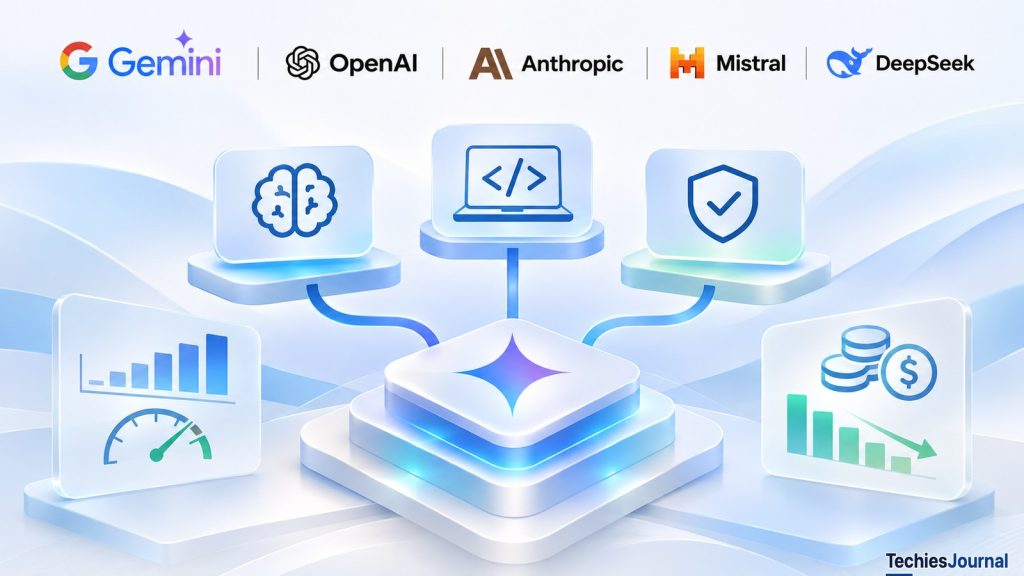
Google’s execution-focused AI model invites an architectural question: should an application use one capable model throughout a workflow, or split the work between models with different strengths?
Imagine asking an AI coding assistant to introduce role-based access control into an existing application. It needs to locate authentication code, understand which services enforce permissions, plan the change, write code and verify that ordinary users cannot perform administrative actions.
One capable model could attempt all of this. But understanding a security boundary is different from applying a well-defined code change or running an existing test. Does every step need the same reasoning capability, and should it have the same price?
Google’s November 12, 2026 announcement of Gemini 4 Hydrogen puts this question in focus. Google positions Hydrogen for rapid coding and agentic execution while its Gemini 4 Carbon and Argon models focus on demanding reasoning. Its Antigravity Orchestrator can switch models during a workflow. Google’s announcement describes the approach, but a product demonstration is not proof that it is the best architecture for every application.
The practical question is when does an additional model help enough to justify another boundary, another call and another way for the system to fail?
Why one AI model may not be enough
A development team often chooses an AI model by evaluating reasoning, coding ability, response time, context size and price. It then uses that model for the whole application. This is a sensible default: integration is simpler, fewer moving parts need monitoring, and the model can retain a consistent working context.
Real workflows, however, contain different kinds of work. Our coding assistant must interpret a requirement, discover relevant files, determine where authorization belongs, edit components and interpret test failures. The architectural decision is not equivalent to a file lookup. A model strong at difficult reasoning may cost more than necessary for routine execution, while a cheaper model may be fast but overlook a dependency that matters.
This opens the possibility of task-level model allocation: assign a more capable model to difficult decisions and a different model to bounded execution. It is not a requirement to run several models in parallel. It may involve switching models only when a task crosses a defined complexity or uncertainty threshold.
The apparent saving comes with an obligation: the application must still deliver a correct result, not merely cheaper individual responses.
What Google introduced with Gemini 4 Hydrogen
Google describes Hydrogen as an execution-focused model for iterative coding, debugging, tool use and multimodal knowledge work. Its model card says it is adapted from Gemini 4 Carbon. It accepts text, images, audio and video, with a combined context window of up to one million tokens. Default synchronous output is limited to 64,000 tokens, while Google’s background long-decode option goes up to one million. These are not interchangeable claims about ordinary API output.
Hydrogen provides four thinking levels (low, medium, high and xhigh), and Google lists standard API rates of US$1.50 per million input tokens and US$7.50 per million output tokens. Google says it is distributed through the Gemini API, AI Studio, Antigravity and additional Google products. Actual access, quotas and applicable commercial terms should be checked for the product and account being used.
In Antigravity, Google says Orchestrator can switch between models such as Carbon and Hydrogen in one development session. Carbon may handle difficult planning while Hydrogen performs implementation or verification steps. Google reports near-Carbon task success on Terminal-Bench 4.0 with 24% less quota consumed and 19% faster completion on average. Google does not say which thinking level or setup it used, or how many tasks. Those are Google’s results, and the quota figure is not automatically a 24% reduction in an organization’s invoice. Orchestrator is part of Google Antigravity, which Google makes available to paid Google AI Pro and Ultra subscribers. Launch announcement.
Model routing and specialized agents were already established design patterns. Hydrogen is a new option in that architecture, not the invention of multi-model AI.
One model versus several: a practical example
Return to the role-based access-control feature. The request is to let administrators manage roles without allowing normal users to invoke administrative endpoints.
One-model workflow. A coding assistant reads the repository, identifies affected functions, proposes and applies changes, runs tests and investigates failures. Its advantage is continuity: one model and one primary execution history. Its disadvantage may be the use of expensive reasoning on simple subtasks. That cost matters only if the workload is frequent enough and sufficiently expensive to justify optimization.
Planner-worker workflow. A stronger model identifies authorization rules, affected API handlers, background workers and data dependencies. It passes a bounded task (including the permitted files, security invariants and test expectations) to an execution model. The worker implements the change. A verifier checks the result, and unexpected design questions return to the planner rather than being decided silently by the worker.
Accessible text alternative for this figure
One model: Read the repository, Plan the change, Edit the code, Run access tests, Approve if tests pass.
Planner, worker and verifier: Planner sets the rules, Worker edits the code, Verifier checks the result, Run access tests, Approve if tests pass.
Both designs end with deterministic access-control tests. The three roles are not necessarily three different models.
That second workflow can be efficient, but it introduces a dangerous failure mode. Suppose the planner forgets that a background job also enforces permissions. A worker could implement the written task perfectly while leaving the job exposed. A verifier using the same incomplete brief might approve it.
The solution is not simply another AI reviewer. The application needs authoritative requirements and deterministic access-control tests, including negative tests showing that unauthorized users are denied. AI can help propose and examine changes, but permission enforcement belongs to the software and its deployment controls.
How multi-model orchestration works
An orchestrator assigns tasks, provides relevant context, coordinates tool calls, captures results and decides when to retry, escalate or stop. A common pattern has three roles:
- Planner: interprets the request, examines dependencies and establishes implementation boundaries.
- Worker: performs bounded activities such as editing code, retrieving evidence or investigating a test failure.
- Verifier: checks output against the task and reports missing evidence or defects.
These are roles, not necessarily three different models. A single model can fill multiple roles, and tests or policy engines may perform important verification without an AI model.
There are useful variations. In sequential routing, one stage hands work to the next. In parallel execution, independent workers act in isolated workspaces and results are integrated afterward. In escalation routing, a lower-cost model handles routine requests but routes uncertain cases to a stronger model.
An even simpler alternative is to keep one model and vary its thinking effort. Hydrogen’s four levels make that an explicit choice. Before building an orchestrator, test whether a lower thinking level can handle routine work while the high level handles hard cases.
This article addresses task-level orchestration. For broader questions about centralized credentials, model eligibility, quotas and provider policies, TechiesJournal’s API Gateway vs AI Gateway explains a different architectural boundary. A gateway can control which models an application is allowed to call. It does not, by itself, determine how application tasks should be planned or verified.
Does using multiple models actually save money?
The price of a single request is not the cost of completing a workflow. A planner-worker design may send fewer expensive requests, but it also transfers context, consumes extra tokens during coordination, retries failures and performs verification.
Consider a fictional workload in which the single-model approach costs $0.40 per successfully completed task. A second architecture appears to cost $0.25 in planning and worker calls, but retry and review overhead raise the final cost to $0.38. Its apparent 37.5% saving falls to 5%. These numbers are illustrative, not Hydrogen measurements.
Latency works similarly. Parallel independent tasks may finish earlier. Sequential handoffs may make a task slower. The useful measures are cost per correct completed task, end-to-end elapsed time, failure rate and human intervention. Counting only input/output token prices can hide expensive rework.
Thinking effort also changes economics. Independent measurements by Artificial Analysis report the following for Hydrogen, as listed on November 13, 2026 (the pages give no measurement date):
| Thinking setting | Intelligence Index | Cost per evaluated task | Time per evaluated task |
|---|---|---|---|
| High | 51 | US$1.87 | 7.9 minutes |
| Xhigh | 54 | US$3.16 | 13.7 minutes |
These times and costs refer to Artificial Analysis Intelligence Index tasks, not ordinary coding requests. Xhigh improves the index by three points while increasing measured cost by about 69% and time by about 73%. The correct choice depends on whether the additional reasoning actually improves the outcome for the application. High measurement · Xhigh measurement.
How Hydrogen compares with models from other vendors
Google is not alone in offering different models for different tasks. The choices include other coding-capable models and smaller options suited to routing, extraction and repeated low-risk operations. The table below gives published standard API rates in US dollars per million input/output tokens, as reviewed November 13, 2026. Provider-specific conditions, caching, tool charges, tokenization and service tiers may affect actual costs.
| Model and provider | Input / output | Relevant use or distinction |
|---|---|---|
| Gemini 4 Hydrogen (Google) | $1.50 / $7.50 | Execution-focused coding, agents, configurable thinking |
| GPT-6.1 Sol (OpenAI) | $2.00 / $10.00 | Near-Astra performance for complex work at a lower cost, per OpenAI |
| Claude Sonnet 5.5 (Anthropic) | $2.00 / $10.00 | Balance of speed and intelligence, per Anthropic |
| Mistral Small 4 (Mistral) | $0.15 / $0.60 | Hybrid reasoning and coding, Apache 2.0 licence, open weights |
| DeepSeek V4.1 Flash 1017 (hosted by Mistral) | $0.30 / $1.20 | Third-party hosted long-context coding model, public preview |
Rates and roles: Google, OpenAI, Anthropic, Mistral Small 4, Mistral-hosted DeepSeek. The DeepSeek row is Mistral hosting pricing, not verified direct DeepSeek API pricing. The rows do not imply identical benchmark performance or equivalent service terms.
OpenAI offers GPT-6 Astra for demanding work, GPT-6.1 Sol for a cost/capability balance and GPT-6 Luna for high-volume focused work. The latter is listed at $0.10 input and $0.50 output per million tokens, but low price does not prove it can replace a stronger coding agent. The developer should compare actual task-success rates. OpenAI model catalog.
Anthropic similarly distinguishes Sonnet 5.5 from Haiku 5.5, which Anthropic positions for high-volume, latency-sensitive tasks such as classification, extraction and routing. Anthropic lists Haiku from $0.10 input and $0.50 output per million tokens. Different tokenizers and effort settings complicate comparisons based on list price alone. Anthropic models.
Mistral Small 4 adds a different dimension: open weights and deployment flexibility. Organizations may evaluate self-hosting, but servers, utilization, monitoring and maintenance are real costs. Low API pricing and open licensing are not the same as a guarantee of low total cost. Mistral documentation.
DeepSeek V4.1 Flash 1017 is the updated October 17 release served under deepseek-flash in DeepSeek’s API, according to its change log. Mistral also offers it as a third-party public-preview model without Mistral modifications. Those offerings can have different prices and operational conditions. We should not treat a DeepSeek-reported Terminal-Bench 4.0 result as directly comparable to another vendor’s Terminal-Bench 4.1 score.
The decision is not which vendor wins a general leaderboard. It is whether a particular model performs the chosen role reliably with the intended tools and security boundaries. Sometimes the best design uses one provider and multiple tiers. Sometimes a separate vendor adds value. Cross-vendor operation also adds API, privacy, availability and troubleshooting complexity.
Where multi-model orchestration can fail
A second model introduces a second interpretation of the task. Requirements can be lost when the planner reduces the original problem to a brief. Workers can produce compatible-looking code while violating an omitted constraint. Parallel agents can edit conflicting interfaces, and reviewers can share the same mistaken premise as the author of the code.
The orchestrator therefore needs an explicit task contract, bounded permissions, evidence of each tool action, escalation rules and a reliable way to identify the exact changes being tested. A model should not be allowed to approve its own production deployment merely because its generated explanation sounds convincing.
Google’s model card also documents remaining hallucination, slowness, timeout and elevated-token-use risks. In internal automated safety evaluations compared with Gemini 3.8 Flash, Google reports a 5.57-percentage-point increase in unjustified refusals. Google says subsequent manual review found most flagged losses were false positives or not egregious. Both parts matter: the automated regression is real as reported, but it is not evidence of equivalent real-world harm.
For a broader discussion of why capable agents still need independent accountability, see TechiesJournal’s AI Is Getting Better at Doing the Work. But Is It Ready to Own the Outcome?. This article’s narrower question is which model should do which part of the task, not who ultimately owns production outcomes.
What the benchmarks do and do not establish
Google’s model card reports 57.0% for Hydrogen on cheating-adjusted Terminal-Bench 4.1, alongside 63.9% for Claude Sonnet 5.5. Hydrogen does better on certain other reported evaluations. On Agents’ Last Exam v1.1 the card lists 71.6% for Hydrogen against 60.4% for Claude Sonnet 5.5, and Hydrogen also leads on selected multimodal tasks. A model can lead in one workload and trail in another without contradiction. Google model card.
The methodology report identifies different evaluation harnesses and configurations. For instance, Google’s Terminal-Bench 4.1 result uses five attempts per task averaged under a specified harness, while several competitor results come from public leaderboards or vendor reports. This matters when a headline number is presented without the test conditions.
Artificial Analysis independently measures some of Hydrogen’s intelligence, speed and cost characteristics, but those measurements also represent a defined benchmark, not a guarantee about a private application repository.
The evidence supports a narrower conclusion: Hydrogen is a credible option for execution-focused workflows, and Google’s orchestration experiment suggests a possible efficiency benefit. It does not prove that model routing is universally cheaper, more reliable or safer. Applications still need their own evaluation on representative tasks.
How developers should choose an architecture
Start with one model and a small set of representative tasks. For our role-based access-control scenario, include a normal implementation case, one with a hidden dependency and one that must be rejected because the requested operation exceeds permissions. Use the same codebase, tools, requirements and success criteria in every comparison.
Record whether the assistant found the affected boundaries, whether authorization tests passed, total elapsed time, actual provider charges, retries and any human correction. Then try a lower reasoning setting or a cheaper model on a bounded stage. Only if the results justify it, add a planner-worker handoff.
| Situation | Sensible starting approach |
|---|---|
| Small or infrequent task | One capable model |
| High-volume extraction or classification | Lower-cost model tested for accuracy |
| Complex planning with predictable implementation | Evaluate planner-worker separation |
| Independent tasks with controlled interfaces | Consider parallel workers |
| Security-sensitive or production-changing actions | Deterministic checks and required authorization regardless of model count |
| Uncertain requirements or limited engineering capacity | Keep the simpler architecture until evidence favors change |
If routing is introduced, record which model handled each task, why it was selected and what evidence justified acceptance. Otherwise, cost and reliability problems become hard to diagnose.
What developers should do next
Hydrogen reflects a real direction in AI systems: developers can select models and reasoning settings for different kinds of work rather than treating all requests as equal. Google has made that division more explicit with an execution-focused model and Antigravity Orchestrator.
But more options do not remove the engineer’s responsibility to choose well. A multi-model design that saves tokens but loses critical requirements is not an improvement. A single model that completes the workload reliably at acceptable cost may be the better architecture.
Begin with the business or engineering task. Establish a measurable baseline, examine where reasoning effort is useful and test the smallest change that could improve the outcome. Add orchestration only if the evidence shows that the extra boundaries are worthwhile.
The goal is not to use more AI models. It is to apply the right capability to the right work, and make every added layer earn its place.
References and further reading
- Google: Introducing Gemini 4 Hydrogen (12 November 2026): positioning, pricing and Orchestrator claims.
- Google DeepMind: Gemini 4 Hydrogen model card (12 November 2026): architecture, context, benchmark outcomes, limitations and safety data.
- Google DeepMind: Hydrogen evaluation methodology (November 2026): harnesses, scoring methods and comparison limits.
- Artificial Analysis: Hydrogen high and Hydrogen xhigh: independent intelligence, cost and duration measurements.
- OpenAI: API model catalog: official model positions and listed token prices.
- Anthropic: Model overview: Claude tiers, workloads and pricing.
- Mistral: Small 4 specifications: model capabilities, licensing and prices.
- DeepSeek: API change log and Mistral: hosted DeepSeek V4.1 Flash: version and hosting-specific details.
Sources were read on November 13, 2026. Vendor prices, model terms and availability can change.