

GLM-5.3 is not the world’s most capable cyber model. What makes it important is that meaningful vulnerability-discovery and exploit-development capability is becoming downloadable. Here is what that changes for defenders.
Some of the most capable AI models come with an important limitation: you normally use them through somebody else’s service.
You send a request to an API. The provider runs the model. It can monitor usage, restrict certain requests, change safeguards or suspend access.
An open-weight model changes that relationship.
Once the weights are released, an organization or individual can run the model on their own infrastructure, connect it to their own tools and modify how it behaves. The original provider no longer controls every interaction.
That difference matters much more when the model can do more than write ordinary software.
GLM-5.3 is a useful example.
In September 2026, the U.S. National Institute of Standards and Technology’s Center for AI Standards and Innovation, or CAISI, described GLM-5.3 as the most cyber-capable open-weight model it had evaluated.
It can find software vulnerabilities and work through parts of exploit development that require substantial technical knowledge.
But there is an equally important qualification.
GLM-5.3 is not the world’s most capable cyber model. NIST’s evaluation still placed it significantly behind the leading U.S. frontier models it tested.
So why does it matter?
Because the important change is not that an open model has won the AI race.
It is that a meaningful level of advanced cyber capability can now be downloaded.
For defenders, that changes both the opportunity and the risk.
What has actually changed?
AI-assisted cybersecurity is not new.
Developers already use AI to inspect code, explain suspicious behaviour and review patches. Security teams use it to summarize alerts, investigate vulnerabilities and support security research.
GLM-5.3 moves farther along that path.
Its developer, Z.ai, says vulnerability-discovery data and environments were deliberately included during post-training.
More importantly, independent testing supports the broader capability claim.
NIST evaluated GLM-5.3 across four benchmarks covering vulnerability discovery and exploit development.
| Cyber evaluation | GLM-5.3 | U.S. frontier best in NIST evaluation |
|---|---|---|
| SEC-Bench Pro | 40.4% | 90.2% |
| ExploitBench | 61.1% | 100% |
| ExploitGym | 9.4% | 44.4% |
| CAISI OSS-Fuzz | 7.7% | 23.2% |
How to read this table: “U.S. frontier best” is the best result achieved by any released U.S. model CAISI evaluated on each benchmark. It does not represent one model across all four rows. Where applicable, U.S. models were tested with cyber safeguards disabled.
Source: NIST Center for AI Standards and Innovation, September 17, 2026.
The comparison needs careful interpretation.
The U.S. frontier column is not one model. It represents the best result obtained by a released U.S. model on each benchmark that CAISI had evaluated. Where applicable, those models were also tested with cyber safeguards disabled.
NIST’s aggregate analysis estimated GLM-5.3 to be roughly four months behind the current U.S. frontier in cyber capability.
So the evidence does not show that open models have caught the frontier.
It shows that the level available through open weights has moved forward substantially.
Why does “downloadable” matter?
Imagine two capable models.
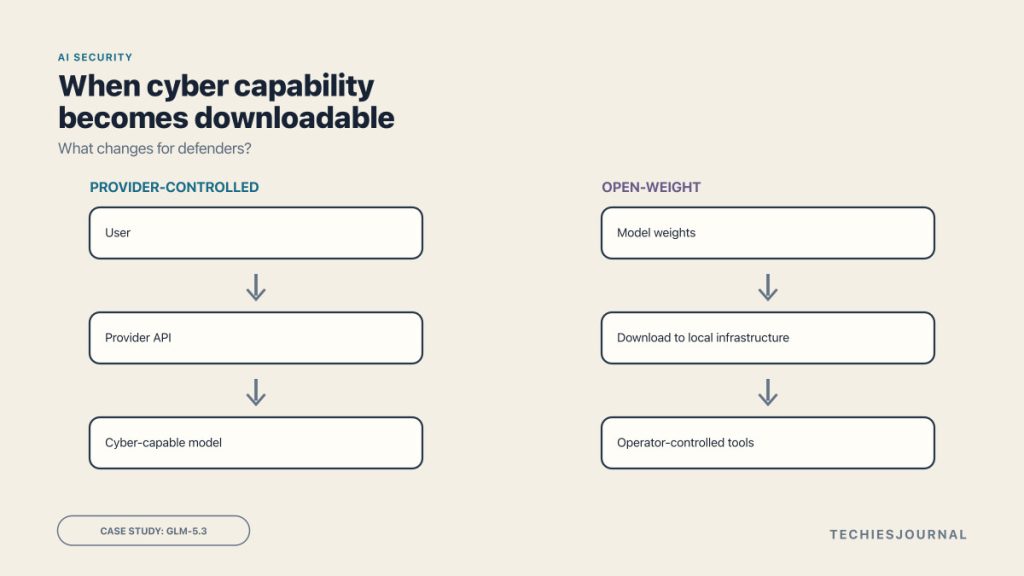
The first operates through a provider: User → Provider API → Model.
The provider remains part of the security boundary. It can potentially control authentication, usage limits, monitoring, safety policies and access.
Now consider an open-weight model: Model weights → Download → Local infrastructure → User-controlled model.
Accessible text alternative for Figure 1
Provider-controlled: User, then Provider API, then provider controls covering access, monitoring, usage policies and which model is served, leading to the cyber-capable model. Open-weight: Model weights, then download, then operator environment, then operator controls covering infrastructure, tools, data, network and model configuration. A closing note states open weights do not automatically make a model unsafe, they change who controls the model and which security controls remain available after distribution.
The operator can decide where it runs, what data it receives, which tools it can access, how frequently it operates, how it is adapted, and which additional controls surround it.
This does not make open-weight AI inherently unsafe.
The same property has important benefits.
Organizations can keep sensitive information inside their own environment. Researchers can study models more directly. Security teams can adapt them to specialized workflows without depending entirely on an external service.
But the control model changes.
Once the weights have been distributed, the original developer cannot rely on the same controls available to an API provider.
That is the important difference.
What does the evidence prove, and what doesn’t it prove?
This distinction matters because cyber benchmarks can easily produce dramatic headlines.
Anthropic independently tested GLM-5.3 on exploit-development tasks.
In its version of ExploitBench, GLM-5.3 produced end-to-end exploits in 50 of 410 attempts. Anthropic’s Claude Mythos Preview produced them in 56 of 410 attempts under the same setup.
In another Anthropic benchmark involving open-source software, GLM-5.3 achieved full control-flow hijacking in 4% of trials. Mythos Preview achieved 6%.
Anthropic also reported a researcher-guided experiment in which GLM-5.3 found previously unknown browser vulnerabilities and combined several of them into a working exploit in a sandboxed environment.
These results are important.
But they do not mean that GLM-5.3 can reliably compromise real organizations by itself.
A benchmark gives the model a defined task, tools, time and environment.
A real attack may require the system to:
- Discover a useful target.
- Understand an unfamiliar environment.
- Find a vulnerability.
- Determine whether it is exploitable.
- Build a working exploit.
- Overcome defensive controls.
- Obtain useful access.
- Continue operating without being detected.
Current evaluations show progress along parts of that chain.
Accessible text alternative for Figure 2
Nine-step chain: 1. Code or target, where the work begins. 2. Find vulnerability. 3. Assess exploitability. 4. Develop exploit. 5. Test and revise. These five steps are evaluated by current benchmarks. 6. Gain useful access. 7. Navigate environment. 8. Avoid defenses. 9. Achieve objective. These four steps are not demonstrated by these evaluations. A closing note states current evaluations show meaningful progress in parts of this chain, but they do not show that the whole chain has become automatic.
They do not show that the whole chain has become automatic.
That is why both extremes are misleading.
“AI can now autonomously hack organizations” goes beyond the evidence.
But “these are only coding assistants” increasingly understates what capable models can do.
Open weights also change the safeguard problem
GLM-5.3 includes safeguards that can refuse clearly harmful requests.
Anthropic tested those safeguards and reported that different techniques could bypass them under its test conditions. Its researchers also modified a copy of the open weights to substantially reduce refusal behaviour without finding a comparable loss of general capability in the evaluations they reported.
Some of those tests used simulated environments rather than real external systems, so the exact bypass percentages should not be treated as measurements of real-world attack success.
The larger engineering issue is simpler.
With an API model, the provider controls the model being served.
With open weights, the operator controls a copy.
That means safeguards inside the model cannot be treated as the entire security boundary.
Organizations using capable open models need controls around the model as well: model safeguards, tool permissions, network restrictions, credential boundaries, sandboxing, and logging with human oversight.
Accessible text alternative for Figure 3
A central AI security model is surrounded by eight controls: sandbox (isolated execution), scoped credentials (only what the task needs), restricted network (no unexpected destinations), approved tools (only vetted capabilities), action limits (rate and scope bounded), logging (every action recorded), human approval (for consequential actions), and evidence validation (findings confirmed, not assumed). A closing note states model safeguards are one layer, not the entire security boundary.
The more capable the model becomes, the more important those surrounding controls become.
This is a trend, not a GLM-5.3 story
GLM-5.3 did not appear from nowhere.
Earlier in 2026, NIST evaluated GLM-5.2 and found that its safeguards allowed assistance with agentic exploit development.
Kimi K3 then moved the open-weight capability level further.
In a joint UK AISI and U.S. CAISI evaluation, Kimi K3 outperformed GLM-5.2 on exploit development, although it remained substantially behind the leading frontier systems.
GLM-5.3 moved the level again.
The individual model names will change.
The more useful trend to watch is: open-weight cyber capability is improving.
That matters because advanced capability and centralized provider control are increasingly becoming separate questions.
What changes for defenders?
The obvious concern is that capable downloadable models may lower some barriers for attackers.
But defenders can use the same class of technology.
Cybersecurity has always contained dual-use tools.
A network scanner can help an administrator understand an environment or help an attacker find targets.
A penetration-testing framework can help a security team test defenses or help someone exploit weaknesses.
Cyber-capable AI adds something different. A model can potentially combine several activities: reason, write code, operate tools, inspect results, change approach, and try again.
The practical effect may be less about inventing entirely new attacks and more about reducing the expertise, time and manual effort required to perform parts of existing security work.
That applies to defenders too.
Instead of asking:
Should we use GLM-5.3?
security teams should ask:
Which parts of our security work can AI improve, and what evidence and controls do we require before trusting it?
Possible areas to evaluate include:
- Vulnerability investigation.
- Secure-code review.
- Patch analysis.
- Exploitability assessment.
- Fuzzing workflows.
- Remediation support.
Start with one narrow workflow. For example: code change, AI security review, candidate issue, human validation, test, fix. Or: scanner finding, AI analysis, exploitability assessment, security engineer validation, remediation.
The model’s output should be treated as a hypothesis until technical evidence confirms it.
Capability becomes more consequential when the model can act
There is a major difference between asking “analyze this source code” and giving a model credentials, a shell, network access, security tools, and permission to decide what to try next.
The second system is no longer simply answering questions.
It is acting.
For defensive use, the environment around the model therefore matters as much as the model itself.
A sensible evaluation environment should include:
- Isolated targets.
- Narrowly scoped credentials.
- Restricted network access.
- Approved tools.
- Action and time limits.
- Complete logging.
- Human approval for consequential actions.
- Reproducible evidence for security findings.
The principle is familiar: limit the blast radius.
AI does not replace that security principle.
It gives us another reason to apply it carefully.
Does this matter to you?
Not everyone needs to learn AI cybersecurity deeply because GLM-5.3 exists.
The useful question is how much this development matters for your work.
| Your role | Depth | What matters |
|---|---|---|
| Software developer | Know | Understand that AI security tools are moving from code explanation toward vulnerability discovery and exploitability analysis. |
| Security engineer | Use | Evaluate AI inside narrow defensive workflows and validate its findings with technical evidence. |
| Security researcher / AI-security architect | Master | Understand cyber evaluations, agent harnesses, sandboxing, model safeguards, tool permissions and capability measurement. |
| Other technology professional | Watch | Understand the broader shift from provider-controlled capability toward models organizations can operate themselves. |
If you are a software developer
You do not need to become an exploit developer.
But it is worth understanding how AI-assisted security review may become part of normal software development.
Explore next: where AI-assisted code review or vulnerability analysis could fit into your existing development process without replacing established security testing.
If you are a security engineer
This development matters more directly.
Choose one defensive workflow and test whether AI improves the complete outcome, not simply whether it produces impressive-looking findings.
Explore next: vulnerability investigation, patch analysis or secure-code review in a controlled environment.
If you are a security researcher or AI-security architect
This is an area worth deeper study.
The difficult question is increasingly not only what a model can do, but where it should be allowed to do it.
Explore next: evaluation environments that measure capability, reliability and containment together.
If you work elsewhere in technology
You probably do not need to download GLM-5.3 or study exploit benchmarks.
The broader development is enough to understand: some capabilities that previously existed mainly behind controlled AI services are moving into models that organizations can operate themselves.
Cybersecurity is one example of that shift.
What should organizations explore now?
There is no reason for most organizations to rush out and deploy a cyber-capable open model.
There is a reason to understand where AI already sits inside the security workflow.
Start with a few practical questions.
Where are security teams already using AI? Understand the current use before introducing another model.
What data is leaving the organization? Source code, vulnerability details and infrastructure information may be sensitive even when they do not look like traditional personal data.
Would local models solve a real problem? Privacy and control can make local deployment attractive, but those benefits should justify the additional operational responsibility.
What happens when the model receives tools? Treat tool access, credentials and network access as separate security boundaries.
Can humans reproduce important findings? A plausible vulnerability report is not the same as a verified vulnerability.
Can every consequential action be reconstructed later? If not, the system is difficult to audit and difficult to trust.
These questions will remain useful after GLM-5.3 has been replaced by something more capable.
The important change is access, not the leaderboard
It is tempting to reduce developments like this to a model race.
Which model scores highest? Which company is ahead? How many months separate one model from another?
Those measurements help researchers track capability.
For most technology teams, they are not the final decision.
The more useful questions are: what can this model reliably do, how much expertise does it still require, what can it access, what happens when it fails, can its actions be contained, and can its findings be verified?
GLM-5.3 does not show that autonomous AI attackers have suddenly arrived.
It shows something more practical.
A meaningful level of vulnerability-discovery and exploit-development capability is becoming available in models that can be downloaded and operated outside the original provider’s infrastructure.
That gives attackers another tool.
It also gives defenders another tool.
The important skill is not learning every new model.
It is knowing when the capability matters to your work, how safely to use it, and when deeper expertise is worth the investment.
Know what changed. Use it where it solves a real problem. Master it only when your work requires that depth.
References and further reading
- NIST CAISI: Assessment of Z.ai’s GLM-5.3 Cyber Capabilities: the primary independent evidence for this article. Explains the four cyber evaluations, GLM-5.3’s position among open-weight models, the remaining gap to the U.S. frontier and important details about how the models were evaluated.
- Anthropic: GLM-5.3 and the Spread of Advanced Cyber Capabilities: useful independent testing of exploit-development capability and safeguards. Anthropic is also a competing model developer, so its interpretations are treated as attributed analysis rather than independent conclusions for this article.
- Z.ai: Preparing GLM-5.3 for Open Release: the model developer’s account of GLM-5.3’s development, including its cyber-focused post-training and its own evaluation results. Vendor claims are treated as such.
- NIST CAISI: Assessment of Z.ai’s GLM-5.2: useful for understanding that the progression in open-weight cyber capability began before GLM-5.3.
- UK AISI / U.S. CAISI: Preliminary Assessment of Kimi K3’s Cyber Capabilities: provides another point in the progression of open-weight cyber capability and shows why evaluation conditions matter when interpreting autonomous attack results.