

TypeSafe AI’s latest release improves its decision-oriented model and introduces experimental image processing, object localization, and longer context. Here is what developers need to understand before adopting the update.
A customer submits a photograph of a damaged laptop to an online retailer. The support system needs to determine whether damage is visible, identify the affected area, and route the request to the appropriate team.
A decision-oriented model offers one way to handle this workflow: instead of generating a lengthy description for application code to interpret, it answers specific questions using structured outputs.
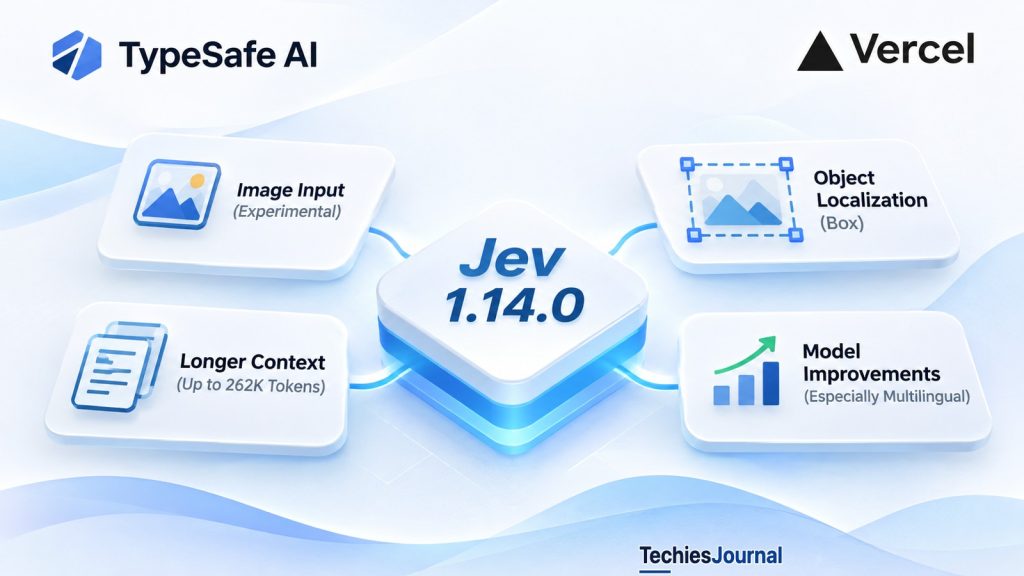
On October 14, 2026, TypeSafe AI released Jev 1.14.0, an incremental update accompanied by experimental image capabilities, a new bounding-box question type, and larger context limits. The company also reports improvements in model quality, particularly for multilingual tasks.
The significance of this release is not a new decision-making architecture. It is an expansion of the information Jev can examine and the kinds of answers it can produce.
What changed in Jev 1.14.0?
Jev is a decision-oriented AI model developed by TypeSafe AI. An application supplies information about a situation and asks predefined questions. The model returns structured answers and probabilities rather than conversational text.
Our earlier TechiesJournal article, Jev Explained: Why This AI Model Makes Decisions Instead of Writing Answers, examines this architecture and its practical applications.
Version 1.14.0 builds on that foundation.
TypeSafe expects most things to be only slightly better than in 1.13.0, with its largest expected gain in multilingual support. At the same time, the company is making previously restricted capabilities accessible for experimentation.
The distinction matters because some features announced alongside 1.14.0 also work with the previous model.
| Capability | Status in Jev 1.14.0 |
|---|---|
| Model quality | Incremental improvements claimed by TypeSafe, particularly for multilingual tasks |
| Image input | Experimental. Also available with Jev 1.13.0 |
box question type | New to Jev 1.14.0. Experimental |
| Longer context | Experimental 262K-token limits. Supported by both 1.13.0 and 1.14.0 |
| Model access | Available through TypeSafe’s API and Vercel AI Gateway |
The standard model interface remains text-based. Image input and longer context are separately enabled experimental capabilities, not default production features.
TypeSafe calls these experimental features its danger zone. The company has made them accessible for development and exploration while stating that they do not yet meet its reliability expectations for production use.
That creates two distinct reasons to examine this release: assessing whether the updated model improves existing applications and experimenting with capabilities that were previously unavailable through the supported interface.
Image support extends structured decisions into visual applications
Jev’s established design allows applications to submit information as state and ask questions about it. Experimental image support extends that approach by allowing visual content to participate in the same request.
TypeSafe uses an assets mechanism to reference images within application state, question instructions, or evaluation criteria. An application can therefore combine text, structured business information, and photographs when formulating a decision.
Consider the damaged-laptop example.
The support system receives a customer message and an image. It could ask whether the photograph shows screen damage and which category best describes the problem.
Instead of generating a paragraph about the photograph, Jev can answer the predefined questions in forms the support application already understands.
This may be useful for product-return workflows, document inspection, maintenance reporting, and other applications where visual evidence contributes to a classification or routing decision.
Image processing is disabled by default. When using TypeSafe’s direct API, developers enable it by sending:
TypeSafe-Danger-Zone-Images: true
TypeSafe’s documentation says box questions are also off by default and need the same header in any request that includes one.
The official image documentation describes supported request structures, image references, and experimental limitations.
The new box question type
The most distinctive addition in Jev 1.14.0 is box, a question type designed to locate an object within an image.
Existing Jev question types largely concern classification, scoring, and evaluating conditions. A box answer instead describes a region of an image.
Its response includes four normalized coordinates, top, bottom, left, and right, and a confidence value between zero and one.
The coordinates describe a rectangle relative to the image dimensions. An application can convert those values into pixel positions to highlight or crop the identified area.
For example, a box answer could have the following structure:
{
  "type": "box",
  "box": {
    "top": 0.25,
    "bottom": 0.82,
    "left": 0.44,
    "right": 0.84
  },
  "confidence": 0.92
}
Illustrative answer adapted from the full response example in TypeSafe’s published Box documentation. In that response the answer sits inside the answers map under a key named for the question, alongside the model name and usage information. These values come from TypeSafe’s example and do not represent an independent TechiesJournal test or a result for the laptop scenario.
The confidence field represents the model’s reported confidence in its localization. It should not be interpreted as an independently verified 92% probability that the object has been located correctly. Developers must measure localization accuracy and confidence behaviour against representative images before choosing thresholds for their applications.
There is also a specific API constraint.
A box question always returns a box. It has no separate not found outcome, even when the requested object is absent.
TypeSafe recommends pairing it with a Noul question that evaluates whether the object is present. The application can then disregard the coordinates when the presence result does not support using them.
For the laptop-support application, that means asking whether a crack is visible before relying on coordinates intended to locate it.
The two results serve different purposes: one evaluates presence, while the other identifies a location. Neither alone constitutes independently verified visual evidence.
The TypeSafe box documentation explains the response format, confidence handling, and recommended question patterns.
For developers, the new type introduces an interesting capability beyond classification. It allows Jev to provide spatial information that can be used by interfaces and downstream processing systems, although its experimental status currently limits its suitability for unattended production workflows.
Longer context increases input capacity, with measurable trade-offs
TypeSafe has also introduced an experimental option for larger inputs.
Under normal settings, Jev supports a maximum of 64,000 tokens per request and 32,000 tokens per question. With longer context enabled, both limits increase to 262,000 tokens.
This capability works with Jev 1.13.0 and 1.14.0.
The larger window could help applications examine lengthy contracts, operational logs, or extended records where relevant information is distributed across multiple sections.
For example, a contract-review application might ask whether a lengthy agreement permits early termination under specific conditions.
The ability to submit the full document simplifies one part of that workflow. It does not necessarily make the resulting decision more accurate.
TypeSafe explicitly reports that longer-context processing is slower and less accurate than operating within the default limits.
That creates an architectural choice: submit the complete source material or first retrieve the sections most relevant to the question.
The second approach may be preferable where an application can reliably identify the material required for its decision.
Longer context is enabled through:
TypeSafe-Danger-Zone-Long-Context: true
TypeSafe charges the same input-token rate regardless of whether the longer-context option is enabled. A larger request can nevertheless cost more because it processes more tokens.
The model documentation describes the limits and their associated behaviour.
Together, image processing, spatial answers, and larger context broaden the range of inputs and outputs Jev can handle. They also make evaluation more dependent on the application’s actual workload.
What existing Jev applications need to consider
For developers already using Jev, the model-quality improvements may be more immediately relevant than the experimental features.
TypeSafe expects Jev 1.14.0 to perform somewhat better across tasks, with the greatest improvement in multilingual support.
These are vendor-reported expectations, not proof that every application will experience better results. TypeSafe also acknowledges limitations in its own internal evaluations and advises developers to prioritize their own testing.
Applications handling multiple languages should compare the two versions using representative production-like examples, especially where classification errors have operational consequences.
There is a second consideration: model version management.
TypeSafe supports fixed model identifiers alongside moving aliases.
| Integration | Model identifier |
|---|---|
| TypeSafe direct API | jev-1.14.0 |
| Vercel AI Gateway | typesafe-ai/jev-1.14.0 |
The identifiers represent the same Jev release through different integration interfaces. Developers should follow the request format and authentication requirements of the platform they use.
Vercel announced its Jev 1.14.0 integration on October 15, 2026. Its AI Gateway announcement includes an example using the AI SDK’s experimental decision interface.
TypeSafe also provides aliases such as jev-latest and jev-preview.
At the October 31 source review, its documentation lists both aliases as pointing to Jev 1.14.0. Unlike a fixed version identifier, an alias can move when a subsequent release becomes available.
That distinction matters for applications whose behaviour depends on model judgments.
A support-routing application could begin classifying some borderline cases differently after an alias changes, even if the application has not been redeployed. The new results might represent improvements, regressions, or acceptable differences.
Using a fixed model identifier makes it easier to evaluate changes before promoting them. TypeSafe also returns the resolved model version in its API response, allowing applications to record which release produced each decision.
TypeSafe’s release announcement also states an intention to give 60 days’ warning before Jev 1.13.0 is formally deprecated and 30 days for Jev 1.14.0, and says it will release a deprecation policy first. Teams that pin a fixed identifier should watch for that notice.
Version management is therefore not merely an integration detail. It is part of maintaining predictable behaviour in software that relies on model-generated judgments.
How developers should evaluate the release
The most useful test is a comparison against an application’s established requirements.
For an existing text-based integration, that means running Jev 1.13.0 and 1.14.0 against the same representative inputs, with expected outcomes determined independently of either model.
The results should reveal whether improvements are meaningful for the classifications, languages, and business conditions the application actually encounters.
Experimental image workflows require additional cases.
In the damaged-laptop example, evaluating only photographs with obvious cracks would reveal little about reliability. A more informative dataset would include subtle damage, undamaged screens, reflections, poor lighting, partially obscured defects, and cases where the requested object is missing.
The evaluation should measure classification accuracy, false identifications, missed defects, localization quality, and the relationship between confidence and actual correctness.
For longer context, a meaningful comparison would examine whether processing a complete document performs better than providing carefully selected relevant sections.
Latency and cost should be measured alongside accuracy so that improvements can be evaluated against their operational consequences.
These tests serve different purposes depending on the application. A support system that recommends a review queue may tolerate errors that would be unacceptable in a workflow controlling payments, access, or physical equipment.
In higher-consequence systems, the application should retain independent policy enforcement and any human review required by the risk.
These are broader architectural considerations, not special properties of Jev 1.14.0. Our previous article, AI Is Learning to Decide Without Talking, examines how Jev and other AI decision mechanisms fit within application architecture.
For this release, the immediate task is narrower: determine whether the new model or experimental capability performs sufficiently well for a clearly defined use case.
What Jev 1.14.0 tells us about the direction of decision models
Jev 1.14.0 is an incremental release rather than a fundamental change to how decision-oriented AI works.
Its model improvements give existing users a reason to reassess performance, particularly for multilingual workloads. The experimental features point toward a broader range of applications involving visual and lengthy information.
The box type is the clearest indication of that direction. Jev is extending beyond selecting and scoring outcomes to producing structured spatial information that applications can interpret directly.
Whether those capabilities become useful in production depends on improvements in model accuracy, consistent behaviour, and the reliability of the surrounding workflows.
TypeSafe has chosen to expose them before declaring them production-ready. That makes Jev 1.14.0 a release worth examining, particularly for developers exploring visual decision systems.
For existing users, this is a model update to evaluate. For developers working with visual decisions, it is an opportunity to prototype a new capability. The distinction is more useful than treating every feature in the release as equally mature.
References and further reading
- Jev: For the builders AND dreamers , TypeSafe AI, October 14, 2026. Official release announcement, model changes, experimental features, and stated limitations.
- TypeSafe Models , TypeSafe AI. Model identifiers, context limits, aliases, supported inputs, language considerations, and pricing.
- Images , TypeSafe AI. Experimental image handling, asset references, and request configuration.
- Box , TypeSafe AI. Object localization, normalized coordinates, confidence values, and the missing-object limitation.
- TypeSafe AI’s Jev 1.14 is now available on AI Gateway , Vercel, October 15, 2026. Gateway model identifier and integration examples.
- Jev Explained: Why This AI Model Makes Decisions Instead of Writing Answers , TechiesJournal, September 23, 2026. Foundational explanation of Jev’s decision-oriented architecture.
- AI Is Learning to Decide Without Talking , TechiesJournal, October 4, 2026. Broader architectural context for AI decision systems.
Source review: October 31, 2026. Performance expectations are attributed to TypeSafe AI. No independent model benchmark or production reliability test was conducted for this article.