

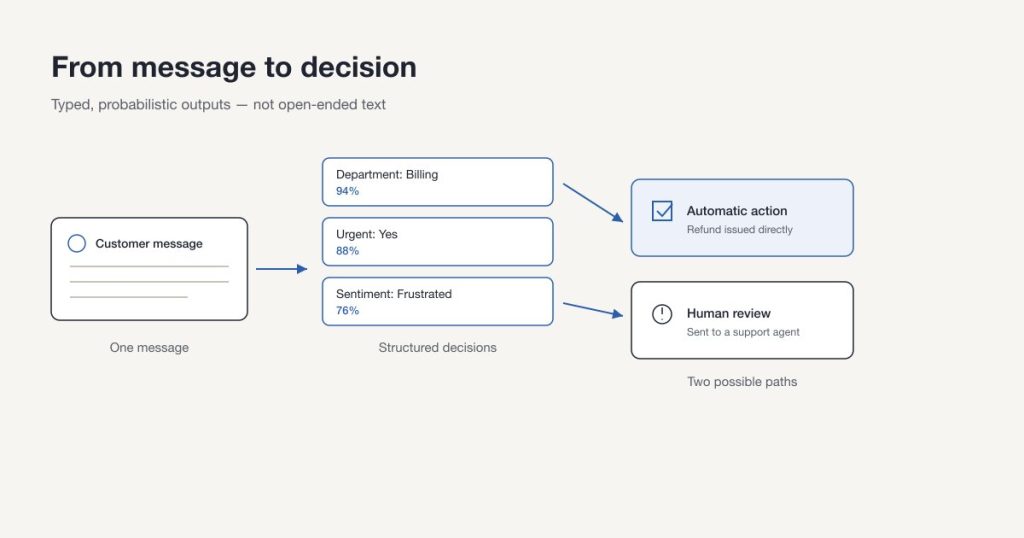
Imagine that a customer sends this message to a support team:
My payment was taken twice, and I need this corrected today.
The application does not necessarily need an AI model to write an answer. Before anyone replies, the system may only need to decide:
- Which team should receive the message?
- Is the issue urgent?
- How frustrated does the customer appear?
- Is the model confident enough to route the case automatically?
Many AI systems send this kind of task to a large language model—the same type of model designed to write emails, explain ideas and hold conversations. The model may produce a paragraph or a JSON object describing its decision. The application then has to validate that output before using it.
Jev, a model released by TypeSafe AI in September 2026, starts from a different question: if software only needs a decision, why ask a model to generate an answer for a person?
Jev does not produce open-ended text. It evaluates information supplied by an application and returns predefined values with probabilities. TypeSafe calls this category a System One model—a model intended to make fast, structured decisions inside software. This is TypeSafe’s own terminology, not an established industry category.
The idea is promising. It is also easy to overstate. Jev can prevent unexpected output structures, but it can still make the wrong decision. Its strongest performance claims currently come from TypeSafe’s own evaluations, and important details about the model remain undisclosed.
This article explains what Jev changes, what remains the same and where this approach may—or may not—fit in real systems.
The problem is not always writing
Large language models are flexible because they generate text one token at a time. That allows the same model to explain a billing problem, write code, summarise a report or answer a question.
Software automation often needs something narrower. An application may need to choose a route, assign a score, decide whether to retry an operation or determine when a person should take over. A paragraph is not the required product. The decision is.
Developers can already ask an LLM to return JSON or use structured-output features. That improves the interface, but the underlying model is still built around generating a sequence. It may use more time and computation than a narrow decision requires.
TypeSafe’s argument is that machine-to-machine decisions deserve a model designed around them from the beginning. The company describes Jev as accepting unstructured or structured state and returning typed, probabilistic decisions that code can consume directly. This is TypeSafe’s own framing of the product’s purpose (vendor claim), not an independently settled conclusion.
This does not make conversational models unnecessary. It separates two jobs that are often combined:
- Understanding an uncertain situation.
- Expressing the result in human language.
Jev focuses on the first job.
How a Jev request works
According to the TypeSafe API documentation (documented, reverified 23 September 2026), an application sends three main elements:
- State: the information to evaluate. This can be text, an object or an array.
- Questions: the decisions the application wants the model to make.
- Criteria: the allowed answers or the meaning of the scale being used.
Jev currently supports three question types, unchanged since launch:
| Question type | Plain meaning | Example |
|---|---|---|
Choice | Select one option from a list defined by the application (up to 255 options) | Billing, Technical or Sales |
Score | Rate something against an ordered set of levels (2–10 levels) | Calm, Frustrated or Very angry |
Noul | Estimate the probability that a yes/no statement is true | Is this urgent? |
For the support message, an illustrative request might ask Jev to choose a department, assess urgency and score frustration. The response could look conceptually like this:
| Decision | Illustrative result |
|---|---|
| Department | Billing — 94% |
| Urgent | Yes — 88% |
| Frustration | High — 76% |
These numbers are fictional and explain the interface; they are not measured Jev results.
The surrounding application remains responsible for deciding what happens next. It might route high-confidence cases automatically while sending uncertain or high-consequence cases to a person.
Try it: from message to decision
Select a different fictional support message below to see how the same three questions could produce different typed answers. All content in this explorer is local to the page and fictional—no message is sent to TypeSafe or any other service.
State (message): “My payment was taken twice, and I need this corrected today.”
- Which team should receive this? (Choice) — Billing, 94%
- Is this urgent? (Noul) — Yes, 88%
- How frustrated does the customer sound? (Score) — High, 76%
Illustrative threshold outcome: confidence is above the application’s configured threshold on all three questions, so this fictional example routes automatically to Billing as urgent.
State (message): “I can’t log in since this morning and I have a client call in an hour.”
- Which team should receive this? (Choice) — Technical, 81%
- Is this urgent? (Noul) — Yes, 62%
- How frustrated does the customer sound? (Score) — Frustrated, 58%
Illustrative threshold outcome: the urgency confidence falls in the application’s configured middle range, so this fictional example is sent to a person rather than resolved automatically.
State (message): “It would be great if the app could export reports as CSV, no rush.”
- Which team should receive this? (Choice) — Product, 90%
- Is this urgent? (Noul) — No, 95%
- How frustrated does the customer sound? (Score) — Calm, 97%
Illustrative threshold outcome: all three answers are high-confidence and low-consequence, so this fictional example routes automatically to a product backlog with no human review.
Fictional interactive example. Every message, question and probability shown here is illustrative and was written for this article—none of it is a measured Jev result, and nothing you select is sent anywhere.
Why TypeSafe expects it to be faster and cheaper
A conventional generative model normally produces output sequentially. Each new token depends on the tokens generated before it. Long answers therefore require repeated generation steps.
Jev gives up open-ended string generation. TypeSafe says its model evaluates multiple questions in parallel and returns only the structured values the application requested. Removing text generation could reduce latency and cost when a workflow contains many small decisions.
As of the source review on 23 September 2026, TypeSafe advertised input pricing of $0.042 per million tokens, with output described in its own launch post as “too cheap to meter.” It reported end-to-end response times of approximately 70 to 500 milliseconds and claimed gains of roughly 193.6× on speed and 444.6× on cost over frontier LLMs on its selected workflows.
These are vendor-reported claims, not settled independent measurements. TypeSafe itself acknowledges important limitations in its launch evidence:
- The workflows were created by members of its own model-capabilities team.
- That introduces a possibility of selection or design bias.
- The largest reported gains may represent the high end of real-world improvement.
- Some reference answers came from the averaged predictions of large external models rather than independently established ground truth.
- Low pricing can be observed today, but its long-term sustainability cannot yet be proven.
As of the source review, Jev is available without a waitlist: sign-up is self-service at TypeSafe’s developer console, with a small free token allowance for new accounts. That lowers the barrier to trying it, but availability is not evidence of accuracy.
The speed and cost are still meaningful reasons to test Jev. They are not reasons to skip independent evaluation.
What calibrated probability really means
Every model can attach a number to an answer. The harder question is whether that number deserves trust.
Suppose a model makes hundreds of predictions and assigns each one approximately 80% probability. If the model is well calibrated, about 80% of those predictions should prove correct. This statistical relationship is called calibration.
Calibration does not guarantee that a particular decision is correct. It helps a system define useful policies across many decisions. For example:
- Act automatically above a tested confidence threshold.
- Ask a larger model for a second opinion in the middle range.
- Send low-confidence or high-consequence cases to a person.
TypeSafe says it trains Jev using Reinforcement Learning for Calibrated Decisions, or RLCD. Its machine-learning primer (documented, reverified 23 September 2026) describes the objective as producing decisions whose probabilities correspond to observed correctness.
That claim must be evaluated in the environment where the model will operate. A model calibrated on one dataset may become unreliable when the language, customers, policies or attack patterns change. Calibration is not a permanent property that can be assumed across every domain.
Does Jev really eliminate hallucinations?
TypeSafe says Jev cannot hallucinate. That statement needs a narrower interpretation.
If an application permits only Billing, Technical and Sales, Jev cannot invent a fourth value such as Legal. It cannot return a paragraph, an unknown field or a malformed answer in place of the permitted type. This removes an important failure mode when AI output is buried inside a software workflow.
It does not prove that the selected value is correct. Jev could still:
- Send a technical issue to Billing.
- Misread an ambiguous message.
- Assign confidence that does not match real accuracy in a new domain.
- Repeat bias present in its training or evaluation data.
- Choose the least-wrong option when none of the permitted choices is appropriate.
The distinction is simple:
A schema-valid answer is not necessarily a correct decision.
Type safety controls what form an answer can take. Reliability depends on the model, the question, the permitted options, the data, the thresholds and the consequences of error.
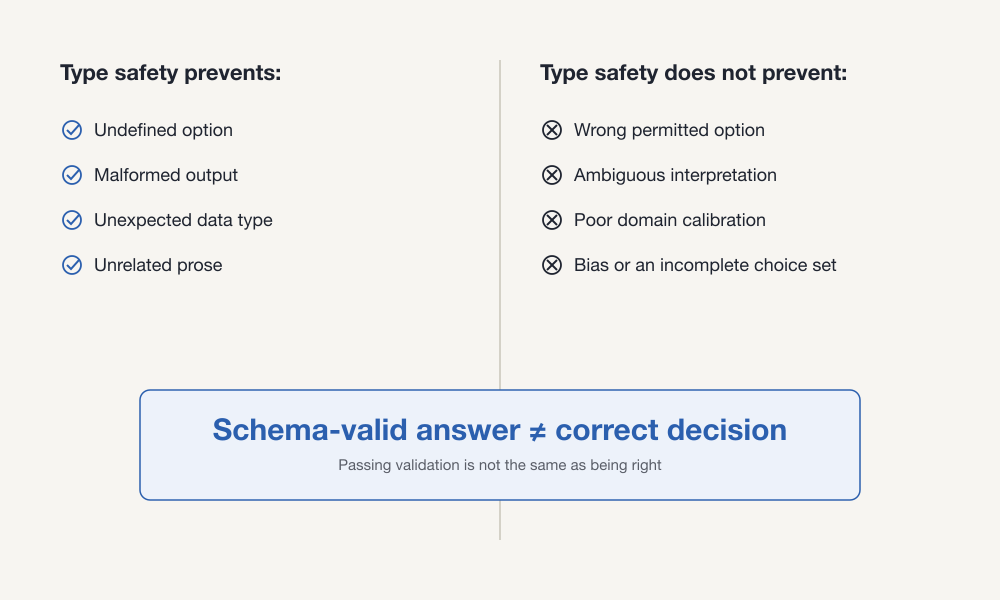
Text equivalent—type safety prevents: an undefined option, malformed output, an unexpected data type, unrelated prose. It does not prevent: a wrong permitted option, an ambiguous interpretation, poor domain calibration, or bias and an incomplete choice set.
Is Jev a genuinely new kind of model?
The problem Jev addresses is not new. Software has long used classifiers, rerankers, policy networks, reward models and business rules to make decisions. Generative models can also return structured output or act as judges of other models.
The more defensible novelty claim is about the package rather than the existence of classification itself. Jev combines:
- Broad language understanding.
- Options defined when the request is made rather than a permanently fixed label set.
- Typed output.
- Probability distributions.
- Multiple decisions evaluated in parallel.
- An API designed for composition inside ordinary code.
An early independent research example is useful precisely because it is cautious. The September 2026 paper Open-Jev Judgments on CallScreenBench (Ren et al., submitted 21 September 2026) tested an open Jev-style implementation for scam-call screening. It reported strong discrimination and calibration on its evaluation, along with lower latency than a generative version of the same backbone. The authors also stated that the gain came from the readout and calibration rather than improved accuracy, claimed no architectural novelty, used synthetic callers and acknowledged that their recipe was selected with test-set exposure.
That does not validate TypeSafe’s proprietary model. It suggests that the broader design pattern deserves investigation without proving that a new foundational category has been established.
Where Jev may fit
Jev appears most relevant when a system needs many fast, constrained decisions over language or structured application state.
Possible uses include:
- Routing support requests.
- Selecting the next tool in an AI agent.
- Deciding whether an operation should be retried.
- Scoring urgency, risk, quality or policy compliance.
- Evaluating an agent’s trace or output.
- Classifying large collections of records.
- Choosing among valid actions in a real-time application.
The consequences matter. Misrouting an email is usually recoverable. Blocking an account, denying a refund, identifying fraud or authorising a financial action requires stronger evidence, monitoring, audit trails and a meaningful appeal path.
Jev should also be compared with simpler alternatives. If a decision follows exact conditions, ordinary code is more predictable. If the categories are stable and enough labelled data exists, a conventional classifier may be easier to own and operate. If the task requires explanation, synthesis or an answer that cannot be listed in advance, a generative model remains a better fit.
Try it: which approach fits the decision?
Select a scenario to compare how a deterministic rule, a traditional classifier, a Jev-style decision model and a generative LLM each fit it—and where each one is weakest. Jev is not the best fit for every scenario below.
Best fit: deterministic business rule. The condition is exact and known in advance (for example, a fixed spending cap), so ordinary code is more predictable and auditable than any model. A classifier or Jev-style model adds uncertainty a fixed rule does not need; a generative LLM is unnecessary overhead here.
Often a good fit: a Jev-style decision model or a traditional classifier. Categories are fairly stable and the input is messy language, which suits typed, probabilistic output. A classifier can work as well if labelled data and a fixed category set already exist; a deterministic rule struggles with ambiguous wording, and a generative LLM is usually slower and more expensive than the task requires.
Best fit: a generative LLM. The task requires composing an explanation that cannot be listed in advance as a fixed set of options. Deterministic rules, classifiers and Jev-style models are built around predefined outcomes, so none of them can produce open-ended prose.
Consequential; requires more than one signal. A Jev-style model or classifier can contribute a calibrated risk score, but the high cost of a wrong decision means the result should feed a broader review process with monitoring and an appeal path—not act alone. A rigid rule alone is usually too brittle for evolving fraud patterns, and a generative LLM’s free-text output is harder to audit at this consequence level.
Plausible fit: a Jev-style decision model. Choosing among a predefined set of tools is structurally similar to a Choice question, and doing it without generating text could reduce agent latency. A classifier can work if the tool set rarely changes; a generative LLM remains useful when the agent must reason about a tool set that is not fixed in advance.
Qualitative, editorially written comparisons—not benchmark scores. The table below is the same comparison in fixed form.
| Approach | Best fit | Important limitation |
|---|---|---|
| Deterministic business rule | Exact conditions with known outcomes | Becomes brittle when meaning depends on messy language or context |
| Traditional classifier | Stable categories supported by suitable training data | Usually requires a fixed task and maintained labelled data |
| Jev-style decision model | Flexible language-based decisions among predefined options | Proprietary behaviour and domain reliability must be tested |
| Generative LLM | Open-ended reasoning, explanation or content generation | Usually slower, more expensive and less constrained for narrow decisions |
What remains unknown
TypeSafe has not publicly disclosed enough information to independently examine several important areas:
- Jev’s parameter count.
- Its exact architecture.
- Whether it was trained from scratch or adapted from another pretrained model.
- Training compute and detailed data-generation methods.
- The complete composition of its synthetic training data.
- Model weights.
- Broad domain-specific calibration results.
- Bias, adversarial and safety evaluations.
- Long-term pricing sustainability.
- Reliability under real production distribution shifts.
The model is proprietary, and as of this review TypeSafe has not published a complete independent technical paper or model card for Jev. These gaps do not show that the claims are false. They limit how confidently outsiders can evaluate them.
The people and company behind Jev
TypeSafe AI identifies three founders on its team page:
- Diogo Almeida, CEO: TypeSafe’s own team page credits him as a co-inventor of RLHF and InstructGPT during his time at Google Brain; press coverage, including TechCrunch, also describes him as a former OpenAI researcher whose work contributed to the instruction-following methods behind ChatGPT.
- Erik Gafni, CTO: a repeat founder with experience building production AI systems and applying multimodal AI in biotechnology.
- Sasha Sheng, COO: a former Meta/FAIR research engineer who worked across product and AI research.
Some headlines call Almeida a “ChatGPT inventor.” That wording gives one researcher too much credit for a system created by a large team. A more accurate description is that his research contributed to the instruction-following methods that helped make ChatGPT possible.
TypeSafe is reported to have raised a $40 million seed round led by DCVC when it emerged from stealth—corroborated by multiple independent reports rather than a single TypeSafe-published funding announcement. A reported post-money valuation near $200 million has been attributed to TypeSafe by at least one outlet but is not independently confirmed. Funding may help the company develop and operate the product, but it is not evidence that the technical claims are correct.
How much should you learn?
Most technology professionals do not need to master Jev today.
Know
Developers, architects, technical leaders and students following AI should understand the broader idea: not every intelligent software decision needs an open-ended language model response.
Use
Teams building high-volume AI agents or decision-heavy applications may want to test Jev. Practical evaluation should include domain accuracy, calibration, latency, cost, fallback behaviour, data handling and the operational effect of wrong decisions.
Master
Engineers designing automated decision platforms need deeper knowledge of calibration, evaluation datasets, distribution shift, threshold policies, observability, human escalation and governance. Those skills matter more than familiarity with one vendor’s API.
Students and general IT professionals can ignore Jev’s internal implementation for now. The durable lesson is the separation between language generation and software decision-making.
A better question than “Will Jev replace LLMs?”
Jev is not designed to replace models that write, explain, research or reason through open-ended problems. It is designed to sit inside software where the application already knows the kinds of answers it can accept.
Its launch raises a useful architectural question:
When software needs a decision rather than an explanation, why pay a model to write one?
Jev may prove to be an important answer. It may also face competition from structured LLM outputs, small fine-tuned models and established classification methods. The evidence is too early to declare a new model era.
What has changed is the question developers can ask. Instead of sending every uncertain task to a conversational model, they can decide whether the job requires language generation at all.
That decision may matter longer than the current excitement around any single model.
References and further reading
- Introducing System One Models & Jev — TypeSafe AI, 15 September 2026. The official launch explanation, performance claims, evaluation design and the company’s own qualifications.
- TypeSafe API reference — TypeSafe AI, reviewed 23 September 2026. The request format, question primitives, response structures and documented limits.
- AI primer: calibrated decisions and RLCD — TypeSafe AI, reviewed 23 September 2026. The company’s explanation of its training objective and interpretation of calibration.
- TypeSafe team — TypeSafe AI, reviewed 23 September 2026. Official biographies of Diogo Almeida, Erik Gafni and Sasha Sheng.
- Open-Jev Judgments on CallScreenBench — Ren et al., 21 September 2026. An independent Jev-style implementation with useful results and unusually clear limitations; it does not evaluate TypeSafe’s proprietary Jev model.
- A new kind of AI model from a ChatGPT inventor is thrilling developers — TechCrunch, 18 September 2026. Reporting on the company, funding, launch and early developer interest.
- What is Jev, an AI “generalist” model with a new take on decision-making? — The Indian Express, updated 23 September 2026. A general overview of the model, public availability and early integrations.