

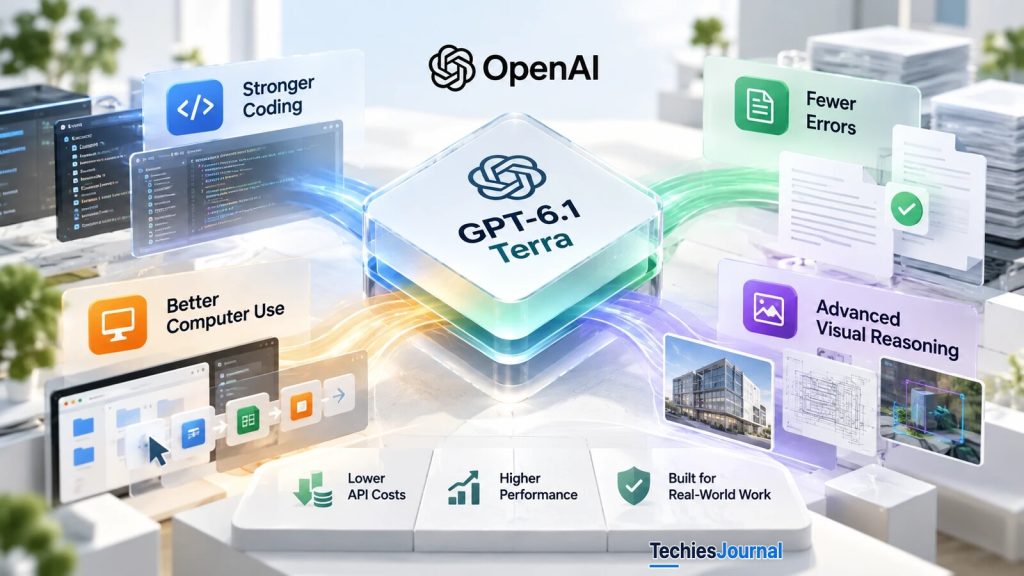
Conceptual promotional-style illustration of the release's themes: coding, fewer errors, computer use and visual reasoning around a GPT-6.1 Terra cube. The labels on the strip are generic, they are not measured results.
OpenAI introduced GPT-6.1 Terra on October 26, 2026, with a focus on making AI more useful for everyday computer-based work.
The model can interpret visual information, work with application interfaces through supported tools, write and revise documents, and assist with coding. These capabilities are not entirely new, but OpenAI reports substantial improvements in performance and cost compared with GPT-5.6 Terra.
For developers and organisations, the more interesting question is whether these improvements make previously expensive or unreliable automation tasks worth reconsidering.
What changed in GPT-6.1 Terra?
OpenAI reports improvements in several areas:
| Capability | Reported result |
|---|---|
| Computer-use tasks | 15 percentage points higher than GPT-5.6 Terra on Agents’ Last Exam at medium effort |
| Visual reasoning | Higher MMMU-Pro scores than GPT-5.6 Terra across all tested reasoning settings |
| API pricing | Standard token prices half those of GPT-6.1 Sol, and at least 50% below GPT-5.6 Terra |
These are results from OpenAI’s published evaluations, not independent TechiesJournal benchmarks.
The figures indicate progress, but they describe different tasks and testing conditions. They should not be combined into one overall performance score.
Coding: A substantial improvement on command-line tasks
Terminal-Bench 4.0 measures how well coding agents solve software-development problems using command-line tools.
At maximum reasoning effort, GPT-6.1 Terra completed 50.3% of the benchmark tasks, compared with GPT-5.6 Terra’s published score of 21.5%.
Source: OpenAI. Percentage of benchmark tasks solved. Not a general software-development success rate.
Text version of the data
- GPT-5.6 Terra: 21.5%
- GPT-6.1 Terra: 50.3%
That represents a 28.8 percentage-point increase and more than twice the earlier published success rate.
This matters for developers using AI to investigate bugs, modify applications and complete routine engineering work.
However, the result also shows a limitation. A model solving around half of the tasks in one benchmark is not ready to replace software-development processes, testing or review.
OpenAI continues to position GPT-6.1 Sol and GPT-6 Astra as better choices for its most complex coding workloads.
Factual accuracy: Fewer mistakes on difficult questions
OpenAI also reports a substantial reduction in factual errors.
On an internal evaluation using prompts designed to expose factual mistakes, the error rate at low reasoning effort fell from 53.6% with GPT-5.6 Terra to 16.7% with GPT-6.1 Terra.
Source: OpenAI. These deliberately difficult cases are not representative of typical production error rates.
Text version of the data
- GPT-5.6 Terra: 53.6%
- GPT-6.1 Terra: 16.7%
That is a difference of 36.9 percentage points, approximately 69% lower than GPT-5.6 Terra’s error rate.
At maximum reasoning effort, OpenAI reports an error rate of 4.3%.
This could improve the usefulness of AI in document analysis, reporting and information-heavy workflows.
There is an important distinction, however. These figures do not describe how often the model makes mistakes across all real-world conversations.
The evaluation uses deliberately difficult prompts. Actual performance will depend on the task, the information provided and how results are verified.
Computer use: Moving from interpreting screens to performing tasks
One of Terra’s main areas of improvement is computer use.
Consider an organisation processing incoming invoices.
An AI agent may need to read an invoice, identify the supplier and amount, open accounting software, enter the details and check whether the transaction was recorded correctly.
Successful execution requires the model to understand visual information and navigate a sequence of actions.
OpenAI evaluates these capabilities using Agents’ Last Exam and OSWorld 2.1.
On Agents’ Last Exam, Terra scores 15 percentage points higher than GPT-5.6 Terra at medium reasoning effort while costing approximately one-third as much per task under the reported evaluation conditions.
OpenAI also reports that Terra exceeds GPT-5.6 Terra’s best OSWorld 2.1 result at medium effort, at a lower cost per task.
These results suggest that AI agents may become more practical for working across desktop applications and document-driven processes.
But understanding a screen does not automatically make an action safe or correct.
In the invoice example, a reliable application should still check for duplicate invoices, validate amounts and require approval before sensitive financial actions.
Those controls must be built into the application workflow.
Visual reasoning: Understanding more than text
Visual reasoning is another important part of this release.
OpenAI reports that Terra outperforms GPT-5.6 Terra across reasoning settings on MMMU-Pro, a benchmark involving complex visual questions.
This is relevant to tasks such as interpreting technical drawings, working with diagrams and matching product photographs to catalogue information.
OpenAI’s examples of professional computer tasks include producing a 3D model from architectural drawings and creating a restoration log from an animated film.
These capabilities extend the possible uses of AI beyond traditional text-processing applications.
However, organisations should evaluate visual interpretation and subsequent computer actions separately. Recognising the information correctly is only one part of completing a task reliably.
API pricing: A lower-cost option for repeated tasks
For developers, one of the most immediate differences is pricing.
OpenAI lists the following standard API rates for GPT-6.1 Terra and GPT-6.1 Sol:
Rates exclude applicable tool charges and processing adjustments.
Source: OpenAI API pricing, October 26, 2026.
Text version of the data
- GPT-6.1 Terra, Input: $1.00
- GPT-6.1 Terra, Cached input: $0.05
- GPT-6.1 Terra, Output: $5.00
- GPT-6.1 Sol, Input: $2.00
- GPT-6.1 Sol, Cached input: $0.10
- GPT-6.1 Sol, Output: $10.00
Terra’s prices are therefore half of Sol’s across these token categories.
That could matter for applications handling thousands of documents or repeatedly using AI to work through computer interfaces.
Lower prices do not always mean lower total operating costs, however.
A model that requires additional attempts, produces more errors or needs frequent human corrections can cost more overall than a more expensive model that completes tasks reliably.
Organisations should measure the total cost per successfully completed task, including processing, tool calls, correction effort and operational overhead.
Which model should developers choose?
OpenAI’s model family provides different choices depending on task complexity and cost sensitivity.
| Model | Where it is worth evaluating |
|---|---|
| GPT-6.1 Terra | Visual workflows, routine coding, document processing and cost-sensitive automation |
| GPT-6.1 Sol | More complex professional reasoning and software development |
| GPT-6 Astra | Particularly demanding end-to-end tasks and advanced reasoning |
These are selection guidelines, not guarantees that one model will always outperform another on a particular workload.
For example, Terra could handle routine document extraction while a more capable model reviews unusual or complex cases.
The right choice depends on measured performance, reliability and total cost for the actual application.
Safety remains part of the application design
OpenAI says it is treating GPT-6.1 Terra as Critical in cybersecurity under its Preparedness Framework, and that the model uses the safeguards developed for GPT-6 Astra.
It also reports that Terra is more likely than GPT-5.6 Terra to stay within the scope of a task and to disclose limitations, and that it held up well in OpenAI’s prompt-injection testing.
These are useful developments, but they should not be confused with unrestricted operational safety.
For AI agents interacting with real software, permissions, validation, approval rules and audit records remain necessary.
A model capable of entering data into a system should not automatically receive authority to approve payments, delete records or change security settings.
The more capable computer-use models become, the more important these boundaries are.
Availability
As of October 26, 2026, OpenAI says GPT-6.1 Terra is available to Plus, Pro, Enterprise and Edu users in ChatGPT Work and Codex.
Developers can access it through the OpenAI API using the model identifier gpt-6.1-terra.
The API model supports text input and output, image input and reasoning settings ranging from none to maximum. Tool calling requires the Responses API.
What should organisations take from this release?
GPT-6.1 Terra is worth evaluating where work involves repeated interactions with software, visual information or documents.
The most practical approach is to choose a representative task, compare it with the existing implementation and measure whether the new model improves accuracy, completion time or total cost.
For teams already using AI agents, Terra may offer a more economical option for routine tasks. For teams that previously rejected AI automation because of cost or reliability, selected workflows may deserve another evaluation.
There is no reason to replace a working system purely because a newer model has been released.
The significance of Terra is that improvements in capability and cost are arriving together.
The real progress is not simply that AI can perform more tasks. It is that more tasks may become practical to automate reliably and economically.
Go deeper
- OpenAI, Introducing GPT-6.1 Terra, Official October 26, 2026 announcement, benchmark comparisons and availability.
- OpenAI, GPT-6.1 Terra API documentation, Context window, reasoning options, supported modalities and API requirements.
- OpenAI, API pricing, Token pricing and processing-tier differences.
- OpenAI, GPT-6.1 Terra System Card, Safety evaluations, model behaviour and limitations.
Related reading on this site
- The AI Price War Is Moving From Token Prices to Cost per Task, on measuring the cost of a successfully completed task rather than the price of a token, the test this article suggests for Terra’s pricing.
- OpenAI DevDay 2026: What Was Announced and What Matters Most, on GPT-6.1 Sol and OpenAI’s other announcements, the model this article compares Terra with in the pricing and model-choice sections.
- AI Agents Are Reaching Bank Accounts: What Banks Have Observed, What Is Reported, and What Remains Unknown, on what US banks have reported about external AI agents reaching customer accounts and why some are blocking them, relevant to the payment and approval boundaries discussed above.
Source review: October 26, 2026. Benchmark and performance results are attributed to OpenAI and have not been independently reproduced by TechiesJournal.