
Sources reviewed for this article: April 2026.
Start with a familiar problem
Fictional scenario: Imagine severe weather disrupts a major airline.
Hundreds of flights are cancelled. Thousands of passengers need new bookings. Aircraft and crews are in the wrong places, while weather conditions continue to change.
Several kinds of computers may become involved. An employee uses a personal computer to help one passenger. Large transaction systems update reservations, payments and seat assignments. Powerful computing systems run weather models and other demanding calculations.
Where does a quantum computer fit?
Today, probably nowhere in the airline’s normal day-to-day operation.
That is a useful place to begin, because a quantum computer is not simply a more powerful version of the computers we already use.
It is a different way of computing, being developed for particular kinds of problems.
So what exactly is a quantum computer?
A quantum computer is a computer that uses controlled quantum behaviour to process information.
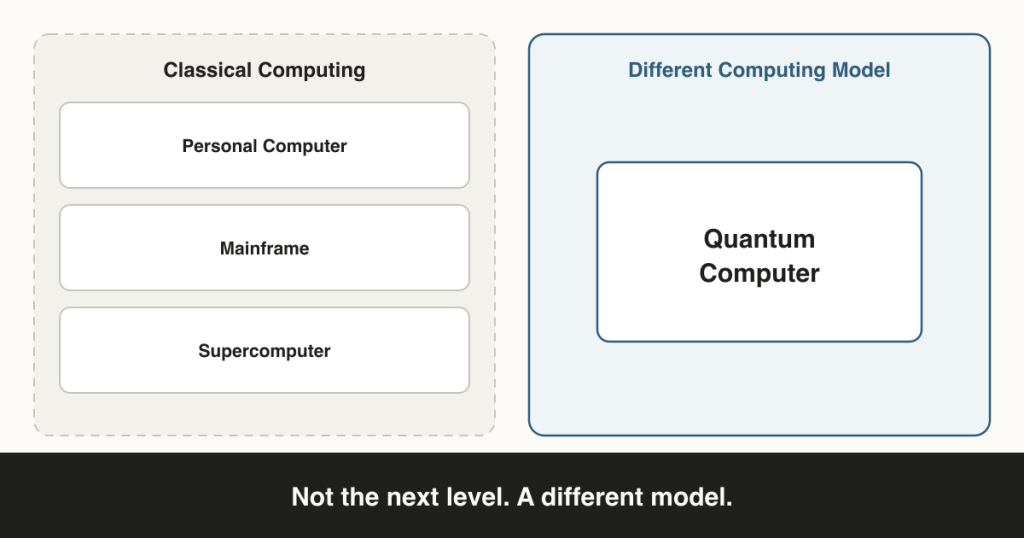
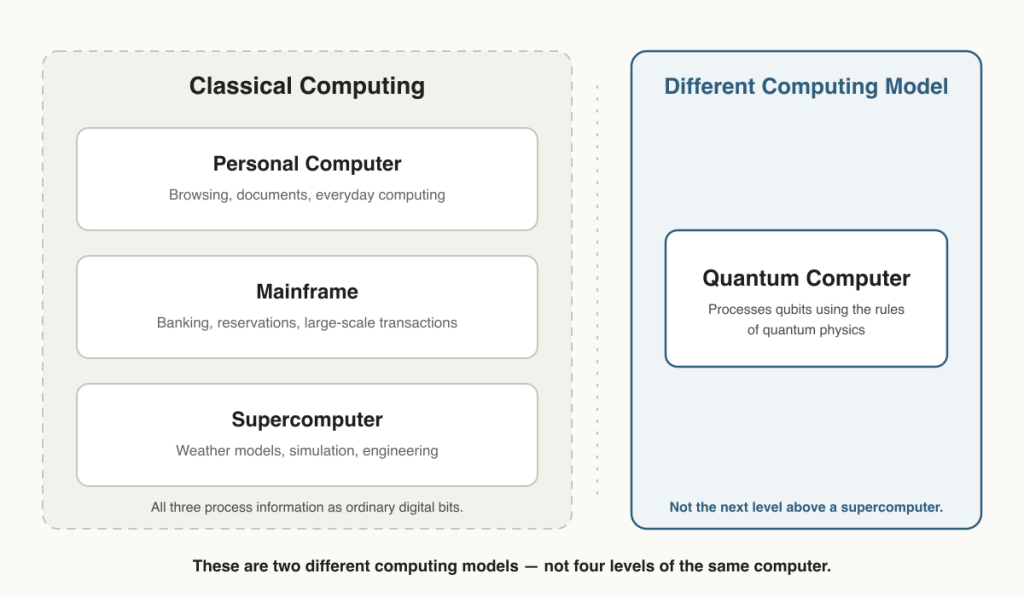
A personal computer, mainframe and supercomputer can differ enormously in size and purpose, but they are all classical computers. Underneath, they process information using ordinary digital bits.
A quantum computer uses quantum bits, or qubits, and processes them using the rules of quantum physics.
That difference does not make quantum computers better at everything.
| Computer | Mainly designed for | Typical work |
|---|---|---|
| Personal computer | Everyday computing | Browsing, documents, programming, applications |
| Mainframe | Large-scale reliable transaction processing | Banking, insurance, reservations, government systems |
| Supercomputer | Extremely large classical calculations | Weather, scientific simulation, engineering, AI research |
| Quantum computer | Certain problems that may benefit from quantum computation | Quantum simulation, specialised algorithms and research |
The most important point is:
These are not four levels of the same computer.
A supercomputer is an extremely powerful classical computer.
A quantum computer uses a different computing model.
That is why asking whether a quantum computer is “faster than a supercomputer” is usually the wrong first question.
The better question is:
For which problems might a different computing model help?
What makes quantum computing different?
A classical computer stores and processes information using bits. A bit has one definite value at a time: 0 or 1.
A quantum computer uses a qubit.
You may have heard the phrase:
“A qubit can be 0 and 1 at the same time.”
It is memorable, but it can create the wrong mental picture. A quantum computer does not simply store every possible answer and then choose the correct one.
A more useful explanation starts with something called an amplitude.
A qubit carries amplitudes
A qubit has an amplitude associated with the possibility of measuring 0 and another associated with measuring 1.
The size of those amplitudes determines the probability of what we will see when the qubit is measured. More precisely, the magnitude squared of an amplitude gives the measurement probability.
We do not need the mathematics here. The important idea is that a quantum algorithm changes these amplitudes before measurement.
With more qubits, the state becomes much richer. Two qubits are described using four amplitudes. Ten qubits require 1,024.
In general, n qubits have 2^n amplitudes describing their joint quantum state.
That sounds enormously powerful, but there is an important catch:
We cannot simply read all those amplitudes out as answers.
When the qubits are measured, we receive ordinary classical results.
A useful quantum algorithm therefore has to do something clever before measurement.
That is where interference becomes important.
Interference is where the algorithm does real work
Quantum amplitudes can combine.
Some reinforce one another. Others cancel.
This is called interference.
A carefully designed quantum algorithm changes the quantum state so that amplitudes associated with useful outcomes become stronger, while amplitudes associated with unwanted outcomes become smaller or cancel.
Then the system is measured.
This is much closer to what happens than the common claim:
“A quantum computer tries every answer at the same time.”
It does not get every answer for free.
The advantage, when one exists, comes from designing an algorithm whose quantum operations shape the probabilities in a useful way.
That is why quantum algorithms matter just as much as quantum hardware.
And what is entanglement?
When several qubits interact, their states can sometimes become entangled.
That means their joint quantum state can no longer be fully described as separate independent qubits. Measurements of an entangled system can show relationships that have no simple classical equivalent.
Quantum algorithms can use these relationships to spread and manipulate information across a group of qubits.
For a foundation-level understanding, three ideas are enough:
- superposition gives a qubit a quantum combination of possibilities;
- interference allows amplitudes to reinforce or cancel;
- entanglement creates quantum relationships between qubits.
None of these properties by itself gives a useful answer.
The algorithm has to combine them in the right way.
How does a quantum program actually run?
Quantum programs are built from operations called quantum gates.
A sequence of gates forms a quantum circuit.
At a simple level, the process looks like this:
- Prepare the qubits.
- Apply quantum gates.
- Allow the quantum state to evolve according to the circuit.
- Measure the qubits.
- Analyse the classical results.
A quantum circuit will often be run many times because one execution does not necessarily produce the same measurement result every time. These repeated executions are often called shots.
Software looks at the distribution of results across those runs.
A quantum computer therefore does not behave like:
Question → quantum computer → perfect answer
It is closer to:
Prepare → run → measure → analyse → possibly adjust → run again
And classical computers are involved throughout the process.
Quantum computing is not separate from classical computing
Return to our airline example.
Suppose, in the future, researchers find a quantum method that genuinely improves one part of a difficult scheduling problem.
The airline would not replace its reservation systems, databases, employee computers and cloud infrastructure with quantum computers.
A more realistic workflow would look like this:
Airline application
        ↓
Classical computer prepares a specific problem
        ↓
Quantum processor performs a suitable calculation
        ↓
Measurements return to the classical system
        ↓
Classical software interprets the result
        ↓
Airline application continues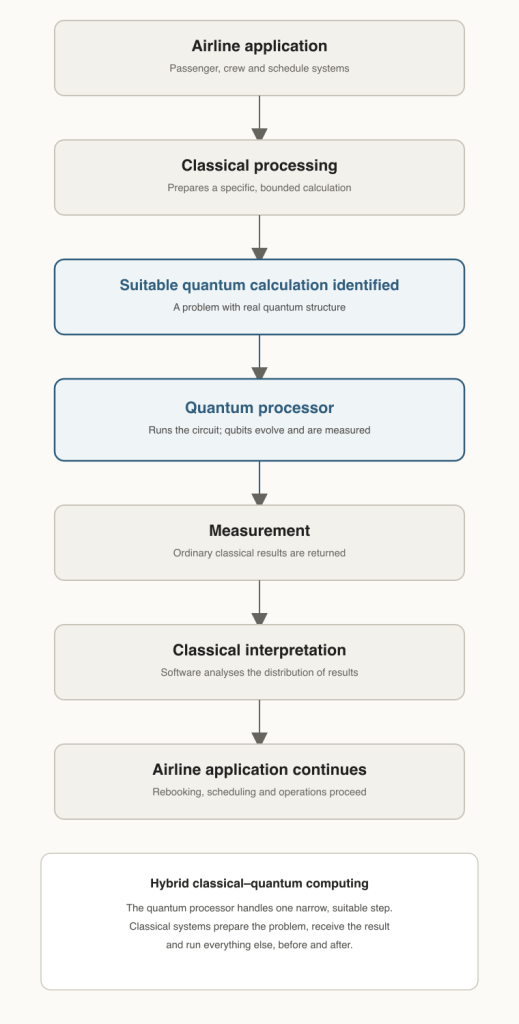
This is often called hybrid classical-quantum computing.
The same idea applies more broadly. CPUs, GPUs, supercomputers and quantum processors may eventually work together, with each being used where it makes sense.
Quantum computing is therefore much more likely to complement classical computing than replace it.
Being a difficult problem is not enough
A problem does not become suitable for a quantum computer simply because it has millions or billions of possible combinations.
Quantum computers are not known to efficiently solve every difficult optimisation or search problem.
Quantum advantage depends on the structure of the problem and whether an effective quantum algorithm exists.
Shor’s algorithm: mathematical structure matters
In 1994, Peter Shor showed that a sufficiently capable quantum computer could factor large integers much more efficiently than known classical methods.
That matters because widely used public-key cryptography, including RSA, depends partly on the practical difficulty of factoring large numbers.
Shor’s algorithm does not blindly search every possible factor. It takes advantage of mathematical structure in the problem.
Google Quantum AI provides a technical demonstration of Shor’s algorithm and period finding.
Grover’s algorithm: an improvement, not magic
Grover’s algorithm addresses a different type of search problem.
For an unstructured search through N possibilities, a classical method may require work proportional to N. Grover’s quantum algorithm can reduce that to roughly the square root of N.
That can be useful, but it does not turn every enormous search problem into an easy one, and it does not provide an exponential improvement.
Google’s Cirq material includes a practical Grover’s algorithm example.
So when someone says:
“This problem has too many combinations, therefore quantum computing will solve it,”
the claim deserves scrutiny.
A stronger example comes from nature itself
One of the clearest reasons for investigating quantum computers is quantum simulation.
Consider a molecule.
Its atoms and electrons ultimately behave according to quantum physics.
Classical computers already perform extremely valuable chemistry and materials simulations using sophisticated mathematical methods and approximations.
But as some quantum systems become larger, accurately representing all their important quantum interactions can become extremely demanding.
This raises a natural question:
Could a controllable quantum system help simulate another quantum system more naturally?
This idea goes back to some of the earliest motivations for quantum computing.
It is one reason researchers continue investigating possible quantum applications in areas such as chemistry, materials science, molecular simulation, catalysts and energy technologies.
That does not mean quantum computers are routinely discovering new medicines or batteries today.
It means there is a technically grounded reason to keep investigating the area.
Promising does not mean proven.
What does a real quantum computer look like?
Photographs of quantum computers can be confusing.
For superconducting systems, you may see a large structure containing gold-coloured plates, wires and cables hanging inside a cylindrical cooling system.
It is easy to assume:
“That is the quantum computer.”
It is only part of it.
A working quantum computing system may include:
User / Application
        ↓
Quantum software
        ↓
Classical computing
        ↓
Control and decoding electronics
        ↓
Cooling / physical environment
        ↓
Quantum processor
        ↓
Qubits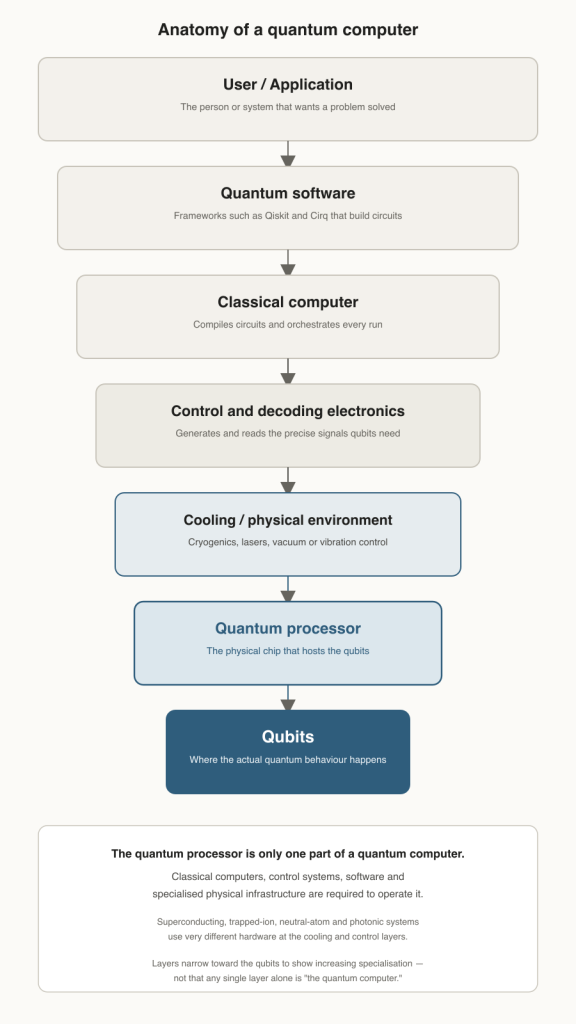
Google describes its approach as a full-stack quantum computing system, integrating processors, control and decoding hardware, cryogenic equipment, operating software and user-facing software. See Google Quantum AI — Quantum Computer.
The exact anatomy differs by hardware approach.
Superconducting processors require specialised cryogenic environments. Other systems may use trapped ions, neutral atoms or photons and therefore need very different physical equipment.
Why is building one so difficult?
Qubits are fragile.
For a quantum calculation to work, engineers must maintain precise control over the quantum state while applying operations and making measurements.
The surrounding environment can disturb that state. Depending on the hardware, engineers may need to manage temperature, electromagnetic interference, lasers, timing, vibration and many other effects.
The loss of useful quantum behaviour is commonly called decoherence.
In plain language:
The system gradually loses the controlled quantum state the calculation needs.
The operations applied to qubits are also imperfect. Measurements can be wrong. Qubits may not interact exactly as intended.
The harder engineering question is:
Can we control enough good qubits, with low enough error rates, for long enough to perform useful calculations reliably?
Why a headline qubit count can mislead you
Quantum announcements often lead with one easy number:
“Our new computer has 1,000 qubits.”
That number matters, but by itself it tells us surprisingly little.
Other important questions include:
- How often do operations fail?
- How accurate are measurements?
- How long can useful quantum states be maintained?
- How well can qubits interact?
- How complex a circuit can be executed before errors overwhelm the result?
- Can errors be detected and corrected?
See IBM Quantum — Processor Types.
The lesson is simple:
More physical qubits does not automatically mean a better quantum computer.
Physical qubits and logical qubits
The qubits physically implemented in today’s hardware are called physical qubits.
They are noisy.
To build much larger reliable quantum systems, researchers need to protect quantum information from those errors.
That is the purpose of quantum error correction.
One approach spreads quantum information across several physical qubits so that errors can be detected and corrected without simply reading and destroying the quantum state.
The protected unit is called a logical qubit.
Physical qubits
      ↓
Error detection and correction
      ↓
Protected quantum information
      ↓
Logical qubit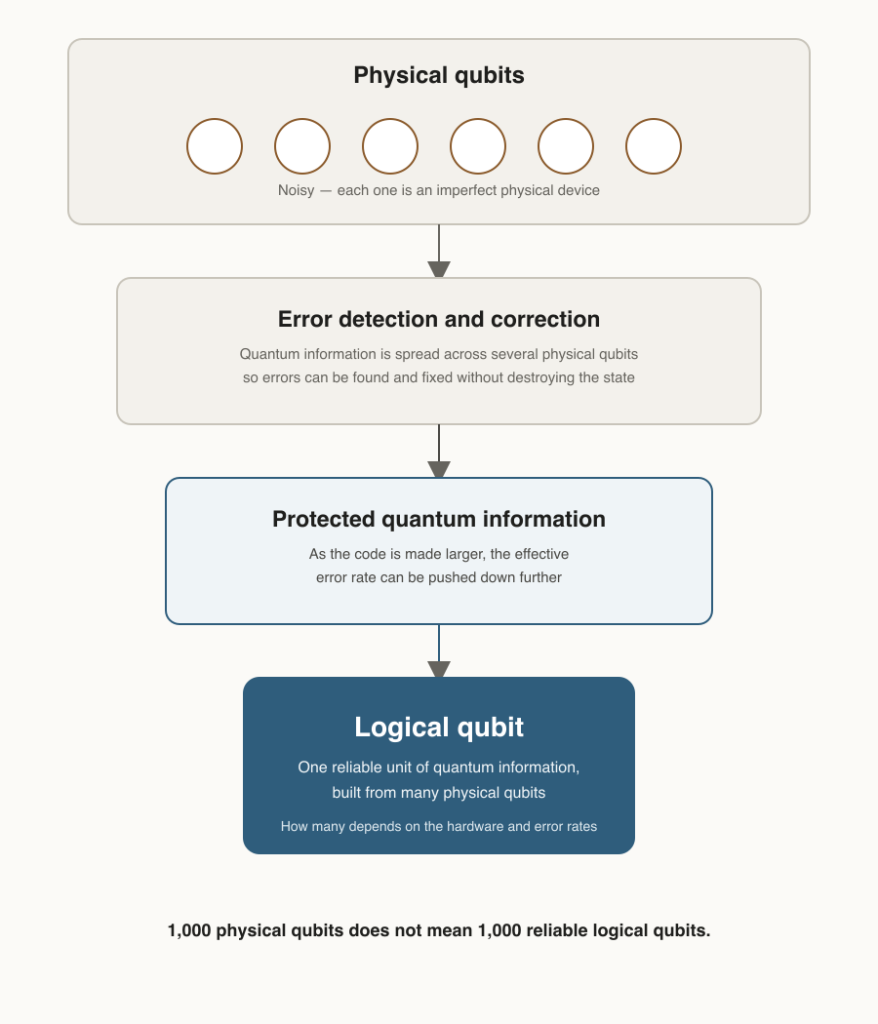
A logical qubit may require many physical qubits. How many depends on the hardware, its error rates and the error-correction method.
That is why:
1,000 physical qubits does not mean 1,000 reliable logical qubits.
In research published in Nature, Google Quantum AI demonstrated below-threshold surface-code error correction on its Willow processors: as the error-correcting code was made larger, the logical error rate decreased rather than increased.
This was an important research result, not the arrival of a large fault-tolerant computer.
See Quantum error correction below the surface code threshold.
How should we judge quantum progress?
When a new quantum processor is announced, qubit count should be only the beginning.
Ask:
- Are these physical or logical qubits?
- What are the error rates?
- How reliable are the gates and measurements?
- How complicated a circuit can run successfully?
- How effective is the error correction?
- What problem was actually demonstrated?
- What classical computer or algorithm was used for comparison?
- Can another team reproduce or verify the result?
- Is the capability available today, or is it part of a roadmap?
The final question is the most important:
Can the machine perform useful computation that justifies using a quantum computer?
Where does quantum computing stand in early 2026?
There is no useful single answer to:
“Is quantum computing ready?”
Different parts of the field are at different stages.
Available today
Real quantum processors exist, and some can be accessed through the cloud.
IBM, for example, provides cloud access to quantum processors through IBM Quantum.
Students, researchers and developers can also use quantum simulators, programming frameworks such as Qiskit and Cirq, and educational environments today.
This is real quantum computing.
But cloud access to a quantum processor is not the same as having a large fault-tolerant quantum computer.
Demonstrated, but still developing
Researchers have demonstrated important progress in areas including quantum error correction, logical-qubit experiments, improved hardware reliability, larger circuits and specialised research calculations.
These achievements are meaningful.
They should not automatically be translated into:
“Quantum computers are now better than classical computers for business.”
Being actively engineered
Major research and engineering efforts are focused on lower error rates, reliable logical qubits, scalable error correction, deeper useful circuits, modular systems and classical-quantum integration.
Promising, but not broadly proven commercially
Researchers continue to investigate possible advantages in areas such as chemistry, materials, selected scientific simulations, optimisation and some mathematical workloads.
The evidence is not equally strong across all of these areas.
Longer-term and uncertain
Large fault-tolerant quantum computers capable of running long, complex algorithms at commercially useful scale remain an engineering goal.
The timetable is uncertain, and so are the applications that will ultimately produce the greatest economic value.
Why invest before large quantum computers are ready?
Because waiting until the technology is mature may be too late to start building everything around it.
Quantum technology requires expertise across physics, electronics, materials, mathematics, computer science, manufacturing and software.
Countries and companies therefore invest not only in processors, but also in research, universities, skills, software, laboratories, supply chains, startups and industry partnerships.
There is also one area where preparation already matters even before a cryptographically powerful quantum computer exists:
security.
Quantum security is already a current problem
Shor’s algorithm matters because a sufficiently capable fault-tolerant quantum computer could threaten widely used public-key cryptography based on mathematical problems such as integer factoring.
Such a quantum computer does not exist today.
But cryptographic migrations take years.
That is why governments and organisations are already moving towards post-quantum cryptography, usually shortened to PQC.
In August 2024, the U.S. National Institute of Standards and Technology finalised its first three post-quantum cryptography standards:
- FIPS 203 — ML-KEM
- FIPS 204 — ML-DSA
- FIPS 205 — SLH-DSA
In March 2025, NIST selected HQC as an additional key-encapsulation mechanism and as a backup based on different mathematics from ML-KEM.
As of early 2026, HQC had been selected for standardisation but was not yet a final FIPS standard.
See:
- NIST — Post-Quantum Cryptography
- NIST — First Three Finalized Post-Quantum Encryption Standards
- NIST — HQC Selected for Standardisation
The practical message is:
Organisations should not wait for a cryptographically capable quantum computer before beginning migration planning.
There is no single global “quantum race”
Countries are investing heavily in quantum technologies, but comparing them using one leaderboard is misleading.
Quantum programmes can cover computing, communications, sensing, cryptography, materials, hardware manufacturing, software, research, talent development and commercialisation.
The United States National Quantum Initiative, European Union Quantum Europe Strategy, United Kingdom National Quantum Strategy, Canada’s National Quantum Strategy and Australia’s National Quantum Strategy all illustrate how governments are building broader quantum ecosystems rather than simply competing for the largest quantum computer.
China is also a major quantum research and technology ecosystem, particularly across computing and communications. Public investment figures and programme definitions are not always directly comparable with those of other countries.
The useful question is not:
Who is winning?
It is:
What capabilities is each ecosystem building, and which of those capabilities have actually been demonstrated?
India shows what “building an ecosystem” means
India’s National Quantum Mission was approved in 2023 with an outlay of ₹6,003.65 crore through 2030–31.
The mission is broader than quantum computing. It covers quantum computing, communication, sensing and metrology, and quantum materials and devices.
For computing, one mission objective is to develop intermediate-scale quantum computers with 50 to 1,000 physical qubits across platforms including superconducting and photonic technologies.
These are targets, not capabilities already delivered.
See the Government of India’s Department of Science and Technology — National Quantum Mission.
Real-world example: Amaravati Quantum Valley
India is also building a quantum-computing ecosystem in Amaravati, Andhra Pradesh.
The Government of Andhra Pradesh, IBM and Tata Consultancy Services are developing the Quantum Valley Tech Park as a hub for quantum computing, research, skills and industry collaboration.
The original May 2025 announcement from IBM and TCS said the facility would include an IBM Quantum System Two with a 156-qubit Heron processor.
However, government-linked coverage of the February 2026 foundation-stone ceremony referred to the planned installation as a 133-qubit quantum computer.
The available primary sources do not clearly reconcile those two figures, so the final qubit specification should be treated as unconfirmed.
What is clear is that Amaravati is intended to host an on-site IBM quantum computing system as part of a wider ecosystem.
Available now
IBM says participating members can access IBM quantum computers through the cloud while the physical facility is being developed.
Quantum education is also expanding. IBM reported in February 2026 that a free online quantum-computing course co-created in India had surpassed 168,000 enrolments for 2026.
See IBM — Breaking Ground on India’s Quantum Future.
Under development
The physical Quantum Valley infrastructure in Amaravati.
Planned
An on-site IBM quantum computing system.
Why this example matters
Building a quantum ecosystem involves more than installing hardware. It also requires trained people, research programmes, software, applications, access to computing resources, universities and industry participation.
That is why Amaravati is useful in this article: it shows how countries are preparing for quantum computing while the technology itself is still developing.
See the IBM / TCS / Government of Andhra Pradesh Quantum Valley announcement.
There is more than one way to build a quantum computer
The industry has not converged on one hardware design.
| Hardware approach | Examples |
|---|---|
| Superconducting circuits | IBM, Google, Rigetti |
| Trapped ions | Quantinuum, IonQ |
| Neutral atoms | QuEra, Atom Computing |
| Photonics | Xanadu, PsiQuantum |
| Topological approach | Microsoft |
| Quantum annealing | D-Wave |
These systems should not be compared only by qubit count because their qubits, connectivity, error characteristics and operating models differ.
In early 2026, which approaches will ultimately scale best is still being worked out.
Return to our airline
Now return to the airline disruption from the beginning.
Could a quantum processor eventually become useful for one narrow part of scheduling or optimisation?
Possibly.
But the correct question would not be:
“Quantum computers are powerful, so why don’t we move airline scheduling to quantum?”
It would be:
Is there a quantum algorithm for this specific problem that performs meaningfully better than the best practical classical approach, on hardware reliable enough to run it?
That is the standard we should use whenever we hear a new quantum-computing claim.
How to read the next quantum announcement
Imagine tomorrow’s headline says:
Company X unveils a 5,000-qubit quantum computer.
Before deciding that a major breakthrough has happened, ask:
- Are these physical qubits or logical qubits?
- What are the error rates?
- How reliably can the system run useful circuits?
- What calculation was demonstrated?
- Why was that problem suitable for a quantum computer?
- What was the best classical comparison?
- Was the result independently verified or peer reviewed?
- Is the machine available now, or is this a roadmap target?
Those questions are more useful than qubit count alone.
Three things you can do now
1. Stop judging quantum computers by qubit count alone
Look for error rates, logical-qubit progress, the actual workload demonstrated and whether the result is available today or only planned.
2. If you work with security, ask about post-quantum readiness
A useful starting question is:
Does our organisation know where quantum-vulnerable public-key cryptography is being used?
3. If you want to understand quantum computing, run one small circuit
A simulator is enough to begin.
Platforms such as IBM Quantum and Google’s open-source Cirq make it possible to move from reading about quantum computing to seeing how a small circuit behaves.
What should you take away?
Quantum computers are real.
They are also easy to misunderstand.
A quantum computer is not a faster personal computer, a larger mainframe or the next version of a supercomputer. It is a different computing model that uses quantum states, interference and entanglement to perform certain calculations differently.
That difference may become important for particular problems, especially where useful quantum algorithms exist. But it does not make every difficult problem a quantum problem.
Real processors can be accessed today. Hardware and error correction continue to improve. At the same time, large fault-tolerant systems capable of running long, commercially important quantum algorithms remain under development.
So TechiesJournal will not tell you:
Quantum computing is the future.
Its eventual role is still being worked out.
The more useful skill today is learning to distinguish:
what exists,
what has been demonstrated,
what is being engineered,
what is planned,
and what is still a possibility.
Continue this series
For students
Quantum Computing: What Should Students Understand and Learn Today?
For technology professionals
Quantum Computing: What Should Technology Professionals Pay Attention To?
For organisations
Quantum Computing: What Should Organisations Prepare For Now—and What Can Wait?
References and deeper reading
Understanding quantum computers
- Google Quantum AI — Quantum Computer
- IBM Quantum
- IBM Quantum — Processor Types
- Google Quantum AI — Cirq
Algorithms
Error correction
Post-quantum security
- NIST — Post-Quantum Cryptography
- NIST — First Three Finalized Post-Quantum Encryption Standards
- NIST — HQC Selected for Standardisation
India and Amaravati
- Department of Science and Technology — National Quantum Mission
- IBM / TCS / Government of Andhra Pradesh — Quantum Valley Tech Park
- IBM — Breaking Ground on India’s Quantum Future
National quantum ecosystems
- United States — National Quantum Initiative
- European Commission — Quantum Europe Strategy
- United Kingdom — National Quantum Strategy
- Canada — National Quantum Strategy
- Australia — National Quantum Strategy
Sources reviewed: April 2026. Hardware, programme and project-status claims should be rechecked if the publication date changes.