

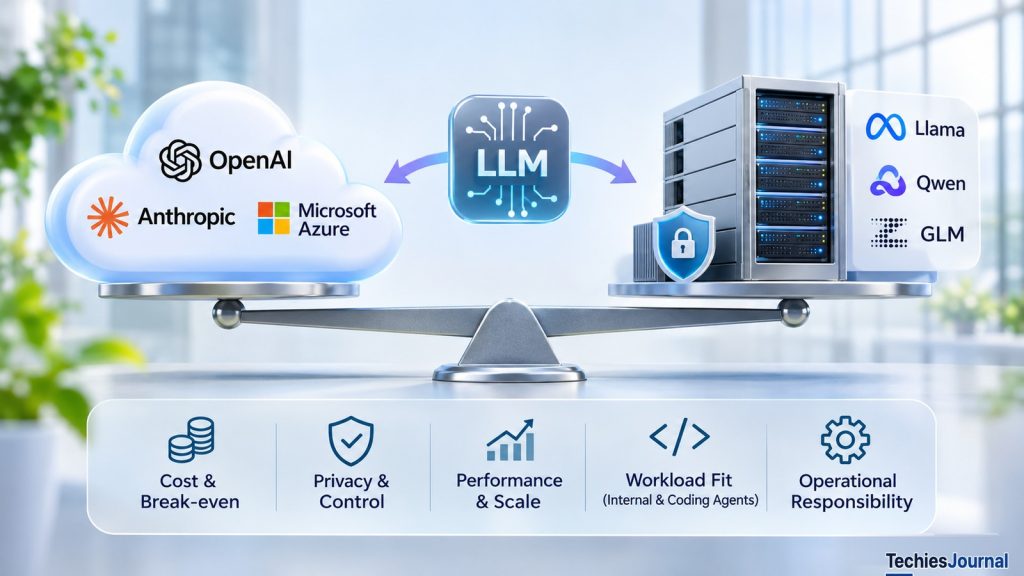
Running an open-weight language model on private infrastructure promises greater control over data, model behavior and operating costs. But how much does a company actually gain? Two practical workloads, an internal knowledge agent and an AI coding agent, reveal why model capability, infrastructure costs and the work being performed matter more than where the model runs.
A company wants to introduce an AI assistant for its employees. The assistant should search internal documentation, explain troubleshooting procedures, summarize incidents and help staff resolve routine issues.
The engineering team faces a choice. It can use a hosted model through an API, paying for inference as employees use it. Or it can deploy an open-weight model on infrastructure controlled by the company.
The second option sounds attractive. Sensitive information could remain within an approved private environment. The team could retain particular model versions, adjust inference settings and avoid depending entirely on a commercial model API.
There is also the financial argument. Why keep paying for tokens when the company could operate its own GPUs?
From an infrastructure engineering perspective, I would challenge that question before approving any hardware expenditure.
It assumes that a GPU and an API subscription provide equivalent intelligence. They do not. A GPU provides computation and memory. The company still needs a model capable of completing its work, a runtime that serves requests efficiently and engineers who can operate the system.
The decision should begin with what the application needs to accomplish, not with how cheaply the company can rent a GPU.
The difference becomes clearer when we examine two applications with very different requirements.
An internal knowledge agent may cost less than expected
Consider a company with 100 employees. Each employee asks an internal AI agent ten questions per working day over 22 working days.
That produces 22,000 interactions per month.
The assistant retrieves information from company documentation, summarizes relevant material and generates an answer. Some questions may require a short explanation, while others involve several documents and additional model calls.
Suppose each completed interaction consumes an average of 6,000 input tokens and 1,000 output tokens, including any repeated model requests.
In TechiesJournal’s calculation from those assumptions, the monthly workload becomes 132 million input tokens and 22 million output tokens.
Using published standard API rates, the model inference costs would be:
| Hosted model | Estimated monthly cost (USD) |
|---|---|
| GPT-6 Luna | $24.20 |
| GPT-6.1 Sol | $484 |
| Claude Sonnet 5.5 | $484 |
| Claude Fable 5.2 | $1,936 |
Illustrative calculation using identical token counts. Excludes retrieval infrastructure, paid tools, premium processing, caching discounts and human review. It does not establish equivalent model quality or actual token use across providers. Rates are standard-tier rates read on November 11, 2026. Each interaction is assumed to stay far below the 272,000-input-token threshold above which OpenAI prices prompts higher, and Anthropic bills Claude Sonnet 5.5 and Claude Fable 5.2 across their full 1M-token context window at standard rates.
Sources: OpenAI API pricing and Anthropic API pricing.
The first observation is important. Depending on the model, the same assumed workload can produce a dramatically different bill.
But the table is not a ranking of the best models for an internal agent.
A low-cost model might answer straightforward policy questions adequately yet struggle with complex incident investigations. A stronger model might produce more reliable results but at a higher price. Different tokenizers, reasoning behavior and tool-use patterns can also change actual token consumption.
The relevant question is whether the model meets the application’s acceptance requirements.
For this internal assistant, those requirements might include retrieving information the employee is authorized to see, producing answers supported by the retrieved documents, acknowledging missing information and responding within an acceptable time.
Access enforcement must remain in the application and retrieval systems. A language model should not be expected to enforce document permissions simply because its instructions say to respect them.
If a lower-cost hosted model consistently meets the requirements, the company may have little financial reason to operate its own inference infrastructure.
It could also route more demanding questions to a stronger hosted model, although routing introduces its own cost and quality considerations.
Model selection can change the economics substantially before the organization changes its hosting arrangement.
What running the model privately costs
Suppose the company considers an open-weight model on a rented GPU.
Instead of paying primarily according to token usage, it pays for the GPU capacity it keeps available.
Runpod’s published Secure Cloud on-demand Pod rates provide a useful reference:
| GPU (VRAM) | Secure Cloud rate and monthly cost at 720 hours |
|---|---|
| NVIDIA L4 (24 GB) | $0.59 an hour, $425 a month |
| NVIDIA L40S (48 GB) | $1.09 an hour, $785 a month |
| NVIDIA A100 (80 GB) | $1.79 an hour, $1,289 a month |
| NVIDIA H100 PCIe (80 GB) | $2.89 an hour, $2,081 a month |
USD, rounded. Illustrative continuous rental costs, not complete production inference costs. Storage, networking, availability capacity and operations are excluded. Provider prices and availability are subject to change. Runpod also lists lower Community Cloud rates for some of these GPUs, for example $0.79 an hour for an L40S, about $569 a month.
Source: Runpod GPU pricing.
An L40S running continuously costs approximately $785 per month at the Secure Cloud rate, before supporting expenses. That is higher than the illustrative $484 monthly API bill for Claude Sonnet 5.5.
It would be tempting to conclude that hosted inference is cheaper. But there is a problem with that conclusion.
The $484 represents a calculated charge for a defined amount of tokens sent to a particular hosted model. The $785 represents renting hardware. It tells us nothing by itself about which open-weight model can run on that GPU, how many requests it can process or whether its answers match Sonnet’s quality.
These are not equivalent service quotations.
To compare them fairly, the company must choose a private model, evaluate its answers against the same workload and measure how much accepted work the GPU completes within the required response time.
Only then can it calculate the effective cost per successful interaction.
The internal assistant may also be busy during working hours and nearly idle overnight. A continuously running GPU costs money during those idle hours. Turning workers off creates startup and availability trade-offs.
A batch-processing system may accommodate those conditions. An interactive assistant expected to answer immediately may not.
The economic benefit of private inference depends on how effectively the company uses the capacity it pays for.
What the company gains by owning inference
A cost comparison misses some of the strongest reasons to run a model privately.
With self-managed inference, the company can control when a model is upgraded, retain a selected version and configure the serving environment for particular operational requirements.
That can matter when the application needs repeatable behavior across a controlled release process.
Private inference can also reduce the need to transmit sensitive prompts and documents to an external model service.
But running a model locally does not automatically make the complete application private.
The internal assistant still retrieves documents, constructs prompts, writes logs and uses monitoring systems. If any of those components transmit confidential information elsewhere, a locally executed model does not close the full data boundary.
Managed model services can provide enterprise data protections too. Microsoft’s Foundry documentation distinguishes model-provider access and training use from processing location and storage, which can vary by deployment type and features. The same page describes abuse monitoring: prompts and completions that an automated system flags can be sampled and reviewed by authorized Microsoft staff, with the data stored in the customer’s geography, unless the customer is approved for modified abuse monitoring. Global and DataZone deployments may also process data outside the resource’s geography. Other providers’ terms differ, so the specific deployment’s terms must be read against the organization’s boundary requirement.
If internal documents must be processed only inside a defined company-controlled environment, private inference may be necessary. If an approved managed service satisfies the requirement, self-hosting may add little security value relative to its operating burden.
Privacy is a property of the complete application and data flow, not a label attached to the model endpoint.
A coding agent changes the economic picture
Now consider a software team using AI coding agents. The agents read repository files, investigate issues, modify code, execute tests and prepare changes for review.
This differs from retrieving internal documentation. A coding agent may inspect many files before identifying a problem. Its first patch may fail tests. It may then analyze logs, revise the implementation and invoke more tools.
Suppose ten developers delegate four coding tasks per working day over 22 days, creating 880 tasks each month.
For a moderate task, assume the complete workflow consumes 100,000 input tokens and 20,000 output tokens. For a heavier task, assume 500,000 input tokens and 50,000 output tokens.
| Hosted model | Moderate tasks/month | Heavy tasks/month |
|---|---|---|
| Claude Sonnet 5.5 | $352 | $1,320 |
| Claude Fable 5.2 | $1,408 | $5,280 |
| GPT-6.1 Sol | $352 | $1,320 |
USD for 880 tasks, standard rate arithmetic. Assumes all interaction tokens are billed at the listed standard tiers. The heavy case is an aggregate across multiple calls, not a single 500K-token prompt. Caching, paid tools, execution environments and review costs are excluded. Model quality and actual usage may differ. Rates are standard-tier rates read on November 11, 2026.
Sources: Anthropic API pricing and OpenAI API pricing.
Caching can change these totals materially. Anthropic bills cache hits for Claude Sonnet 5.5 at $0.10 per million tokens against $2 for base input, and OpenAI lists cached input for GPT-6.1 Sol at $0.10 against $2. Coding agents resend much of their context between calls, so a hosted bill can sit well below the figures above. As a hypothetical sensitivity, if 80% of the heavy case’s 440 million input tokens were cache hits, the Claude Sonnet 5.5 total would fall from $1,320 to about $651 before any cache-write charges. That is a TechiesJournal calculation, not an observed result.
At the heavier end, recurring model charges become significant. That makes private inference worth investigating, but not automatically worth deploying.
The cost of generating code is not the cost of producing an accepted software change.
An inexpensive model can become costly if it repeatedly produces patches that fail tests and need developer correction. A more expensive model may complete difficult work with fewer retries, though that advantage must be measured rather than assumed.
For coding agents, I would measure successful task completion, elapsed time and human correction alongside model charges.
Whether an open-weight model can handle the same coding work
Open-weight models are credible candidates for coding and agentic tasks, but a public leaderboard does not establish that one can replace a hosted model in a particular company.
SWE-bench Verified, which evaluates agents against issues in public code repositories, became a common reference point. In September 2026, however, Epoch AI classified the benchmark as flawed, citing contamination and scoring issues.
A model’s score can also depend on the agent harness, prompts, tools and execution configuration. A public benchmark does not reproduce a company’s private repositories, dependencies, tests or acceptance standards.
A better comparison would give the hosted and private candidates a representative set of equivalent internal tasks. The team would examine bug fixes, test generation, dependency upgrades and changes spanning several files.
For each task, the team should record whether the tests passed, whether the change met the request, how many attempts were needed, how long it took and how much developer correction remained.
That evidence matters more than a headline benchmark percentage when the decision is whether to spend money operating dedicated inference hardware.
The chosen model determines the hardware bill
A reason to evaluate capability first is that different open-weight models impose very different serving requirements.
Qwen3.5-27B is described on its model card as a 27 billion parameter language model. At four bits per parameter, the theoretical weight payload is around 13.5 GB before metadata and runtime overhead. A suitable quantized deployment on a 48 GB GPU is worth evaluating, but its context length, concurrency and real throughput remain to be tested. The card’s own serving examples use eight-GPU tensor parallelism and advise keeping at least 128K tokens of context where possible, which shows how quickly memory planning moves beyond the weights alone.
GLM-5.3-Flash uses a mixture-of-experts architecture with approximately 321 billion total parameters and 18 billion active per token. The smaller active number reduces some computation, but does not remove the requirement to store and access the model weights. TechiesJournal’s earlier explanation of open-weight models and why mixture of experts helps compute but not storage covers the same distinction for three other models.
Its documented default FP8 checkpoint needs approximately 306 GiB of weight storage before runtime and KV-cache overhead, and the published recipe’s default configuration uses eight H200 GPUs, a configuration the Runpod table above does not price. The same recipe lists a BF16 checkpoint that needs roughly twice the FP8 weight memory and a 4-bit NVFP4 checkpoint that requires NVIDIA Blackwell GPUs.
That default checkpoint cannot fit on one L40S. A company attracted by a powerful open-weight coding model may discover that the required private infrastructure is much more expensive than the GPU used in its first spreadsheet.
Open weights offer deployment freedom, but do not guarantee affordable deployment.
Why multiple agents make inference more demanding
The coding-agent scenario also tests concurrency.
A model-serving runtime must handle requests with different context lengths and output sizes. For conventional autoregressive transformers, processing the input is often described as prefill, followed by token generation during decoding.
The runtime maintains reusable attention state, known as the key-value cache, or KV cache. Long contexts and multiple active agents increase the memory needed for that state.
Serving systems such as vLLM employ scheduling and batching techniques to improve GPU utilization. But available memory and computation remain finite. TechiesJournal’s guide to choosing an AI inference engine for production compares the serving engines in more detail. Queues and slower responses emerge when demand exceeds capacity.
This matters particularly for multi-step coding agents. Each delayed response can postpone the next tool call, test or correction.
The company should therefore measure end-to-end task completion time under realistic concurrent demand, not only single-request token generation speed.
Hosted services operate much of the serving infrastructure for customers, while still imposing limits and introducing provider dependencies. Self-managed inference provides direct capacity control but requires the company to design, monitor and restore that capacity itself.
That operational difference belongs in the cost comparison.
Where the break-even point sits
In the heavy coding example, Claude Sonnet 5.5 produces an illustrative model bill of $1,320 per month. One continuously rented L40S costs about $785.
The gap looks promising, but it is not proof of savings, and the caching sensitivity above shows how far it can narrow. The private deployment might need a larger model, more GPUs, more operations support or more retries to achieve the same accepted results.
The comparison should use a common measure:
Cost per accepted task = total relevant operating cost ÷ accepted tasks completed
For hosted inference, total cost includes model usage, relevant tool charges and the surrounding application and review work. For self-managed inference, it includes GPUs or hardware, storage, networking, redundancy, operational support and comparable human correction.
TechiesJournal’s earlier article on how AI pricing is moving from token prices to cost per task covers the retries, caching and review costs that this measure has to include.
Both approaches must be evaluated against the same success criteria, privacy requirements and response-time expectations.
A private model handling predictable tasks at high utilization may be economical. Another requiring expensive hardware but producing uncertain results may not be.
A hybrid approach can make sense when different workloads require different model capabilities, provided routing is constrained by the company’s data policy. A confidential request cannot be sent to an unauthorized cloud endpoint simply because the approved private model is busy.
The useful question is which arrangement produces an accepted result at the lowest sustainable cost while meeting the application’s constraints.
What I would choose for these workloads
For the internal knowledge assistant, I would begin by evaluating a suitable managed model against the company’s accuracy, privacy and latency requirements. The illustrative API charges do not, by themselves, justify maintaining dedicated GPU capacity.
Private inference becomes attractive when it meets a processing-boundary requirement or demonstrates a clear operating advantage under sustained traffic.
For the coding agent, I would examine private inference more seriously once model expenses and usage become substantial. But I would test coding-task success and human correction before treating a low GPU rate as a saving.
The evidence could support a hosted model, a self-managed one or a combination of both. That is not indecision. It follows from the fact that these workloads have different capability, infrastructure and security requirements.
The advantage is control, but control must create value
Open-weight models allow organizations to retain model versions, operate within defined processing environments and potentially improve economics for suitable high-volume work.
Those benefits are real. So are the added responsibilities for capacity, memory, concurrency, reliability, upgrades and security.
The internal knowledge agent illustrates why modest hosted-model charges can weaken the business case for a private GPU. The coding agent shows why sustained, expensive interactions can make private inference worth evaluating, while also exposing model capability and hardware limits.
An organization should own AI inference when that ownership delivers a capability, privacy boundary or economic advantage its workload genuinely needs and that it can sustainably operate.
The goal is not to own more infrastructure. It is to deliver better outcomes with the right level of control.
Sources and further reading
- OpenAI API pricing
- Anthropic API pricing
- Runpod GPU cloud pricing
- Microsoft Foundry data privacy
- Qwen3.5-27B model card
- GLM-5.3-Flash vLLM deployment recipe
- vLLM documentation
- Epoch AI review of SWE-bench Verified
Research date: November 11, 2026. All workload volumes, monthly costs and examples are illustrative calculations, not observed production results. Prices and model requirements change, so check current figures before relying on them. No firsthand deployment or matched hosted-versus-private benchmark is claimed.