

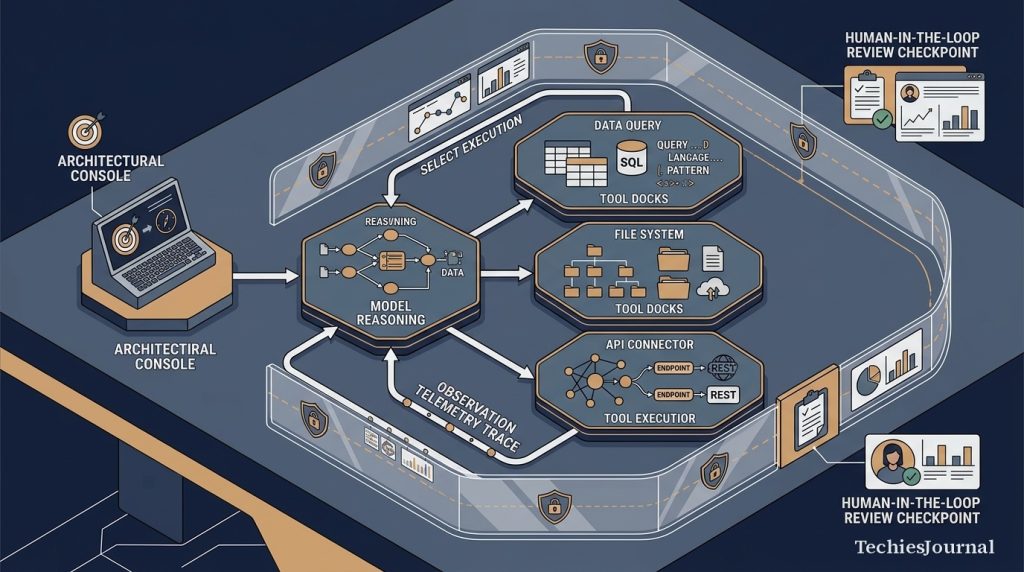
AI agents have become one of the most talked-about topics in artificial intelligence. You may hear that agents can plan work, use tools, make decisions, and complete tasks with less human involvement. That sounds powerful. It can also make the subject feel more complicated than it really is. Building on the core foundations of AI, machine learning, and LLMs, before deciding whether you need to learn AI agents, start with a simpler question: What makes an AI agent different from a normal AI assistant?
An AI Assistant Usually Responds
A normal AI assistant mostly waits for your instruction. You ask a question and it gives an answer. You ask it to write code and it generates code. You ask it to summarize a document and it produces a summary. The interaction is usually: You ask → AI responds.
An AI agent can go further. Instead of only answering, it may work through several steps to complete a task.
An Agent Can Take Actions
Imagine you ask an AI system: "Review these support tickets, group the common problems, and prepare a short report." A normal AI assistant may help you analyze the tickets if you provide them. An AI agent may be able to read the tickets, organize the information, identify common issues, use another tool if needed, create the report, and save the result.
The important difference is not that the AI suddenly became intelligent in a completely new way. The difference is that the AI has been given tools, instructions, and the ability to work through multiple steps. That combination is what makes an agent useful.
A Simple Way to Think About It
An AI agent usually has a few basic parts: a goal, an AI model that helps decide what to do, tools it can use, and the ability to repeat steps until the task is complete. For example, with the goal of finding the main issues in customer feedback, the agent may read the feedback, group similar comments, decide which issues appear most often, create a summary, and check whether the task is complete. That is much closer to a small workflow than a single question-and-answer interaction.
Agents Are Not Fully Independent
The word "agent" can make it sound like the AI is completely independent. In practice, that is usually not what we want. Agents still need clear goals, limits, access controls, reliable tools, validation, and human review where the risk is high. An agent that can send emails, change records, deploy software, or spend money needs much stronger controls than one that simply summarizes documents. The more an agent can do, the more carefully it needs to be designed.
Do You Need to Learn AI Agents?
That depends on your role. If you mainly use AI tools for writing, research, coding help, or analysis, you may only need to know what agents are and understand where they are useful. If you are a developer building applications with AI, you may need to use agent concepts: understanding how an AI system receives a goal, chooses a next step, uses tools, keeps track of context, handles errors, and decides when to stop. If you are designing larger AI systems, you may need deeper knowledge of reliability, security, evaluation, permissions, and workflow design.
Again, you do not need to master the subject simply because it is popular.
| System Pattern | Execution Mechanism | Tool & State Handling | Human Oversight Need | Best Practical Application |
|---|---|---|---|---|
| AI Assistant | Single prompt-response turn | Passive; relies on prompt context; no external tools | Continuous; user reviews every individual reply | Drafting text, summarization, exploratory code help |
| Fixed Workflow | Deterministic programmatic rules (if/then) | Pre-configured APIs and database pipelines; rigid state | Exception-based; alerts on runtime failure | Automated ETL, scheduled notifications, form routing |
| Tool-Using Agent | Iterative goal loop (Reason → Act → Observe) | Dynamic tool selection; maintains state across steps | Checkpoint-based; required for sensitive actions | Support ticket triage, multi-source research, diagnostic triage |
| Multi-Agent System | Coordinated delegation across specialized agents | Decoupled tools; task handoffs and shared artifacts | Governance-level; organizational policy and audits | Cross-team enterprise workflows, distributed data processing |
Start With Workflows Before Agents
One useful mistake to avoid is trying to build an agent for every problem. Sometimes a normal workflow is better. If the steps are already known and predictable, regular software may be simpler and more reliable. For example: Receive a file → validate it → store it → send a notification. You may not need an AI agent for that.
Agents become more useful when the task requires some judgement between steps. For example: Read a customer request → understand the problem → choose the right tool → gather information → prepare a response. The difference is important. Do not use an agent simply because the technology is new. Use it when the problem actually needs the flexibility an agent provides.
Before building an autonomous agent, ask if a deterministic workflow is sufficient. If the steps, inputs, and business rules are already predictable, traditional software is faster, cheaper, and far easier to debug. Introduce agentic decision loops only where the task genuinely requires dynamic reasoning between steps.
Learn the Idea Before the Framework
There are already many tools and frameworks for building AI agents. They will continue to change. Do not begin by trying to learn every framework. First understand the basic ideas: goal, context, reasoning, tools, actions, feedback, limits, and human review. Once those ideas are clear, learning a framework becomes much easier. If you start with the framework, you may learn how to use a tool without understanding why the system behaves the way it does.
Final Thought
AI agents are not simply chatbots with a new name. They are AI systems that can work through several steps and use tools to help complete a goal. That makes them useful. It also makes them more important to control carefully. For most people, the first step is not to become an AI agent expert. It is to understand where agents are useful, where a normal workflow is better, and how much of the subject your role actually requires.
For the practitioner detail on keeping an agent safe once it has real capabilities, see Give tools narrow authority and Control an agent outside the model in Navigating the AI World.