

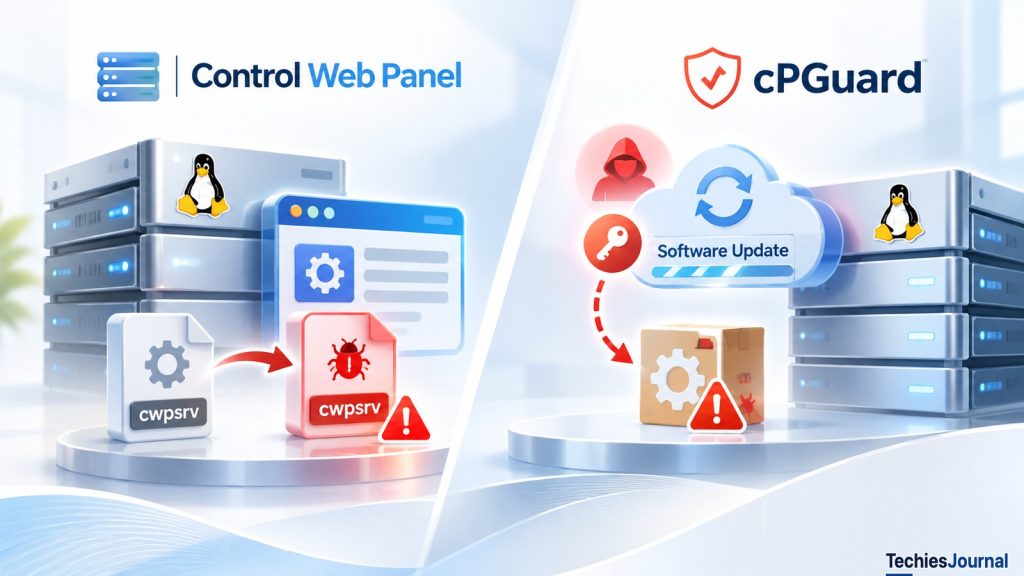
A backdoored Control Web Panel binary and a hijacked cPGuard update channel are separate incidents. Here is what each means for hosting administrators.
Two incidents affecting Linux hosting environments
In early November 2026, researchers and vendors disclosed two separate security incidents involving tools used to manage and protect Linux hosting servers. On November 5, QiAnXin XLab published research into CWPdoor, a backdoor embedded in a modified cwpsrv web-server binary used by Control Web Panel (CWP). Separately, OPSSHIELD disclosed on November 3 that an attacker had broken into part of its infrastructure and used its cPGuard update channel to push a malicious update on November 2.
| Incident | Attack route | Security impact |
|---|---|---|
| CWPdoor | An attacker-supplied updater-like script replaces cwpsrv with a trojanized binary | Hidden remote command execution |
| cPGuard | Stolen update-distribution credentials allow a malicious update to reach customer servers | Root-level execution, credential exposure and persistence |
The incidents should not be described as one campaign or one compromised update channel. XLab has not established that the legitimate CWP vendor’s official update infrastructure was breached. XLab says it does not know how the script reaches servers or which vulnerability is used. The cPGuard incident involved an actual compromise of OPSSHIELD’s distribution mechanism. What the two share is practical: both reach a server through software that runs with high privilege, so the response in each case is to verify the binary, then rotate what a root process could read.
CWPdoor: the web server continues working while hiding a backdoor
CWP provides a server-hosting administration interface. Its cwpsrv component serves management traffic. According to XLab, its Cyber Threat Insight and Analysis System captured a script named cwpsrv_update.sh on June 29, 2026. The script downloads a file named cwpsrv from 136.0.141[.]71 and replaces the file of the same name on the system. XLab says the script supports only cwpsrv versions 1.24.0 and 1.15.10 and must run as root.
XLab describes the replacement as a passive backdoor. It behaves like a legitimate cwpsrv for ordinary requests and acts only on a request carrying three specific headers, X-Ngx-Integrity-Time, X-Ngx-Integrity-Data and X-Ngx-Integrity-Sig. If the timestamp or the signature check fails, the request continues as ordinary traffic. XLab also says the backdoor tampers with the request’s module context so that the logging module does not record the request, and that the script restores file and directory timestamps and runs history -d. TechiesJournal’s inference, not an XLab statement, is that such a backdoor is difficult to detect from availability checks, because the panel keeps working.
XLab also reports that a file named evidencia.tgz was uploaded to VirusTotal from Brazil on September 30, 2026. It contained a cwpsrv.suspeito file that XLab identifies as CWPdoor, with zero detections, next to a sample most vendors identified as the Ebury backdoor. XLab concludes real victims exist and says the relationship between Ebury and CWPdoor is unclear.
According to QiAnXin’s Hunter Platform data cited by XLab, more than 340,000 CWP instances were exposed to the internet over the past month (XLab). That measures exposure, not confirmed infections, and it does not establish how many systems received the trojanized binary.
Source: QiAnXin XLab, CWPdoor.
cPGuard: trusted software updates became the delivery route
OPSSHIELD’s November 3 disclosure says an attacker entered its billing and licensing environment on November 1 and 2, took the keys used to publish updates, and uploaded a fake cPGuard update on November 2. The vendor says cPGuard agents installed it between about 02:08 and 03:20 UTC. Do not rely on that window to rule a server out. OPSSHIELD’s advisory shows affected versions installing in its example log entries through 12:46 on November 2, and says a missing or incomplete log does not by itself show a server was unaffected. It recommends contacting OPSSHIELD Support if you are unsure.
According to the vendor, the malicious script ran with root privileges, collected password hashes, SSH keys, MySQL credentials and shell history, and left a hidden root shell and a scheduled task behind. The two OPSSHIELD pages differ on how the attacker got in. The disclosure says a customer account registered on November 1 led into the billing application, and that the exact request is not in its logs. The advisory says compromised credentials were used and that how they were obtained was under investigation.
| Vendor-reported observation | Scope |
|---|---|
| Customer servers that ran the malicious update | Approximately 2,950 |
| Billing-portal account records copied | Approximately 7,900 |
| Affected update versions (OPSSHIELD advisory) | 5.88.12 through 5.88.19 |
OPSSHIELD says billing account passwords were stored as bcrypt hashes. The figures are vendor-reported incident findings, not independent confirmation of precisely what was exfiltrated from every server. The server count also moved: OPSSHIELD’s first advisory estimated that the attacker retrieved 32 collected files and called that a preliminary count of confirmed retrieval, not the number of affected servers, while its later disclosure puts about 2,950 servers as having run the update.
Sources: OPSSHIELD incident disclosure (latest) and OPSSHIELD advisory (earlier findings).
What cPGuard administrators should do
OPSSHIELD’s advisory says to run cPGuard 5.88.25 or later. Its later disclosure names 5.88.26 as the clean release and says a further update removes the i93677 scheduled task. Update to the latest version, then confirm the files listed below are gone. The advisory lists the steps in this order.
1. Check the update history. An entry from 5.88.12 through 5.88.19 means the server installed an affected update. OPSSHIELD says this confirms installation, not which files were transferred, and that such a server should be treated as potentially compromised even if it now runs 5.88.25 or later.
grep 'Successfully updated' /opt/cpguard/logs/install_log2. Update.
cpgcli update --start3. Verify the version. OPSSHIELD’s advisory asks for 5.88.25 or later and says to contact support if the update fails.
cpgcli --version4. Confirm the leftovers are gone. The disclosure names /etc/cron.d/i93677, /var/tmp/.i93677/ and /var/tmp/.cpg91511_sh. The advisory adds /var/tmp/.cpg91511 and /var/tmp/.cpg91511/loot.tgz. OPSSHIELD says the absence of these files after cleanup does not establish whether the script previously ran.
5. Rotate credentials. A clean update does not revoke credentials already copied. OPSSHIELD asks administrators of potentially affected servers to:
- Reset the root and all local account passwords, from a trusted recovery environment according to the advisory, and change passwords reused on other systems from a trusted device.
- Replace the root SSH keys and remove the old public keys from
authorized_keyson every system that trusted them. Treat other servers reachable with those keys as exposed until the keys are replaced. - Change the MySQL root password and the database passwords stored in
/root/.my.cnf. - Rotate passwords, API keys and tokens found in root’s shell history, plus keys in
/root/.s3cfgand any DigitalOcean tokens (the advisory names both). - Reset the OPSSHIELD billing-portal password and turn on two-factor login. The disclosure asks for the reset even where cPGuard was offline during the window.
- Rebuild from a clean backup taken before November 1 only if OPSSHIELD told you the attacker logged in to your server by hand. Otherwise the advisory does not recommend a routine rebuild, and calls that assessment provisional.
TechiesJournal’s article on what leaves with a firewall configuration and what to rotate covers the same rotation problem for another device class. Its article on what to do after an exploited device is patched explains why a patched system is not necessarily a clean one.
What CWP administrators should do
XLab publishes the following host checks. The first looks for the Unix socket ngx_http_integrity_helper that CWPdoor uses for inter-process communication.
ss -axp | grep integrity
ps aux | grep cwpsrv
strings /usr/local/cwpsrv/bin/cwpsrv | grep X-Ngx-Integrity
For the second command, XLab says to look for suspicious helper child processes of cwpsrv. For the third, it says to look for suspicious X-Ngx-Integrity strings in the binary. Network teams can also search firewall and proxy logs for connections to 136.0.141[.]71, the address XLab lists as the downloader.
If an infection is confirmed, XLab recommends three steps. First, replace the malicious cwpsrv with the legitimate backup the attacker’s script created in /usr/local/cwpsrv/bin, named cwpsrv.prev- followed by a timestamp. Second, upgrade to the latest version and confirm that ss -axp | grep integrity no longer returns a match. Third, rotate all control panel credentials immediately, treat them as compromised, and treat the host as compromised and investigate it for other threats.
Note that XLab also says the script deletes its backup when the replacement succeeds, so that cwpsrv.prev- file may not exist. TechiesJournal’s inference is that a binary obtained from a trusted CWP source is the safer replacement. XLab asks you to treat the host as compromised, because the backdoor can run arbitrary commands, so replacing the binary alone is not enough.
Source: QiAnXin XLab, CWPdoor.
What administrators should take away
CWPdoor demonstrates how a modified executable can conceal remote access inside software that still appears to work. The cPGuard incident shows the separate danger of an attacker gaining access to a legitimate update-distribution path. The practical response depends on which event affected the host: verify installed binaries and update history, replace compromised components, investigate persistence, and rotate exposed credentials.
References
- QiAnXin XLab: CWPdoor research, November 5, 2026
- OPSSHIELD incident disclosure (latest), November 3, 2026
- OPSSHIELD advisory (earlier findings), November 3, 2026
Sources were read on November 12, 2026. OPSSHIELD says it will keep updating its disclosure, so check it before acting.