

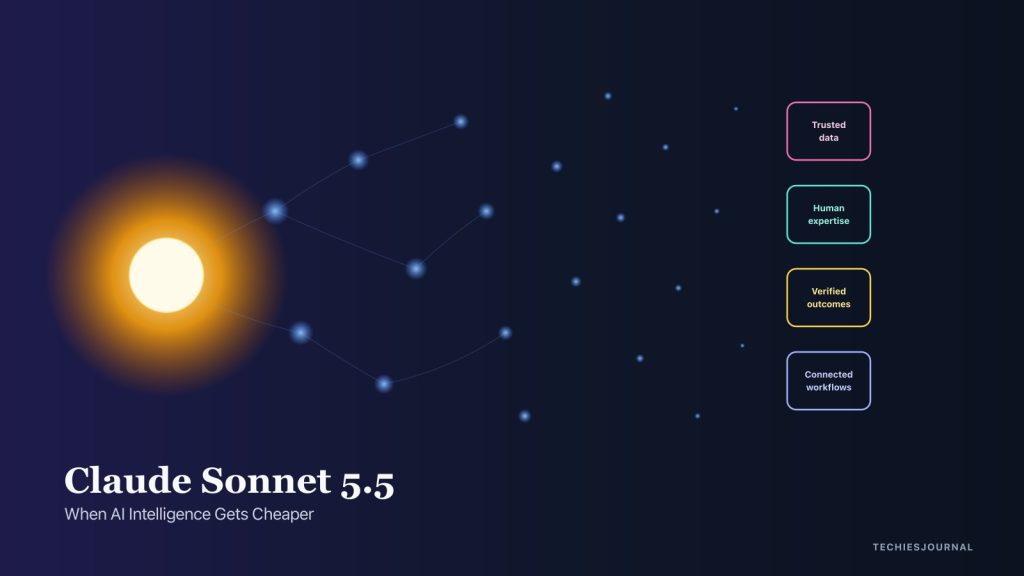
Anthropic released Claude Opus 5.5, its most capable model, on September 22. Six days later, Claude Sonnet 5.5 arrived.
The interesting part is not how quickly another model appeared. It is what Sonnet 5.5 offers. Anthropic says it is more than 30% faster than Sonnet 5, can cost up to 30% less per task, and comes close to the more expensive Opus model on some professional work.[1]
This is becoming a familiar pattern across AI. Capabilities that begin at the expensive frontier gradually become faster, cheaper and more widely available.
That raises a bigger question than which Claude model performs better.
If capable AI becomes something almost everyone can access, where does the real advantage move next?
Is AI intelligence becoming a commodity?
The word commodity needs some care.
AI models are not interchangeable. They still differ in reasoning, coding, tool use, reliability, speed, context handling and specialist capabilities. Some difficult problems still benefit significantly from the strongest frontier models.
But something narrower is happening.
For a growing number of everyday tasks, several models may now be good enough.
A company summarizing documents, classifying support requests, extracting information, generating routine code or operating a defined workflow may have several capable models to choose from.
Once that happens, the decision starts changing from which model is the smartest to which model can complete this job reliably at the right cost.
Sonnet 5.5 is another sign of that transition.
The broader evidence goes beyond Anthropic. AI model providers increasingly offer families ranging from high-capability frontier models to faster and cheaper alternatives. Open-weight models add further competition. Industry measurements have also documented substantial declines in the cost of reaching previously expensive levels of model performance.[3]
This does not mean AI intelligence has already become a commodity.
It means useful levels of intelligence are becoming less scarce.
And when something becomes less scarce, value tends to move elsewhere.
If everyone has the model, what becomes valuable?
Imagine two companies using similarly capable AI models for customer support.
One connects the model to a chat interface.
The other combines it with accurate customer history, trusted product information, clear escalation rules, tested workflows and people who understand when the system should not make a decision.
Both companies have access to AI.
They do not have the same capability.
That difference points toward where value may move as model access becomes easier.
Accessible text alternative for this figure
A two-column table shows what is becoming easier to obtain against what is becoming more valuable. General model capability pairs with trusted context and data. AI-generated output pairs with verification. Access to AI pairs with workflow integration. Generic knowledge pairs with domain judgment. Model execution pairs with governance and accountability.
The model still matters.
But increasingly, so does everything around it.
Cheap generation makes verification more important
AI can already produce code, documents, analysis and designs at a speed that would have been difficult to imagine a few years ago.
Producing something is becoming cheaper.
Establishing that it is correct does not necessarily become cheaper at the same rate.
Consider software.
Generating thousands of lines of code may take minutes. Someone, or another reliable system, still needs to establish that the code works, is secure, handles unexpected conditions and solves the intended problem.
The same problem appears in research, financial analysis and business decisions.
When generation becomes abundant, verification can become the scarce part.
This is one reason access to a powerful model alone may become less differentiating.
Sonnet 5.5 also gives us a cybersecurity signal
Anthropic says Sonnet 5.5 is the first Sonnet release to include cybersecurity safeguards and fallback mechanisms previously used for its most capable models.[1]
That is worth noticing.
It suggests that capabilities requiring stronger controls are moving into faster and more economical model tiers as well.
We should not jump from that to the conclusion that cheaper AI automatically creates more sophisticated attackers. Cyber operations still require access, infrastructure, knowledge and reliable execution.
But reducing the cost of activities such as code analysis, vulnerability research and automation can change the economics for defenders and attackers alike.
Cybersecurity is therefore one example of the broader trend. Capabilities that were once relatively expensive to access are moving downward through the model market.
The model may become a replaceable part of the system
There is another consequence.
Organizations may increasingly stop using one model for everything.
A difficult reasoning problem could go to a frontier model built for much larger delegated tasks.
Routine work could go to a faster and cheaper model.
Specialized tasks could use another provider or an open model.
The application chooses the intelligence appropriate for the job.
Anthropic itself increasingly presents Claude as a model family with different capability, speed and cost characteristics.[2]
If this direction continues, asking which AI model does your company use may eventually tell us less than how does your system decide which intelligence to use for each job.
That is a much more interesting engineering question.
What should you take from this?
You do not need to switch models whenever a cheaper or faster one appears.
Instead, understand what level of intelligence your work actually requires.
- If you use AI: know that the newest or most expensive model is not automatically necessary for every task.
- If you build with AI: measure task success, reliability, latency and total cost. Design so that changing models does not require rebuilding the entire application.
- If you lead technology: pay increasing attention to what surrounds the model, your data, workflows, verification, domain expertise and governance.
Those things may become harder for competitors to copy than access to the model itself.
The AI race is changing
Claude Sonnet 5.5 matters because it is another sign that AI competition is no longer only about producing the most capable model.
Capability still matters.
But so do speed, cost and the ability to provide enough intelligence for the job.
It is too early to say that AI intelligence itself has become a commodity. Models remain different, and the frontier continues to move quickly.
But useful intelligence is becoming cheaper and more accessible.
If that continues, simply having access to powerful AI will become less of an advantage.
The advantage will increasingly come from what we build around it, and how well we turn inexpensive intelligence into dependable work.
References and further reading
- Anthropic — Claude Sonnet 5.5. Primary source for Sonnet 5.5’s performance, speed, cost-per-task positioning and cybersecurity safeguards. ↩
- Anthropic — Claude model family guidance. Useful for understanding Anthropic’s positioning of different Claude models according to capability, speed, cost and workload. ↩
- Stanford AI Index 2026. Independent evidence for longer-term changes in model capability, competition and the declining cost of reaching previously expensive levels of AI performance. ↩
- Artificial Analysis — Claude Sonnet 5.5. Independent model evaluation used to check the broader capability-convergence trend rather than relying solely on model-provider claims.