

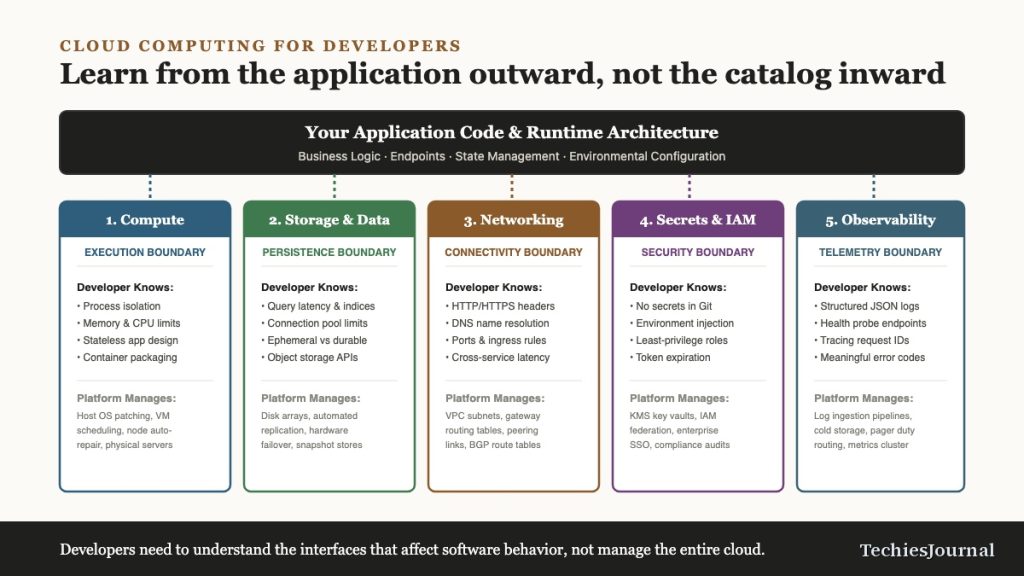
Cloud computing is now part of everyday software development. Applications are deployed to cloud platforms. Databases run there. Files are stored there. APIs, queues, monitoring, authentication, and many other services may also come from the cloud. Because of this, developers are often told: "You need to learn cloud." But that statement is too broad. A developer usually does not need to learn every cloud service or become a cloud architect. The better question is: What cloud knowledge actually helps a developer do their job well?
First, Understand What the Cloud Really Is
Cloud computing is not a completely different kind of computing. At a simple level, you are using computing resources provided by another company instead of running everything yourself. Those resources may include servers, databases, storage, networking, messaging, monitoring, and identity services. Companies such as AWS, Microsoft Azure, and Google Cloud provide these services. The names are different, but many of the basic ideas are similar. That is why learning the concepts first is more useful than memorizing hundreds of product names.
A Developer Should Understand Where the Application Runs
A developer should know what happens after the code leaves their laptop. For example: Where is the application deployed? How does it receive traffic? Where does it store data? How does it connect to other services? How are configuration and secrets provided? What happens if one part of the application fails? You may not be responsible for managing the infrastructure, but understanding this environment helps you build better software. It also makes conversations with DevOps, platform, and cloud teams much easier.
Learn the Common Building Blocks
You do not need to study the full catalogue of a cloud provider. Start with the services that appear in most applications. Understand the basic purpose of:
- Compute: Where your application runs, increasingly managed through packaging applications with containers and Docker.
- Storage: Where files and other objects are kept.
- Databases: Where application data is stored.
- Networking: How applications and services communicate.
- Identity and access: Who or what is allowed to access a service.
- Monitoring and logs: How you understand what the application is doing after deployment.
The product names will change from one cloud provider to another. The ideas remain useful.
Developers Should Understand Configuration and Secrets
Applications often behave differently in development, testing, and production. That means developers should understand how configuration is handled. You should also know why passwords, API keys, and other sensitive values should not be placed directly in source code. Cloud platforms provide ways to manage these values securely. You may not need to design the entire security system, but you should understand enough to avoid creating unnecessary risk.
Understand Basic Scalability and Failure
Running an application in the cloud does not automatically make it scalable or reliable. Developers should understand a few simple ideas: What happens if more users arrive? Can another instance of the application run? What happens if a service is temporarily unavailable? Does the application retry safely? Where is user session information stored? These questions affect the way software is written. Cloud knowledge therefore is not only an infrastructure topic. It can influence application design.
Learn One Cloud Platform Practically
Concepts are important, but some hands-on experience helps. Choose the cloud platform that is most relevant to your work or career. You do not need to learn AWS, Azure, and Google Cloud at the same time. Deploy a small application, connect it to a database, store a file, look at the logs, configure an environment variable, and see how authentication and permissions work. That small amount of practical experience will teach you more than trying to memorize a large list of cloud services.
| Cloud Domain | What Developers Should Understand | What Platform Teams Typically Manage | Practical Application Impact |
|---|---|---|---|
| Compute & Execution | Process isolation, memory/CPU allocation, container packaging | Physical host patching, hypervisors, cluster node autoscaling | Prevents out-of-memory crashes, ensures stateless scalability |
| Storage & Databases | Latency, connection pool exhaustion, ephemeral vs persistent storage | SAN/NAS arrays, automated backups, multi-region replication | Avoids database lockups, handles uploaded media cleanly |
| Networking & Routing | Ports, DNS resolution, HTTP/HTTPS headers, egress cost factors | VPC subnets, peering topologies, CIDR blocks, BGP routing | Ensures services communicate without silent timeout failures |
| Secrets & Identity | Zero hardcoded secrets, environment injection, least-privilege roles | KMS key vaults, enterprise IAM federation, SSO compliance | Eliminates repository credential leaks and privilege escalation |
| Observability | Structured JSON logs, health probe endpoints, distributed trace IDs | Log ingestion pipelines, long-term storage, alerting clusters | Enables immediate triage and root-cause isolation in production |
What You Probably Do Not Need Yet
Most developers do not need to begin with advanced network design, complex multi-region architecture, deep infrastructure automation, every Kubernetes feature, every cloud security service, or hundreds of provider-specific products. Those areas may become important later. But learning them before you need them can easily distract you from the cloud knowledge that directly improves your development work.
Know, Use or Master?
For many developers, cloud computing belongs somewhere between Know and Use. You should know the main cloud concepts and understand how your application fits into the environment. You should use the services directly connected to the applications you build. You may need to master cloud architecture only if your role moves toward platform engineering, DevOps, cloud engineering, or solution architecture. The depth should follow the responsibility.
Learn the cloud from the application outward, not from the service catalogue inward. Master how your application handles state, configuration, network latency, and failure first. Cloud provider service names and web consoles change frequently, but these software architecture fundamentals remain durable across every provider.
Final Thought
Developers do need cloud knowledge. But they do not need to learn the entire cloud. Start by understanding where your application runs, how it stores data, how services communicate, how access is controlled, and how you observe the application after deployment. Then learn the cloud services you actually use.
Learn the cloud from the application outward, not from the service catalogue inward.
For where AI workloads fit into this same infrastructure picture, and the hardware constraints that shape them, see Read the seven-layer map correctly and Understand GPU and memory constraints in Navigating the AI World.