

You type a question into an AI tool. A few seconds later, it gives you a clear answer. Sometimes the answer is so natural that it feels like the AI understood your question exactly as a person would. But that is not really what is happening. Understanding the basic process helps you use AI more carefully and judge its answers better.
Your Question Becomes Input
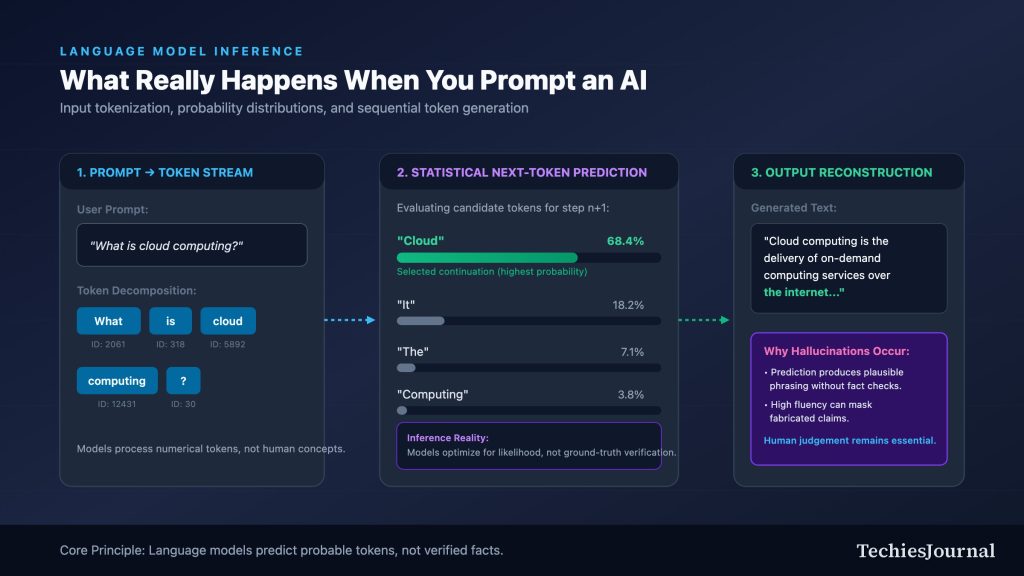
When you type a question, the AI does not simply read it in the same way a person does. Your text is first broken into smaller pieces called tokens. A token can be a word, part of a word, punctuation, or another small piece of text. The model works with these tokens rather than with sentences in the human sense. It uses the patterns it learned during training to understand how those pieces relate to each other.
The Model Looks at Patterns
A large language model has learned from very large amounts of text. During training, it learns patterns such as:
- which words often appear together
- how sentences are normally structured
- how ideas are commonly explained
- how questions and answers are related
When you ask a question, the model uses those learned patterns to predict what should come next. It does not search its memory for one fixed answer. It generates the answer step by step.
It Predicts One Piece at a Time
Suppose you ask: "What is cloud computing?" The model does not prepare the full answer first and then send it to you. It predicts the next likely token, then the next one, then the next one. This happens very quickly, which is why the final answer appears to flow naturally. The answer may look carefully planned, but underneath it is being generated one small piece at a time.
Your Context Matters
The model does not only look at your latest sentence. It may also use the information available in the current conversation. That context helps it understand what you mean. For example, if you are already discussing Kubernetes and then ask "Why do we need it?" the model can usually understand that "it" refers to Kubernetes. This is why giving clear context often improves the answer. The model can only work with the information it has available at that moment.
Why AI Can Sound Confident Even When It Is Wrong
This is one of the most important things to understand. An AI model is designed to generate a likely and useful response. That does not guarantee that every statement is true. Sometimes the model may produce information that sounds reasonable but is incorrect. This can happen because it is generating an answer from learned patterns rather than checking every statement against a trusted source.
This is often called an AI hallucination. The word can sound complicated, but the idea is simple: The AI can produce an answer that looks convincing even when part of it is wrong. That is why important information still needs verification.
Practical Rule of Thumb: Fluency is a prediction pattern, not verification. When an AI generates a confident technical answer, it has assembled high-probability language, not verified the factual accuracy of the claim. Always keep critical evaluation in the loop.
Does the AI Understand What It Is Saying?
This depends on what we mean by "understand." AI models can work with language in very powerful ways. They can compare ideas, explain concepts, summarize information, write code, and solve many kinds of problems. But they do not experience the world in the same way people do. They do not have human experience, judgement, or awareness simply because their answers sound natural. It is safer to think of an AI model as a very capable system for working with patterns in information rather than as a person inside a computer.
The AI Tool May Do More Than the Model
There is another important point. When you use an AI assistant, the language model may only be one part of the system. The application may also search the web, read documents you provide, use external tools, run calculations, connect to other systems, or use stored context or conversation history. So the final answer may come from a combination of the model and other tools around it. This is why two AI applications using similar models can behave differently.
Why This Matters to You
You do not need to understand all the mathematics behind an AI model to use it well. But you should understand three things: the AI is generating an answer based on patterns, the quality of your context can affect the quality of the answer, and a confident answer is not automatically a correct answer. Once you understand that, AI becomes easier to use responsibly. You are less likely to treat it as magic, and you are less likely to trust every answer without thinking.
For the broader architectural vocabulary of search, retrieval-augmented generation (RAG), and external tool use, see our comprehensive guide to how AI answers questions across compound systems.
Final Thought
When you ask an AI a question, it is not simply looking up a stored answer. It takes your input, uses the context available, and generates a response one piece at a time based on patterns it learned during training. That process can produce very useful answers. It can also produce mistakes.
Use AI as a powerful tool, but keep your judgement in the loop.
For a fuller walkthrough of how an AI system actually produces an answer, see the chapter What is actually happening when it answers in Navigating the AI World.