

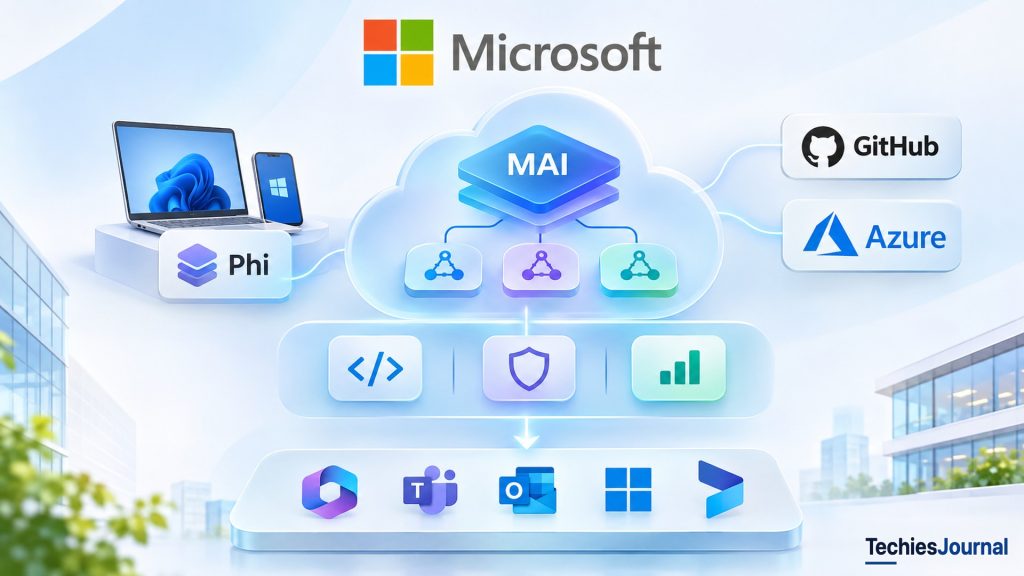
Microsoft is one of the largest providers of AI infrastructure and enterprise AI services. Its partnership with OpenAI has played an important role in that position. However, alongside offering models from other AI companies, Microsoft has been developing an increasingly diverse portfolio of its own.
From the compact Phi models to the large MAI reasoning models and specialized models for coding, cybersecurity and business decisions, Microsoft’s investment extends across several areas of artificial intelligence.
What makes this development particularly interesting is that Microsoft is not simply building another general-purpose AI model to compete with GPT, Claude or Gemini. Its portfolio reflects different approaches to model efficiency, computational requirements and enterprise applications.
Understanding these models, their technical capabilities, competitive position and distribution strategy provides a clearer picture of Microsoft’s evolving role in the AI industry.
Microsoft’s journey as an AI model developer
Microsoft’s model development follows two complementary directions. Microsoft Research has investigated how smaller models can acquire useful capabilities without requiring the computational resources of frontier systems. Microsoft AI, commonly referred to as MAI, has invested in large foundation models and specialized intelligence for its products.
The Phi-4 Mini model card describes training on synthetic examples and filtered web data. Synthetic data is generated rather than collected directly from existing documents. Carefully selecting and constructing training examples helps a compact model learn useful patterns without relying entirely on increased model size.
MAI takes a different approach. Microsoft introduced Thinking 1 in June 2026, followed in October by a disclosure of its next foundation, MAI Base 2. A foundation model acquires broad capabilities during initial training and can subsequently be adapted for reasoning, instruction following or specialized work. Microsoft describes its pre-training pipeline as independent of third-party model distillation, a technique where one model learns from another model’s outputs. That is a claim about MAI’s training approach, not a description of every Microsoft-developed model. Microsoft’s frontier training report explains this distinction.
The November 17 Ignite announcements added models for coding, cybersecurity, image generation, conversational speech, transcription and structured decisions. The range is significant because the same engineering requirements do not apply to each workload.
Understanding Microsoft’s model portfolio
Phi is intended to make intelligence practical within smaller memory and computing budgets. MAI’s large foundations address advanced reasoning, while its specialized models target recurring work inside applications. Decision models form another category because they can be built from existing foundations developed by other providers.
| Model or family | Primary capability | Access or maturity |
|---|---|---|
| Phi-4 (14B), Mini (3.8B) | Language and compact inference | Downloadable weights |
| Phi-4 Multimodal (5.6B) | Text, vision and audio | Downloadable weights |
| Phi-4 Reasoning / Plus (14B), Reasoning Vision (15B) | Text and visual reasoning | Downloadable weights |
| MAI Base 1 and Base 2 | Foundation training | Research foundations, Base 2 post-training at announcement |
| MAI Thinking 1 | Advanced reasoning | Foundry public preview |
| MAI Code 1.1 Flash, Code 2, Code 2 Flash | Software engineering | GitHub Copilot, plan-dependent, Code 2 Flash limited Foundry preview |
| MAI Work Flash | Productivity | Reported product evaluations |
| MAI Cyber models, including Cyber 2 Flash | Security analysis | Earlier models in use, Cyber 2 Flash from mid-December in Microsoft security products |
| Microsoft Decision 1 / 1.1 | Structured decisions | 1.1 generally available |
| MAI Image 2.7, Realtime 1, Transcribe 2 | Media and speech | Announced, access varies by model and product |
Sources: Phi family, Phi reasoning, reasoning vision, Thinking 1, Copilot catalogue, Ignite and Decision 1.1. This is a researched portfolio, not an exhaustive active-model count.
A model listed in Foundry is not necessarily a Microsoft-developed model. Nor does a downloadable model cease to exist when a particular hosted deployment is retired. The Foundry lifecycle schedule is relevant when selecting a managed deployment, while the licence governs what developers may do with downloaded weights.
What makes Microsoft’s models technically different?
Bringing intelligence closer to the device
A language model contains numerical values called parameters, learned during training. Storing billions of these values requires memory, and the precision used to represent them makes a difference.
At 16 bits per parameter, Phi-4 Mini’s 3.8 billion parameters require approximately 7.6 GB for raw weights. Representing them using fewer bits, through quantization, can reduce that requirement. A four-bit representation would theoretically require 1.9 GB before additional storage and runtime overhead.
Text version of Figure 1
- 16 bits: 7.6 GB.
- 8 bits: 3.8 GB.
- 4 bits: 1.9 GB.
- 3 bits: 1.425 GB.
- Raw weights only, before quantization metadata, runtime overhead and context memory.
16 bits
3.8 billion parameters times 16 bits, divided by 8 bits per byte, is 7.6 GB.
This is the full-precision reference. It is raw weights only.
8 bits
3.8 billion parameters times 8 bits, divided by 8, is 3.8 GB.
Half the 16-bit figure. Accuracy can change and hardware support decides whether the saving is realized.
4 bits
3.8 billion parameters times 4 bits, divided by 8, is 1.9 GB.
This is the theoretical figure before quantization metadata and runtime overhead.
3 bits
3.8 billion parameters times 3 bits, divided by 8, is 1.425 GB.
The lowest precision shown. Microsoft describes a three-bit variant of a coding model, which still recommends far more memory than the weights alone suggest.
The actual memory requirement also depends on the inference engine, quantization metadata, intermediate calculations and the information retained from the input and generated text. Reducing numerical precision can affect accuracy, and efficient execution depends on hardware support. Microsoft’s Windows ML samples provide a practical starting point for local testing, not a universal hardware minimum.
Microsoft has also explored compression for its coding models. Its MAI Code 1.1 Flash announcement describes an on-device three-bit variant retaining a 256,000-token context limit. Microsoft recommends more than 120 GB of RAM for best performance, so on-device here does not mean an ordinary phone or laptop. A token is a unit of text processed by the model. The context limit does not mean every device can process the full sequence at an acceptable speed.
The engineering objective is to retain enough intelligence to perform useful work while controlling memory, latency and infrastructure costs. This can matter for offline processing, sensitive documents and applications that make many routine requests.
Increasing capacity without activating every parameter
Microsoft’s larger MAI models address computational efficiency differently. A large model does not necessarily need to activate all its parameters for every token. Parts of the model can be divided into learned networks called experts. A routing mechanism selects a subset of those networks, combines their contributions and passes the result to subsequent computations. This architecture is called Mixture of Experts (MoE).
| Model | Total parameters | Active per token |
|---|---|---|
| MAI Thinking 1 | Approx. 1 trillion | 35 billion |
| MAI Base 2 | 2.8 trillion | 80 billion |
Text version of Figure 2
- An input token reaches a learned router.
- The router selects a subset of experts (two of eight in this illustration).
- The selected experts’ outputs are combined.
- MAI Thinking 1: 35 billion active of about 1 trillion total, about 3.5 percent.
- MAI Base 2: 80 billion active of 2.8 trillion total, about 2.9 percent.
The active proportion is approximately 3.5% for Thinking 1 and 2.9% for Base 2, calculated from Microsoft’s reported parameter counts. These ratios are not estimates of electricity consumption or memory savings. The unselected experts still need to be accessible, and distributing them across accelerators introduces communication overhead. A model with 35 billion active parameters is therefore not equivalent to a model containing only 35 billion parameters.
Improving the economics of training
Microsoft reports training MAI Base 2 on 16,000 NVIDIA GB200 GPUs over 38 days. Its October 15 report estimates that its training recipe is 4.2 to 12.3 times more efficient in pre-training computation than DeepSeek V4 Pro Base across four held-out evaluations. Put differently, a model built on Microsoft’s recipe would need roughly one-quarter to one-twelfth of the computation to match that base model’s results. Microsoft notes that DeepSeek V4 Pro Base is the only released base checkpoint above one trillion parameters, though it was trained on significantly fewer operations than Base 2. Microsoft attributes its progress to scaling research, changes to model and infrastructure design, and expanded data pipelines.
Text version of Figure 3
- Reference model: 100 percent.
- Microsoft recipe, low end of the range: about 23.8 percent (4.2 times more efficient).
- Microsoft recipe, high end of the range: about 8.1 percent (12.3 times more efficient).
- Training computation only. Inference cost is a separate question.
The distinction between training and inference is important. Training establishes model capabilities, while inference applies those capabilities to new requests. A reduction in training computation does not establish that a model is roughly four to twelve times cheaper to operate. Base 2 was undergoing post-training when the report appeared, so downstream quality and serving efficiency require separate assessment.
Intelligence designed for particular enterprise tasks
Not every application needs a model that generates a lengthy response. A software system may need to classify a request, verify a condition, prioritize an item or determine whether additional review is necessary. Asking a general-purpose model to generate an explanation for every such operation may add unnecessary latency and cost.
Microsoft Decision 1 was adapted from Alibaba’s Qwen3.5-9B. Its successor, Decision 1.1, uses Google’s Gemma 4 26B A4B foundation and accepts images as well as text. Microsoft describes a custom inference engine designed for decision requests rather than ordinary token-by-token text generation, and training that encourages calibrated choices and abstention when information is insufficient.
Text version of Figure 4
- Input request.
- Decision model: chooses among permitted options, gives a calibrated confidence score, can abstain.
- Software policy: authentication, permissions and approvals.
- Authorized outcome: act, flag or escalate.
In an enterprise workflow, a model might classify a request as routine, ambiguous or potentially restricted. The application can route it accordingly, but authentication, permissions and approval requirements remain deterministic software responsibilities. A model’s confidence is not authorization to execute an action.
Specialization also explains Microsoft’s coding, security and productivity models. The aim is to optimize for the tasks these applications perform repeatedly, rather than expect a single general-purpose model to provide the best result for every operation.
How competitive are Microsoft’s models?
Software engineering performance and price
Microsoft’s November 17 announcement distinguishes Code 2, intended for complex engineering changes, from Code 2 Flash, intended for high-volume routine edits and explanations. Microsoft explicitly says the models are not yet tuned for harder scientific work and very long-horizon agent tasks.
| Model | Comparator | Reported relative performance | Relative cost including promotion | Estimated cost without promotion |
|---|---|---|---|---|
| Code 2 | GPT-6.1 Sol | 98% | 40% | 80% |
| Code 2 | Claude Opus 5.5 | 96% | 5% | 10% |
| Code 2 Flash | GPT-6 Luna | Comparable | 65% | 130% |
| Code 2 Flash | Claude Haiku 5.5 | Comparable | 20% | 40% |
Microsoft-reported selected coding evaluations. The final column is TechiesJournal’s calculation, assuming unchanged token consumption and competitor rates. Removing the stated 50% promotional discount doubles the reported MAI relative cost. These are not actual standard API price quotes.
Text version of Figure 5
- Code 2 vs GPT-6.1 Sol: 40 percent with the promotion, 80 percent without.
- Code 2 vs Claude Opus 5.5: 5 percent, 10 percent without.
- Code 2 Flash vs GPT-6 Luna: 65 percent, 130 percent without (more expensive than the comparator).
- Code 2 Flash vs Claude Haiku 5.5: 20 percent, 40 percent without.
With the promotion
As Microsoft reports it: Code 2 at 40 percent of GPT-6.1 Sol and 5 percent of Claude Opus 5.5, Code 2 Flash at 65 percent of GPT-6 Luna and 20 percent of Claude Haiku 5.5.
The reported costs include a 50 percent promotional price.
Without the promotion
Doubling each reported MAI cost gives 80, 10, 130 and 40 percent.
Code 2 keeps a clear advantage against Opus 5.5, while Code 2 Flash would cost more than GPT-6 Luna in that one comparison. This assumes unchanged token consumption and competitor rates.
The difference matters for teams estimating ongoing expenses. On the reported assumptions, Code 2 retains a significant cost advantage against Opus 5.5 even without the promotion, while Code 2 Flash becomes more expensive than GPT-6 Luna in that particular comparison. A team should evaluate normal pricing and actual completion rates before committing to a model.
Task completion and execution time
A Microsoft Community Hub experiment provides another perspective. The partial Terminal-Bench 2.0 run used low reasoning effort, one attempt per task and an ARM64 environment.
| Model | Passed / valid tasks | Mean agent time (seconds) |
|---|---|---|
| MAI Code 2 | 45/58 | 235.1 |
| MAI Code 2 Flash | 39/55 | 173.6 |
| GPT-6.2 Sol | 44/55 | 113.9 |
| Gemini 4 Hydrogen | 44/55 | 152.5 |
Text version of Figure 6
- MAI Code 2: 235.1 seconds, 45 of 58 valid tasks passed.
- MAI Code 2 Flash: 173.6 seconds, 39 of 55.
- GPT-6.2 Sol: 113.9 seconds, 44 of 55.
- Gemini 4 Hydrogen: 152.5 seconds, 44 of 55.
In this experiment, Code 2 took roughly twice as long on average as GPT-6.2 Sol. The different valid-task sets, execution errors and incomplete cost records prevent a definitive ranking. The report is a Microsoft-hosted community evaluation rather than an independently audited leaderboard.
The practical measure for engineering teams is cost per accepted software change. A cheap patch that fails testing can require several attempts, while an expensive model may offer little additional value for a routine edit. Automated tests, human review, waiting time and rework belong in the evaluation alongside token charges.
Who each model was compared with
The comparisons above are Microsoft’s own, and Microsoft chooses the rivals. The table lists them so that the reader can see what each claim rests on.
| Microsoft model | Compared with | Measure | Who ran it |
|---|---|---|---|
| MAI Thinking 1 | Claude Opus 4.6, Claude Sonnet 4.6 | SWE-Bench Pro, blind human preference | Microsoft |
| MAI Base 2 | DeepSeek V4 Pro Base, Kimi K3, Qwen3.8, MiMo-V2.6-Pro | Held-out bits per byte, training computation | Microsoft |
| MAI Code 2 and Code 2 Flash | GPT-6.1 Sol, Claude Opus 5.5, GPT-6 Luna, Claude Haiku 5.5 | Averaged coding benchmarks and cost | Microsoft, FrontierCode scores from Artificial Analysis |
| MAI Cyber 2 Flash | GPT-6 Astra | CyberGym-E2E quality and cost per task | Microsoft |
| Decision 1.1 | Jev 1.14, Gemini Decision 1, GPT-6 Luna (Decisions) | Artificial Analysis Decision Index v2.1 | Artificial Analysis index, reported by Microsoft |
| MAI Image 2.7 | GPT Image 2.6 Sunburst (max) | Image editing ranking and price | Artificial Analysis ranking, reported by Microsoft |
| MAI Realtime 1 | GPT-Realtime 2.1 | External and Dynamics 365 benchmarks | Microsoft |
Sources: Thinking 1, frontier pre-training, Code 2, Cyber 2 Flash, Decision 1.1 and Ignite.
Three limits follow from the table. First, no row uses the same task for every model, so the table cannot rank them. Second, the Thinking 1 comparisons name Claude Opus 4.6 and Sonnet 4.6, earlier versions than the Opus 5.5 used for Code 2. Third, the Phi models have no frontier comparison at all, because they target a different job. The table shows who Microsoft chose to compare against, not who would win on your workload.
Chinese and Japanese alternatives
The same distinction applies to compact models. Similar parameter counts do not guarantee similar knowledge or language capabilities. A November 2026 preprint compared 52 small models on 283 Japanese pharmacy examination questions across three runs. Selected results illustrate the variation.
| Model | Mean accuracy |
|---|---|
| Qwen3 4B | 71.96% |
| Ministral-3 3B | 45.23% |
| Gemma 3 4B | 33.80% |
| Llama 3.2 3B | 24.62% |
| Phi-4 Mini 3.8B | 21.44% |
This narrow, non-peer-reviewed evaluation is neither a general intelligence ranking nor evidence of clinical suitability. It demonstrates why language and domain requirements matter. Japan’s NTT tsuzumi 2, a 30-billion-parameter model designed for single-GPU deployment and Japanese enterprise workloads, illustrates a different design priority. No matched comparison with Phi was established in this research.
Hosting conditions also affect the experience. Artificial Analysis recorded approximately 18 tokens per second and 4.62 seconds to the first answer token for a hosted Phi-4 Mini endpoint at the earlier research snapshot. These are not local-device measurements. Developers should evaluate their own hardware, language, input types and response-time targets.
Where Microsoft uses its models
Microsoft’s existing software provides a distribution channel for its intelligence. In GitHub Copilot, developers can select supported MAI models alongside competing models without changing their development environment.
Productivity is another area. Microsoft says Work Flash was adapted from Code 2 Flash and reports evaluations spanning Excel, Word, PowerPoint, Teams and FabricIQ. A spreadsheet assistant, for instance, needs to work with structured data and formulas, whereas a document assistant needs to handle text and formatting. The evaluations identify intended workloads, not proof that every instance of those products is powered by Work Flash.
The Ignite announcement also reports that Dragon Copilot Transcribe uses MAI Transcribe 2 and supports ten million patient encounters per month. This measures encounters supported by a product, not unique customers. Microsoft reported that earlier MAI Cyber models are used in security workloads. Cyber 2 Flash is announced exclusively for Microsoft security products such as MDASH, replacing the existing model for eligible customers from mid-December. In its Decision 1.1 announcement, Microsoft reports more than 4,000 customers since the initial public preview. These are vendor-specific usage measures and cannot be added together or treated as global model share.
Text version of Figure 7
- GitHub Copilot: the Code models.
- Microsoft 365 and FabricIQ: Work Flash, reported through product evaluations.
- Security products: Cyber models, reported at almost 40 percent of MDASH scans.
- Dragon Copilot: Transcribe 2, 10 million patient encounters a month.
- Business software: Decision 1.1, used by more than 4,000 customers.
Applications outside Microsoft
The MAI Licensed Weights announcement describes customer-specific evaluations of models adapted to organizational workloads. The examples are useful because the relevant measure is the quality of a particular task, not overall intelligence.
| Organization | Reported application and outcome |
|---|---|
| AT&T | 5G network operations analysis, standard-task cost reported at 1/50 of GPT-6.1 Sol |
| Woven by Toyota | Ready-to-merge code fixes in 44% of cases where existing frontier models needed human intervention |
| Alaska Airlines | Aircraft maintenance report classification accuracy improved from 81.2% to 91.1% after tuning |
| Optimizely | A/B testing code generation performance improved from 66% to 84% |
These are Microsoft’s reported customer evaluations, not independent production audits. The Alaska example illustrates why domain-specific training matters: classification accuracy can improve even when the application does not require the strongest general-purpose model. Qualified employees retain responsibility for final maintenance decisions.
Why are Microsoft’s AI models less visible as standalone products?
When a user opens a branded AI assistant, the provider’s identity is prominent. When a user works inside a spreadsheet, code editor or security application, completing the task may matter more than which model performed it.
Microsoft explicitly describes a product-first approach in its frontier pre-training report, optimizing models and infrastructure together for its own applications before extending the benefits to Foundry customers. Its established software distribution creates an opportunity to deliver intelligence without requiring every user to choose a separate MAI-branded chatbot.
There is a commercial implication. If a lower-cost internal model can reliably handle a large share of routine work, the provider could reduce inference expenditure and reserve other models for tasks where their capabilities justify the cost. Microsoft’s reported coding evaluations demonstrate why this possibility deserves attention. They do not establish actual company-wide savings or how many requests Microsoft routes to its own models.
This strategy is not unique. Google also integrates models into existing applications, while OpenAI, Anthropic, Meta and DeepSeek distribute intelligence through different combinations of assistants, APIs, partnerships and downloadable weights. Microsoft’s combination of enterprise software, cloud infrastructure and model development gives it multiple routes to market. Public brand visibility and actual usage are therefore distinct. Comparable market-wide adoption data was not established, and the evidence does not show that Microsoft deliberately suppresses publicity.
Where developers can access Microsoft models
Public access does not mean public ownership of weights. Phi-4 Mini is released under the MIT licence, allowing developers to obtain the weights and evaluate them on suitable infrastructure. MAI Labs offers browser experimentation with selected models. Foundry offers managed access to Thinking 1 in preview and Decision 1.1 generally available. GitHub Copilot offers the supported coding models.
Microsoft’s November 17 Licensed Weights offering is a separate commercial path for selected enterprises to customize and deploy MAI models in their Azure environments. The announcement describes upcoming Frontier Company engagements, not an unrestricted public release or permission to move weights to any cloud. It also describes customer control over data and adaptations, subject to the actual agreement. The commercial terms need to be reviewed before use.
Decision 1.1 was announced as generally available through Foundry, OpenRouter and Vercel. Microsoft also announced future distribution of Code 2 models through OpenRouter, Vercel, Hermes, OpenCode and Kilo. Announced integrations should not be presented as live until verified.
Text version of Figure 8
- Phi weights: downloadable, Phi-4 Mini under the MIT licence.
- MAI Labs: browser experimentation with selected models.
- Foundry and API: Thinking 1 in preview, Decision 1.1 generally available.
- GitHub Copilot: supported coding models, plan-dependent.
- Licensed Weights: selected enterprises customize and deploy MAI models in their Azure environments, coming through Frontier Company engagements.
At the earlier research snapshot, Phi-4 Mini recorded more than 300,000 downloads on Hugging Face. Downloads do not establish unique users, commercial deployment or sustained use. Exact portfolio-wide normal API prices and comparable global model share remain unknown.
What this means for developers and enterprises
Microsoft’s portfolio provides several choices rather than a single replacement for competing models. Phi deserves evaluation when memory, local execution or deployment control matters. MAI Thinking 1 is a candidate for advanced reasoning, subject to preview constraints. Code 2 and Flash can be evaluated on actual software changes. Decision 1.1 fits bounded classification and scoring when software can enforce policy and handle uncertainty.
Local execution can improve control over data, but application logs, telemetry, connected tools and network requests still need protection. Managed services reduce infrastructure responsibilities while introducing contractual and service dependencies. Customized licensed weights may offer greater control, but they also bring hosting, evaluation, upgrade and support obligations.
Microsoft’s strengths lie in the variety of engineering approaches, its independent frontier training capability and established routes for integrating intelligence into enterprise software. The evidence does not yet establish consistent superiority across tasks, languages or providers. For technology teams, the meaningful question is which model meets the application’s quality, cost, latency and deployment requirements, not which company has the most prominent AI brand.
Go deeper
- Microsoft AI: Frontier Pre-training
- Phi-4 Mini model card
- Microsoft AI: MAI Code 2 and Code 2 Flash
- Microsoft Decision 1.1
- Understanding Microsoft’s AI Ecosystem: the platform overview this article builds on.
- Microsoft Hybrid Intelligence: how Microsoft splits AI work between the device and the cloud.
Reviewed November 25, 2026. Vendor results are Microsoft-reported and the cost comparisons are TechiesJournal calculations on stated assumptions, not price quotes. Availability, preview status and pricing change often, so check Microsoft’s current documentation before relying on a detail.