

Google made Gemini 4 Carbon available on November 10, 2026, after an earlier release to a set of cybersecurity defenders, adding a new model to its growing Gemini family. At first glance, it may look like another AI release promising better reasoning, stronger coding capabilities and improved benchmark scores.
But Carbon has a more interesting ambition.
Google wants the model to tackle complex problems that cannot always be solved in a few prompts. These include investigating difficult software failures, working through large development projects, analyzing complicated documents and coordinating other AI agents.
The difference is not simply generating a better answer. It is about how much work an AI model can carry through, especially when the task requires investigation, planning, execution and repeated verification.
That makes Carbon worth examining beyond its benchmark rankings.
1. What makes Gemini 4 Carbon different?
Most modern AI assistants can write code, summarize documents, explain technical concepts and help developers troubleshoot problems.
Carbon is designed to go further into tasks that require sustained reasoning.
Consider a software application experiencing intermittent failures across several services. The cause is unclear, the logs contain incomplete information and fixing one component might affect others.
An AI assistant might suggest possible explanations. Carbon is intended to investigate such problems more deeply, examine competing possibilities, work through multiple steps and verify its findings as the investigation progresses.
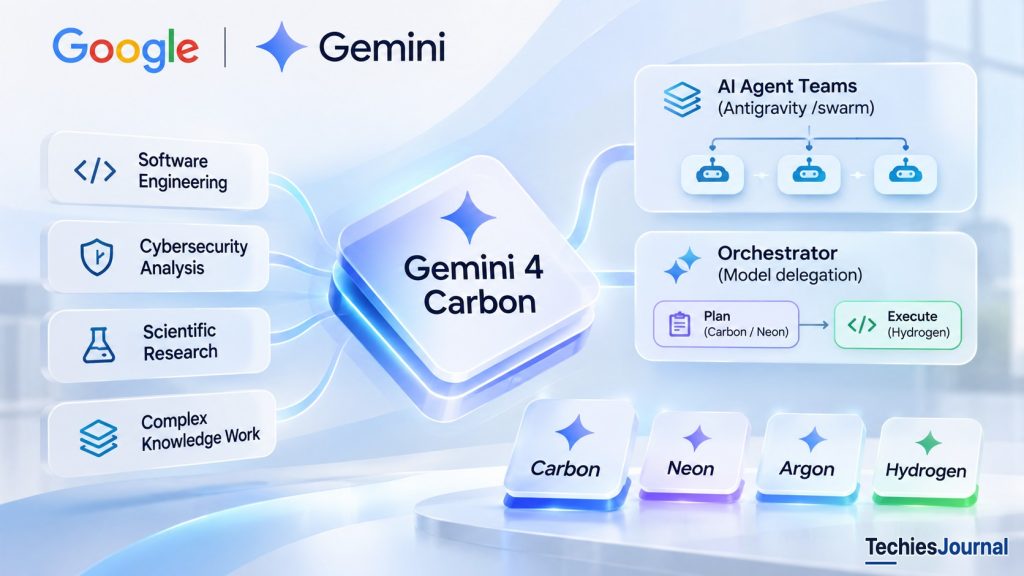
Google identifies software engineering, cybersecurity, scientific research and complex enterprise knowledge work as Carbon’s main strengths.
It also highlights Carbon’s ability to work with dense documents containing charts, diagrams, tables and other information that cannot always be understood through text alone.
These capabilities could be useful for developers working with large repositories, security professionals investigating vulnerabilities, researchers examining complicated material and enterprises dealing with substantial volumes of information.
Google reports that Carbon ranked first on CursorBench 4.0, Perplexity’s WANDR and Zapier’s AutomationBench. These results are encouraging, although benchmark performance does not guarantee the same outcome in every real-world environment.
The more interesting part of the announcement is how Google intends to use this reasoning capability inside AI development workflows.
Source: Gemini 4 Carbon is now available (Google, November 10, 2026)
2. From one AI assistant to a team of agents
Alongside Carbon, Google introduced a preview of /swarm in Google Antigravity, its AI development environment.
Instead of assigning an entire project to one AI agent, developers can divide work among several agents operating in parallel.
Imagine a development team upgrading a large application. One agent could investigate dependencies, another could update application components, while another examines test failures. A more capable model such as Carbon could help with architectural decisions, coordination and verification.
Google’s implementation uses isolated Git worktrees to separate code changes and a shared message board through which agents coordinate their work. Developers can also observe what the agents are doing through Antigravity’s Swarm interface.
This is an important shift in how AI coding tools are developing.
Previously, using an AI assistant often meant giving it a task, reviewing the response and issuing the next instruction. Agent-based tools can now carry out longer sequences of work, use development tools and coordinate related activities.
Carbon is designed to contribute where deeper reasoning is needed, rather than necessarily performing every routine operation itself.
Google has demonstrated this approach through projects involving interactive 3D environments, engineering visualizations and complex software development.
These examples demonstrate technical possibilities. They do not establish that AI agent teams will always be faster or more reliable than a single capable agent.
Google itself acknowledges that parallel agents can consume usage quotas substantially faster than ordinary AI conversations.
That is an important limitation for developers who might otherwise assume that more agents automatically mean greater productivity.
Sources: Gemini 4 Carbon is now available (Google, November 10, 2026) | Gemini 4 Carbon and /swarm (Google Antigravity Blog)
3. Carbon, Neon, Argon and Hydrogen: Which model is for what?
Carbon is not intended to replace every other Gemini model.
Google is increasingly offering models with different balances of reasoning capability, responsiveness and cost.
Only eight days after Carbon became available, Google introduced Gemini 4 Neon, making that distinction even more relevant.
| Model | Google’s positioning |
|---|---|
| Gemini 4 Carbon | Deep reasoning, difficult investigations and long-running complex tasks |
| Gemini 4 Neon | Strong reasoning with improved speed and cost efficiency |
| Gemini 4 Argon | General-purpose advanced engineering and knowledge work |
| Gemini 4 Hydrogen | Fast everyday execution and coding tasks |
Neon is particularly interesting because Google reports that it delivers performance competitive with Carbon on several evaluations while completing certain tasks more economically.
At its default High thinking level, Google reports approximately 32% lower cost per task than Carbon on the Artificial Analysis Intelligence Index. That is a vendor-reported result, not a universal cost guarantee.
Antigravity also offers Orchestrator, which can pair a powerful planning model such as Carbon or Neon with Hydrogen for routine execution.
Unlike /swarm, which coordinates multiple agents, Orchestrator can delegate work between models within a single agent conversation. Google’s documentation says the planner can be chosen on Google AI Pro and Google AI Ultra, while in Gemini Enterprise Orchestrator runs Carbon as the planner with Hydrogen as the executor.
The distinction may sound technical, but the underlying idea is simple: a difficult architectural decision and a routine code modification do not necessarily require the same AI model.
This could help developers balance capability and cost rather than relying on the most powerful model for every action. TechiesJournal looks at when using more than one model is worth the added complexity in Gemini 4 Hydrogen and Multi-Model AI: When Does Using More Than One Model Make Sense?.
Sources: Introducing Gemini 4 Neon (Google, November 18, 2026) | Choose a model (Google Antigravity Docs)
4. Can developers and businesses use Carbon today?
Yes, although availability depends on how it is accessed.
Google provides Carbon through paid Gemini API access in Google AI Studio and enterprise offerings such as Gemini for business. It has also rolled out Carbon to Google AI Ultra subscribers through Antigravity, the Gemini app and AI Mode in Search.
For developers using the API, Google announced introductory pricing of $2 per million input tokens and $10 per million output tokens through November 30, 2026. After that date Google’s announcement lists $4 per million input tokens and $20 per million output tokens.
These are API rates, not necessarily the cost of using Carbon through an Antigravity subscription. Current pricing, quotas and access conditions should be checked before choosing a plan.
For most individual users, there may be little reason to select Carbon for everyday questions, basic writing or routine coding assistance.
Its value becomes more relevant when a task genuinely requires substantial investigation, careful reasoning or extended work across multiple steps.
The same applies to businesses.
An organization does not need a team of AI agents simply because the technology is available. For straightforward activities, existing AI tools may already be sufficient.
The case becomes stronger when work involves difficult dependencies, large technical environments or independent activities that can benefit from coordinated execution.
Even then, the results need to be assessed for accuracy, cost and reliability. Agents that can execute commands, access repositories or connect to business systems also need appropriate permissions and human oversight.
Sources: Gemini 4 Carbon is now available (Google, November 10, 2026) | Choose a model (Google Antigravity Docs)
5. Is Gemini 4 Carbon a meaningful step forward?
Carbon represents more than another improvement in AI benchmark performance.
Its release, together with Antigravity’s /swarm and Google’s growing family of specialized models, shows a direction in which AI systems can allocate different kinds of work to different models.
That is potentially useful for software engineering, research, cybersecurity and other demanding technical activities.
But there is a difference between demonstrating that agents can coordinate work and proving that they can consistently deliver better business outcomes.
Google has demonstrated sophisticated capabilities, and its reported evaluations provide reasons to investigate them. Organizations still need to establish how those capabilities perform against their own requirements and existing alternatives.
For developers, Carbon is worth exploring when current AI tools struggle with difficult investigations or long-running tasks. For technology leaders, the more important question is whether coordinated AI workflows can improve measurable results without introducing unnecessary complexity.
The significance of Gemini 4 Carbon is not simply that Google has built a more powerful AI model. It is that Google is moving toward AI systems where powerful models can reason, specialized models can execute, and multiple agents can work together on increasingly complex problems.
Whether that becomes a practical advantage will depend on what those systems can reliably deliver.
References and further reading
- Gemini 4 Carbon is now available (Google, November 10, 2026): official release announcement covering capabilities, performance, availability, pricing and use cases.
- Gemini 4 Carbon and /swarm (Google Antigravity Blog): explains multi-agent coordination, isolated workspaces and the Swarm interface.
- Introducing Gemini 4 Neon (Google, November 18, 2026): explains the newer model’s positioning, performance and efficiency.
- Choose a model (Google Antigravity Docs): model choices by plan, and how Orchestrator pairs a planner model with an executor model.
Source review: November 23, 2026. Benchmark and performance results attributed to Google are not presented as independently reproduced TechiesJournal findings. Pricing, plan availability and the Antigravity documentation were checked on the same date and may change.