

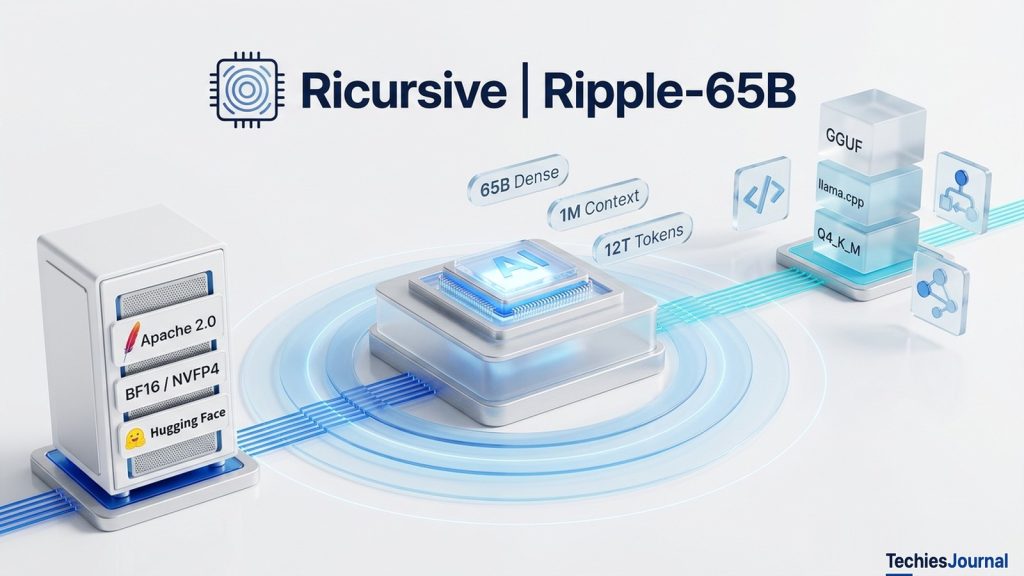
Ricursive Intelligence, an AI lab that describes itself as starting with chip design, released Ripple-65B Preview on November 4, 2026. The weights are Apache 2.0, the coding scores are the lab’s own, and the GGUF files for llama.cpp come from a community maintainer.
Ricursive releases Ripple-65B Preview
Ricursive Intelligence created its Ripple-65B Preview repositories on Hugging Face on November 4, 2026, and its launch blog lists the model as available on Hugging Face, Together AI, GMI Cloud, OpenRouter and Fireworks. The model card calls it a 65B parameter dense Transformer focused on agentic coding. This article reports what Ricursive and the community maintainer AtomicChat say, and separates their claims from what could be checked.
Ricursive’s website describes the company as a frontier AI lab focused on building self-improving systems, starting with chip design. Its launch blog says Ripple-65B Preview is a general-purpose variant of the proprietary model that powers its AI chip design platform. Both descriptions are Ricursive’s own.
What Ricursive released
| Specification | Published detail |
|---|---|
| Developer | Ricursive Intelligence, Hugging Face organisation ricursiveAI |
| Architecture | Dense Transformer with 80 layers and a d_model of 5120 |
| Parameters | 65B |
| Pretraining tokens | 12 trillion, from a text-only, predominantly English and code corpus |
| Advertised context | 1,048,576 tokens |
| Official instruction-tuned builds | BF16 (129.6 GB) and NVFP4 (57.2 GB, labelled Experimental) |
| Other official repositories | BF16 base model (pretrain-only) and a DFlash2 speculative-decoding drafter (4.04B parameters, BF16) |
| Licence | Apache 2.0, per the LICENSE file in each official repository and the community GGUF repository |
| Repositories created | November 4, 2026 (BF16, NVFP4, DFlash2) and October 14, 2026 (base) |
| Revisions read on November 12, 2026 | BF16 b172323f (last modified November 10), NVFP4 2789217b (November 11), community GGUF df550a71 (November 6) |
Source: Ricursive’s model cards for the BF16, NVFP4, base and DFlash2 repositories, with file sizes and dates from Hugging Face’s repository metadata. The card states 1Mi (1,048,576 tokens), while the repository’s config.json sets max_position_embeddings to 2,097,152. Ricursive’s NVFP4 build keeps attention in BF16 and quantises the MLP layers, which it calls a conservative quantisation.
What Preview means here
The card says this release has gone through relatively light post-training with a focus on agentic coding. It was pretrained on a text-only corpus that is predominantly English and code, and Ricursive ships the NVFP4 build as experimental. The 1,048,576-token context is the figure Ricursive advertises. The only long-context result on the card is Ricursive’s own AA-LCR score of 75.0, so the context length has not been verified by anyone else.
Publisher-reported performance
Ricursive’s card reports a score of 80.52 on TerminalBench 2.1 and says this surpasses significantly larger US open-weight models, listing Reflection Beam 501B at 80.1, Meta Muse Spark Open 816B at 76.4, Thinking Machines Inkling 975B at 63.8 and NVIDIA Nemotron 3 Ultra 550B at 56.4. The card says the comparison uses official model card scores where available and Ricursive’s own in-house evaluation flow for missing ones. It also says that “our results represent a best-effort attempt at a fair comparison”. All four comparison models are mixture-of-experts models with more total parameters than Ripple. The card’s benchmark table is the source for every score in this article. TechiesJournal’s guide to how to read AI model claims covers what to ask of numbers like these.
On speed, the card says the model reaches “250 tok/s on 2xB200 batch=8 prior to quantization or custom kernels”. The card does not say whether that is per request or summed across the batch. The figure does not establish latency on your own machine.
Where Ripple trails, and what independent testing shows
The same card shows benchmarks where Ripple scores below the best model it lists. These are Ricursive’s own figures, and the model names are the card’s.
| Benchmark | Ripple-65B Preview | Best score listed on the card |
|---|---|---|
| SWE-bench Verified | 76.5 | 81.6 (Reflection Beam 501B) |
| GPQA Diamond | 85.2 | 90.6 (Reflection Beam 501B) |
| MMLU | 89.6 | 92.6 (Muse Spark Open 816B, run by Ricursive in-house) |
| MCP Atlas | 71.67 | 89.2 (Muse Spark Open 816B) |
Source: the benchmark table in the Ripple-65B Preview model card. The card marks scores Ricursive ran itself in italics, which is why the MMLU figure is labelled in-house.
No independent evaluation was found on November 12, 2026. Artificial Analysis returned no page for Ripple-65B Preview and its model list showed no Ripple entry, and the Vals Index and Vals AI model pages also showed none. LMArena’s leaderboard sits behind a bot check and could not be read, so this article makes no statement about it. Every number above therefore traces to Ricursive, and the quality figures below trace to AtomicChat.
Community GGUF builds and llama.cpp
Ricursive’s Hugging Face organisation lists no GGUF repository, and neither the BF16 nor the NVFP4 model card mentions GGUF, llama.cpp or vLLM. The most downloaded GGUF set comes from AtomicChat, whose repository lists Apache 2.0 as its licence. Its card describes Atomic Chat as an app that runs open-weight models locally, links to the app and says the team wrote the llama.cpp support for Ripple. That support was merged into llama.cpp as pull request #31692 on November 5, 2026 and first shipped in build b12167 on November 6. The link between the pull request author and Atomic Chat is AtomicChat’s statement. Other community conversions exist, and Ricursive endorses none of them. TechiesJournal’s comparison of Ollama and llama.cpp explains the runtime side.
AtomicChat publishes 12 quantised files plus the BF16 original. AD means Atomic Dynamic, AtomicChat’s own per-tensor layouts made with an importance matrix, and the plain Q4_K_M is its baseline. The last column is AtomicChat’s own measurement on its own test corpus. It shows how often a file picks the same next token as the BF16 original.
| File | Listed size | Same top token as BF16 |
|---|---|---|
| Q4_K_M | 38.8 GB | 93.0% |
| AD-Q4_K_M | 40.4 GB | 95.9% |
| AD-IQ4_XS | 38.7 GB | 95.6% |
| AD-IQ3_XXS | 28.0 GB | 91.2% |
Source: the AtomicChat GGUF model card, which gives these sizes in gigabytes on disk. File sizes are not the full memory requirement, because the KV cache and the chosen context length need more. A 38.8 GB file does not fit in 24 GB of video memory. For a 24 GB card, AtomicChat suggests its 20.0 GB AD-IQ2_XXS file, which it measures as matching the original model’s top token 80.8% of the time, a large drop in fidelity. The same card gives the example command llama-server -m Ripple-65B-Preview-AD-Q4_K_M.gguf --jinja -c 32768 -ngl 99, and says a plain Q4_K_M run on one GH200 96 GB GPU generated 40.6 tokens per second in one run.
Ways to run it
| Route | What it is | Size | Source and status |
|---|---|---|---|
| Official BF16 | Instruction-tuned model, with a SGLang 0.5.19 recipe for two NVIDIA B200 GPUs on Linux with CUDA Toolkit 13 | 129.6 GB | Ricursive BF16 repository, recipe in its inference/server folder |
| Official NVFP4 | Instruction-tuned model, labelled Experimental, with a notebook and a DGX Spark script that pin SGLang 0.5.19 | 57.2 GB | Ricursive NVFP4 repository |
| Community GGUF | 12 quantised files for llama.cpp build b12167 or newer | 18.5 GB to 68.8 GB quantised | AtomicChat repository, not published or endorsed by Ricursive |
| Hosted | Endpoints listed on OpenRouter, from three providers | None to download | OpenRouter listing |
Ricursive’s cards state no VRAM requirement for either official build, and the BF16 card says the 65B size can fit on consumer hardware such as the NVIDIA DGX Spark. The practical side of running open models yourself is covered in TechiesJournal’s guide to what it actually takes. Treat every route as not reproduced here, and recheck the model revision, runtime version and quantisation quality before relying on any of them.
For hosted access, OpenRouter listed three endpoints for the model, observed on November 12, 2026, at $0.10 to $0.20 per million input tokens and $0.30 to $0.60 per million output tokens, with Together listing a 131,072-token context against 1,048,576 for the other two. OpenRouter’s prices change, and Fireworks, which Ricursive also names, was not checked.
Sources
- Ricursive: Ripple-65B Preview launch blog
- Ricursive Intelligence website
- Ripple-65B Preview model card (BF16)
- Ripple-65B Preview NVFP4 (Experimental)
- Ripple-65B Base Preview
- Ripple-65B Preview DFlash2
- AtomicChat Ripple-65B Preview GGUF
- llama.cpp pull request #31692
- llama.cpp release b12167
- OpenRouter: Ricursive Ripple 65B Preview
- Artificial Analysis models
- Vals AI: Vals Index
Sources were read on November 12, 2026. Scores, compatibility and prices are those of Ricursive, AtomicChat and OpenRouter, and can change.