

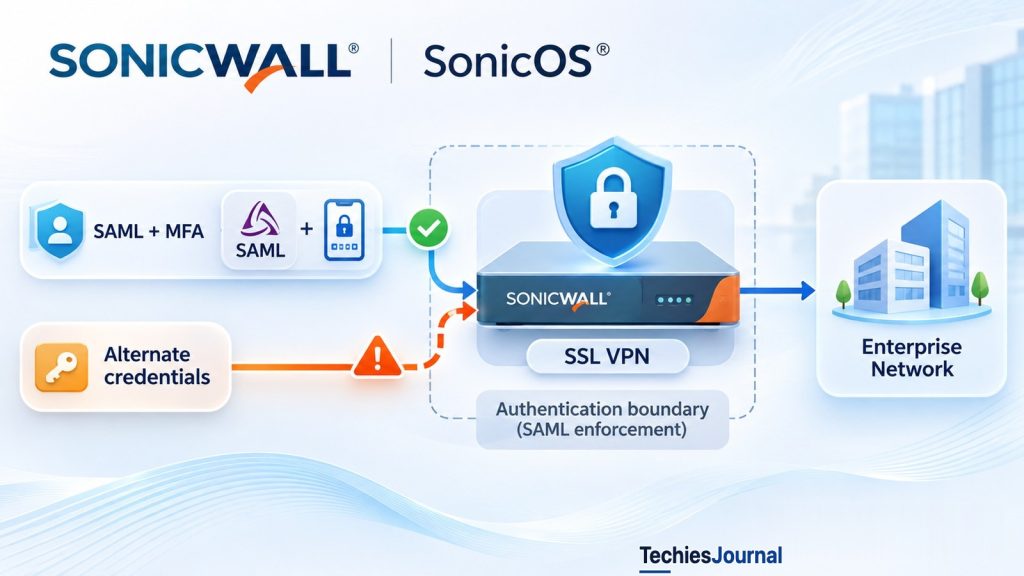
Certain SonicOS SSL VPN deployments can accept alternate credentials without enforcing their required SAML authentication path. The vulnerability is in CISA’s Known Exploited Vulnerabilities catalog. SonicWall lists corrected Gen7 and Gen8 firmware.
Information current as of November 9, 2026, including the revision of SonicWall’s advisory published that day.
SonicWall has disclosed CVE-2026-19868, a flaw in how certain SonicOS SSL VPN deployments enforce authentication when SAML is configured. SSL VPN is the remote-access service through which staff connect to the company network from outside. Someone with valid credentials for an alternate authentication method may be able to access the VPN without passing through the expected SAML login flow. If the organization’s multi-factor authentication (MFA) policy is enforced through SAML, that MFA requirement may also be bypassed.
This is not a credential-free login vulnerability. It concerns how a VPN enforces its required authentication method when another valid method exists. CISA added the vulnerability to its Known Exploited Vulnerabilities catalog on November 6, 2026. SonicWall lists corrected firmware for affected Gen7 and Gen8 devices, its seventh and eighth generations of firewalls.
Essential facts for administrators
| Question | What the sources say |
|---|---|
| Vulnerability | CVE-2026-19868, SonicWall SonicOS SSL VPN |
| What is bypassed | SAML authentication and any MFA that SAML enforces |
| Attacker prerequisite | Valid credentials for an alternate authentication method |
| Exposure | Relevant SonicOS Gen7/Gen8 versions with SAML enabled for SSL VPN |
| Exploitation | SonicWall PSIRT investigated a report of potential exploitation, and CISA added the vulnerability to its KEV catalog on November 6, 2026 |
| Fixed Gen7 | SonicOS 7.3.4-7013 or later, according to SonicWall |
| Fixed Gen8 | SonicOS 8.2.3-8015 or later, according to SonicWall |
| Administrator action | Check configuration and build, install supported firmware, validate authentication, assess prior access |
Sources: SonicWall PSIRT advisory SNWLID-2026-0014, SonicWall Gen7/Gen8 firmware notice, and CISA KEV.
What the authentication flaw changes
Many companies connect remote-access VPN logins to a central identity provider through SAML, short for Security Assertion Markup Language. Instead of the firewall independently deciding whether a password is sufficient, the identity provider performs the required checks, which may include MFA and conditional-access rules.
By design, a VPN session should start only after the required SAML login completes. A second authentication method must not silently become an easier route to the same access.
The CISA entry for CVE-2026-19868 describes exactly that situation: a person with valid credentials for an alternate method bypasses SAML authentication controls, potentially including SAML-enforced MFA.
An identity provider could correctly reject a login that lacks MFA, while the firewall still accepts a session through a different credential path. The failure is in enforcing the intended VPN authentication policy across available login methods. It does not prove that the identity provider itself was compromised or that any arbitrary user can enter without credentials.
SonicWall has not publicly disclosed a complete exploit sequence or the full implementation defect in the advisory reviewed for this publication, and this article does not speculate about them. The vulnerability description does not name the alternate methods, but SonicWall’s workaround refers to LDAP, RADIUS and TACACS+ authentication servers configured on the firewall, which suggests the kinds of alternate credentials involved.
Affected firmware and the configuration boundary
SonicWall’s November 2026 security notice provides the following Gen7/Gen8 firmware matrix:
| Device family | Vendor-listed impacted builds | Vendor-listed corrected build |
|---|---|---|
| Gen7 physical and virtual | SonicOS 7.3.3-7015 and older | SonicOS 7.3.4-7013 and later |
| Gen8 physical and virtual | SonicOS 8.2.2-8015 and older | SonicOS 8.2.3-8015 and later |
The notice addresses multiple SonicOS vulnerabilities, so the version matrix should be paired with the CVE-specific PSIRT record. That record, in the revision published on November 9, 2026, lists the same impacted builds and the same corrected builds for CVE-2026-19868. SonicWall states that this vulnerability only affects the SSL VPN service if SAML is enabled for SSL VPN logins, which is the key condition.
A government advisory from the Canadian Centre for Cyber Security lists Gen8 versions prior to 8.2.2-8015 as affected, which would leave 8.2.2-8015 itself out. SonicWall lists 8.2.2-8015 and older as impacted in both its firmware notice and its CVE-specific advisory, so the vendor records govern the upgrade target and 8.2.2-8015 should be treated as impacted. Administrators should also verify model compatibility and whether a newer supported maintenance build has superseded the listed fix.
Gen6 and older hardware is outside the Gen7/Gen8 upgrade path described in SonicWall’s notice and is end-of-support. An unsupported firewall cannot be assumed protected by a firmware release intended for a different generation.
Why CISA’s exploitation listing matters
CISA added CVE-2026-19868 to KEV on November 6, 2026. KEV is intended to identify vulnerabilities supported by evidence of real-world exploitation, making it useful for patch prioritization. SonicWall’s own advisory says its PSIRT investigated a report indicating potential exploitation, and the Canadian Centre for Cyber Security says SonicWall indicates that the vulnerability is being exploited.
The public listing does not supply a count of compromised organizations, a verified attacker identity or a step-by-step account of every observed incident. Until reliable evidence appears, those details are unknown.
The entry lists November 20, 2026 as the federal remediation due date. That date applies within the relevant U.S. federal requirements. It is not automatically a regulatory deadline for every private company, but affected internet-accessible VPN deployments should still be fixed promptly.
Source: CISA Known Exploited Vulnerabilities Catalog.
Remediation and verification
The primary fix is to upgrade to the supported corrected SonicOS build for the firewall generation. SonicWall’s firmware notice lists Gen7 7.3.4-7013 or later and Gen8 8.2.3-8015 or later. Check the PSIRT advisory for CVE-specific details and newer guidance before deploying.
Administrators can work through these steps:
- Identify relevant VPN gateways. Inventory SonicOS Gen7 and Gen8 physical and virtual appliances, including their exposed SSL VPN interfaces.
- Check the effective authentication configuration. Establish whether SAML is enabled for SSL VPN and whether an alternative credential method can authenticate users.
- Verify the exact firmware build. Compare the installed branch and build with SonicWall’s device-specific corrected release, not just a broad version label.
- Apply the vendor-supported update. Use the organization’s approved maintenance process, preserve configuration backups and verify management access.
- Test the intended login policy. Confirm successful users complete SAML and MFA where required, and that alternative sign-in paths cannot grant equivalent access outside policy.
- Review possible prior exposure. Correlate SSL VPN session records with identity-provider authentication logs and investigate unexpected accepted sessions.
The final step is defensive investigation advice, not a vendor-published exploit signature. The reviewed public advisories do not provide a complete set of CVE-specific indicators of compromise. Our article on what to do after an exploited fix describes why a fix says nothing about the days before it and how to treat an edge device afterwards.
If patching must be delayed and SAML authentication is in use, SonicWall’s advisory, as updated on November 9, 2026, gives a workaround: disable or delete any active LDAP, RADIUS and TACACS+ authentication servers configured on the firewall, each under Device, Users, Settings, Authentication. This is a vendor-documented workaround, and SonicWall still urges customers to upgrade as soon as possible. Because those servers may also be used for other logins, test the change first and keep a working administrative path to avoid lockout.
The wider lesson for remote access
An organization can configure strong MFA centrally and still expose remote access if the protected service accepts another authentication method that does not enforce the same policy.
CVE-2026-19868 is one example. A successful upgrade is not the whole outcome if an unintended login path remains enabled, which is why the steps above include testing how access is actually granted.
Having SAML and MFA configured is not enough. Every VPN login path that is allowed must enforce the access policy the organization intended.
Go deeper
- SonicWall PSIRT: SNWLID-2026-0014, CVE-specific vendor advisory.
- SonicWall: SonicOS 7.3.4 and 8.2.3 Security Advisory, published November 3 and updated November 6, 2026.
- CISA Known Exploited Vulnerabilities Catalog, November 6, 2026 entry.
- Canadian Centre for Cyber Security AV26-1133, November 6, 2026, including the noted version discrepancy.