

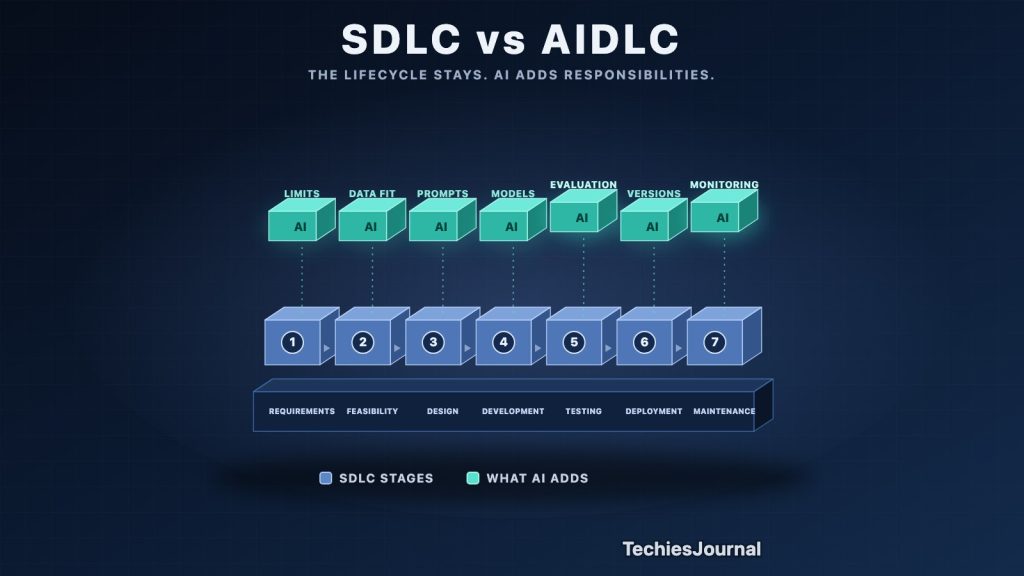
AI introduces new requirements for testing, monitoring, and model management. Does that mean traditional software development practices are no longer enough?
Software development has always involved defining requirements, designing solutions, writing code, testing, and maintaining applications. These responsibilities remain important when artificial intelligence becomes part of a system.
What changes is how some application behaviour is produced and verified. Traditional software generally follows explicitly implemented rules. AI-enabled software may also depend on model predictions or generated responses that vary with the input, context, and available information.
This raises a practical question: Does AI require a different development lifecycle, or can existing software engineering practices be extended?
Understanding SDLC and AIDLC
SDLC (Software Development Life Cycle) describes the activities involved in planning, designing, developing, testing, deploying, and maintaining software.
Organizations may use Agile, Waterfall, DevOps, or other delivery approaches. The methods differ, but the underlying engineering responsibilities remain.
AIDLC (AI Development Life Cycle) is a term used to describe the additional activities involved in developing and operating AI systems. Depending on the application, these may include data preparation, model selection, training, evaluation, and monitoring.
However, the terminology is not universally defined.
For example, AWS uses AI-DLC (AI-Driven Development Lifecycle) to describe an approach in which AI participates in software engineering activities.
That creates an important distinction.
AI-assisted development means using AI tools to help build software.
AI-system development means building software that contains AI capabilities.
An organization can use AI coding assistants without developing an AI application. Similarly, an AI-enabled application can be built using conventional development tools.
In this article, AIDLC refers to the additional lifecycle practices needed when developing AI-enabled systems.
SDLC vs AIDLC: What Actually Changes?
| Development stage | Traditional SDLC | Additional considerations for AI-enabled systems |
|---|---|---|
| Requirements | Define features, business rules, and expected behaviour. | Also define acceptable model behaviour, quality expectations, limitations, and uncertainty handling. |
| Feasibility | Assess technical feasibility, cost, resources, and business value. | Also evaluate model suitability, data availability, and whether AI can reliably address the problem. |
| Design | Define architecture, databases, APIs, integrations, and security. | Also consider model integration, data pipelines, retrieval, prompts, and AI-specific security risks. |
| Development | Implement business logic through code and configuration. | Integrate existing AI models or develop custom models, depending on the application. |
| Testing | Verify functionality, integrations, security, and performance. | Retain conventional testing and add model-quality and behavioural evaluation. |
| Deployment | Release approved application versions through controlled processes. | Also manage relevant model versions, prompts, datasets, and AI configurations. |
| Maintenance | Monitor application health, resolve defects, and deliver updates. | Also monitor AI output quality, changing data, and unexpected model behaviour. |
The difference is not that traditional software is completely predictable while AI systems are entirely unpredictable.
Both require careful engineering. AI introduces additional uncertainty that must be evaluated and managed.
Does Every AI Application Require Model Training?
No. This is an important distinction in modern AI development.
Consider a customer-support application.
Traditional software: The application checks return eligibility using predefined business rules. Developers implement the rules and test the expected outcomes.
Application using an existing AI model: The company adds a conversational assistant powered by a pretrained language model. Developers integrate the model, connect approved information sources, define its permitted behaviour, and evaluate its responses.
The company does not necessarily train a model.
Custom machine-learning system: The company develops a model to predict which support requests require escalation. This involves collecting and preparing training data, training the model, evaluating its performance, and monitoring its predictions.
These applications have different engineering requirements.
A system using an existing language model does not automatically need the same development process as a system training models from scratch.
Why AI Testing Needs Additional Attention
Traditional software testing can often verify a specific result for a defined input.
For example, an application can check whether a customer qualifies for a return under a 30-day policy.
An AI assistant answering questions about that policy introduces another challenge.
Two responses may use different wording while communicating the same correct information. An answer may also sound convincing while incorrectly interpreting the policy.
Testing must therefore examine the quality of the response, not simply whether the application runs successfully.
Depending on the use case, AI evaluation may examine:
- Accuracy: Is the information correct?
- Relevance: Does the response address the question?
- Grounding: Is the answer supported by approved information?
- Safety: Does the system respect defined restrictions?
- Consistency: Does it behave acceptably across different inputs?
These evaluations supplement conventional software testing.
Authentication, authorization, API contracts, and business rules still require strict verification.
For example, an AI assistant might recommend approving a refund. The application must independently verify whether the refund is permitted before executing it.
AI-generated recommendations should not bypass established business and security controls.
What Changes After Deployment?
Traditional application maintenance includes monitoring availability, resolving defects, managing infrastructure, addressing security vulnerabilities, and implementing business changes.
AI-enabled systems require these activities along with monitoring of model-related behaviour.
A machine-learning model may become less accurate when the data it encounters changes over time.
Applications using pretrained language models face other challenges. Their results may change because of model upgrades, modified instructions, outdated reference documents, or changes to connected services.
These problems do not necessarily have the same cause.
For example, if a customer-support assistant uses an outdated return-policy document, retraining the model may not be necessary. Updating the information source and verifying retrieval may resolve the issue.
This leads to an important operational distinction.
Monitoring an AI application means checking the quality of its behaviour, not just whether its services are running.
Google Cloud’s MLOps guidance describes automated validation, deployment, and monitoring practices for machine-learning systems. These principles provide useful foundations, although their implementation differs between custom ML models and applications using pretrained language models.
Does AI Replace Traditional SDLC?
No.
AI introduces additional engineering responsibilities, but it does not eliminate software architecture, coding, testing, security, or operational management.
The appropriate practices depend on what an organization is building.
A team using AI coding assistants may need stronger review and testing controls for generated code.
A team integrating a language model into an application may need additional evaluation, prompt management, retrieval testing, and monitoring.
An organization developing custom machine-learning models may require more extensive data preparation, training, validation, and model management.
These practices are often discussed under terms such as MLOps and LLMOps.
Organizations should adopt the practices their systems require rather than introduce a separate lifecycle simply because AI is involved.
What Should Development Teams Remember?
SDLC remains the engineering foundation. AI adds responsibilities that depend on the type of system being developed.
Development teams should understand whether they are integrating an existing model or building their own, retain conventional testing while adding appropriate AI evaluation, and monitor application behaviour after deployment.
The objective remains unchanged: deliver software that meets its requirements, operates reliably, and behaves within acceptable boundaries.
AI changes how teams achieve that objective. It does not remove the need for disciplined software engineering.
References and Further Reading
Each source was opened and checked on 9 October 2026. The NIST page is an excerpt of AI RMF 1.0 (2023), and the OWASP list is the 2025 edition.
- NIST: AI Risk Management Framework. Explains how AI-related risks can be governed, measured, and managed throughout a system’s lifecycle.
- Google Cloud: MLOps. Describes validation, deployment, monitoring, and other operational practices for machine-learning systems.
- AWS: AI-Driven Development Life Cycle. Explains AWS’s approach to AI-assisted software engineering, which is distinct from developing applications that contain AI.
- OWASP: Top 10 for Large Language Model Applications. Covers security risks associated with LLM applications.