

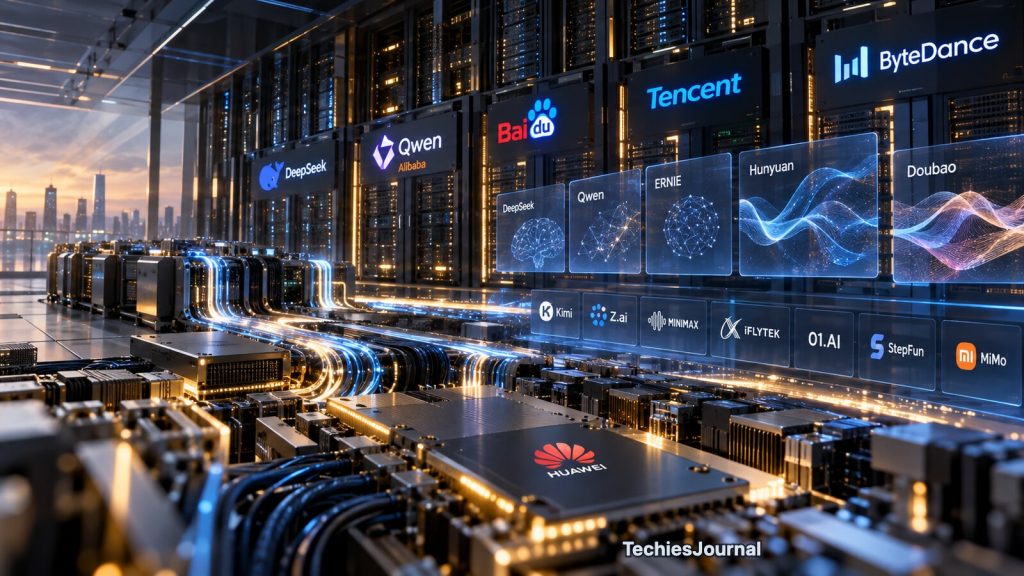
Chinese technology companies are developing AI processors, interconnects, software platforms and models. What do these systems actually do, how do they work together, and what is commercially available today?
Cover illustration of China's AI infrastructure ecosystem. The companies shown are independent. AI-generated concept art, not a photograph of any facility.
Imagine a company building an assistant to search internal documents and answer thousands of employee questions. It can choose a Chinese model such as Qwen or DeepSeek, but selecting the model solves only one part of the problem. The company still needs somewhere to run it, enough memory to hold its parameters and working data, software to translate its calculations for available processors, and a way to keep the service responsive when demand rises.
That is why China’s AI developments are worth examining beyond language-model releases. Huawei is developing accelerator systems and interconnects. Alibaba is linking its Qwen models to chips and cloud services. Baidu combines models, development tools and cloud infrastructure. Tencent operates AI products and cloud services while expanding its computing investment. These are related activities, but they should not be mistaken for one unified national platform.
The engineering story is how models, software, accelerators, networks and cloud services fit together, and how much of that work is demonstrated rather than announced.
Following one AI request through the computing stack
A user types a question into our hypothetical employee assistant. The application checks permissions and retrieves relevant documents. It sends a prompt to an AI service. A serving system chooses available hardware, loads or accesses the model’s weights, and calculates the next tokens in the response.
Those calculations consist largely of matrix operations. Specialized AI accelerators perform many such operations in parallel. Their processing power matters, but so does the rate at which model weights and intermediate data move between memory and compute units. For a large model, reading data may become a bottleneck even when the arithmetic units are capable of more work.
When the model is spread across multiple accelerators, they may need to exchange intermediate results. The communication pattern depends on how the model is divided: one approach separates parts of the layers, another splits operations within layers, and a third replicates the model while processing different requests. Each approach changes the memory and networking requirements.
Accessible text alternative for this figure
Top to bottom: an application receives the user request and handles permissions and retrieval. A model service handles the prompt, batching, scheduling and the API. A compiler and runtime handle operators, kernels and memory allocation, with CANN and PaddlePaddle as example ecosystems.
Below that is the computing hardware: AI accelerators for matrix operations, memory and storage for weights, context and cache, and an interconnect for device-to-device communication. Cloud operations and commercial delivery sit underneath all of it. The figure is conceptual and does not show any vendor deployment.
The distinction between training and inference matters here. Training repeatedly adjusts model parameters and often exchanges large amounts of information between processors. Inference uses trained parameters to answer requests. It is sensitive to response latency, memory bandwidth, model size, concurrent users and the amount of context retained. A cluster excellent at training is not automatically the cheapest system for serving many small requests.
AI accelerators: why a processor is not the whole product
A general-purpose CPU is designed to handle diverse tasks. AI accelerators concentrate hardware resources on the repeated numerical operations used in neural networks. Different accelerators make different trade-offs in arithmetic formats, on-chip memory, external memory, data movement and programmability.
Huawei Ascend is the processor family beneath Huawei’s AI computing systems. The company combines Ascend NPUs with SuperPoD system designs and CANN software. Its September 2026 Atlas 960E announcement describes a configuration supporting up to 4,096 NPUs, plus a memory and interconnect architecture designed for large distributed jobs. Those are Huawei’s product specifications, not independent results showing how a customer’s model performs. Huawei, September 2026.
Alibaba T-Head is building the Zhenwu accelerator family alongside Yitian CPUs, Panmai smart network-interface chips and interconnect components. Alibaba’s September 2026 roadmap introduced the Zhenwu V900, described the earlier M890 AI Supernode as serving large-model inference, and said its newer architecture could support clusters of up to 500,000 cards. Alibaba also said its supernodes were coming online commercially, but a stated maximum cluster size is not evidence that one production installation already operates at that size. The company’s claims about relative chip performance need independent workload-level comparison. Alibaba, September 2026.
Baidu’s Kunlun accelerator ecosystem provides another domestic-hardware approach. Baidu also develops the PaddlePaddle framework, ERNIE models and managed cloud services. Their relationship is commercially relevant, but overall AI Cloud revenue does not reveal the portion of workloads running on any particular chip. Baidu cloud, Baidu Q2 2026 results.
A buyer evaluating these systems needs more than an advertised operations-per-second figure. The useful tests are application-specific: can the desired model run correctly, how much memory does it need, how many tokens per second can it deliver at a target response time, how well does it scale when more hardware is added, and what does the entire service cost to operate?
The problem between the processors
Suppose eight accelerators divide a model’s work. At certain points, each needs results calculated by others. If those transfers take longer than the calculations, faster arithmetic will not solve the delay. Increasing the number of devices can also increase the cost of exchanging data.
An interconnect is the communication system linking computing devices. Its bandwidth describes how much information can move over time. Its latency describes the delay before data begins arriving. Both matter, and neither predicts overall model throughput without the workload and software configuration.
Huawei’s UnifiedBus connects a cluster’s components under one protocol. Huawei describes unified memory addressing and peer-to-peer interconnect, and has introduced the Hi-ONE near-packaged optical interconnect engine, specifying 7.2 Tbit/s transmission capacity per engine. That is a component specification. It must not be interpreted as the inference throughput of a SuperPoD. Huawei has separately stated that more than 1,000 Atlas 900 A3 SuperPoDs were deployed, while its latest architectures include newer designs and future expansion. Distinguishing those statuses prevents an announced roadmap from becoming an invented deployment. Huawei architecture, Huawei keynote.
Alibaba’s supernode and network-chip work addresses the same general engineering constraint from a different implementation. Neither firm invented the problem: GPU clusters and other distributed systems around the world also need high-bandwidth fabrics, good scheduling and software that limits unnecessary communication.
There is a broader lesson here. Processor count is capacity on paper. Useful throughput depends on how much time the system spends performing work rather than waiting for data or coordinating with other devices.
The software layer that makes hardware usable
Our employee assistant may be written using a familiar AI framework. Moving its model to a different accelerator is not necessarily a matter of changing one configuration field.
Model operators must be supported by device-specific implementations, often called kernels. A compiler and runtime schedule those operations, allocate memory, manage transfers and coordinate hardware. Unsupported operations may require rewrites. Supported ones may still run inefficiently. Numerical differences and distributed execution can introduce correctness or reproducibility issues that require testing.
Huawei CANN provides a software ecosystem for Ascend hardware. Huawei reports expanded open-source development and PyTorch support. Those are meaningful adoption steps, but a supported framework backend is not a guarantee that every model and operator runs with identical behavior or performance. Huawei.
Baidu PaddlePaddle is a machine-learning framework with training and deployment capabilities, connected to Baidu’s broader AI tools. Alibaba Cloud Model Studio and associated services give developers a managed way to use Qwen and other supported models, without operating all the serving infrastructure themselves.
Software maturity matters because companies must maintain systems over time. An accelerator that looks competitive on a selected benchmark may be unattractive if migrating a production application requires extensive rewrites or limits debugging, observability or operational support.
From hardware to a service people can buy
Return to the employee assistant. The organization could download a permitted open-weight model and host it on its own computing equipment. It would then operate the model server, monitor latency, manage upgrades, secure document access and provision enough accelerator memory for demand.
Or it could buy a hosted model service. In that case, the provider operates much of the underlying inference capacity, while the customer still owns the application’s data-governance and access-control decisions. The bill may depend on input and output tokens, capacity reservations or other product-specific terms.
This is why a model company, a cloud provider, and a consumer-app company can follow different revenue paths. A chatbot can be free for individuals while an API has usage fees. A company may release model weights without payment for downloads but sell managed hosting, subscriptions, enterprise support or related cloud services.
Revenue from a company’s overall cloud division cannot be assigned directly to an individual model. Similarly, the existence of API prices establishes a commercialization channel, not disclosed revenue or profitability for that model.
Major Chinese AI model families and commercialization routes
The following is a curated industry reference, not every model released in China. Official links are provided for readers to verify model availability and current commercial terms. Pricing, region restrictions and licensing can change.
| Developer | Major model family | Official model/developer link | Typical uses | Documented or reported commercialization route |
|---|---|---|---|---|
| DeepSeek | DeepSeek V-series and R-series | DeepSeek · API docs | Language, reasoning, coding | Hosted API, consumer web chat and app, open-weight availability not verified here |
| Alibaba | Qwen, Qwen Coder, Qwen VL and image families | Qwen · Model Studio | Language, coding, vision, multimodal | Metered cloud-model APIs, managed inference and enterprise cloud services |
| Tencent | Hunyuan | Hunyuan · Tencent Cloud | Language, image, video and enterprise applications | Cloud model services, API products and enterprise integration |
| Baidu | ERNIE | ERNIE · Baidu AI Cloud | Language, reasoning and multimodal | Managed model/cloud services and enterprise solutions. Model-level revenue undisclosed |
| ByteDance | Doubao, Seed, Seedance, Seedream | Seed models · Volcengine | Language, image, video and multimodal | Commercial model APIs and hosted services through Volcengine, consumer products as offered |
| Moonshot AI | Kimi and K-series | Kimi · API | Long-context work, coding and agents | Hosted API usage (pay-as-you-go, with enterprise plans), consumer paid tiers not verified here |
| Z.ai / Zhipu | GLM / ChatGLM | Z.ai · API docs | Language, coding and agents | API access and a subscription coding plan, product pricing varies |
| MiniMax | MiniMax language, speech and video models | MiniMax · Platform | Language, voice and video | Paid APIs and subscription plans |
| iFlytek | Spark / SparkDesk | Spark | Speech, language and enterprise applications | Model and speech APIs, model customisation and industry deployments, plus consumer and office applications |
| 01.AI | Yi | Official Yi repository | Language and enterprise use | Open-weight releases under Apache-2.0 (per the repository, whose latest news item is dated 2024-07-29), current model-specific sales not established here |
| StepFun | Step series | StepFun | Reasoning, language and multimodal | Paid API platform and a monthly subscription plan, revenue not disclosed |
| Xiaomi | MiMo | MiMo | Reasoning, coding and product AI | Developer API access and MiMo-branded tools, individual model revenue not disclosed |
Table scope and evidence: official developer links are provided, but not every linked service exposes a public, stable price sheet. The routes shown are distribution/commercialization approaches, not audited revenue by model. A publishing agent must recheck each link and its commercial wording before release. Open weights do not automatically mean that a model is open source or free to operate.
Which business models are technically different?
Hosted API: The provider maintains inference servers. Customers pay according to a published or contracted measure. This can be convenient for small teams, although data handling, regional availability and price changes require examination.
Self-hosted weights: The customer may run an eligible model on hardware of its choosing, subject to license terms. It gains infrastructure control but assumes operating costs and engineering responsibility.
Managed enterprise cloud: A provider may combine model access with computing instances, storage, security tools and operational support. The model is only part of the commercial service.
AI inside an existing product: A company can improve search, communication, marketing, devices or productivity software using its models. The financial benefit may be indirect and should not be treated as standalone model revenue unless disclosed.
What financial disclosures can, and cannot, prove
Alibaba reported US$7.1 billion in AI Cloud and Compute Services revenue in its quarterly results published on August 20, 2026, an increase of 45% year over year. Baidu reported RMB 7.3 billion in second-quarter AI Cloud Infrastructure revenue, up 50%, while saying its GPU Cloud revenue grew 283%. These are differently defined, company-reported business figures. Adding them together would not yield a consistent market size. Alibaba results, Baidu results.
Reuters reported that Tencent completed a debt issuance worth approximately US$5.7 billion on 13 October 2026. The funds are not a disclosed budget exclusively for generative AI. Financing, infrastructure spending, business revenue and per-model profit are four different measures, and they should stay separate. Reuters.
What remains hard to establish
Chinese companies have operating cloud services, domestic accelerator programmes, deployed systems and extensive AI-model portfolios. But these are not all at the same maturity level.
A production-ready comparison would require reproducible workload tests: supported models and precision formats, end-to-end tokens per second, latency under load, memory footprint, power draw, availability, integration work and total operating costs. Marketing specifications are useful starting points, not substitutes for those results.
Supply capacity also matters. A working chip design does not prove that enough units can be manufactured and delivered at the quality, price and volume demanded. Domestic development does not demonstrate independence from international manufacturing equipment, components or software dependencies. Those dependencies should be assessed individually rather than reduced to a claim of either full independence or complete reliance.
China’s AI infrastructure is therefore best understood as several connected engineering efforts moving at different speeds. Huawei’s emphasis on tightly connected accelerator systems, Alibaba’s attempt to optimize models through the cloud stack, and Baidu’s framework-plus-cloud approach all reflect a broader industry truth: useful AI capacity emerges from the complete system, not from the headline chip count or newest model release.
For technology teams, the practical takeaway is to evaluate the model, serving software, hardware support, deployment obligations and commercial terms together. That method works regardless of where the technology is developed.
References and further reading
The sources below were opened and checked on 14 October 2026. Company specifications and figures are attributed to the companies and were not independently verified.
- Huawei: Atlas 960E, UnifiedBus and Hi-ONE. September 17, 2026. Manufacturer architectural and scaling claims.
- Huawei: Ascend and CANN strategy. September 2026. Reported deployment and software ecosystem claims.
- Alibaba: Full-stack AI roadmap. September 22, 2026. Zhenwu, Yitian, Panmai, Qwen and supernode claims.
- Alibaba: Apsara infrastructure announcement. September 25, 2026. Complementary roadmap information.
- Alibaba: Financial results. August 20, 2026. Revenue results.
- Baidu: Q2 2026 results. August 18, 2026. AI Cloud Infrastructure figures and qualifications.
- Reuters: Tencent debt issuance. October 13, 2026. Financing outcome.
- PaddlePaddle documentation. Framework information.
- Huawei Ascend documentation. Software and accelerator ecosystem.
- Alibaba Cloud Model Studio pricing. Example of current model-service pricing. Recheck at publication.
Editorial disclosure: Manufacturer specifications and company revenue figures are attributed. No independent benchmarking, capacity audit or model-level financial audit was performed for this article.