

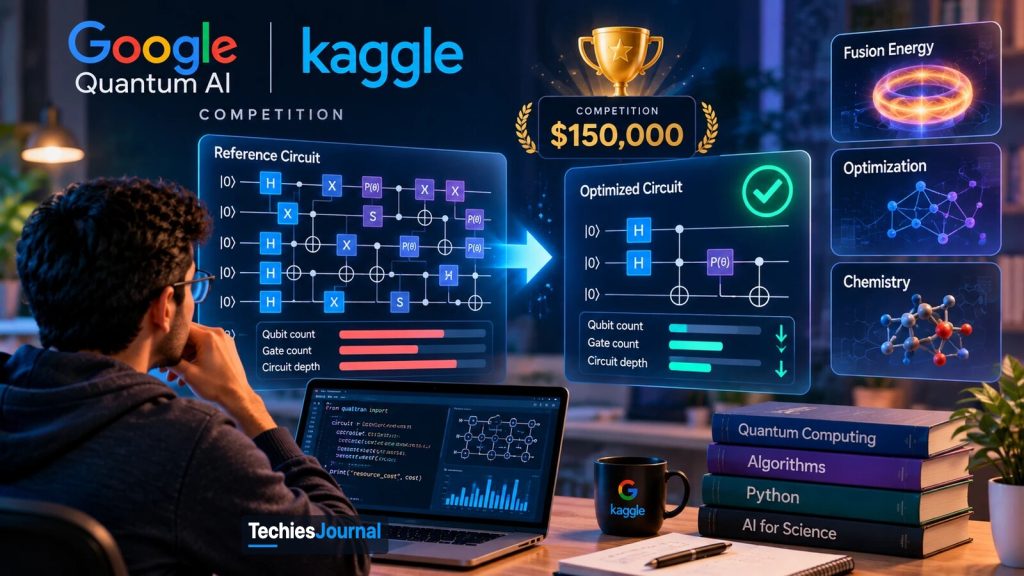
Illustration of the competition idea: a developer compares a reference quantum circuit with an optimized one. Not real circuits.
Google’s new Kaggle competition asks participants to make quantum circuits more efficient. For students and software developers, it offers an opportunity to explore quantum software. But understanding the challenge and competing seriously require very different levels of preparation.
A developer can ask whether this competition is for them
Imagine you are a software developer who enjoys solving difficult programming problems. You know Python, understand algorithms and perhaps use AI tools to explore alternative solutions, but you have never studied quantum physics beyond a few introductory concepts. Then you discover a competition organized by Google Quantum AI that asks participants to optimize quantum circuits and provides tools to check their solutions.
Your first reaction might be that this is a competition for physicists and specialized quantum researchers. That assumption is worth questioning.
On October 21, 2026, Google Quantum AI announced the Verifiable Quantum Circuit Compilation competition on Kaggle. The challenge focuses on software, algorithms, circuit optimization and automated verification rather than building physical quantum computers. It presents an interesting opportunity for people whose strengths lie in computer science, but an opportunity to explore a subject is not the same as being prepared to solve its hardest problems.
Can a software developer realistically explore this competition without a physics background, and what would they need to learn before attempting the challenges?
The answer becomes clearer once we understand what participants are being asked to optimize.
Participants reduce the resource cost of quantum circuits
A quantum computer performs computations using quantum gates, and a sequence of these gates forms a quantum circuit. The circuit acts on qubits, the quantum counterpart of the bits in an ordinary computer. A quantum circuit is somewhat like a program because it describes the operations needed to perform a calculation, but it follows different computational rules from ordinary software.
Two conventional programs can produce the same output while using different amounts of memory and processing time. Similarly, two quantum circuits may implement the same intended calculation while requiring different numbers of gates and qubits. Those resource differences matter because useful fault-tolerant quantum computers will need error correction to protect calculations from hardware errors, and error correction adds substantial overhead to every qubit and gate an algorithm uses.
If researchers can implement the same computation with fewer expensive operations, they may reduce the hardware resources needed to run it in the future. This is the problem Google’s competition addresses. Participants receive reference implementations of selected quantum computations and develop alternatives that pass the provided correctness checks while achieving a lower cost.
The cost is not a count of every gate. The Kaggle evaluation multiplies a qubit count by a Toffoli count, a gate that is especially expensive on error-corrected hardware, with task-specific terms. The fusion task also counts T gates at a quarter of a Toffoli, the optimization task squares the qubit count and penalizes decoding failures, and the chemistry task scales the cost by a factor that reflects the quality of the classical factorization. The final score is the geometric mean of the three tasks’ improvements over a baseline.
The competition does not require participants to operate a quantum processor. It asks them to improve how particular calculations are expressed as quantum circuits. For developers familiar with algorithms, optimization or compilers, the objective may sound recognizable: find a more efficient implementation without changing the required behaviour. The difficult part is verifying that the new implementation remains correct.
Verification makes automated optimization practical
Imagine using an AI coding agent to optimize a conventional function. The agent suggests a different algorithm, you run tests, compare the output against a trusted implementation and measure whether the new version is faster or uses less memory. You repeat the process until you find a useful improvement. Google wants a similar feedback process for quantum circuits.
Quantum computation creates a complication. A register of n qubits can hold a weighted combination of all 2ⁿ possible bit patterns at once, called a superposition, and keeping track of those weights on a classical computer becomes prohibitively expensive as the number of qubits increases. If every AI-generated circuit required an expensive quantum simulation, testing thousands of candidates would be impractical.
How kickmix makes verification more manageable
Google’s approach works around this problem by focusing on a restricted family of circuits. Its open-source kickmix library, part of the Qualtran project, works with circuits built from reversible classical logic, diagonal phase gates, which attach a sign or angle (a phase) to a result, and measurement-based uncomputation, a cheap way of cleaning up temporary values that the next sections explain. These circuits have useful mathematical structure: each one maps a definite input bitstring to a single output bitstring together with a phase, instead of spreading it across many outputs. A classical computer can therefore test their behaviour far more efficiently than it could simulate an arbitrary quantum circuit.
Google’s verifier tests every valid input when the input domain is small and many random inputs otherwise, a method often called fuzz testing. For each input it checks the output, the phase and that the temporary qubits are left clean. A candidate that fails is rejected, and a candidate that passes can be scored for resource cost. The process then repeats.
The verification loop
Select a step to see what it does and what it does not establish.
1. Propose
- 1Propose an implementation (current step)
- 2Verify it
- 3Measure its cost
- 4Attempt an improvement
What happens
- A person, an AI coding agent or an optimizer writes a new version of a circuit for one benchmark.
- The reference implementation is the starting point.
What it does not show
- That the new version is correct.
- That it is cheaper than the reference.
2. Verify
- 1Propose an implementation
- 2Verify it (current step)
- 3Measure its cost
- 4Attempt an improvement
What happens
- The verifier runs the circuit on every valid input when the input domain is small and on many random inputs otherwise, and checks the outputs, the phases and that scratch qubits are returned clean.
- A circuit that fails is rejected.
What it does not show
- An exact proof of equivalence for every possible input.
- That the circuit works outside the structured family of circuits the verifier supports.
3. Measure
- 1Propose an implementation
- 2Verify it
- 3Measure its cost (current step)
- 4Attempt an improvement
What happens
- A circuit that passes is scored on its resource cost, which combines qubit count and Toffoli count for each task.
- The competition scores the geometric mean of the three tasks’ improvements over a baseline.
What it does not show
- That every kind of gate counts equally.
- That a lower score means the full quantum application is ready to run.
4. Improve
- 1Propose an implementation
- 2Verify it
- 3Measure its cost
- 4Attempt an improvement (current step)
What happens
- The participant uses the verifier and the score to decide what to change next.
- The loop repeats, each pass starting from a candidate that has already been checked.
What it does not show
- That an improvement on one benchmark carries over to the others.
- That convincing code is the same as correct code.
The loop only works because verification is fast. That is why the competition restricts itself to circuits that a classical computer can test.
The verification method has limits. Randomized tests do not prove that two arbitrary circuits are exactly equivalent for every input. Google’s companion research paper and the Kaggle domain notes instead describe two results that work together. Mathematically, if a circuit fails on a fraction ε of inputs, weighted the way the full algorithm uses them, its quantum output stays within 2√ε of the ideal.
Random testing then estimates that fraction statistically, and Kaggle’s example is that 100,000 passes without a failure put the failure rate below 0.1% with overwhelming confidence. The result is a high-confidence bound under assumptions about the inputs, not a proof of exact equivalence.
This is an important distinction. Google has not discovered an efficient way to verify every possible quantum program. It has identified a structured class of computations where testing is practical enough to support automated optimization. For a software developer, that is a valuable lesson even beyond quantum computing: AI-generated improvements become more useful when there is a dependable way to evaluate correctness and cost.
Three benchmarks come from fusion, optimization and chemistry
The competition concentrates on three computational subroutines drawn from larger quantum algorithms. Each subroutine performs a relatively specific task, but its cost can significantly affect the resources needed by the full algorithm.
| Challenge | What participants work on | Relevant computing skills |
|---|---|---|
| Fusion energy | A more efficient inverse-square-root phase calculation | Numerical methods, arithmetic and approximation |
| Optimization | A Reed–Solomon decoder used in a quantum algorithm | Algorithms, coding theory and reversible computation |
| Chemistry | Compact parameter representations and lookup circuits for FeMoCo simulation | Mathematical optimization, data representation and quantum algorithms |
The fusion challenge concerns the interactions between charged particles in simulations of fusion fuel used to design inertial confinement fusion targets. Participants work on an efficient quantum-circuit implementation of a phase proportional to 1/√x, where x is a squared distance, within a specified error tolerance. A well-known classical analogue is the fast inverse square root from the video game Quake III, but the quantum version must be reversible and far more accurate.
The optimization challenge involves Reed–Solomon decoding, a mathematical technique associated with error-correcting codes. Here the decoder must operate inside a quantum algorithm called Decoded Quantum Interferometry, which introduces requirements beyond those of a conventional software decoder.
The chemistry challenge concerns FeMoCo, an iron–molybdenum cluster associated with biological nitrogen fixation. Participants co-design the classical factorization of the molecule’s Hamiltonian, the arrangement and precision of its Givens rotations, and the lookup circuits that load the rotation angles. The rotation gates themselves are priced by formula rather than designed.
These are serious research-oriented problems. They are not three introductory exercises designed to teach someone their first quantum gate. That does not mean a newcomer cannot learn from them. It means the appropriate starting point is understanding the supplied reference implementation rather than attempting to redesign the entire calculation immediately.
Software developers bring useful skills but not all of them
The competition highlights an important distinction between quantum hardware and quantum software. Quantum hardware development may require deep knowledge of physics, experimental systems, materials and device control. Quantum software also involves problems familiar to computer scientists: algorithms, data representation, compilers, mathematical optimization, testing and resource estimation.
A developer with strong programming foundations already has some useful preparation. Python experience can help with exploring Qualtran and reading its reference implementations. Algorithmic thinking is valuable when comparing different ways of expressing a computation, testing and debugging skills matter when using the supplied verifier, and mathematical reasoning helps determine whether a proposed transformation preserves the intended calculation. Kaggle itself states that no quantum physics background or quantum hardware is required to take part.
However, these skills do not automatically translate into quantum-circuit expertise. One particularly important concept is reversible computation. In an ordinary program, you can overwrite a variable or discard temporary information when you no longer need it, but quantum operations generally cannot erase information in the same way while remaining reversible.
A quantum algorithm may therefore need to undo temporary calculations so that unwanted intermediate state does not interfere with the result. This is known as uncomputation. Developers approaching the challenge will also encounter concepts such as quantum gates, qubit costs, phase operations and circuit approximation errors. You do not necessarily need a degree in physics to begin understanding these ideas, but you cannot ignore them and expect ordinary programming experience alone to solve the benchmarks.
Know, Use and Master separate exploring from competing
The right preparation depends on how deeply you want to participate. TechiesJournal’s Know → Use → Master framework helps separate exploration from serious competition. The three levels are not a mandatory progression, and you can stop after gaining the understanding you need.
Three levels of involvement
Select a level to see what it asks of you and what it does not require.
Know
What you do
- Read Google’s announcement and one benchmark description.
- Explain why circuit costs matter, what the competition improves and why checking correctness is essential.
What you do not need
- To write or submit any code.
- A physics degree.
Use
What you do
- Obtain a reference implementation and run its supplied verifier.
- Reproduce the baseline result and understand what the cost score measures.
What you do not need
- To improve on the baseline yet.
- Deep expertise in the benchmark’s mathematics.
Master
What you do
- Understand a benchmark’s mathematics, circuit structure, correctness conditions and cost model.
- Propose changes that pass the official verifier and score better.
What you do not need
- To enter the competition just because a prize exists.
- To follow the levels in order if one level already meets your goal.
The levels are not a mandatory progression. You can stop at the level that gives you the understanding you need.
Know: Understand the opportunity
At this level, your goal is to understand what quantum circuit optimization means. You should be able to explain why circuit resource costs matter, what the competition is trying to improve and why checking correctness is essential. Reading Google’s announcement and examining one benchmark description may be enough.
This is a sensible starting point for students, developers exploring quantum computing for the first time or professionals trying to understand where software engineering fits into the field. You do not need to submit a solution to benefit from this level of learning.
Use: Explore a working reference implementation
At this level, you move from reading to experimentation. You should be comfortable using Python, working with unfamiliar research code, running tests and interpreting output. Your objective is to obtain the relevant reference implementation, run its supplied verifier and understand the resource-cost measurement.
A successful first experiment might involve reproducing the baseline result without modifying the circuit at all. That may sound modest, but it establishes something essential: you can run the tools and understand what they are measuring. Once that works, you can investigate a small, controlled change.
Master: Attempt a competitive optimization
Serious participation requires substantially more preparation. You need to understand the benchmark’s mathematical requirements, circuit structure, correctness conditions and cost model well enough to propose meaningful alternatives. Depending on the selected challenge, that may require knowledge of reversible arithmetic, numerical approximation, coding theory, quantum algorithms or scientific computing.
You also need to demonstrate that an improvement satisfies the official verifier and performs better under the defined metric. This is closer to advanced algorithms research than an ordinary coding exercise.
Explore Google’s Quantum Computing Challenge
If this competition interests you, start with the official Google Quantum AI competition on Kaggle. Read the challenge descriptions, participation rules and evaluation criteria before attempting a solution. You do not need to commit to competing immediately, and understanding one benchmark and exploring its reference implementation can be a useful first step.
As of October 23, 2026, the Kaggle page lists an entry deadline of January 13, 2027 and a final submission deadline of January 20, 2027, with prizes totalling $150,000. Dates, prizes and eligibility can change, so confirm them on the competition page before you plan around them. For more technical background, see Google’s competition announcement and the Qualtran open-source project.
The competition suits some goals better than others
The competition is relevant to different readers for different reasons, but it should not become an automatic learning priority simply because Google organized it. If you are beginning to learn programming, your time is probably better spent building strong foundations in Python, algorithms and mathematics before attempting advanced quantum-circuit optimization. If you already have those foundations and enjoy mathematical programming, the challenge could be a useful way to discover whether quantum software interests you.
Developers experienced in compilers, performance engineering, formal methods, scientific computing or AI-assisted optimization may find more of the problem familiar. For them, the challenge could be a meaningful technical stretch project. Working through a benchmark may help demonstrate skills in algorithm design, verification, performance analysis and research-oriented software development, and a documented improvement with reproducible evidence could become a useful portfolio project. Participating does not automatically qualify someone for a quantum-computing role, because the field includes many specializations and this challenge covers only part of quantum software engineering.
The opportunity cost matters too. If your immediate goal is becoming a backend developer, cloud engineer or application-security professional, this may be an interesting side project rather than the most valuable skill to prioritize. If your goal is research-oriented computing, compilers or advanced algorithms, it may deserve more attention. The right question is not whether the competition is prestigious but whether the problems it exposes are relevant to the technical direction you want to pursue.
AI proposes candidates and an independent verifier checks them
Google’s challenge is also an example of how AI-assisted development can be applied to problems where correctness matters. An AI system can propose a circuit implementation, a separate verifier evaluates whether the candidate satisfies the required behaviour, and the cost model determines whether the candidate is an improvement. The AI system does not establish correctness simply by producing convincing code.
That distinction matters for developers working well beyond quantum computing. AI-generated solutions are most useful when there are meaningful, independent ways to test them, so the quality of the resulting work depends not only on what AI can generate but also on what the surrounding tools can reliably evaluate.
There are limits to what competition results would establish. Finding a lower-cost implementation for one benchmark would be a meaningful achievement under that benchmark’s rules and could reduce estimated resources for a larger fault-tolerant quantum algorithm. It would not, by itself, prove that a complete quantum application is ready for production or that quantum computers now outperform classical systems on the associated scientific problem. The competition improves part of the computational design process, while hardware capabilities, error correction, other algorithmic operations and total execution costs still matter.
Exploring is easy to start, but competing takes preparation
Google’s competition highlights something that introductory discussions of quantum computing can overlook. Progress does not depend only on making better physical qubits. Researchers also need better ways to represent computations, reduce expensive operations, verify circuits and estimate the resources algorithms will require, and those are areas where software engineering and computer science can make substantial contributions.
For students and developers, the competition offers a concrete way to explore that work. You can begin by understanding the problem, then examine the supplied reference implementations and decide whether deeper experimentation is worth your time. There is no requirement to become an expert immediately, and no particular reason to compete merely because a prize is available.
You do not need to master quantum physics to begin exploring quantum software. But meaningful progress requires understanding what you are optimizing, what correctness means and how to verify the result.
Go deeper
Research reviewed October 23, 2026. Competition rules, prize conditions, deadlines and software interfaces may change, so check the official Kaggle materials before entering or making a submission.
Competition, announcement and research
- Google Quantum AI, Verifiable Quantum Circuit Compilation on Kaggle, Kaggle, the official overview with rules, evaluation, timeline, prizes and domain notes. Consult the current eligibility and starter materials before participating.
- Announcing the Verifiable Quantum Circuit Compilation Competition, Tanuj Khattar and Ryan Babbush, Google Open Source Blog, October 21, 2026, the competition’s purpose, the three benchmarks and the kickmix verification approach.
- Leveraging Verifiable Structure in Quantum Circuits to Find More Efficient Compilations with Agentic AI, Khattar, Rubin, Gidney, Broughton, Low and Babbush, arXiv, October 2026, the companion paper on circuit structure, verification, cost models and benchmark design for readers who want the mathematical detail.
Tools and background
- Qualtran, Google Quantum AI, the open-source Python framework for expressing and analyzing fault-tolerant quantum algorithms. Its kickmix library is the one the competition uses.
- Quantum computing for the very curious, Andy Matuschak and Michael Nielsen, a free introductory essay that the Kaggle page recommends for newcomers.
This article separates what Google and Kaggle state from the author’s guidance for readers. Competition terms and software interfaces should be rechecked before acting.
Related reading on TechiesJournal
- Quantum Computing for Students: What Should You Understand, and How Deep Should You Go?, TechiesJournal, May 2026, background for readers who want to understand the field before choosing a specialization.