

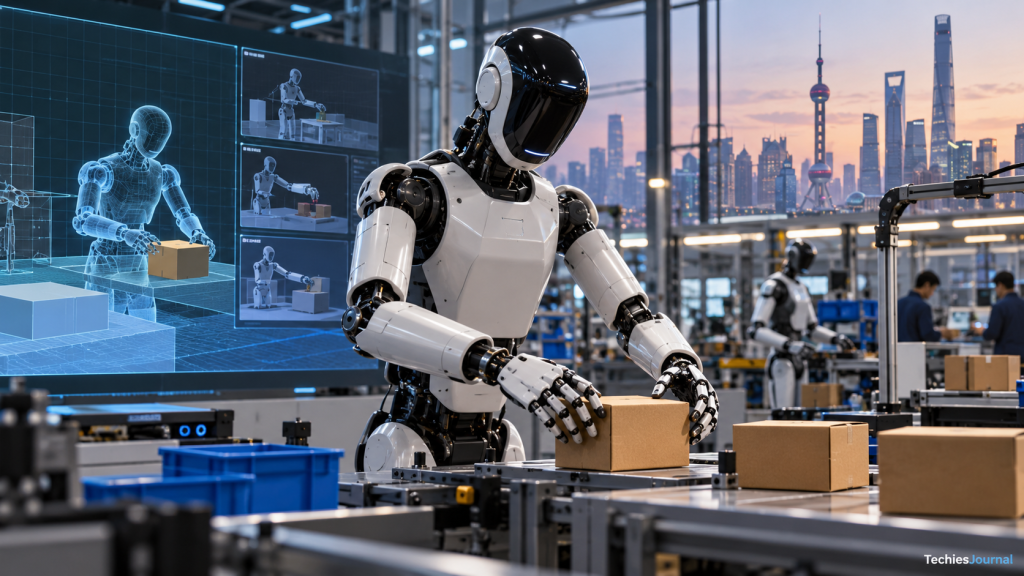
Beyond the humanoid demonstrations
China’s humanoid robots are attracting attention at technology exhibitions, where they perform martial arts, dance and demonstrate increasingly sophisticated movements.
Behind these performances, Chinese researchers are working on a less visible challenge: teaching robots to do useful work.
Consider a robot packing products in a factory. The objects may arrive in different positions. Some may be heavier than others. Occasionally, an item might slip or a box might be placed incorrectly.
A human worker can usually adjust without much thought. A robot must recognize the change and determine how to respond.
Traditional industrial robots already perform many repetitive tasks successfully, but they generally work within carefully designed processes. Making robots adaptable enough to handle changing conditions requires a different combination of training, software and hardware.
Chinese researchers and companies are developing several parts of that technology.
Three developments help explain where the progress is happening.
AgiBot: Giving robots experience
In 2025, Chinese robotics company AgiBot and its research collaborators introduced AgiBot World, a collection of more than one million recorded robot movements across 217 tasks.
The project covers five deployment scenarios.
These recordings give AI models examples of how robots interact with objects.
A robot learning to pour water, for example, needs more than an instruction telling it what to do. It must learn how to position its arm, hold the container and control the movement.
Recorded demonstrations can help models learn these relationships.
AgiBot’s researchers also developed Genie Operator-1 (GO-1), an AI model trained to perform physical tasks.
The paper reports real-world tests on dexterous and long-horizon tasks.
The researchers reported that GO-1 outperformed the prior RDT approach by 32% on the tasks they tested.
The performance figures came from the developing team, and independent reproduction of the results has not been established in the evidence reviewed.
Still, the project makes an important contribution to China’s robotics research.
AgiBot is developing not only physical robots, but also the training resources and AI models intended to help those machines learn different tasks.
Source: AgiBot World Colosseo, 2025
RoboTwin: Learning in a virtual environment
Another Chinese research collaboration is investigating how robots can learn without requiring every training attempt to take place on physical equipment.
Researchers from Shanghai Jiao Tong University, the University of Hong Kong, Shanghai AI Laboratory and collaborating institutions developed RoboTwin 2.0, published at ICML 2026.
The project creates virtual environments where robots can practise handling objects.
Imagine teaching a robot to pick up a package.
In a virtual environment, researchers can change the package’s position, size and surrounding objects. The robot can practise under many different arrangements without repeatedly moving physical equipment.
RoboTwin 2.0 supports 50 tasks involving robots with two arms, across five robot configurations.
The researchers reported that models trained using simulated experiences performed better in selected physical robot tests.
An independent audit of robotics benchmarks found that RoboTwin 2.0 fails fewer of its diagnostics than LIBERO and CALVIN.
The results do not mean virtual training perfectly reproduces real-world conditions. They demonstrate that carefully designed simulations can contribute useful training experiences and help researchers evaluate robot-learning methods.
For China’s robotics research community, RoboTwin offers a complementary approach to AgiBot World.
AgiBot collects examples of physical activities. RoboTwin provides environments where robots can practise variations of those activities virtually.
Sources: RoboTwin 2.0, ICML 2026 | Independent benchmark audit, 2026
From research systems to China’s robotics industry
Training models is only part of the challenge. Robots also need physical hardware capable of carrying out the movements they learn.
Chinese manufacturer Unitree has developed humanoid platforms such as the G1, which researchers can use to test walking, balancing and physical manipulation.
The company illustrates China’s growing capacity to produce robotic hardware, while AI models developed by other teams may provide some of the capabilities demonstrated on those machines.
Another company, Shenzhen-based DexForce, is pursuing a commercial approach built around simulated robot training.
These developments show how China’s research into robot learning is attracting commercial interest.
But a manufacturing partnership alone does not establish that a robot can perform an entire production task independently or economically.
That question becomes clearer when we examine what is happening inside robotics training facilities.
The factory challenge
In August 2026, Reuters investigated China’s humanoid robotics industry, including a training facility in Liuzhou.
Human operators at the facility guided robots through activities such as sorting crates, packaging noodles and preparing drinks.
The operators used specialised controls to demonstrate movements, creating examples that could later be used to train AI models.
This provides an important perspective on the industry’s progress.
Some of the capabilities seen in robotic demonstrations still require extensive human involvement during development.
The investigation also identified difficulties involving manipulation skills, operating speed and the cost of deploying humanoid robots for production work.
For a factory, completing a task once is not enough.
A robot must repeat the work reliably throughout normal operations, handle unexpected situations and justify its cost compared with existing automation.
Chinese companies are experimenting with these applications, but the available independent evidence does not yet establish widespread, dependable humanoid autonomy in manufacturing.
China’s progress beyond the robot itself
The most interesting development in China’s embodied AI research is not any single humanoid machine.
It is the work taking place around the machine.
AgiBot is developing large collections of physical training experiences. RoboTwin researchers are creating simulated environments for practising new tasks. Companies such as Unitree are building the hardware, while DexForce is exploring how these training methods could support commercial applications.
These efforts address different parts of the same problem.
The research has produced substantial datasets, working AI models and physical demonstrations. The harder step is turning those capabilities into robots that can perform useful work consistently outside controlled environments.
China is making progress not only in building robots that move, but in developing the technology that could help them learn what to do.
Whether those capabilities become dependable, economically useful workers will depend on what the robots can demonstrate in everyday operating conditions, not on how impressive they appear on stage.
Explore the Research and Code
The projects below publish technical resources for readers who want to investigate further. Publicly accessible code, models, datasets and images can have different reuse licenses.
- AgiBot World on GitHub: Explore research resources for teaching robots from recorded physical tasks.
- RoboTwin on GitHub: Explore the simulated manipulation tasks and research tools behind RoboTwin 2.0.
Sources and further reading
- AgiBot World Colosseo: A Large-scale Manipulation Platform for Scalable and Intelligent Embodied Systems, 2025. Original research on AgiBot’s dataset and physical evaluations.
- RoboTwin 2.0: A Scalable Data Generator and Benchmark with Strong Domain Randomization for Robotic Manipulation, ICML 2026. Research on simulated training for two-arm robots.
- What Are We Actually Benchmarking in Robot Manipulation?, 2026. External benchmark evaluation.
- Reuters, China’s humanoid robots aren’t smart enough to take your job yet, August 2026. Reporting on training and industrial deployment challenges.