

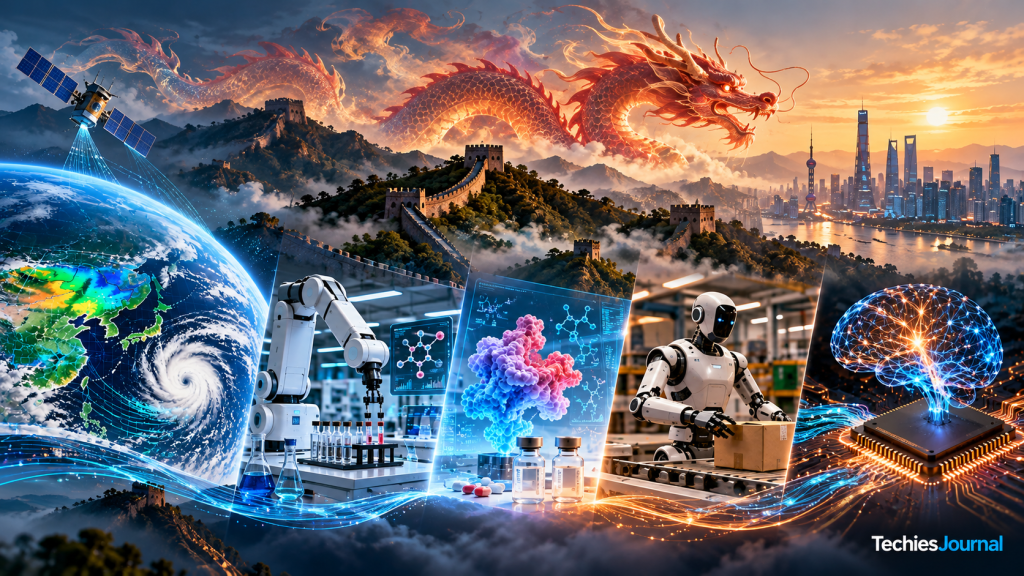
Most discussions about artificial intelligence today begin with large language models. We compare their reasoning, coding abilities and performance on benchmarks. Each release draws attention because language models have become useful across many areas of software and work.
But looking at AI only through language models gives us an incomplete picture.
Across China, researchers are working on different problems: predicting weather, conducting laboratory experiments, discovering potential medicines, teaching robots to handle physical objects and exploring new ways to build computing systems. Some projects use language models as components. Others rely on different techniques entirely.
The interesting question is not whether these developments prove that one country is ahead of another. It is what researchers have actually demonstrated, how their results were tested and where the limits remain.
Forecasting the weather without running the usual calculations
Traditional weather forecasting uses numerical models that calculate how atmospheric conditions evolve according to physical equations. They demand substantial computing power. AI forecasting takes another route: models learn patterns from historical atmospheric data and use those patterns to predict future conditions. Once trained, some systems can generate forecasts rapidly, although training and operational infrastructure still carry costs.
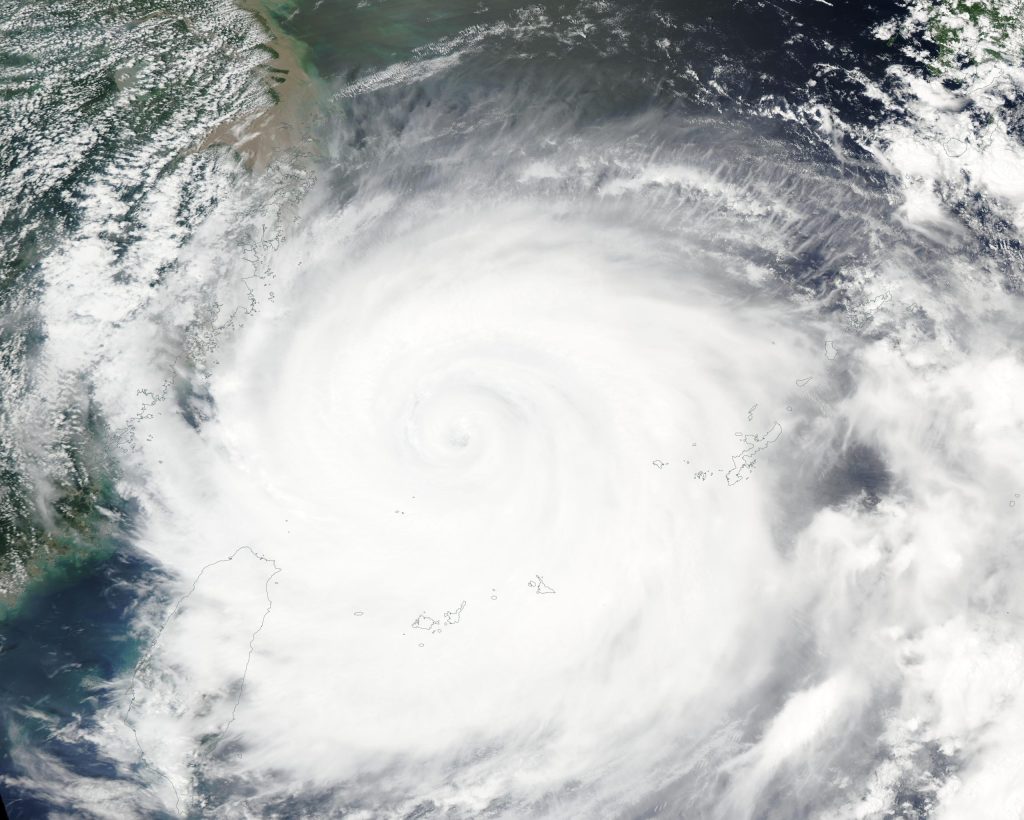
Image: MODIS Land Rapid Response Team, NASA GSFC, Public domain, via Wikimedia Commons
In 2023, Huawei Cloud researchers described Pangu-Weather in Nature. The system used a three-dimensional neural-network architecture to represent atmospheric information at different heights. Its authors reported competitive medium-range forecasts and rapid prediction generation under their experimental conditions. Source: Nature. Official code: GitHub repository, public, with no licence file, so linked for reference only.
Other Chinese research collaborations developed FengWu and FuXi. Their approaches differed: FuXi organized forecasting into stages optimized for different lead times, while FengWu combined information across atmospheric variables. These were competing technical strategies, not one uniform method.
What happened when researchers compared them under the same conditions?
A 2024 study in npj Climate and Atmospheric Science evaluated Pangu-Weather, FengWu, FuXi, Google’s GraphCast and NVIDIA’s FourCastNet v2 across East Asia and the western North Pacific. Under the study’s common initial conditions, FengWu performed best on its main atmospheric forecasting measures, followed by FuXi and GraphCast. Pangu-Weather ranked lower among the five. Results also differed by task. For the typhoons examined, FengWu performed well at predicting storm tracks but had the largest storm-intensity errors among the models compared. Source: independent comparison.
| Model | Overall result (same starting conditions) | Typhoon track | Typhoon intensity |
|---|---|---|---|
| FengWu | Best on the main atmospheric measures | Performed well | Largest intensity errors of the models compared |
| FuXi | Second, behind FengWu | Not stated in the sources reviewed | Not stated in the sources reviewed |
| GraphCast | Third, behind FuXi | Not stated in the sources reviewed | Not stated in the sources reviewed |
| FourCastNet v2 and Pangu-Weather | Ranked lower | Not stated in the sources reviewed | Not stated in the sources reviewed |
That difference matters. Predicting where a storm will travel is not the same as predicting how powerful it will become.
In 2026, the European Centre for Medium-Range Weather Forecasts (ECMWF) stopped real-time operation of several older external AI forecasting models, including Pangu-Weather. The decision reflected changes in its operational programme and the usefulness of maintaining those earlier models. It did not erase their research contributions. Source: ECMWF.
The achievement here is not a permanent ranking. Chinese researchers helped develop methods that could be evaluated against observed atmospheric conditions and compared by independent meteorological teams. That gives us a more meaningful picture of progress than a headline benchmark.
When AI enters the scientific laboratory
Scientific research involves more than proposing an answer. Researchers prepare materials, operate equipment, measure outcomes and use those measurements to decide what to investigate next. Some Chinese research groups are connecting these steps through AI-assisted experimental systems.
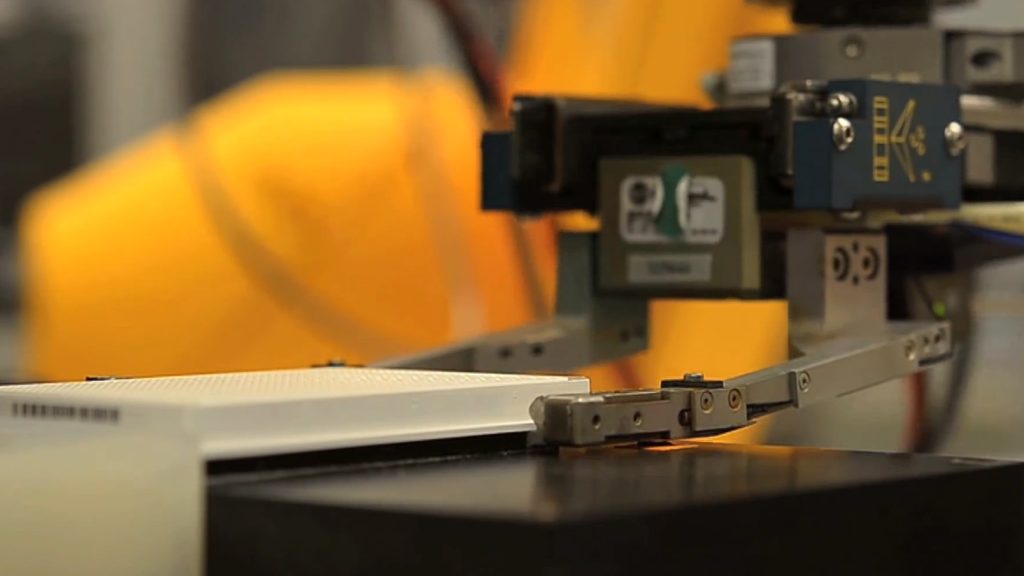
Image: National Institute of Allergy and Infectious Diseases, Public domain, via Wikimedia Commons
In 2022, researchers affiliated with the University of Science and Technology of China described AI-Chemist. Their system connected computational planning to robotic equipment operating across 14 laboratory workstations used for activities such as synthesis, characterization and performance testing. The important contribution was the connection between software decisions and physical experiments, not simply the ability to describe an experiment in words. Source: published research.
Accessible text alternative for this figure
Text version of the diagram. The cycle has four steps. 1. Plan: software and language-model agents propose the next experiment. 2. Run: a robotic workstation carries out the synthesis. 3. Measure: characterization and performance tests are taken. 4. Decide: the results choose the next experiment, and the cycle repeats.
The demonstration had limits. It operated within the laboratory’s available tools and defined experimental workflows. It did not establish that a machine could independently solve any scientific problem.
A newer example is MARS, from research led by the Shenzhen Institutes of Advanced Technology, part of the Chinese Academy of Sciences, with collaborators. The published project describes 19 specialized language-model agents, 16 research tools and robotic laboratory operations. The agents help coordinate planning, analysis and execution, while experimental measurements inform later steps. Its researchers reported results involving perovskite materials, including optimization within a limited series of experiments. Source: Matter paper.
MARS raises a useful question: does this count as AI research beyond LLMs when it uses language models? Yes, if we are clear about the distinction. Language models are part of the system, but the system’s purpose is experimental work involving specialist tools and physical equipment. Beyond LLMs does not mean without LLMs. It means looking beyond conversational performance to the tasks these systems support.
The next article in this series will examine autonomous laboratories in more depth, including the reliability and reproducibility problems that remain.
How AI contributes to drug development
Drug discovery brings a different kind of evidence. AI can help researchers identify biological targets and promising molecular structures, but a computer-generated candidate is a long way from a medicine. Laboratory testing, preclinical research and human trials still matter.
Rentosertib, an investigational treatment for idiopathic pulmonary fibrosis, illustrates that path. It was developed by Insilico Medicine, an international biotechnology company with substantial research and clinical operations in China. It would be inaccurate to label the programme a discovery made exclusively by a Chinese laboratory.
A randomized phase 2a trial, published in Nature Medicine in 2025, enrolled 71 participants across 21 sites in China. Its primary focus was safety and tolerability over 12 weeks. Lung-function changes were among the secondary outcomes. The researchers reported encouraging signals in some groups, but the small sample, short follow-up, adverse events and treatment discontinuations limit what those results establish. Source: clinical study.
On September 10, 2026, Insilico Medicine announced that the first participant had been dosed in its larger, 52-week phase 3 GENESIS-IPF-3 trial. This is an important development stage, not a successful phase 3 result or a regulatory approval. Source: company announcement.
| Stage | What is known | Status |
|---|---|---|
| Discovery | AI helped identify a biological target and candidate molecule. A candidate is not yet a medicine. | Completed as part of the programme |
| Phase 2a (randomized, published 2025) | 71 participants at 21 sites in China. Primary focus: safety and tolerability over 12 weeks. Lung-function changes were secondary outcomes. | Published. Small, short study |
| Phase 3 (GENESIS-IPF-3) | 52-week trial. First participant dosed on 10 September 2026. The company reports a planned 320 participants at 47 centres in China. | In progress. No efficacy result reported |
| Regulatory approval | None | Not approved |
The example does not prove that AI-designed medicines are generally better than those developed using other methods. It shows that AI-assisted discovery can form part of a programme that progresses into controlled clinical testing, where biological and medical evidence, not the technology’s origin, must determine the outcome.
Teaching robots through physical examples
Robots face problems that text alone cannot teach. A machine needs to learn what happens when objects are grasped, lifted, moved or placed under varying conditions.
Chinese robotics developer AgiBot introduced AgiBot World, a research dataset described as containing more than one million recorded robot trajectories across 217 tasks. Each trajectory captures observations and actions associated with physical manipulation. Source: AgiBot World paper.
This is useful training infrastructure, but dataset size is not a measure of general-purpose robotic intelligence. What matters is whether models trained on such data can perform reliably with unfamiliar objects and changing conditions. We will examine that question, and the evidence from real hardware, in Article 3.
A different approach to AI computing
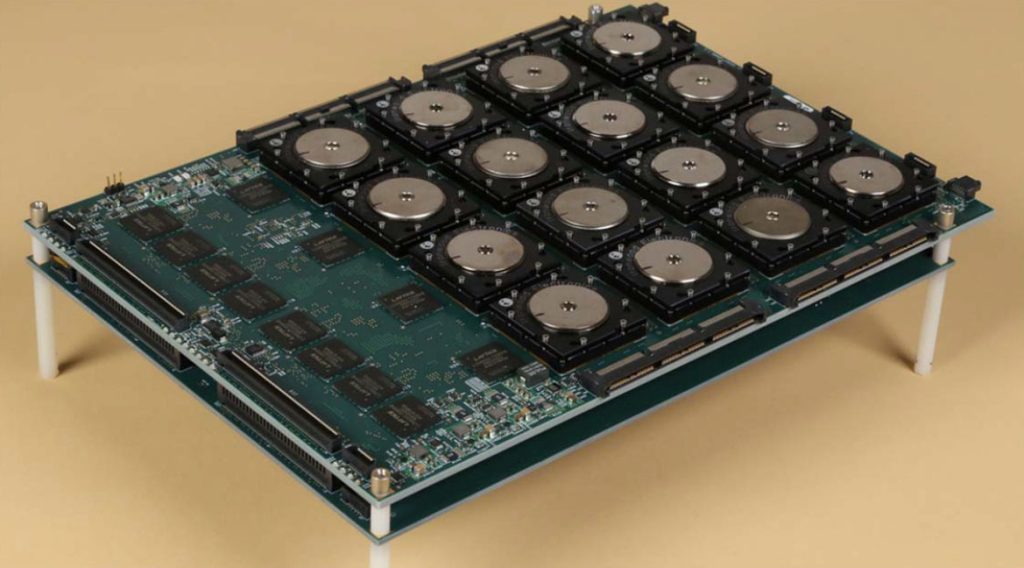
Image: DARPA SyNAPSE, Public domain, via Wikimedia Commons
At Zhejiang University, the Darwin programme explores neuromorphic computing: architectures inspired by aspects of biological neural signalling. Its Darwin Monkey system reportedly combines 960 Darwin3 chips to support large simulations of spiking neural networks. Source: Zhejiang University.
That is a significant research architecture, not evidence of human-like intelligence. Simulated neuron counts do not establish superiority over conventional accelerators. Useful comparisons need equivalent workloads, accuracy and energy measurements. Article 4 will investigate what neuromorphic computing can and cannot offer.
From research to practical use
The research landscape extends beyond universities. Chinese manufacturers also report deploying AI for specific industrial tasks. CITIC Dicastal, for example, has described AI-assisted X-ray inspection for detecting defects in automotive-wheel production. That is a concrete application of computer vision to an established manufacturing process. Its reported productivity improvements, however, should be treated as company claims unless supported by independently comparable measurements.
These examples show different forms of progress. Weather models can be evaluated against observations. Laboratory systems must produce experimental results. Drug candidates require clinical evidence. Robots must perform on physical hardware. Alternative computing systems must prove their benefits through comparable workloads.
The work also comes from different kinds of institutions: universities, government-affiliated institutes, businesses and international collaborations. Describing it all as one coordinated national effort would obscure who developed what and how each contribution should be judged.
What this research establishes is more interesting than a contest over national rankings. Chinese researchers and China-connected teams have made substantive contributions across several technical areas, but their achievements stand at different levels of maturity. Some are independently evaluated. Others remain bounded experiments or institution-reported capabilities.
AI progress extends beyond what models can tell us. It also includes what they can predict, discover and help accomplish, and the evidence showing whether those capabilities work.
Sources and further reading
- Pangu-Weather: Nature (2023).
- Independent comparison of five AI weather models: npj Climate and Atmospheric Science (2024).
- ECMWF: Farewell to the external AI models (2026).
- AI-Chemist: published study (2022).
- MARS: Matter research.
- Rentosertib phase 2a: Nature Medicine (2025).
- GENESIS-IPF-3 phase 3 initiation: Insilico Medicine (2026).
- AgiBot World Colosseo: research preprint (2025).
- Darwin series: Zhejiang University (2026).