

China’s AI research is entering the laboratory
Much of the attention surrounding China’s artificial intelligence development focuses on language models, technology companies and competition with international AI providers.
But some of the country’s research institutions are applying AI to a different challenge: scientific experimentation.
Developing a new material often means investigating hundreds of possible combinations. Each candidate must be prepared, tested and measured before researchers can determine whether it is useful.
Scientists cannot test every possibility. They must choose where to concentrate their efforts.
Researchers in China are developing laboratories that connect AI with robotic equipment to help with this process. Software can examine earlier results and suggest promising experiments, while machines prepare materials and conduct tests.
The idea is not to replace scientists. It is to make parts of the experimental process more connected and efficient.
Research at the University of Science and Technology of China (USTC) and the Chinese Academy of Sciences provides several examples of how this approach is developing.
USTC’s AI-Chemist: Connecting AI with physical experiments
In 2022, researchers at USTC and collaborating institutions introduced AI-Chemist, a system combining AI software, a mobile robot and 14 automated laboratory workstations.
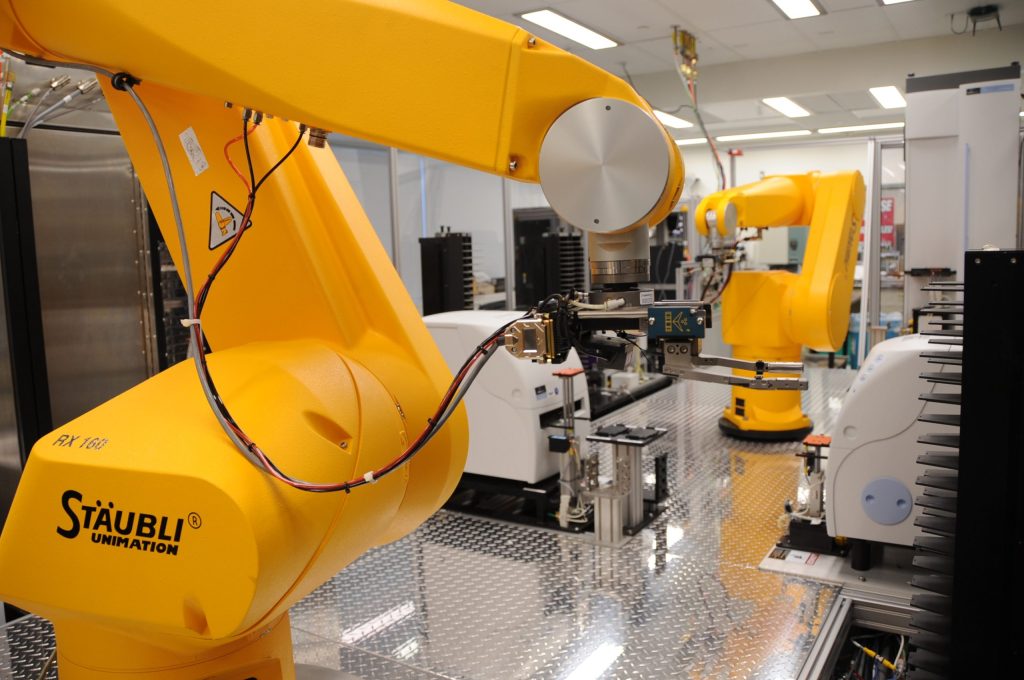
Image: Maggie Bartlett, National Human Genome Research Institute, Public domain, via Wikimedia Commons
Different workstations prepared chemicals, conducted experiments and measured results. The robot transported samples between instruments.
The significant development was how these activities worked together.
Rather than simply following a fixed sequence of instructions, the system could use experimental measurements and computational models to help identify what should be tested next.
In one demonstration, researchers investigated combinations of metals for a chemical reaction important in electrochemistry.
They began with 207 physical experiments. The resulting measurements helped the system identify other promising combinations without testing every possibility.
The researchers also demonstrated the laboratory on fluorescent compounds and materials that support reactions using light.
These experiments showed that AI-assisted planning could be connected to several types of chemical investigation within one laboratory platform.
| Aspect | Reported | Limit |
|---|---|---|
| Setup | A mobile robot and 14 automated workstations for synthesis, characterization and performance tests | Workflows were defined within the laboratory |
| First study | 207 experiments on five non-precious metals, executed by the robot | Focused on one electrochemistry-related reaction |
| Demonstrations | Fluorescent compounds and materials that support light-driven reactions | Results from the authors’ own laboratory |
| Key capability | Measurements helped choose the next experiments | Not proof that every chemistry task can be automated |
The results came from the researchers’ own experimental environment. They did not establish that AI-Chemist could perform every kind of chemical research.
Nevertheless, the project demonstrated an important capability: using information gained from real experiments to help guide subsequent laboratory work.
Source: An All-Round AI-Chemist with a Scientific Mind, National Science Review, 2022
From Hefei to Mars: An unusual experiment
The USTC research team later demonstrated the approach on a more unusual problem.
In 2023, researchers published a study in Nature Synthesis describing how their robotic AI chemist helped develop a catalyst using Martian meteorites.
A catalyst is a material that makes a chemical reaction easier or more efficient.
The researchers were investigating catalysts that could support oxygen production from water.
Such technology could eventually be relevant to space exploration, where producing useful resources locally may reduce the need to transport everything from Earth.
The team used AI-assisted calculations and laboratory experiments to search through millions of possible material combinations.
The system helped select a catalyst, which was then prepared and tested.
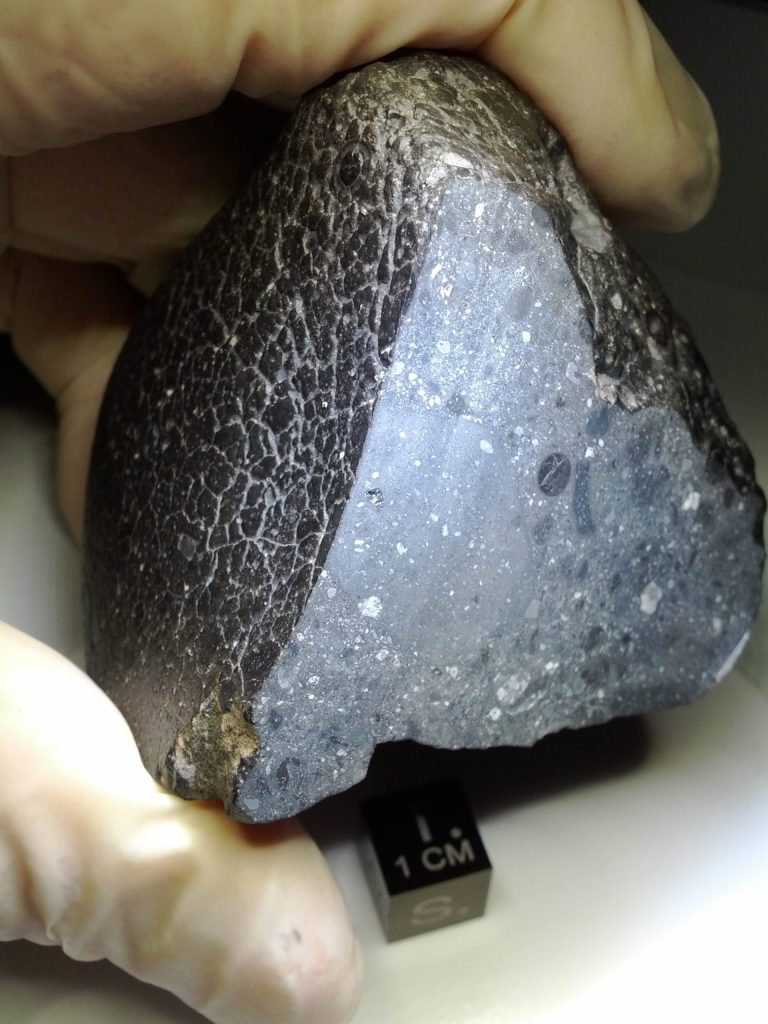
Image: NASA, Public domain, via Wikimedia Commons
The experiment took place on Earth using Martian meteorites. It did not involve operating a laboratory on Mars or demonstrate a complete oxygen-production system ready for a space mission.
| Question | Answer | Limit |
|---|---|---|
| Where was the experiment? | On Earth, using Martian meteorites | Not a laboratory on Mars |
| What was searched? | Millions of possible material combinations, as stated in the article | Not every combination was tested in the laboratory |
| What was made? | An oxygen-producing catalyst, selected with AI-assisted calculations and tested in the laboratory | Not a complete oxygen system for a mission |
| Why it matters | Local production of useful resources could reduce what must be carried from Earth | A future relevance, not a demonstrated mission capability |
What makes the work noteworthy is the scientific problem it addressed.
The researchers used AI and robotic experiments to investigate a large number of material possibilities that would have been impractical to test individually.
This demonstrated how their laboratory approach could be applied beyond routine chemical testing to a specialised materials-development challenge.
Shenzhen’s MARS: Bringing AI agents into materials research
Another development emerged from the Shenzhen Institutes of Advanced Technology, part of the Chinese Academy of Sciences.
In January 2026, researchers led by the institute and collaborating institutions described a system called MARS.
While AI-Chemist connected computational models with robotic equipment, MARS explored how multiple AI agents could coordinate different parts of scientific work.
| Agent group | Role |
|---|---|
| Orchestrator | Coordinates the other groups |
| Scientist | Retrieves knowledge and designs solutions |
| Engineer | Turns designs into experimental protocols |
| Executor | Controls the robotic equipment |
| Analyst | Interprets data and plans optimization |
Some agents examined existing research and helped plan experiments. Others converted those plans into instructions for laboratory equipment or analysed the results.
The researchers demonstrated the system using perovskites, materials being studied for applications including solar cells and electronics.
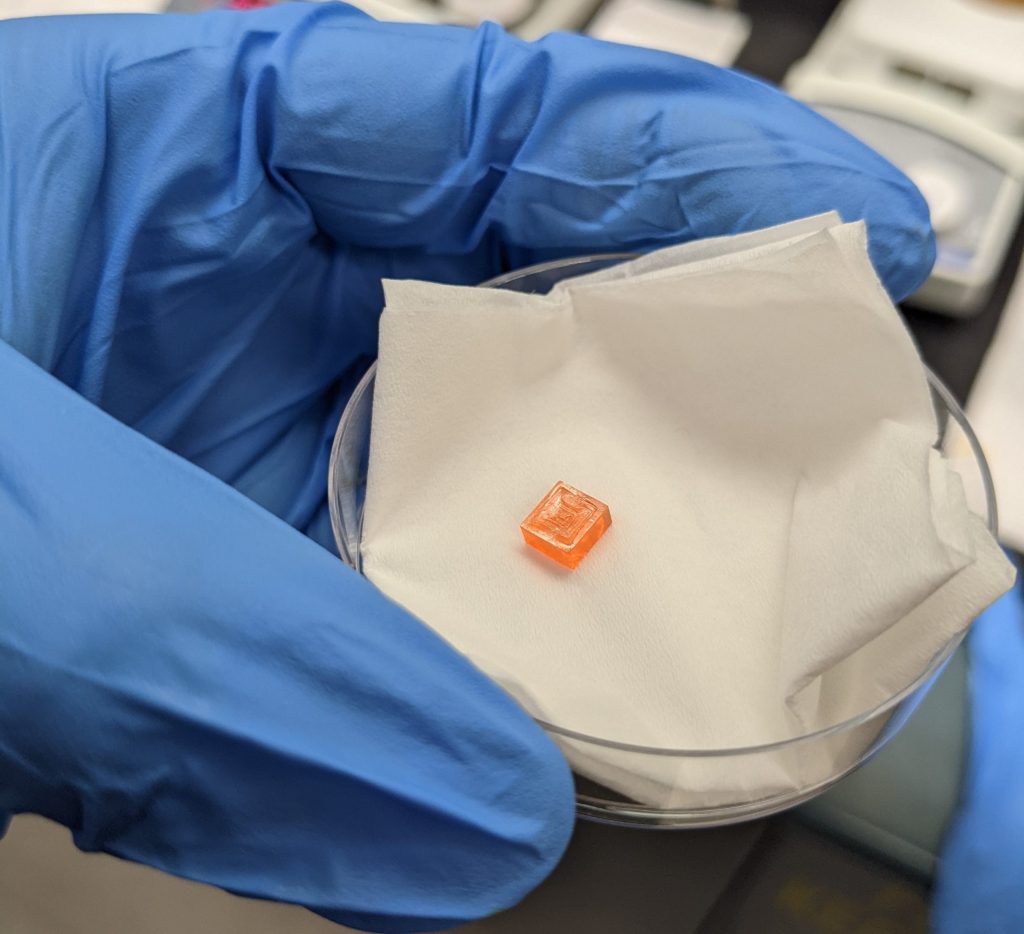
Image: Kttimliu, CC BY-SA 4.0, via Wikimedia Commons (licence)
Certain perovskites are sensitive to moisture, making their stability an important research problem.
In one experiment, MARS helped improve the preparation of perovskite nanocrystals within ten experimental rounds.
In another, it helped develop a protective structure intended to improve a material’s resistance to water.
The researchers reported completing that particular design process in approximately 3.5 hours.
That figure comes from the research team’s own report. Independent reproduction of the reported improvement has not been established.
The important contribution is the connection between AI agents, scientific tools and robotic experimentation.
MARS uses language models, but its purpose is not to produce better conversational responses. The models help coordinate work that must ultimately be tested through physical experiments.
A growing research direction, not an isolated experiment
These projects are part of wider activity within China’s scientific research community.
A 2025 perspective published in Digital Discovery reviewed several Chinese developments in autonomous laboratories, including systems for chemical synthesis, materials preparation and experimental testing.
Some projects focused on connecting robotic equipment with computational methods. Others investigated how AI could help interpret scientific information and coordinate experiments.
The review provides evidence of activity extending beyond AI-Chemist and MARS, although it does not independently validate the performance of every system discussed.
China is also not alone in developing autonomous laboratories.
Researchers in other countries have demonstrated comparable approaches that combine machine learning with laboratory automation.
The significance of the Chinese work is therefore not that China invented this field. It is that its universities and research institutes are contributing practical experimental systems across several areas of chemistry and materials science.
From research demonstrations to dependable laboratories
The published experiments establish that Chinese research teams have connected AI-assisted decisions with physical laboratory work.
But demonstrating a system in one laboratory is different from making it dependable across many research environments.
Equipment varies between institutions. Experimental results can depend on preparation methods, temperatures, instrument settings and other conditions.
A laboratory that successfully develops a material must also produce records that allow other researchers to examine and reproduce the result.
Safety presents another challenge.
A chemical experiment cannot proceed simply because an AI model recommends it. Equipment limits, chemical compatibility and appropriate supervision remain essential.
These concerns are not unique to Chinese research. They are challenges for autonomous laboratories internationally.
For the projects examined here, independent reproduction of the complete experimental workflows has not been established in the evidence reviewed.
The demonstrated results are meaningful, but they should not be confused with proof that automated laboratories are ready for unrestricted use across scientific research or industry.
Why China’s work matters
The developments at USTC and the Shenzhen Institutes of Advanced Technology show a different direction in China’s AI research.
Instead of focusing primarily on systems that generate answers, these researchers are connecting AI with equipment that produces new experimental evidence.
AI-Chemist demonstrated coordinated chemical research across several tasks. The Martian meteorite project applied the approach to an unusual materials problem. MARS explored how AI agents could help manage a more complex experimental workflow.
These are specific research achievements rather than evidence of widespread industrial adoption.
Their significance lies in demonstrating how AI can help scientists investigate possibilities that would otherwise require extensive manual experimentation.
| Project | AI role | Reported scale | Still open |
|---|---|---|---|
| AI-Chemist (USTC, 2022) | Plans the next experiments from measurements | 14 workstations; 207 experiments in one study | Reproduction in other laboratory setups |
| Martian meteorite catalyst (USTC, 2023) | Helps select a catalyst from a large search space | Laboratory tests of the selected catalyst on Earth | Real-world oxygen production |
| MARS (SIAT-led, 2026) | Coordinates several AI agents with robots | Perovskite optimization in ten rounds; 3.5 hours (team’s own report) | Independent comparison and reproduction |
China’s researchers are not simply developing AI that can discuss scientific discoveries. They are building systems that participate in the experiments used to investigate them.
The wider value will depend on how reliably those systems work beyond their original laboratories. For now, the published research provides evidence of a developing scientific capability and another important direction in China’s AI activity beyond conventional language-model applications.
Sources and further reading
- An All-Round AI-Chemist with a Scientific Mind, National Science Review, 2022
- Automated Synthesis of Oxygen-Producing Catalysts from Martian Meteorites by a Robotic AI Chemist, Nature Synthesis, online 2023, volume 3 (2024)
- Knowledge-Driven Autonomous Materials Research via Collaborative Multi-Agent and Robotic System, Matter, 2026
- Autonomous laboratories in China: an embodied intelligence-driven platform to accelerate chemical discovery, Digital Discovery, 2025 perspective
- Steering Towards Safe Self-Driving Laboratories, Nature Reviews Chemistry, 2025