

Researchers at Sakana AI and UC Berkeley have tested whether an AI model can improve by learning from teams of agents built from itself. Their results show measurable gains on research tasks, while also revealing why self-improvement remains difficult to evaluate.
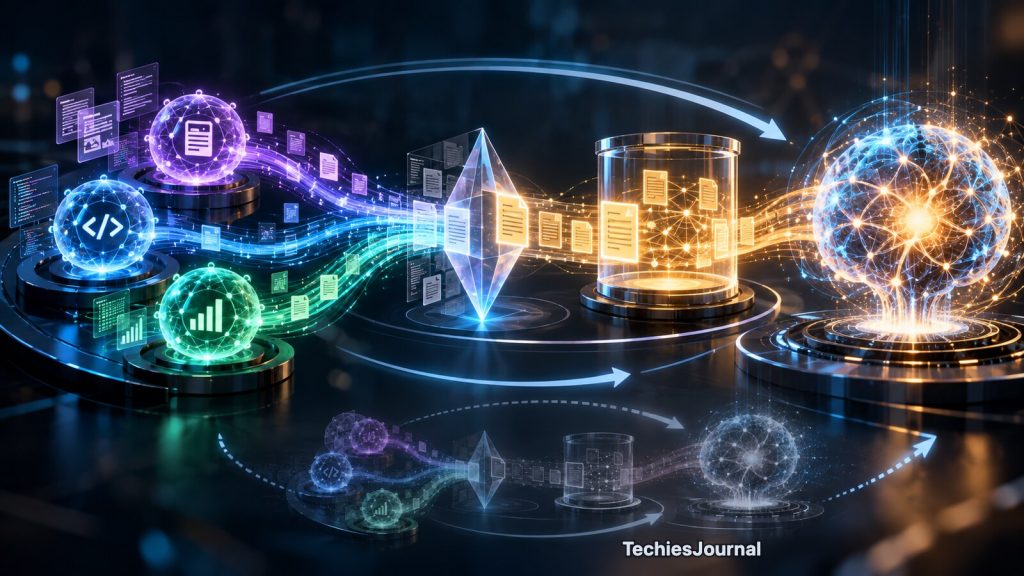
Conceptual illustration of the MASS research process. It is not the researchers' original architecture diagram.
AI models can now help people write software, analyze information, conduct research and solve complex problems. But improving the models themselves remains a difficult process.
Researchers typically train models using selected data, evaluate performance and adjust the training process. More capable models can also help generate training data or assess work done by other models. What happens when the model being improved helps find better ways to work and decide which results are worth learning from?
That is the question behind Multi-Agent Self-Supervision (MASS), research introduced by Tokyo-based Sakana AI with researchers from the University of California, Berkeley in October 2026. MASS uses multiple agents built from one model to solve tasks, improve their collaboration and select execution records for further training. The updated model repeats the process.
After two improvement cycles, the researchers reported gains on several research-oriented benchmarks. But performance declined slightly on two software-engineering benchmarks. The study therefore asks a precise question: Can an AI model become better by learning from the collective work of agents that share its own capabilities?
How Sakana AI approaches AI research differently
Sakana AI was founded in Tokyo in 2023 by David Ha, Llion Jones and Ren Ito. Jones co-authored the influential Attention Is All You Need paper, which introduced the Transformer architecture. Sakana AI draws inspiration from evolution, adaptation and collective intelligence. Its projects include Evolutionary Model Merge, The AI Scientist and the Darwin Gödel Machine.
Unlike laboratories best known for general-purpose model families, Sakana AI puts particular emphasis on ways of organizing, combining and improving AI systems. That is a difference of emphasis, not an exclusive capability: Sakana AI develops models, and other laboratories also study agents and self-improvement.
| Area | Sakana AI | OpenAI | Anthropic | Google DeepMind |
|---|---|---|---|---|
| Research emphasis | Collective intelligence, evolution, model improvement, automated research | General-purpose models, reasoning, agents, model training | Claude models, coding, reasoning, reliability | Multimodal models, scientific AI, reasoning, agents |
| Representative work | MASS, The AI Scientist, Darwin Gödel Machine | GPT model families and agents | Claude and Claude Code | Gemini and scientific AI |
| Approach relevant here | Learning from coordinated agents and selected experience | Training, post-training, agent development | Training, post-training, tool use, alignment | Training, reinforcement learning, search, scientific discovery |
| Role of multiple agents | A central research subject, including improving shared models | Task and research workflows | Coding and research workflows | Research and reasoning workflows |
| What MASS establishes | A tested way to turn multi-agent work into training examples for the shared model | Not assessed by this study | Not assessed by this study | Not assessed by this study |
This comparison concerns research directions, not rankings of model capability or a claim of exclusive methods.
MASS extends Sakana AI’s previous work. Instead of merely optimizing how an agent system behaves, it tests whether experience from an effective team can improve the underlying model.
What exactly is MASS?
MASS stands for Multi-Agent Self-Supervision. Several agents use the same underlying language model but receive different roles and instructions. Together they may prepare data, analyze results, write code and check one another’s work. MASS searches for a better arrangement of that collaboration and then trains the shared model on selected records of the work.
Those records, often called trajectories, capture messages, tool calls and results from the task-solving process. The aim is to transfer useful patterns from the team’s collective activity into the model’s parameters.
| Capability | Conventional multi-agent workflow | Sakana AI MASS |
|---|---|---|
| Several agents collaborate and divide tasks | Often | Yes |
| Teams and results can be evaluated | Yes | Yes |
| Workflow organization can be changed | Sometimes | Yes |
| Selected executions become model-training data | Not inherent | Yes |
| Shared model parameters change between rounds | Not inherent | Yes |
| Updated model performs solver, optimizer and evaluator roles | Not inherent | Yes |
| Repeated improvement demonstrated | Varies | Two cycles |
The key distinction is that ordinary multi-agent collaboration can improve an outcome without changing the model at all. MASS attempts to preserve some of the team’s advantage through model training. It is not the first system to learn from AI-generated material. Its particular contribution is this combination of workflow search, self-evaluation and model updates.
How the improvement cycle works
One shared model serves in three roles. The task solver produces the research work, the workflow optimizer revises the team’s roles and sequence, and the evaluator compares completed results.
First, improve collaboration. The optimizer proposes a workflow, agents execute it, and the evaluator compares the result with the best work so far. The optimizer revises the workflow using that feedback. The model’s weights remain fixed in this stage: only the organization of work changes.
Second, learn from selected work. MASS runs promising workflows repeatedly, ranks the resulting work, and retains selected trajectories for supervised fine-tuning. The researchers used LoRA fine-tuning on the shared model. The updated model then takes on all three roles in the next round.
Accessible text alternative for this figure
Two stages in a row. Stage 1, improve collaboration, with the model weights fixed: the optimizer proposes a workflow, the agents execute it, the evaluator compares the result with the best so far, and the optimizer revises the workflow. Stage 2, learn from selected work: run promising workflows repeatedly, rank the results, keep selected trajectories, and fine-tune the shared model with LoRA.
A third box, the updated shared model, takes on all three roles in the next round: task solver, workflow optimizer and evaluator. An arrow returns from it to stage 1, showing the cycle repeating, and a note says researchers still design the tasks, training method, safeguards and evaluation procedure. The figure is TechiesJournal explanation of the described method, not the researchers’ diagram.
This is termed recursive self-improvement because the updated model participates in producing its next training signal. Researchers still design the tasks, training method, safeguards and evaluation procedure. The experiment does not demonstrate unrestricted self-development.
What did Sakana AI actually test?
The researchers started with Qwen3.6-27B in the qwen-code coding-agent environment. Their synthetic research suite had 12 tasks across finance, robotics and pharmacy, each requiring code, numerical results and a report. Nine were assigned to training and three held out from post-training. Eight ultimately provided training data because workflow search did not improve one training task.
They ran two complete MASS cycles. The model’s own evaluator guided the learning loop, while GPT-5.5 and Claude Opus 4.8 served as outside evaluators for measuring progress. Those outside judgments were withheld from the MASS training process. This provided a separate assessment, although AI-based evaluation itself still has limitations.
What the experiments found
On the three held-out synthetic tasks, outside evaluators preferred the first-round model over the base model 53.9% of the time. After two rounds, the second-round model won 69.9% of comparisons against the base and 60.8% against the first-round model.
| Comparison | Reported external-judge win rate |
|---|---|
| Round 1 vs. base | 53.9% |
| Round 2 vs. base | 69.9% |
| Round 2 vs. round 1 | 60.8% |
A win rate reports how often one output was preferred in a defined comparison. It does not mean the model became 69.9% more intelligent.
The study also examined six public benchmarks:
| Benchmark | Base model | After two MASS cycles | Direction |
|---|---|---|---|
| ScienceAgentBench | 28.8% | 31.7% | Improved |
| MLR-Bench | 1.71 | 2.25 | Improved |
| AstaBench E2E-Hard | 0.053 | 0.067 | Improved |
| DSBench | 0.473 | 0.482 | Slight improvement |
| Terminal-Bench 2.0 | 0.375 | 0.352 | Declined |
| SWE-bench Verified | 0.626 | 0.611 | Declined |
Values are reported by the researchers. Different benchmarks use different scoring scales. Their raw values should not be compared with one another.
The strongest gains appeared on research-oriented benchmarks closer to the training tasks. The decreases on Terminal-Bench 2.0 and SWE-bench Verified show that better research-task performance did not automatically transfer to software engineering.
Sakana AI additionally reported 1.2–1.6× higher benchmark score per output token across four research benchmarks. That is not a 20–60% increase in general intelligence, nor a comparable reduction in the total computing cost of training.
Why learning from multiple agents matters
In a comparison of training examples, a model trained on multi-agent trajectories reached a 68.3% win rate against the base model after processing about 28.8 million supervised training tokens. A single-agent-trained comparison reached 64.0% after about 42 million supervised tokens.
| Training material | Supervised tokens | Win rate vs. base |
|---|---|---|
| Single-agent trajectories | ~42 million | 64.0% |
| Multi-agent trajectories | ~28.8 million | 68.3% |
The findings suggest that selected team records may offer useful training signals per supervised token in this setting. They do not isolate multi-agent coordination as the only cause: the workflows, instructions and evaluation processes also differed. And supervised tokens omit the costs of generating trajectories, searching workflows and evaluating outputs. MASS was not shown to be cheaper end to end.
Can the model become better at improving itself?
MASS trains on task-solving trajectories, yet the researchers also observed improvements in workflow discovery and evaluator agreement with outside judges. Those two roles matter because the next round depends not only on solving tasks but also on finding better arrangements and identifying useful examples.
In a separate experiment, stronger optimization and evaluation found successful workflows more quickly than improving evaluation alone. Workflow search could also be unstable: a good candidate might be followed by worse results.
The study supports improvement across roles in the tested setting. It does not show that the loop can continue improving forever.
Where MASS still falls short
Uneven transfer. Four research benchmarks improved, while two software-engineering benchmarks declined. Gains on selected tasks are not broad capability gains.
Only two rounds. Twelve synthetic research tasks and two complete cycles cannot establish long-term or accelerating self-improvement.
Shared blind spots. The same model produces work and judges it during training. If it accepts a weak result, that error can influence what is learned. Multiple agents sharing a model do not amount to independent verification.
Unknown full cost. Model inference, repeated agent execution, evaluation, workflow search and fine-tuning all consume resources. The paper’s token-efficiency measurements do not establish lower total cost.
Incomplete reproduction package. Sakana AI released code, but not every benchmark adapter or experimental configuration needed to reproduce all reported results directly from the repository.
Does MASS make Sakana AI more capable than frontier-model developers?
MASS is a training method, not a new frontier general-purpose model. The study improved an existing Qwen model under specified conditions. It did not show the resulting model outperforming current GPT, Claude or Gemini models on common independent benchmarks.
Its contribution is narrower and valuable: multi-agent execution records can provide training signals that improve future work on related tasks. Whether the method scales to larger models, different tasks or many more rounds remains to be tested.
What this research means for AI development
A difficult part of training AI for open-ended work is deciding which work is genuinely better. Unlike tasks with clearly verifiable answers, research reports and complex analyses may require costly experiments or specialist review.
MASS tests whether teams of agents can generate useful experience and whether the model can select and learn from some of that experience. The results support that possibility on research tasks, while highlighting how unreliable judgments could reinforce mistakes.
The next tests are clear: broader tasks, independent replication, full-cost accounting and longer improvement runs. For now, MASS demonstrates that collective agent experience can become useful training material, not that AI has learned to improve itself without limits.
Sources and further reading
Editorial source cutoff: 14 October 2026. Each source was opened and checked on 14 October 2026. The results are as the authors report them and were not independently reproduced.
- Sakana AI: MASS research announcement. October 2026.
- Lee et al.: Recursive Self-Improvement through Multi-Agent Self-Supervision. Original research paper, October 2026.
- Sakana AI: MASS technical research explanation. Method, experiments and limitations.
- SakanaAI/mass: Public code and reproducibility notes. Code repository.
- Sakana AI: Company information. Background and founders.
- Sakana AI: Evolutionary Model Merge. Related research.