

You have probably already used Generative AI.
Perhaps you asked ChatGPT to rewrite an email, summarize a document, explain something you did not understand, or help prepare a presentation.
Let us start with an equally simple example.
A customer contacts a company:
“My package was supposed to arrive yesterday. Where is it?”
An employee asks an AI assistant:
“Write a polite reply apologizing for the delay.”
The AI produces a response.
What happened here?
The AI created something.
It did not check where the package was. It did not open the customer’s order. It did not contact the courier. It did not decide whether the customer deserved a refund. And it did not send the response.
The employee still had to review the answer and decide what to do with it.
Accessible text alternative for this figure
Flow from left to right: a customer asks where their package is. An employee asks the AI to write a polite reply. The generative AI creates a draft reply. The draft is text only, nothing is checked or sent. The employee reviews the draft, decides and sends it.
Principle: the AI created the response, the person still carried out the work.
Visual key: human, AI model, AI agent (a model inside a loop), goal (flag), tool (cog), data source (cylinder), external system (screen), decision (diamond), action (arrow block), policy (document) and human approval (person with a check).
This is a useful starting point for understanding Generative AI.
Generative AI creates new content from the information and instructions it receives. That content might be text, code, images, audio, video, or other forms of generated output.
ChatGPT, for example, can be used for tasks such as writing, rewriting, summarizing and explaining information.
But the important point in our example is simpler:
The AI created the response. The person still carried out the work.
What if we ask the AI to find the answer itself?
Let us change the request.
Instead of saying:
“Write a polite reply.”
we say:
“Find out why order #1234 is delayed and prepare the right response.”
Something important has changed.
The AI cannot answer properly from the prompt alone.
It may need to know:
- when the order was placed
- whether it left the warehouse
- where the courier says the package is
- whether delivery was attempted
- whether the customer has contacted support before.
So we give the AI access to more information.
Accessible text alternative for this figure
Customer, then employee asking the AI to find out why order 1234 is delayed, then the AI, then a prepared response. Three sources feed the AI from above: the order system, courier tracking and customer history.
Caption: more information makes the AI more useful. It does not yet say who decides the next step.
Now the AI can do much more.
It can retrieve information and use that information when preparing its answer.
Does that make it an AI agent?
Not necessarily.
Using a tool does not automatically make AI an agent
Suppose the software around the AI has already been programmed to do this:
- Read the order number.
- Look up the order.
- Check courier tracking.
- Give the results to the AI.
- Ask the AI to write the response.
The AI has access to useful information.
But who decided the sequence?
The software did.
The route was already designed.
The same issue appears with other tools.
An AI system might be able to use:
- a calculator
- a search engine
- a database
- a company API
- a document store.
Those capabilities make the system more useful.
They do not, by themselves, tell us whether the AI has meaningful responsibility for deciding what should happen next.
Evidence check: Tool access and agency. Anthropic uses the term augmented LLM for a language model enhanced with capabilities such as retrieval, tools and memory. It separately describes agents as systems in which the model dynamically directs its own process and tool usage.
That distinction is useful here.
The question is not simply:
Does the AI have tools?
A better question is:
Who decides what to do with them?
Accessible text alternative for this figure
Left panel, what capabilities are available: search, database, files, API and calculator are connected to the AI.
Right panel, who chooses what happens next: either a predefined software route whose steps were coded in advance, or the AI deciding from what it observes and choosing the next step itself.
Principle: having tools is not the same as having agency.
This gives us an important principle:
Having tools is not the same as having agency.
Instead of giving instructions, give it a goal
Let us change the customer-service request again.
This time we say:
“Resolve this customer’s delivery problem.”
Notice what disappeared.
We did not say:
First check the order.
Then check the courier.
Then inspect the address.
Then do this.
Then do that.
We gave the system a goal.
Now imagine that it can decide some of the steps required to pursue that goal.
It checks the order.
The order says the package left the warehouse.
What should happen next?
The system decides that courier tracking is relevant.
The courier reports an unsuccessful delivery attempt.
Now what?
Perhaps it checks whether the address is correct.
The address is correct.
The system now has new information and must decide what to do next.
The process starts to look different.
Accessible text alternative for this figure
A goal, resolve the delivery problem, enters a loop with four stations: decide next step (the agent), act (for example check the order, check the courier, check the address), observe the result, and the question finished. If no, the loop continues. If yes, the work is done and a person sees the outcome.
Principle: generative AI produces something. An AI agent works toward something.
This is where the idea of an AI agent becomes useful.
A practical way to understand an AI agent is:
An AI agent receives a goal and can decide at least some of the steps needed to pursue it.
Google describes AI agents as software systems that use AI to pursue goals and complete tasks, commonly involving capabilities such as reasoning, planning, memory and some degree of autonomy.
For learning purposes, we can remember the difference this way:
Generative AI produces something. An AI agent works toward something.
That is a teaching shortcut, not a formal industry definition.
Real systems overlap, and the boundary is not always clean.
But it gives us a useful mental model.
A research task makes this easier to see
Consider two requests.
Request A
“Tell me about the Canadian electric-vehicle market.”
An AI model could answer from the information available to it.
Now consider:
Request B
“Research the Canadian electric-vehicle market. Compare adoption, charging infrastructure, government policy and major barriers. Give me a sourced report.”
A useful system might now have to:
- understand the research goal
- decide what subjects need investigation
- search for information
- read sources
- compare what it finds
- identify missing evidence
- search again
- resolve conflicting information
- organize the findings
- prepare the report.
The interesting part is not simply that it can search.
The interesting part is what happens after each search.
Does the system examine what it learned and decide what it still needs?
Accessible text alternative for this figure
Vertical flow: research goal, plan, search, read, then the decision enough evidence. If no, the system identifies gaps and searches again, returning to the search step. If yes, it compares what was found, synthesizes and produces a sourced report.
Caption: the question is what happens after each search.
This is much closer to agent behaviour.
A real example: Gemini Deep Research
Google has described Gemini Deep Research as an autonomous research agent.
Its documented behaviour includes planning research, searching for information, reasoning across what it finds and refining its research as it works.
Google has also described a user-review step in which a research plan can be reviewed before the research proceeds.
The product will continue to evolve, but the behaviour gives us a useful real-world example of the idea we just learned.
Do not focus only on the product name.
Focus on the pattern:
Goal → work out steps → use available capabilities → observe what happens → decide what to do next.
Then what does “Agentic AI” mean?
This is where the terminology becomes less tidy.
You may encounter terms such as:
- AI agent
- autonomous agent
- agentic workflow
- agentic system
- Agentic AI.
These terms are not used with perfectly consistent boundaries across the industry.
Anthropic, for example, distinguishes workflows, where models and tools operate through predefined code paths, from agents, where the model dynamically directs its process and tool use. It uses agentic systems more broadly when discussing both kinds of architectures.
Other organizations use somewhat different language.
So we should not pretend there is one universally accepted three-box classification.
Instead, let us return to our delivery problem.
Imagine our delivery agent is operating inside a larger business system.
It may interact with:
- an AI model
- the order-management system
- courier tracking
- customer records
- company policies
- deterministic business rules
- approval limits
- a human support employee
- perhaps other specialized AI capabilities.
Now the interesting question is no longer simply:
“Can the model generate a response?”
The system is organized around achieving a goal while deciding, coordinating and acting within defined boundaries.
Accessible text alternative for this figure
A rounded frame labelled agentic system contains: a goal at the top, the AI agent beneath it, then three inputs side by side, tools (external systems), data (customer context) and policies (business rules), all feeding a decision. The decision passes through a permission boundary that leads left to act or right to human review.
A useful way to understand Agentic AI is therefore:
AI designed to pursue goals, make decisions, use available capabilities, and take or coordinate actions with some degree of independence.
Again, treat this as a practical explanation rather than a universally standardized definition.
And do not imagine the relationship as:
Generative AI → AI Agent → Agentic AI
as though one technology replaced the previous one.
A generative model may power an agent.
An agent may operate inside an agentic system.
That system may also contain ordinary software, deterministic rules, tools, policies and people.
The concepts overlap.
The real change becomes clearer when AI can act
Return to our customer problem one more time.
Suppose we tell the system:
“Handle routine delivery problems. If our policy allows a replacement, arrange it. Escalate exceptions to a person.”
The system investigates a missing package.
It concludes that the shipment is probably lost.
It checks company policy.
The customer qualifies for a replacement.
Now we reach an important question:
Is the AI allowed to create the replacement order itself?
That is different from merely recommending one.
Accessible text alternative for this figure
The agent investigates and decides the shipment is probably lost. It proposes an action, creating a replacement order. A decision asks whether this is allowed under policy, limits and sensitivity. If yes, the AI acts and an external system changes: a real order now exists. If no, or the case is sensitive, a person reviews and approves or rejects.
Caption: a recommendation can be wrong. An action can be wrong and change something real.
Once an AI system can change another system, the consequences of its decisions become more important.
A generated sentence can be wrong.
A system action can be wrong and change something in the real workflow.
That is why authority matters.
Ask a better question: What is the AI allowed to do?
When someone tells you that a product has an “AI agent,” do not stop at the label.
Ask what the AI can actually do.
One useful way to examine the system is:
CREATE
Can it generate text, images, code or other content?
READ
Can it retrieve information from files, databases, websites or applications?
DECIDE
Can it choose what step should happen next?
ACT
Can it change another system, send something, create something, approve something or execute an operation?
CONTINUE
Can it keep working across multiple steps without a person directing every individual action?
Accessible text alternative for this figure
Row one, capability: create, read, decide, act. Row two, authority: a scale from the human performing the action to the AI performing a permitted action. Row three, independence: a scale from one response to pursuing a goal across steps.
Caption: what can it decide, what can it access, what can it change?
This is more useful than trying to place every AI product into one permanent category.
Ask:
What can it decide?
What can it access?
What can it change?
Those questions reveal much more about the system than the marketing label.
But isn’t this just automation?
Sometimes it is.
And sometimes AI is only one part of an otherwise traditional automated process.
Suppose a company has this rule:
IF invoice amount is greater than $10,000, send it for manager approval.
That is automation.
The route is predetermined.
Accessible text alternative for this figure
Invoice, then the check amount greater than 10,000 dollars, then yes, then manager approval.
Now suppose AI reads a scanned invoice and extracts the amount.
The AI helped with the process.
But the route can still be predetermined:
Accessible text alternative for this figure
Invoice, then the AI extracts the amount, then the existing business rule applies, then manager approval.
Adding AI did not automatically turn the workflow into an agent.
Now consider a different goal:
“Investigate why this invoice looks unusual.”
The system might decide to inspect:
- the purchase order
- previous invoices
- quantities
- pricing history
- supplier information
- supporting documents.
What it checks next may depend on what it discovers.
That is a different behaviour.
Accessible text alternative for this figure
Left panel, traditional workflow: input, step A, step B, rule, step C, in a fixed order. The route is designed in advance.
Right panel, agent: goal, decide what to inspect, use a tool, observe, next step, with a loop back to deciding. The route depends on what it finds.
Caption: automation follows a route we designed. An agent can have some responsibility for choosing the route.
Anthropic’s distinction between workflows and agents is useful here: workflows use predefined code paths, while agents allow the model to dynamically direct parts of the process and tool usage.
A simple way to remember this is:
Automation follows a route we designed. An agent can have some responsibility for choosing the route.
Again, this is teaching language, not a claim that every real system fits neatly into one side.
In practice, strong systems often combine both.
Some decisions are better handled by deterministic software.
Some tasks benefit from AI reasoning.
Not every decision needs AI.
Does an agent always need a person to start it?
No.
So far, our examples began with a person asking for something.
But imagine an IT system.
At 2:15 a.m., monitoring detects that an application has become unavailable.
There is no employee sitting at a chatbot typing:
“Please investigate the outage.”
The monitoring event itself can trigger work.
An agent could potentially:
- receive the incident
- inspect monitoring information
- examine recent changes
- consult operational knowledge
- compare similar incidents
- determine an appropriate next step
- perform permitted actions or escalate.
Accessible text alternative for this figure
A system event at 2:15 a.m., the application is unavailable, triggers the agent without any chat prompt. The agent investigates monitoring data and recent changes, evaluates and decides, then either performs a permitted action or escalates to a person.
Caption: agentic AI does not have to look like a chatbot.
Microsoft documents autonomous-agent patterns in Copilot Studio where agents can respond to events, make decisions and execute tasks without waiting for a user prompt, subject to their configured triggers, instructions and boundaries.
This teaches us something important:
Agentic AI does not have to look like a chatbot.
The work may begin because something happened in another system.
Should we remove the human?
Not necessarily.
Imagine our delivery agent can issue replacements.
A company might decide:
Replacement value up to $100: agent may proceed if all policy conditions are satisfied.
But:
Replacement value of $4,000: human approval required.
The AI can still perform much of the investigation.
The important boundary is authority.
Accessible text alternative for this figure
A proposed action, issue a replacement, reaches the question within authority. If yes, for example a replacement up to 100 dollars with all policy conditions met, the agent acts. If no, for example a replacement of 4,000 dollars, a person reviews and approves or rejects.
Caption: which decisions can AI make, and which should remain with people?
This is not necessarily a weakness in the agent.
It can be deliberate system design.
Microsoft’s guidance for autonomous agents emphasizes scoped permissions, explicit decision boundaries and human oversight for critical actions.
So the useful question is not:
“Can we remove the human?”
It is:
“Which decisions can AI make, and which decisions should remain with people?”
Human review helps, but it is not magic
There is another important limitation.
It is easy to design a diagram that says:
Accessible text alternative for this figure
Dangerous action, then human review, then safe.
Reality is more complicated.
AI behaviour can be probabilistic.
Microsoft has warned, in the context of human supervision for computer-use agents, that an agent may not always request human review in every situation where a person might expect it to stop.
That means human approval is an important control, but it should not be treated as a magical guarantee.
Controls need to be designed around the actual risks and authority of the system.
What if the agent gets something wrong?
Consider another customer message:
“I still haven’t received the refund you promised.”
Suppose the AI misunderstands the account history.
If it is only drafting a response, a person may catch the mistake before anything happens.
But imagine the system is authorized to issue refunds.
Now the path might become:
Accessible text alternative for this figure
Chain: a customer request about a refund, a misunderstanding where the AI misreads the account history, a wrong decision that a refund is owed, a wrong action where the AI issues the refund itself, and an external system change where money has moved.
Side note: if the AI only drafts a reply, a person can catch the mistake first. If the AI is authorized to issue refunds, the same mistake changes a real system.
Caption: the underlying mistake may be similar. The consequence is not.
The underlying AI mistake may be similar.
The consequence is not.
This is why permissions, limits and auditability become increasingly important as AI systems gain authority.
NIST’s work on AI-agent security has highlighted issues including agent identity, authorization, delegation, access to tools and applications, auditing and attacks such as prompt injection.
A useful relationship to remember is:
Accessible text alternative for this figure
Three stacked bands in order: more authority (the AI can change more systems), more possible consequence (a wrong decision reaches further), stronger controls (matched to what the system can change). Six controls are listed: permissions, boundaries, approvals, monitoring, audit and recovery.
Caption: controls should match what the system is capable of changing.
This does not mean autonomous systems are automatically unsafe.
It means the controls should match what the system is capable of changing.
Can you identify what is happening?
Before we finish, try these examples.
Example 1“Summarize this 30-page report.”
What is the core behaviour?
Generative AI.
The system is primarily producing a new representation of supplied information.
Example 2“Research five competitors, compare their products and pricing, find missing information and prepare a sourced report.”
Is this automatically an AI agent?
Potentially, but the prompt alone is not enough to know.
If software follows a completely predefined retrieval sequence and then asks an AI model to write the report, it may still be an AI-assisted workflow.
If the system plans the research, chooses what to investigate, evaluates what it finds, identifies gaps and decides what to do next, the behaviour is much more agent-like.
The architecture matters.
Example 3“If an invoice exceeds $10,000, send it to a manager.”
Traditional automation.
The route is predetermined.
Example 4AI reads the invoice and extracts the total. Existing software then applies the $10,000 rule.
Is it an agent?
Not automatically.
AI is participating in the workflow, but the decision route can still be predetermined.
Example 5“Every morning, investigate unresolved customer complaints. Resolve routine cases within policy and escalate exceptions.”
This is much closer to agentic operation.
The system has:
- an ongoing goal
- multiple possible actions
- decisions based on changing information
- defined authority
- escalation boundaries.
The exact architecture still matters, but we can now recognize the behaviour.
Three questions are more useful than the label
Generative AI, AI agents and Agentic AI are useful terms.
But the boundaries are not perfect.
Products combine capabilities.
Definitions continue to evolve.
And vendors do not always use the terminology in exactly the same way.
So when you encounter a new “AI agent,” do not begin by arguing about the label.
Begin with three questions:
What can it decide?
What can it access?
What can it change?
Those questions tell you how much responsibility the AI actually has.
A fourth question naturally follows:
Where does human authority remain?
If the system only creates a draft, the answer is relatively simple.
If it can research, choose steps, call tools, make decisions and change external systems, the design problem becomes much more interesting.
Accessible text alternative for this figure
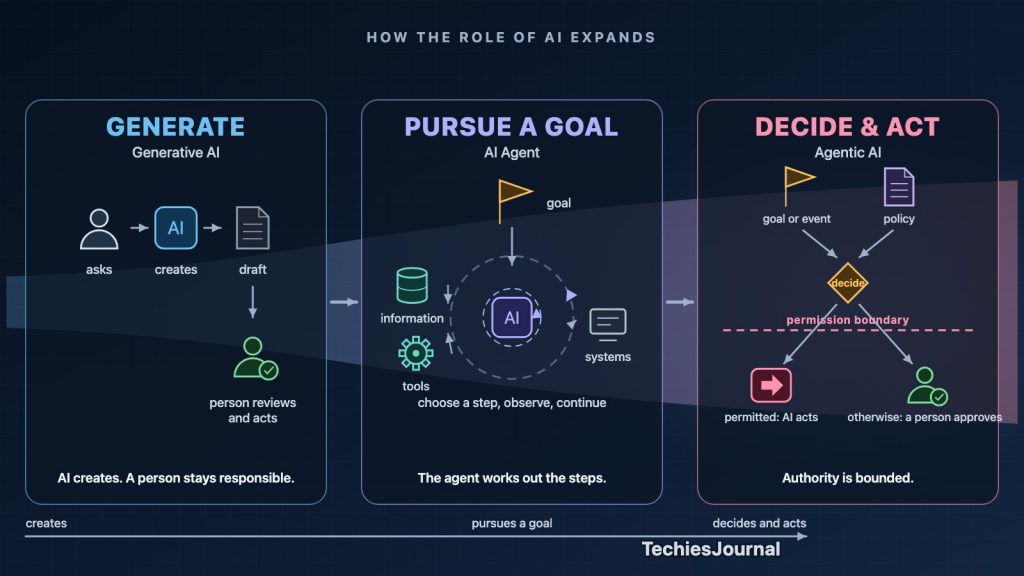
Three cards in order. Generative AI: what can I create for you? AI agent: what goal are we trying to achieve, and what should I do next? Agentic operation: what can AI decide and do, within what boundaries, to help achieve that goal?
Note: not a strict ladder, a way to notice how the role of AI changes with more responsibility.
Do not read this as a strict maturity ladder.
Read it as a way to notice how the role of AI changes as we give it more responsibility.
Once that difference is clear, another question becomes much more interesting:
What is actually happening behind the scenes to make all of this work?
That is where the technical journey begins.
Next in this series
Generative AI, AI Agents and Agentic AI: How They Work Under the Hood
The next article moves behind the interface.
We will follow a request through the technical system and examine how models generate responses, how tools are called, how agents plan and observe, how memory and state work, how agentic workflows coordinate actions, and where security, reliability and human-control mechanisms fit.
References and further reading
Each source below was opened and checked against the sentence that cites it on 6 October 2026.
- Anthropic: Building Effective Agents. Primary evidence for the distinction between augmented LLMs, workflows and agents, including predefined orchestration versus model-directed process and tool usage.
- Google Cloud: What are AI agents?. Primary evidence for goal pursuit and commonly described agent capabilities including reasoning, planning, memory and autonomy.
- Google: Gemini Deep Research overview. Primary product evidence for Deep Research as an autonomous research agent, its plan review step and its iterative research behaviour.
- Microsoft Learn: Event triggers overview, Microsoft Copilot Studio. Primary evidence for event-triggered autonomous operation, agent instructions, trigger scope and the data-protection boundaries Microsoft documents for autonomous agents.
- Microsoft Learn: Human supervision of computer use, Microsoft Copilot Studio. Primary evidence for the limits of human-review mechanisms in probabilistic agent behaviour.
- Salesforce: Agentforce. Primary product evidence for customer-service agent use cases and hand-off to human support where appropriate.
- NIST: New Concept Paper on Identity and Authority of Software Agents (February 2026). Independent evidence for agent identity, authorization, auditing and non-repudiation, access to data, tools and applications, and prompt-injection controls.
- OpenAI Help Center: ChatGPT capabilities overview. Primary product evidence for familiar generative tasks such as drafting, rewriting, summarizing and explaining. It does not classify the current product as generative only.
Editorial evidence note
The following phrases in this article are deliberately TechiesJournal teaching models, not formal industry definitions:
“Generative AI produces something. An AI agent works toward something.”
“Automation follows a route we designed. An agent can have some responsibility for choosing the route.”
“More authority → more possible consequence → stronger controls.”
They simplify documented architectural and governance concepts for a general reader.