

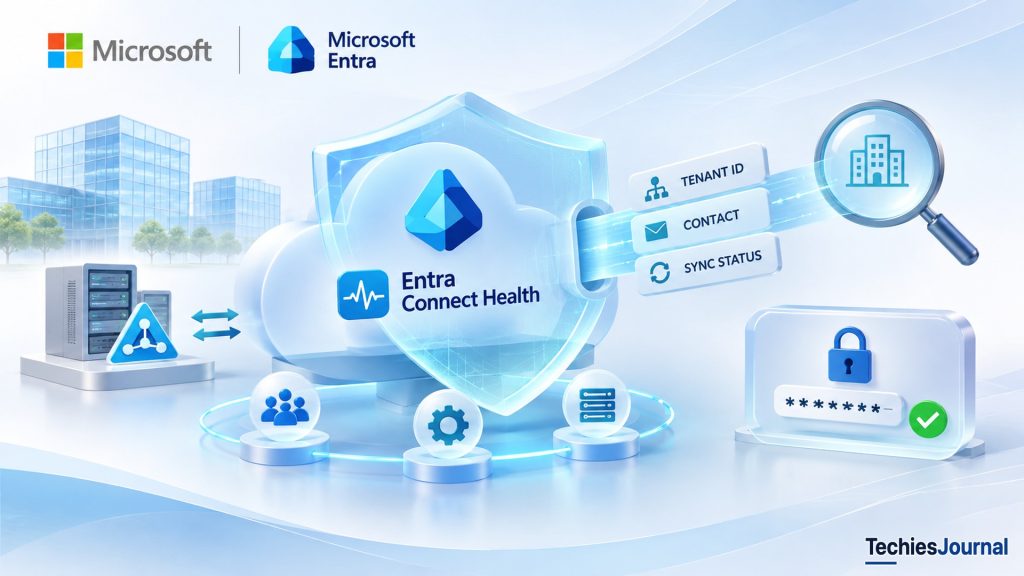
An identity monitoring service can reveal useful information about an organization without exposing a single password. That is the central concern in a November 2026 security incident involving Microsoft Entra Connect Health, a service used to monitor parts of hybrid identity infrastructure.
Microsoft confirmed to BleepingComputer that a security issue affected Entra Connect Health, that it deployed a fix on November 19, and that affected customers were notified through Azure Service Health. According to BleepingComputer’s November 21 report, unauthorized parties accessed tenant-level contact and configuration metadata. The reported customer notification says investigators identified read-only access and no unauthorized configuration changes.
The distinction matters. The incident establishes unauthorized information access. It does not, on the available evidence, establish stolen passwords, administrator account takeover, or compromise of an on-premises Active Directory environment.
1. Why Entra Connect Health holds useful information
Organizations using both on-premises Active Directory and Microsoft Entra ID need visibility into the services that connect their identity systems. Entra Connect Health helps them monitor synchronization and other supported hybrid identity services, including the health of monitored components, alerts, and operational status.
That monitoring role creates operational metadata. Administrators benefit from knowing whether synchronization is enabled, when it last ran, and who receives service notifications. The same details can make an organization easier to identify and approach through targeted social engineering if disclosed to an unauthorized party.
Microsoft documentation: What is Microsoft Entra Connect and Connect Health?
2. What Microsoft reported
BleepingComputer’s account of Microsoft’s customer notification provides this sequence:
| Date in 2026 | Reported development |
|---|---|
| July 23 | Vulnerability introduced into the Entra Connect Health API |
| November 9 | Microsoft discovered the vulnerability |
| November 19 | Server-side fix deployed |
| November 20 | Microsoft investigation concluded and affected-customer notification began |
| November 21 | BleepingComputer published its report |
The date the vulnerability entered the service is not an established date of first exploitation. Microsoft has not publicly disclosed when the attacks began, who carried them out, or the total number of affected tenants.
The notification described exposed data including administrator and technical-contact email addresses, tenant IDs and display names, initial tenant domain names, country and region information, license tiers, synchronization status and last synchronization timestamp, and Connect Health onboarding status. An expired certificate that had been used to register Connect Health agents with a Microsoft internal service, decommissioned in late 2024, was also reportedly returned by the vulnerable API. Microsoft said that certificate was no longer in use.
The same account states that the vulnerability did not expose passwords or password hashes, authentication tokens, valid cryptographic keys, on-premises servers and Active Directory topology information, or Azure subscription details. These are Microsoft-reported investigation findings, not an independent forensic examination by TechiesJournal.
3. Why metadata exposure is still a security event
Consider a fictional organization that uses on-premises Active Directory and Microsoft Entra ID. An attacker obtains the organization’s initial tenant domain, the email address of an administrator, and the fact that directory synchronization is enabled.
None of those values authenticates the attacker. They could, however, be used to make a fraudulent support message look more credible. A phishing message might reference the actual tenant domain and claim to require a synchronization-health verification. This is a plausible secondary risk, not a claim that such a campaign occurred in this incident.
Three security outcomes must remain separate:
- Metadata exposure: An unauthorized party can read information about a tenant or monitored service. This was reported.
- Configuration change: An unauthorized party alters monitoring settings or another service configuration. BleepingComputer’s summary says the flaw could potentially have allowed changes to Connect Health monitoring configurations, and Microsoft said its investigation did not identify such changes.
- Identity compromise: An attacker gains usable authentication material or control of an account. The incident reporting does not establish this outcome.
Treating these outcomes as interchangeable would exaggerate the evidence and could lead to unnecessary emergency actions.
4. What affected administrators should do
Microsoft says the November 19 correction was applied on its service side and that no customer software update is required to fix this specific vulnerability. Its customer advice, as reported by BleepingComputer, nevertheless includes checks intended to reduce downstream risk.
- Review tenant-specific notification. Check Azure Service Health for a message about the Entra Connect Health exposure. Do not assume that every tenant was affected or that an absence of a public tenant list proves inclusion. Managed service providers should check each customer tenant separately, because BleepingComputer reported that some providers received notifications for several tenants.
- Review privileged sign-ins and audit activity. Examine relevant Entra sign-in and audit records for unusual activity, particularly around administrative identities. These logs are not a complete forensic record of unauthorized calls to Microsoft’s affected backend API.
- Validate Connect Health configurations. Compare expected monitoring and notification configurations with their current values. This is a precautionary check, not evidence that unauthorized changes occurred.
- Protect privileged identities. Use phishing-resistant multifactor authentication wherever supported and follow established privileged-access restrictions. For a closer look at which sign-in methods Microsoft classes as phishing-resistant and where session theft still matters, see Microsoft 365 Token Replay: Why MFA Alone Did Not Stop These Attacks.
- Prepare administrators for targeted impersonation. A message containing accurate tenant identifiers or contact information is not necessarily legitimate. Verify requests through established support channels.
The report also points to a Microsoft-provided PowerShell script, published at aka.ms/ConnectHealth/scripts, that displays the current types of tenant metadata potentially exposed. That address leads to a Microsoft repository on GitHub, whose README describes read-only reference scripts that send GET requests to the Connect Health APIs and make no configuration changes. The scripts do not show precisely what any attacker retrieved in the past. Administrators should still inspect the scripts and their provenance before running them under their organization’s change controls.
Sources: Microsoft Entra Connect Health flaw exploited to steal tenant data (BleepingComputer, November 21, 2026) | Microsoft Entra Connect Health Reference Scripts (Microsoft, GitHub)
5. Do not confuse the incident with a separate upgrade program
Microsoft maintains separate security-hardening guidance for Entra Connect Sync and Connect Health. The guidance currently includes a mandatory Entra Connect Sync requirement for version 2.6.84.0 or later with application-based authentication by April 7, 2027. It also names minimum Connect Health agent versions and a recommended upgrade date of September 30, 2026, which has now passed, and it lists the service impact if the minimum versions are not met.
Those requirements should be assessed through normal lifecycle management. They are not an emergency client-side patch for the November 2026 metadata exposure. Mixing the two topics would make the advice less useful.
Microsoft documentation: Security hardening to the autoupgrade process for Microsoft Entra Connect and Microsoft Entra Connect Health
6. The practical lesson for hybrid identity teams
The Entra Connect Health incident shows that an identity environment’s supporting monitoring services deserve attention alongside the systems that handle authentication. Operational metadata can help an attacker build context even when passwords and tokens remain protected.
For a notified organization, the immediate task is to follow Microsoft’s tenant-specific guidance, review relevant administrative activity, validate monitoring configurations, and strengthen resistance to targeted social engineering. For organizations not notified, the incident is a reminder to maintain sound identity controls without assuming they were breached.
An exposure of identity-related metadata is serious enough to evaluate, but it is not proof of identity takeover. The response should follow the verified scope of the event.
References and further reading
- Microsoft Entra Connect Health flaw exploited to steal tenant data (BleepingComputer, November 21, 2026): incident reporting based on a Microsoft customer notification and a Microsoft spokesperson’s confirmation.
- What is Microsoft Entra Connect and Connect Health? (Microsoft Learn): product context for the monitoring role.
- Microsoft Entra Connect Health and user privacy (Microsoft Learn): data-processor classification, 30-day retention and how to stop data collection.
- Security hardening to the autoupgrade process for Microsoft Entra Connect and Microsoft Entra Connect Health (Microsoft Learn): the separate upgrade and authentication requirements, not an incident remediation.
- Microsoft Entra Connect Health Reference Scripts (Microsoft, GitHub): read-only reference scripts that show the current Connect Health data returned for a tenant.
Source review: November 23, 2026. Incident details come from Microsoft’s customer notification as reported by BleepingComputer and from a Microsoft spokesperson’s statement to that publication. No standalone Microsoft incident bulletin was available at the time of review. The Microsoft Learn pages and the script repository were checked on the same date.